It is well known that the gospel of John is considerably different than the other three Gospels. One of the reasons that the Gospel of John seems so different is the three synoptic gospels are so similar. For example, there is no birth, baptism or temptation in John. While Jesus does seven miracles, they are called “signs” and there are no exorcisms. There are no parables, despite Mt 13:34 and Mk 4:34 which indicate that Jesus primarily spoke in parables in the second half of his ministry.
There are several extended dialogues in the Gospel of John which have no real parallel in the synoptic gospels. Jesus does not re-interpret the Mosaic law as in the Sermon on the Mount nor does he predict the fall of Jerusalem (cf. Mark 13 and parallels.) In fact, there is barely a hint of a second coming of Jesus in John. Instead Jesus promises to send the Paraclete to the disciples after he returns to heaven (14:25-26, 16:7-15). The Last Supper is not described as an ongoing celebration for the church. Instead, John describes Jesus washing the feet of the disciples (13:1-16). While the arrest and crucifixion is described in similar ways to the synoptic gospels, there is no agony in the garden of Gethsemane.
How do we account for these differences? Here I am following Andreas J. Köstenberger, A Theology of John’s Gospel and his Letters (Grand Rapids, Mich.: Zondervan, 2009), although Köstenberger himself follows B. F. Wescott. Wescott observed John’s Gospel was written after the success of the (Pauline) Gentile Mission as well as after the destruction of Jerusalem. Assuming a date in the mid 90s, the Gospel was written at the same time as the Gnosticism was developing as a competitor to Apostolic Christianity. For Köstenberger, the Fall of Jerusalem is the most important factor in the purpose of the book.
I am sure the rise of Gnosticism is a major factor for how John presents Jesus to his readers, but I am not sure the success of the Gentile mission is as much of a factor than often assumed. John wrote the gospel some thirty years after the death of Paul, from Ephesus, the city where Paul had his most success among Gentiles. Yet the Gospel has very little to say about Gentiles. The Samaritan Woman (John 4) is a possible example, but Samaritans are a in many ways neither Jew nor Gentile. The healing of the official’s son in John 4:46-54 is sometimes offered as an example of a Gentile who encounters Jesus, but if he is John certainly does not make this explicit.
The Gospel is evangelistic. John wrote to Jewish readers who might be open to Jesus as an alternative to the Temple and the festivals. But there are a few stories which are could be described as drawing Gentiles to Jesus. The story of the blind man who is healed in John 5 may show that Jesus is superior to Asclepius, a Roman god of healing. Given the number of allusions to the Hebrew Bible and the importance of the Jewish story of redemption, it is clear that the main target of the Gospel is Jewish.
Tthe Gospel is apologetic. John wrote to Christians (either Jewish or Gentile) in order to clarify who Jesus was as an answer to growing questions raised by developing Gnostic theology. There is a serious theological challenge developing in the church, John must address this as insufficient for explaining who Jesus was. John describes Jesus as the Word, equal with God because he is God. But Jesus is also flesh, fully human. These two facts are stated in the prologue and supported throughout the Gospel of John.
The Gospel of John is therefore a window into the end of the apostolic era. Christianity was making progress against paganism, but needed to to develop a theology of Jesus in the face of an internal challenge.
Introduction. Authorship is an issue most introductions the Letters of John must treat, but usually the Gospel of John and the Letters are viewed as coming from the same person or persons, often a “community” living in Ephesus near the end of the first century. More critical commentaries will leave open the question of whether the author is the Apostle John (the traditional view) or a community formed around the teaching of the Apostle.
A second issue which commentaries must deal with in an introduction is the identity of the opponent in 1 John. Since John calls then “antichrists” because they deny that Jesus came in the flesh, they are frequently associated with Docetism, an early attempt by Jewish Christians to understand Jesus as fully divine, only appearing to be human. Brown surveys every suggested opponent and concludes that there are similarities to several groups, but we simply do not know enough about the target of John’s polemic to be certain they are “early Gnostics” or any other known teacher.
Since 1 John is usually the first book of the New Testament that most beginning Greek students read through, there are several handbooks for reading the letters. In general, these books move through the Greek text word by word with detailed comments on grammar aimed at helping the beginning Greek student learn how exegesis works. I will mention three of these here before moving on to commentaries proper.
Marvin Wilson and Chris Alex Vlashos, A Workbook for New Testament Greek: Grammar and Exegesis in First John(Peabody, Mass.: Hendrickson, 1998). This little book is broken up into assignments, with unusual vocabulary / parsing at the beginning of the assignment. The student is then given a series of questions which point them to the major Grammars (Zerwick, Moule, Turner, Winbery) as well as exegetical commentaries. There are a few “for further study” questions which require a bit more thought and discussion. The book has a handy “vocabulary of 1 John” as well as a parsing guide for the book. This book would be good for someone trying to work through John on their own, but it is best used in a classroom setting.
Martin M. Cully, I, II, III John: A Handbook on the Greek Text (Waco: Baylor, 2004). This book is a running commentary on the syntax of the letters of John, identifying grammatical categories for virtually every word. The English paragraph is printed, followed by each verse in Greek, then each phrase in the verse with commentary. For some words or phrases Cully points out that “scholars differ,” providing the various options for the student to sort out. Only rarely does Cully cite a particular grammar, which has the advantage of allowing professors to use whatever intermediate grammar they choose. The book is certainly a handy size, making it an easy read along side the Greek New Testament.
Herbert Bateman, IV, A Workbook for Intermediate Greek: Grammar, Exegesis and Commentary on 1-3 John (Grand Rapids, Mich.: Kregel 2008). This is a workbook for the serious student of New Testament Greek. At over 600 pages, it would be difficult to finish the book in a single semester! The text of the letters of John is broken into 35 sections, beginning with 3 John, then 2 John. Each section features some syntactical category (the perfect tense, infinitives, etc.) Bateman has a twelve-step exegetical process (16) which he uses in each pericope of the Letters, although not every step appears in every chapter. Since this is a workbook, there are questions and space for answers. For syntax questions, Bateman provides pages in several major grammars to review elements of grammar. He asks syntactical, lexical / semantical, and theological questions. By the time a student worked through this book, they will have written their own commentary on the Letters of John!
Raymond Brown, The Epistles of John (New York: Doubleday, 1982). Along with his commentary on the Gospel of John and his Introduction to the Gospel of John (completed by Maloney after Brown’s death), this commentary is one of the most significant contributions to the study of the Johannine literature in the twentieth century. Brown introduced his views on the Johannine community in his commentary on the Gospel of John and develops it further in this commentary. I highly recommend the 130 page introduction to the commentary as required reading for anyone working seriously in John. While interest in his theory of the “Johannine Community” has waned, it is hard to read a commentary on John’s Gospel or Letters which do not engage Brown on nearly every page. At almost 800 pages, this commentary on the Epistles of John is the most detailed exegetical commentary available. The commentary proceeds through the text word-by-word, dealing with lexical and syntactical matters. Greek appears only in transliteration, all sources are cited in-text. After the detailed note section, Brown provides a “comment” in the overall theology of the pericope, often connecting it to his previous work on the Gospel of John. These comments all assume his Johannine community theory. Sections end with a bibliography pertinent to that section.
Ben Witherington, Letters and Homilies to Hellenized Christians, Volume 1 (Downers Grove, Ill: InterVarsity, 2006). Witherington treats the letters of John in his socio-rhetorical commentary along with the Pastoral Epistles. The commentary argues that hte letters were written at the end of the first century to serve a “Johannine community” which had recently suffered a schism based on a view of Jesus which differed from the Beloved Disciple. In general, Witherington finds these letters to be amenable to his form of rhetorical study. Second and Third John are “deliberative discourse” while 1 John is epideictic, “a sermon” (409-10). The commentary is based on the English text, with transliterated Greek treated in the footnotes. Because of the style of the commentary, Witheringtom makes occasional grammatical comments in the footnotes, the main text is interested in the flow of the argument. Like other socio-rhetorical commentaries, Witherington provides sometimes lengthy “Closer Look” sections. Of particular interest is his section on “Avoiding Sin and Going On To Perfection” (501-5), a refreshingly non-Calvinist view of the issue, even if in the end I disagree with his conclusion.
Colin G. Kruse, The Letters of John (PNTC; Grand Rapids, Mich.: Eerdmans, 2000). Cruse beings his commentary by suggesting a plausible scenario for the production of these letters. Assuming the Letters and the Gospel of John were produced by the apostle John (“the fairest way to read the evidence,” 14), Kruse argues that the letters were written after a first form of the Gospel was written in response to a successionist group which differed from John on the nature of Jesus. This group appears to have been aggressive in that they sought to bring others into their circle. First John is a circular letter to all of the congregations in and around Ephesus, 2 and 3 John are to specific house churches advising them directly what to do with traveling teachers “peddling their new and heretical teaching” (3). After the letters were written, John died, and the final form of the gospel as we have it today was published. What happened to the successionists is unknown, but they may develop into Gnosticism. The body of the commentary is based on the English text, with Greek details in the footnotes. The style is very readable, with occasional excursuses. For example, Kruse briefly comments on the use of chrisma in 1 John 2:20; in another place he has a useful summary of the New Testament teaching on antichrist.
Daniel Akin, 1, 2, 3 John (NAC; Nashville: Broadman & Holman, 2001). Akin affirms the traditional view that John the Apostle wrote both the Gospel and Letters which bear his name in the New Testament. Like most, Akin understands that John was writing in response to an attack from a specific false teaching concerning Jesus, but also a defective morality and arrogant spirituality (31). In the introduction he has a brief overview of the theology of the letters, including a paragraph on the overlooked eschatology of the letters. The body of the commentary prints the English text followed by detailed comments with Greek in transliteration. This makes for a readble commentary which will be useful for preparing to preach these letters.
Conclusion. There are a new missing here, such as I. H. Marshall’s 1978 commentary in the NICNT series or F. F. Bruce’s brief 1970 commentary. I omitted Robert W. Yarbrough contribution in the Baker Exegetical series simply because I do not own a copy and have not used it yet. I also cheated a bit on my “five commentary” rule to get the exegetical guides in. What have you found useful for teaching the letters of John?
The disciple Thomas is an easy target for preachers, who call him “doubting Thomas” and urge their congregations to have more faith than this skeptical follower of Jesus. This is unfortunate, since it appears that John uses Thomas’ confession of faith in Jesus as Lord and God as the theological apex of the book. Finally, at long last, someone fully understands who Jesus is and announces for the reader the true identity of Jesus: he is the Lord, and he is God.
Thomas was not with the disciples when Jesus first appeared to them in the Upper Room. We are not told why, and it may not be important. But while the other ten were locked in the Upper Room out of fear, Thomas was someplace else. There are two possible explanations for his absence.
On the one hand, Thomas seemed ready to die with Jesus in John 11, so it may be the case that he is willing to go about his life, almost daring the Jews to arrest him too. The other disciples are locked in a room, more or less hiding from the Jewish authorities. Rather than the skeptical, doubting disciple, Thomas was out in public, willing to be arrested as his master was.
On the other hand, perhaps Thomas experienced a “crisis of faith” when Jesus died. If he believed Jesus was the Messiah and that the Messiah was not going to be crucified by the Romans, perhaps Jesus’ death caused him to doubt everything. He may be in a state of denial, like Peter, but deeper.
Whatever the case, he returns to the upper room has is told that Jesus is alive, but more than that, he has risen from the dead to a new kind of life. When he is told that Jesus rose from the dead, he refuses to believe without further evidence. Thomas gets a bad reputation as a skeptic for not believing what the disciples told him. On the other hand, there is virtually nothing in Second Temple Period Judaism that anticipated the death of the Messiah not his resurrection to eternal life. It was something which Thomas was not ready to believe since it was unbelievable within his world view.
The disciples are making an extraordinary claim, something which will require them to re-think virtually everything that they believe. No Jewish group in the first century thought Messiah would offer himself as a sacrifice, and no one would have guessed that he would be raised from the dead. There is simply nothing in Thomas’s world view to handle this wort of claim. He therefore needs to experience it himself in order to understand it.
When Jesus appears in the midst of the disciples a second time, Thomas believes and confesses Jesus as “Lord and God” (verse 28). Thomas’s confession is a theological statement for the whole book of John. The writer has been slowly revealing who Jesus is through a series of misunderstandings, people hear Jesus’ words but do not fully comprehend his meaning. Even after the resurrection, Mary thinks Jesus’ body was stolen, then the disciples wonder if he ever really died. Even when he appears to them, they still do not confess Jesus quite the way Thomas does in verse 28.
John intends this statement to be the final word on who Jesus is, he is the “Lord and God” of the reader, and that by believing that he is the Lord one can have eternal life in his name (verse 31).
John Calvin on Peter’s attack on the servant of the High Priest:
“It was exceedingly thoughtless in Peter to try and prove his faith by the sword, while he could not do so by his tongue. When he is called to make a confession, he denies; now unbidden by his Master he raises a riot.”
I think most Christians struggle with this since it is far easier to hack at someone than to bear witness peacefully. I usually do not even hit an ear.
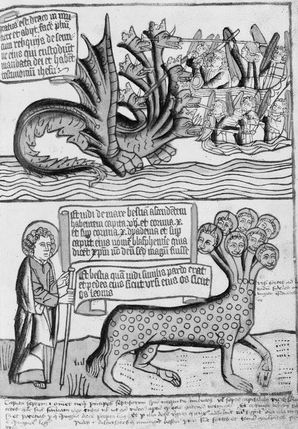
G. R. Reasley Murray commented that Revelation 13 is a kind of “satanic trinity” (Revelation, 207). Vern Poythress considers the language of Revelation 13 to be a “counterfeit” of the true Christ: “ kind of pseudo-incarnation of Satan, is a counterfeit unholy warrior opposed to Christ the holy warrior” (Poythress, 410). Greg Beale considers this a “Christological parody” (Revelation, 17). For Beale, the “war against the saints” is a “an ironic parody of the Son of man’s final triumph” and even the number 666 is a parody of the trinity (777). (Beale, Revelation 699).
This is a very common view, and one that is, I believe, an accurate assessment of Revelation 13. The Dragon is the father, who is the power behind an anti-Christ image (the beast from the sea). The beast from the earth is a kind of anti-holy spirit, preforming miracles which support the claims of the first beast. The first beast has a counterfeit resurrection in the form of a mortal wound that was healed (Rev 13:3). The miraculous character of his healing creates astonishment and followers for him, just as the miracle of the resurrection creates followers of Christ. The beast has ten crowns (13:1), parallel to Christ’s many crowns (19:12).
The relationship between the dragon and the first beast is a parody of the relationship between the Father and the Son in the Gospel of John. While it is not fashionable to see Revelation and the Gospel of John as representing similar theology, it appears to me that Beasts of Revelation 13 relate to the dragon and each other in ways which resonate with the Gospel of John.
First, the dragon gives the beast “his power and his throne and great authority” (13:2). This is the same relationship which John describes in his Gospel between the Father and the Son. In John 5:22–27 the Father gives his authority to the Son in order that he execute judgment.
Second, In addition, those who worship the beast are implicitly worshiping the dragon (Rev 13:4). Jesus states in John 5:23 that those who honor the Son, honor the Father. This is an extremely common theme in the Gospel of John.
Third, Both beasts speak with the voice of the dragon (13:11). So too in the Gospel of John, Jesus speaks only what he has heard from the Father (John 7:16-18). In John 5:19-24 the Son can only do what he has seen from the Father.
Fourth, the function of the second beast is to be exercise the authority of the first beast after the near-fatal wound (13:12-13). This beast is not worshiped itself, but does miracles in behalf of the first beast, causing people to worship the first beast. This is not unlike the activity of the Holy Spirit in John 16, who is sent after the resurrection in order to guide the followers of Jesus. The Advocate will not speak on his on authority, but of the one who sent him, the Father. It is perhaps significant that the second beast breathes fire to destroy, in John 20 Jesus breaths on the disciples, giving to them the Holy Spirit.
This list could be multiplied, but these few examples show that the “satanic trinity” is a parody of the relationship of the Father, Son, and Holy Spirit as presented in John’s gospel. While there is little in the way of exact verbal parallels, this not a serious problem since Revelation rarely quotes any text directly, even when it is certain that the writer is alluding to a previous text. While the writer, as a resident of Asia Minor, may have known John’s theology and incorporated it into his own book, it is also possible that this is a hint that the author behind the Gospel of John also produced Revelation.
Bibliography: Vern S. Poythress, “Counterfeiting In The Book Of Revelation As A Perspective On Non-Christian Culture” JETS 40 (1997): 411-18.
 It is well known that the gospel of John is considerably different than the other three Gospels. One of the reasons that the Gospel of John seems so different is the three synoptic gospels are so similar. For example, there is no birth, baptism or temptation in John. While Jesus does seven miracles, they are called “signs” and there are no exorcisms. There are no parables, despite Mt 13:34 and Mk 4:34 which indicate that Jesus primarily spoke in parables in the second half of his ministry.