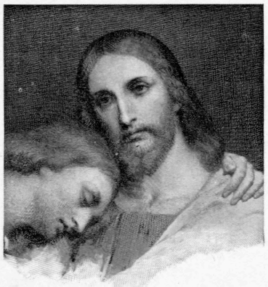
Was John the Disciple Whom Jesus Loved?

Before approaching the Letters of John, I thought I should touch on a question which will bear on the authorship of the Letters.  Few scholars will deny a relationship between the letters of John and the Gospel of John.  On the basis of style and vocabulary alone it is clear that the same person (or persons) wrote the Gospels and the Letters of John.  Traditionally, the fourth Gospel and the letters have been thought to be written by John, the Apostle, the son of Zebedee.  It is also  a long standing tradition to equate John, son of Zebedee with the “disciple whom Jesus loved.”

Neither John nor James appear in John’s Gospel, which is unusual since they are the only disciples features in the synoptic gospels other that Peter. In the Gospel of John, many of the other disciples are given a more clear role in stories where they had been anonymous. For example, in the feeding of the 5000, we are told specifically Philip and Andrew are the disciples who spoke to Jesus about the crowd and the impossibility of feeding such a large crowd (John 6:5-9).

John’s gospel also features a character who is never named, but rather is called the “disciple whom Jesus loved.” Traditionally, the “the disciple whom Jesus loved” is John, the son of Zebedee.

  • The “the disciple whom Jesus loved” was at the last supper (13:23), and in the Synoptics we are told only the disciples joined Jesus for the Passover meal (Mark 14:17). This places the “the disciple whom Jesus loved” within the inner circle of the twelve.
  • In many of the passages that he appears he is linked with Peter (John 13:23-24; 20:2-9; 21:20), and cannot be any of the disciples mentioned by name in John 13-16.
  • He is one of the seven who are fishing in chapter 21. This eliminates all the disciples except James and John, the sons of Zebedee, and two unnamed disciples.
  • The “disciple whom Jesus loved” is likely not James, since he was killed by Acts 12, much too early to have written the Gospel.

The internal evidence from the Gospel of John implies that the “the disciple whom Jesus loved” was in fact John, the son of Zebedee. The “the disciple whom Jesus loved” could have been one the two unnamed disciples in John 21:2, but this seems unlikely. Other suggestions for the “the disciple whom Jesus loved” include Lazarus, who is identified as a person whom Jesus loved (John 11:5, 35-36), or the rich young ruler of Mark 10:21, because Jesus is said to have loved him. There were probably dozens of disciples that could have qualified for the title if all it took was being loved by Jesus. Lazarus and the rich young ruler simply do not qualify because they were not at the last supper.

Thus the title “the disciple whom Jesus loved” is a humble indication that the author uses to identify himself. The only real candidate from among the group of twelve disciples is John, the son of Zebedee.  While it is possible that the Beloved Disciple is not John, The fact that the Gospel of John is so concerned with eyewitnesses to Jesus that it is unlikely that the author could be creating this witness out of thin air.

Does this matter for our reading of the Gospel of John or the Letters of John?  The letters of John are very concerned with the love of God and the love the Christian has for God and other believers.  It seems to me that this emphasis on the Love of God comes from the writer’s own experience of the Love of Jesus, having been “the disciple whom Jesus loved.”
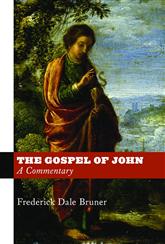
Frederick Dale Bruner – The Gospel of John: A Commentary

I posted a few days ago on the upcoming Keener commentary on Acts.  I notice that Eerdmans is releasing Frederick Dale Bruner’s The Gospel of John: A Commentary on February 28.  At 1311 pages, it is another a mammoth work ($75, hardcover).  Von Wahlde’s John commentary in the Eerdmans Exegetical Commentary series is a bit short of 1000 pages, but he has a separate book for introductory material.

Bruner wrote two volumes on Matthew which were fairly well-received.  He balances critical and exegetical comments with “history of interpretation” in a way which is quite readable.  Assuming the format is similar to the Matthew commentary, Bruner consults early church and Reformation reformation writers in smaller print after his exegetical comments.   These are often juxtaposed with modern commentaries so that the past and the present are in constant dialogue.

I look forward to this new commentary on John, although my shelf for John commentaries is already quite well-stocked.  Since I have been preaching through John on Sunday Evenings I am always on the prowl for a new book on John.  After a visit to The Bookstore (Eerdmans’ excellent shop here in Grand Rapids), I will post a review.

John 8:7 – Cast the First Stone

One of the most famous lines in the gospel is “let the one who is without sin cast the first stone.”  Jesus is alluding to Deuteronomy 13:9 and 17:7 (cf. Lev 24:14), from which the legal tradition of facing an accuser is based.

This verse is usually taken out of context and directed at judgmental Christians by people who are rather enjoying their sin. There is a presumption that religious leaders are stuffy, puritanical types who are out to punish other people who are committing the same sins they are committing in secret.  In fairness, there is quite a bit of that sort of hypocrisy in the church. Someone like Fred Phelps has done a great deal of harm to the possibility of sharing the love and grace Jesus offers to people.

However, it is impossible for there to be no judgment of right and wrong at all. Some behaviors are wrong (most cultures rarely condone adultery, which is more than a sexual taboo!)  Usually, sexual ethics are the problem. Few people have a problem called theft or murder a crime, brutality should condemned by everyone. But I am not sure I hear Christians harshly condemning financial fraud or violent crime quite the same way they do sexual sins. Did any Christians make an emotional condemnation of Bernie Madoff?

Save A Soul MissionInstead of condemning people who live a lifestyle that contradicts what we believe biblical Christianity demands, it would be better to express our belief that the behavior is sinful while also showing that a person can be forgiven without being hateful. Telling someone they are a horrible sinner doomed for hell rarely works, and in most cases, it drives people further away from the Gospel.

The saying of Jesus is also a caution for those who condemn others for their behavior. We do more good by confessing our own limitations and struggles and helping people to recover from destructive lifestyles. Christians who deny they struggle with sin create an inauthentic situation, which further alienates those who need the gospel.

Jesus never denied fellowship to anyone around the table because they were thieves (tax collectors) or sexually sinning.

The common use of the phrase “cast the first stone” to silence condemnation of sin ignores the rest of the story. Jesus also tells the woman to “sin no more.”  Jesus does demonstrate forgiveness and grace, but he also makes a clear statement that her behavior must change. Since her sin is self-destructive, to continue in it would be foolish.

John 7 – Jesus and the Feast of Tabernacles

Jesus returns to Jerusalem for the third time in the Gospel of John, this time for the Feast of Tabernacles (7:2) and the Feast of Dedication (10:22).  He spends a significant time in Jerusalem and there is increased opposition to Jesus from the Jews in the city. This will culminate in John 11:57 when the Pharisees decide that they must arrest and execute Jesus.

Feast of TabernaclesThe Feast of Tabernacles (Sukkot) is a week long celebration of the Wilderness period (usually in late September or October, 15-21 Tishri, see Lev 23:34).  In A. D. 32, the feast was celebrated Sept 10-17, the Feast of Dedication is two months later.  Tabernacles is an 8 day pilgrimage in Sept / Oct at the end of the grape harvest, marked by prayers for rain.  By the first century, there were daily processions from the pool of Siloam to the temple to pour out libations on the altar.  The courts of the temple were lit by huge torches, thus we have a combination of the themes of water and light that Jesus uses for the teaching sections.

The Feast of Tabernacles celebrated the time Israel spent in the wilderness but also their entry into the land of Canaan. Just as Passover celebrated the birth of the nation in the Exodus, Tabernacles celebrated the nation’s pristine years in the wilderness, where they learned the name of God, received his Law, where they rebelled against him but also experienced his grace and forgiveness.  The wilderness period culminated in the Conquest, Joshua’s entry into the Land of Canaan and the expulsion of the Canaanites from the Land promised to Abraham and his descendants.

In the prophets, the Exile was described as a long time in the wilderness. Israel was once again facing the punishment of God because of their covenant unfaithfulness.  The Feast of Tabernacles naturally stirred the nation’s hope for a new Joshua who would begin another Conquest of the Land promised to Abraham.  That Jesus is the same name as Joshua ought not be ignored, since Jesus will draw attention to himself as a messianic figure during a Feast dedicated to a remembrance of that first Joshua and the end of the exile in the wilderness.  Perhaps Jesus is the one that will end the long Exile of Israel, now under Roman rule.

Just as he did in the feeding of the 5000, Jesus plays on the imagery of Israel in the wilderness in the feast of Tabernacles in order to draw attention to himself as the one who leads Israel out of the wilderness at the end of her long Exile.

John 3:16 and Red Letter Bibles

In John 3, where do the words of Jesus end and the words of the John begin?

Red Letter Bibles

Many “red-letter” Bibles will mark the entire section as the words of Jesus. The ESV, for example, marks the whole section red, but drops the quote marks at 3:15 with an explanatory footnote. The NIV2011 drops the red letters starting in 3:16, while many editions of the KJV run the words of Jesus through the end of the section.

It is an editorial decision to print letters in red, the original manuscripts did not mark these words with any specific color and not all modern Bibles have red letters (for example, the pew Bibles in my church do not have red letters at all). In fact, according to Wikipedia, the first red-letter Bible was printed in 1900! For many people, the “red letters” are more important that the “black letters” because they are the words of Jesus.  In fact, I recently spoke to someone who told me they only read the “Red Letters.” I suppose this limits one’s reading in the Old Testament, but I think his point was that he wanted to read the “Real Words of Jesus“ and the color helped him in his Bible reading.

While this tradition of printing the words of Jesus in red is a relatively recent innovation, the tradition of decorating the “special words” in the Bible goes back to medieval manuscripts. For example, the tenth century Codex 565  is considered one of the most beautiful of all texts (currently in  St. Petersburg). In this manuscript, the Gospels are on purple vellum with gold lettering. The 14th century manuscript Codex 16 contains the Gospels in Greek and Latin written in four colors of ink.  The regular text is vermilion, the words of Jesus and the angels, and Jesus’s genealogy are in red, words quoted from the Old Testament and the words of the disciples, Zachariah, Elizabeth, Mary, Simeon, and John the Baptist are in blue. The words of the Pharisees, the centurion, and Judas are in black.

Most often Bible editors break off from Jesus’s words after 3:15, making 3:16-21 an exposition of Jesus’s words by the author of the gospel. John 3:13-15 are the words of Jesus since uses the title “Son of Man,” a phrase used elsewhere only by Jesus to refer to himself. The beginning of 3:16 is John’s explanation of the preceding words of Jesus (Köstenberger, John, 114). There is a significant range of scholarly opinion on where to end the words of Jesus.  For example: Raymond Brown and Francis Maloney think Jesus’s words continue through verse 21  Ben Witherington starts John’s section a 3:12. Schnackenburg starts John’s section at 3:13.

In addition, the use of μονογενής, “only born son” in 3:16 is an echo from John’s prologue (1:14, 18). The prologue contains the words of the Gospel writer, not Jesus. The light and dark motif in John 3:19-21 is also typical of John theology from the prologue and the epistles of John. That the gospel writer should step in and comment on the words of Jesus is not unusual in John. This sort of commentary occurs again in John 3:31-36 where John expands on the words of John the Baptist.

Does this issue matter?  The fact is that John is recording Jesus’s words in his own language, making it very difficult to sort out when he is offering a commentary on the words of Jesus and when he is reporting Jesus’s teaching. For many, the idea Jesus did not say John 3:16 is a shock, although the content of that verse is found throughout the dialogue with Nicodemus. Some editors have decided that Jesus’s words in in 3:15 for good reasons and communicate that decision with a splash of red-ink.

To me, this is a matter of truth: what did John intend when he wrote John 3?  It appears his intention was to explain Jesus’s words from his own theological perspective. He develops several themes he originally raised in his prologue. The whole chapter is authoritative, whether the words are from Jesus or the inspired author of John.


Bibliography:
Raymond Brown, The Gospel According to St. John I-XII (AB 29A; New York: Doubleday, 1966).
Andreas Köstenberger, John, (BENTC; Grand Rapids, Mich.: Baker, 2008).
Francis Maloney, The Gospel of John (Collegeville, Minn.: Liturgical, 1998).
Rudolf Schnackenburg, The Gospel According to St. John (trans. C. Hastings; 3 vol.; New York: Crossroad, 1990).
Ben Witherington, III,  John’s Wisdom (Louisville: Westminster John Knox, 1990).