John 1:19-28 – Jesus and John the Baptist

When the crowds ask John the Baptist who he is, his answer is a series of confessions concerning who he is not (1:20-21). He “confesses freely” that he is not a messianic figure in such a way that leaves no question, although he claims to be another kind of harbinger of the messianic age. The Gospel of John presents the Baptist as an honest witness honest who gave an accurate testimony concerning Jesus. It is possible that the gospel writer intended John’s three-fold testimony to stand in contrast to Peter’s threefold denial (John 18:17, 25, 27). John the Baptist also denied things, but in his case he was telling the truth!

John the BaptistNot only does the writer state John’s honest testimony in three ways, he confesses three things that he is not (the Messiah, Elijah, or the Prophet). John’s threefold denial of being the messiah is very broad, covering a variety of messianic expectations in the Second Temple Period.

I am not the Christ. The title is messiah, and many Jewish people in the first century expected an ultimate son of David to appear and re-establish a kingdom in Jerusalem. There was no one expectation, in fact, Qumran expected two messiahs. 4 Ezra expected a messiah who would rule for 400 years (ten generations) and then die.

I am not Elijah. Based on Malachi 4:5-6, many Jews believed that Elijah would return before the messiah came. Peter asks about the coming of Elijah after the transfiguration (Mark 9:9-13) and Jesus identified John as the “spirit and power of Elijah” (Matt 11:14, 17:12). Many thought Elijah might come to the aid of those suffering innocently, as reflected in the mocking of Jesus on the Cross (Mark 15:33-36).

I am not the Prophet. The Prophet was a messianic expectation based on Deuteronomy 18:15-18. In that text God says that a prophet like Moses will someday come and God will put his word in that prophet’s mouth. While it is possible the Deuteronomy passage had Elijah in mind, the Samaritans believed that a messianic prophet would someday come and the Qumran community believed that two messiahs, one of David and one of Aaron would eventually arrive to purify the Temple and the Kingdom. Fourth Ezra 2:18 says the prophets Isaiah and Jeremiah will return in the last days.

John identifies himself as the “voice crying in the Wilderness” (1:23) This is an allusion to Isaiah 40:3, but the context of this allusion is critically important. Isaiah 40 is a prophecy describing the return from exile after Jerusalem fell in 586. The prophet is inviting the people of Israel to come out of exile and return to the wilderness where the Lord will meet them and lead them back to the land as he did in the original Exodus.

Like the original Exodus, in Isaiah 40 -55 God will meet the people in the wilderness and care for them, although this time it will be like a return to Eden. The wilderness will blossom and water will flow, and the people will enter the Land once again. Cyrus the Great permitted Judah to return to Judea and Jerusalem beginning in 538 B.C., but relatively few exiles returned, most remained in the Diaspora. Those who returned faced hardships (as described in Nehemiah). The return from exile after 538 B.C. did not fulfil the expectations of Isaiah 40-55 for a peaceful and prosperous Israel living in Zion.

For this reason there were many in the first century who seemed to think the exile continued as long as there was no king in Israel and as long as the “times of the gentiles” continued. Daniel 9 seems to show the exile was far longer than the 70 years predicted by Jeremiah, there will be 70 times 7 years until the restoration of peace to the land and the true Davidic king begins to rules from Jerusalem.

John claims to be an apocalyptic messenger preparing Israel for the long-awaited end of the exile.

Did the people who came to hear John preach understand his message this way? Are there any hints in the first few chapters of John’s Gospel that Jesus sees himself as the messiah?
John 1:14-18 – The Glory of God

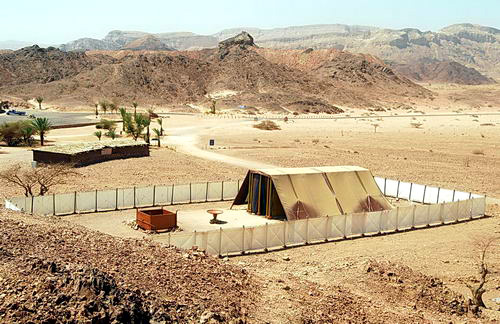
In John 1:14-18 John uses a metaphor to describe how the Word, as the Creator God and true light, could be the human Jesus. The Word “became flesh and tabernacled among us.” This is an allusion to the Wilderness period when God lived amidst his people at the Tabernacle (Numbers 35:34, also in the Temple; 1 Kings 6:13). Most important, the Tent of Meeting is called the Test of Testimony (σκηνὴ μαρτυρίου) in LXX Exodus 33:7. This combines two key themes in John 1, the Word dwelt with men. The Word is a witness to God. The Tent of Meeting is the place where God revealed himself in the wilderness and revealed himself to Moses.

The TabernacleThe “glory of God” may also allude to the Wilderness period (Numbers 16:19, Psalm 102:16, referring to the first Temple and Ezekiel10:4, the glory of God departing from the Temple). In the Gospel of John, Jesus reveals God’s glory in several ways. The seven signs in John reveal Jesus as God’s glory (2:11, 11:4, framing the seven signs.) Jesus says he has his own glory (17:5, 24). Jesus is glorified during his public ministry, but ultimately in the crucifixion (11:4, 12:28, 13:31-32).

John also alludes to Moses and the Law in verse 17. When the Law was given, the people saw the glory of God on the mountain and were terrified. They could not stand to see the power and the glory of God. Even the phrase “no one has ever seen God” alludes to Moses at Sinai. Moses saw only the effects of the glory of God, not God himself (Exodus 33:20).

Perhaps the most surprising allusion to the wilderness period here is the statement that The word was “full of grace and truth.” Commentaries usually get bogged down on “fullness” as a potential allusion to Gnosticism. But I think the phrase “grace and truth” is more important since this is a way in which God described himself to Moses in Exodus. In Exodus 34, God reveals his glory to Moses. When he does, the Lord himself proclaims that he is the LORD, abounding in steadfast love and faithfulness, using two words in Hebrew, hesed and ‘emet. These are well-known from the theology of the Hebrew Bible and are roughly equivalent to grace and truth in John 1:14.

Therefore, John claims that the Word is the true Light of God and that he is a complete revelation of God’s steadfast love and faithfulness, using the same words God himself used in his self-revelation in Exodus 34:6.

Why the Wilderness? First, it was in the wilderness that Israel first became the “people of God.” He had rescued them from Egypt and brought them into the wilderness to initiate their relationship through a covenant at Sinai. Isaiah 40-55 describes the end of the exile as a return to the wilderness. When God rescues his people from exile, they will once again travel the wilderness back to the land of the Promise. Third, as N. T. Wright often says, Second Temple Period Judaism thought of themselves as still in exile. The Word, therefore, is inaugurating a new wilderness period. Jesus is God dwelling among his people in a tent (of flesh this time), leading them into the wilderness where he will care for them (John 6).

In the Gospel of John, Israel will encounter the glory of God through Jesus, but they will once again rebel and reject him, preferring to remain in the darkness.

Who was Doubting Thomas?

Thomas has an unfortunate nickname – doubting Thomas. Most people have heard the phrase even if they have no idea where it came from. This nickname has stuck, and Thomas’ character as a doubter is famous. The problem is, it is difficult to know whether his doubt was in fact doubt about Jesus, or confidence in his own understanding about the nature of the Messiah and resurrection. Commenting on John 11:19, Andreas Köstenberger says “doubting Thomas” replied “rather sarcastically and no doubt with gallows’ humor, perhaps under his breath, ‘Let’s also go that we may die with him” (Signs of the Messiah, 125).

Maybe. But it is possible to describe Thomas as a very faithful disciples who never lost hope in Jesus as the Messiah, despite his own misunderstanding. In fact, what seems like pessimism may also be read as a willingness to lay down his life for Jesus, to face his persecutors and force the issue of who Jesus really is.

Doubting Thomas?Thomas is only mentioned in Matthew, Mark and Luke, but he is featured in three key stories in the gospel of John. All we really know about him on a personal level is that he is called “Didymus,” a word which means “twin,” presumably because he had a twin brother. In fact, the Hebrew name Tom or Tomas in Aramaic also means twin. There were Gnostics who thought that Thomas was Jesus’ twin, and died in his place. The so-called Gospel of Thomas was written by Gnostics and preserves some teachings of Jesus in an overly-spiritualized form. According to tradition, Thomas ended up as far east as India and planted many churches there before he was martyred.

After the resurrection, Thomas is not among the disciples when Jesus first appears, prompting his famous “doubt” about the resurrected Lord Jesus (John 20:24-30). Where was Thomas? Why was he not with the disciples? Was Thomas not with the disciples because he was still in despair over the death of Jesus?  Possibly.  On the other hand, it is possible that Thomas is the only disciple willing to show his face outside of the locked upper room!  Perhaps he is out in the streets, going about his life, willing to “take the risk” that someone might recognize him and arrest him as a follower of Jesus.

Dorothy Lee suggested John used Thomas and Mary Magdalene as examples of two individuals who struggle to understand the resurrection.  There a few parallels between the two witnesses of the resurrection.  For example, both attempt to touch risen Jesus.  Both Mary and Thomas mix faith with misunderstanding, and both receive a revelation from Jesus.  For Lee, Thomas is no less faithful than the other disciples because of his absence from the upper room.  Thomas’ reaction to the resurrection leads to a significant statement of who Jesus is in the conclusion of gospel of John.

Thomas is therefore singled out from the disciples to be the first to recognize Jesus as Lord and God after the resurrection.  In the synoptic Gospels, Peter speaks for the twelve at the midpoint of the story to confess that Jesus is God’s Messiah, but in John it is Nathanael in the first chapter and Thomas in the twentieth chapter who confess that Jesus is the messiah.  In Thomas’ case, he calls Jesus Lord and God – a highly theological statement which indicates that Jesus is not just messiah, but in fact God.  Notice that Jesus does not correct Thomas, as an angel might if someone offered to worship it as a god.  Jesus accepts this worship from Thomas because he is in fact God.

Bibliography: Dorothy A, Lee, “Partnership In Easter Faith: The Role Of Mary Magdalene And Thomas In John 20,” JSNT 58 (1995): 37-49.

Gospel of John and the “Other Disciples” – Nathanael

The identity of Nathanael is a problem since he is not mentioned as a disciple in the synoptic gospels.  Usually he is identified as Bartholomew based on the order of the apostles in the synoptics.  (Bartholomew always follows Philip in the lists.)  Bar-Tholami is the from of the name in Aramaic, meaning “son of Tholami,” therefore his full name was likely  Nathaneal Bar-Tholami (cf. Simon Bar-Jonah). John seems to treat Nathanael as an apostle, and he never mentions Bartholomew, making the identification quite likely.

When Philip declares that he has found the Messiah, he describes Jesus in biblical terms: Jesus is the one whom Moses wrote about in the Law and the Prophets wrote about (John 1:43-45).  That the Law and the Prophets testify to the messiah is clear from other New Testament texts.  Early on the apostles drew together a number of texts which were proofs that Jesus was the Messiah, but their source for much of this material is Jewish thinking about what to expect in the Messiah.

Nathaniel’s response is stunning:  “Can anything good come from Nazareth?”  (1:46) This seems a rude statement of prejudice, probably because Nazareth was a rather small and insignificant town in Galilee. It is true both towns were small and insignificant, but what should Nathaniel have said?  Presumably he ought to have recalled that the Messiah was to come from Bethlehem, according to Mi 5:2; or that he should be in the line of David from Psalm 2, or that he will be a king of Israel as in Zeph 3:15, or that he will come as a peaceful king riding a donkey, as in Zech 9:9.  But not that he will be a carpenter form Nazareth!

Is this an irrational prejudice? Most likely, and it is this sort of prejudice which blinds people to the gospels – how can someone like that possible have something to share with me spiritually?  Perhaps we do not suffer from a prejudice, but other people might very well have a real problem with us and will not hear the gospel because we are overplaying a less important issue rather than helping people to encounter Jesus.  In Nathaniel’s case, prejudice does not prevent him from coming to faith in Jesus.  He is able to set aside his preconceptions and encounter Jesus as he really is – the Son of God.

When Jesus arrives he declares that Nathaniel is an “Israelite in whom there is no guile.”   The background to this equally puzzling statement is the story of Jacob.  Jesus might as well have said, “here is a son of Israel with no Jacob left in him!” Just as the true heir of the promise was Jacob, not Esau; the true heir of the promise in John are the disciples, not the Pharisees, etc.  That there is a bit of play on the Jacob story is also clear in the reference to “heaven opening” and angels ascending and descending.  Essentially Jesus is saying that Jacob is a true Israelite, a man who is honestly seeking his God and is not distracted by the Works of the Law (Romans 2:28-29, 9:6-7)  In John 8:31 Jesus says that if the disciples abide in his words they will truly be his disciples, the same word is used as 1:47.

Nathaniel is a True Israelite, and if the disciples really understand and internalize his Jesus’ words they too will be True Israel.

Gospel of John and the “Other Disciples” – Philip

John’s gospel quite different from the synoptic Gospels in that he includes a few stories from the “other disciples.” For example, in Galilee Jesus finds Philip and simply tells him, “follow me.” Philip is featured in John in several contexts (6:5–8; 12:21–22; 14:8–10). In the other gospels Philip. only appears in the lists of apostles.

At the feeding of the 5000, Philip does not anticipate the miracle, but focuses on the problem of feeding such a large group (John 6:5-8). We know that Jesus’ question was a test, and we have a sense that Philip did not “pass” the test. But what is it that Philip should have said or done?

In this context, what was Philip to think? Jesus asks him where they were to buy food – the only answer to that question would seem “nowhere” since we do not have the money, nor is there a place to buy sufficient food. Perhaps Philip was to search his memory for a scriptural context for the event in which he was about to participate. If he knew the scripture well (as was implied at the time of his calling), then he ought to have recalled that the Lord did in fact provide food for Israel in the wilderness, and that one of the images of the messianic age was supposed to be provision of food, so that no one would be hungry in true Israel. Philip therefore looks at the problem from a perfectly acceptable human perspective (this is too great of a problem to handle!), while Jesus looks at the problem from a divine perspective – God owns all the food in the world and provided for his people in the wilderness in the past.

Near the end of Jesus’ ministry, several Greek converts to Judaism ask to see Jesus. They ask Philip to arrange this meeting, but Jesus has told the disciples not to go to Gentiles. This raises a problem, so Philip tells Andrew (John 12:21-22). This too can be taken as a misunderstanding of the scripture. It is not that Gentiles will never be able to come the to the Messiah, Isa 25:6-8 makes it clear that the nations will come to Zion at the time of the Messiah’s banquet. But there is a stream of Judaism which did not think any nations would survive this encounter! Of all the disciples, Philip (the guy with the Greek name) should have understood this most clearly. If he lived in a gentile city, what did he think would happen to his neighbors when messiah came?

At the last supper, Philip misunderstands Jesus’ statement “I am the Way, the Truth and the Life” (John 14:8-10). Jesus says that he is about to go back to the father, but Philip cannot seem to understand this rather complex theological statement. Just show us the father, Philip says, and forget about these theological claims about yourself. “Philip’s words here are easy to understand because they represent the general human longing to gain a firsthand personal and practical confirmation of theological ideas and assertions” (Borchert, John 12-21, 112).

Here is the problem – Philip’s practicality prevents him from hearing the deep resonations of Jesus’ statement about himself. Jesus is claiming to be God here, Philip sets that aside rather easily. Jesus rebukes Philip, although Jesus does uses the plural pronoun. All the disciples misunderstand that the messiah is not just a deliverer, but the Glory of God incarnate.

Is Philip a rationalist? (Borchert says this, more or less.) Not really, but his pre-conceived ideas about who messiah could be has blinded him from hearing this (somewhat clear) revelation form Jesus that the Messiah is in fact God, dwelling among men, so that he can solve the problem of sin once for all.