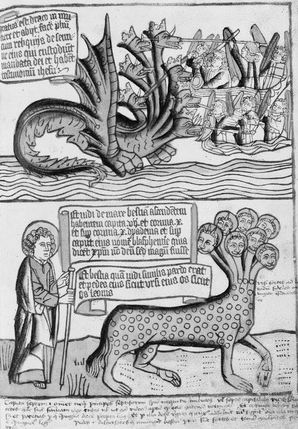
G. R. Beasley-Murray commented that Revelation 13 is a kind of “satanic trinity” (Revelation, 207). Vern Poythress considers the language of Revelation 13 to be a “counterfeit” of the true Christ: “ kind of pseudo-incarnation of Satan, is a counterfeit unholy warrior opposed to Christ the holy warrior” (Poythress, 410). Greg Beale considers this a “Christological parody” (Revelation, 17). For Beale, the “war against the saints” is a “an ironic parody of the Son of man’s final triumph” and even the number 666 is a parody of the trinity (777) (Beale, Revelation 699).
This is a very common view, and one that is, I believe, an accurate assessment of Revelation 13. The Dragon is the father, who is the power behind an anti-Christ image (the beast from the sea). The beast from the earth is a kind of anti-holy spirit, preforming miracles which support the claims of the first beast.
The first beast has a counterfeit resurrection in the form of a mortal wound that was healed (Rev 13:3). The miraculous character of his healing creates astonishment and followers for him, just as the miracle of the resurrection creates followers of Christ. The beast has ten crowns (13:1), parallel to Christ’s many crowns (19:12).
The relationship between the dragon and the first beast is a parody of the relationship between the Father and the Son in the Gospel of John. While it is not fashionable to see Revelation and the Gospel of John as representing similar theology, it appears to me that Beasts of Revelation 13 relate to the dragon and each other in ways which resonate with the Gospel of John.
First, the dragon gives the beast “his power and his throne and great authority” (13:2). This is the same relationship which John describes in his Gospel between the Father and the Son. In John 5:22–27 the Father gives his authority to the Son in order that he execute judgment.

Second, In addition, those who worship the beast are implicitly worshiping the dragon (Rev 13:4). Jesus states in John 5:23 that those who honor the Son, honor the Father. This is an extremely common theme in the Gospel of John.
Third, Both beasts speak with the voice of the dragon (13:11). So too in the Gospel of John, Jesus speaks only what he has heard from the Father (John 7:16-18). In John 5:19-24 the Son can only do what he has seen from the Father.
Fourth, the function of the second beast is to be exercise the authority of the first beast after the near-fatal wound (13:12-13). This beast is not worshiped itself, but does miracles in behalf of the first beast, causing people to worship the first beast. This is not unlike the activity of the Holy Spirit in John 16, who is sent after the resurrection in order to guide the followers of Jesus. The Advocate will not speak on his on authority, but of the one who sent him, the Father. It is perhaps significant that the second beast breathes fire to destroy, in John 20 Jesus breaths on the disciples, giving to them the Holy Spirit.
This list could be multiplied, but these few examples show that the “satanic trinity” is a parody of the relationship of the Father, Son, and Holy Spirit as presented in John’s gospel. While there is little in the way of exact verbal parallels, this not a serious problem since Revelation rarely quotes any text directly, even when it is certain that the writer is alluding to a previous text. While the writer, as a resident of Asia Minor, may have known John’s theology and incorporated it into his own book, it is also possible that this is a hint that the author behind the Gospel of John also produced Revelation.
Bibliography: Vern S. Poythress, “Counterfeiting In The Book Of Revelation As A Perspective On Non-Christian Culture” JETS 40 (1997): 411-18.
 John does not identify this angel, although some speculate it is Gabriel primarily because the name Gabriel means “mighty one.” It is not necessary to make the connection to Gabriel, although there are certainly other parallels here to Daniel. Gabriel is mentioned twice in Daniel, both times he is delivering a message to Daniel from God, and twice in Luke where he is the angelic messenger who tells Mary that she is pregnant.
 oath he makes in verse 6, swearing by both the land and the sea. Because of this, David Aune argues the angel is an allusion to the Colossus of Rhodes (Revelation, 2:556-557).
 First, thunder is a stock metaphor for divine speech. In the Hebrew Bible, the voice of God is often described in terms of thunderous noise (2 Sam 22:14/Psalm 18:3; Job 37:2-5). It is possible thunderous speech is related to the description of the Lord as the “lion of Judah” (Amos 1:2, 3:8). Occasionally angels have voices like thunder, such as 3 Baruch 11:4, and in The Odyssey, Zeus speaks like thunder.