The identity of Nathaniel is a problem since he is not mentioned as a disciple in the synoptic gospels. Usually he is identified as Bartholomew based on the order of the apostles in the Synoptic Gospels. Bartholomew always follows Philip in the lists. Bar-Tholami is the from of the name in Aramaic, meaning “son of Tholami,” therefore his full name was likely Nathaniel Bar-Tholami (cf. Simon Bar-Jonah). John seems to treat Nathaniel as an apostle, and he never mentions Bartholomew, making the identification quite likely.
When Philip declares that he has found the Messiah, he describes Jesus in biblical terms: Jesus is the one whom Moses wrote about in the Law and the Prophets wrote about (John 1:43-45). That the Law and the Prophets testify to the messiah is clear from other New Testament texts. Early on the apostles drew together a number of texts which were proofs that Jesus was the Messiah, but their source for much of this material is Jewish thinking about what to expect in the Messiah.
Nathaniel’s response is stunning: “Can anything good come from Nazareth?” (1:46) This seems a rude statement of prejudice, probably because Nazareth was a rather small and insignificant town in Galilee. It is true both towns were small and insignificant, but what should Nathaniel have said? Presumably he ought to have recalled that the Messiah was to come from Bethlehem, according to Mi 5:2; or that he should be in the line of David from Psalm 2, or that he will be a king of Israel as in Zeph 3:15, or that he will come as a peaceful king riding a donkey, as in Zech 9:9. But not that he will be a carpenter form Nazareth!
Is this an irrational prejudice? Most likely, and it is this sort of prejudice which blinds people to the gospels – how can someone like that possible have something to share with me spiritually? Perhaps we do not suffer from a prejudice, but other people might very well have a real problem with us and will not hear the gospel because we are overplaying a less important issue rather than helping people to encounter Jesus. In Nathaniel’s case, prejudice does not prevent him from coming to faith in Jesus. He is able to set aside his preconceptions and encounter Jesus as he really is – the Son of God.
When Jesus arrives he declares that Nathaniel is an “Israelite in whom there is no guile.” The background to this equally puzzling statement is the story of Jacob. Jesus might as well have said, “here is a son of Israel with no Jacob left in him!” Just as the true heir of the promise was Jacob, not Esau; the true heir of the promise in John are the disciples, not the Pharisees, etc. That there is a bit of play on the Jacob story is also clear in the reference to “heaven opening” and angels ascending and descending. Essentially Jesus is saying that Jacob is a true Israelite, a man who is honestly seeking his God and is not distracted by the Works of the Law (Romans 2:28-29, 9:6-7) In John 8:31 Jesus says that if the disciples abide in his words they will truly be his disciples, the same word is used as 1:47.
Nathaniel is a True Israelite, and if the disciples really understand and internalize his Jesus’ words they too will be True Israel.
The differences between John and the Synoptics is an opportunity for scholars to study the formation of a gospel from a different angle. John may have used other Gospels or purposefully ignored them. Often complicated scenarios are created in order to describe multiple versions of the Gospel of John. Raymond Brown suggested a plausible multiple edition theory to explain how John’s gospel developed over a period of time. In most “multiple editions” theories there was a single base document which underwent several revisions, possibly at the hand of the original author, over a number of years.
Brown’s first stage was the actual public ministry of Jesus and his disciples. After the resurrection, the twelve apostles publicly preached the resurrection of Jesus. The synoptic gospels reflect this apostolic preaching. The tradition that Mark preserve the preaching of Peter may indicate that the outline and content of the book as the content to of the apostolic “trust.” Matthew and Luke make use of Mark, and possible Q (or Matthew has the Q material, either way, Matthew and Luke reflect the Galilean disciples of Jesus).
According to Raymond Brown, John reflects the preaching and teaching of the disciples of Jesus in and around Jerusalem. This accounts for the different sorts of information that was remembered and passed along, for differences in tone and language, for the emphasis on Jerusalem and the Jewish festivals, and possible (so says Brown), the Light / Dark theme that is parallel to what we read in the Qumran materials.
It is possible this Johannine Community included Samaritans, based on John 4 and 8:48 (Jesus is accused of being a Samaritan). Jews and Samaritans sharing fellowship in a single religious community would have been scandalous, especially in pre-70 Judea. Brown suggests that Jews that accepted Jesus as the Messiah convinced in synagogues.
But relationships between these Jews and Samaritans would have been tense. Discussion of Jesus as Messiah generated a number of “homilies” preserving Jesus’ teaching as attempts to convince Jews he was the Messiah. It is possible that some time before A. D. 70 these Jewish Christians were expelled from the synagogue, ostracized and persecuted (as implied in John 1:11, 10:28-29; 15:18, 16:2 and the “not of this world” theme in 15:18, 16:3, 16:33).
The Gospel of John therefore could be aimed at Jewish Christians that are still in the synagogue (“crypto-Christians” in Brown) who are not fully “Christian” in the opinion of the author. They need to come out and be separate from the Synagogue. A second aim would therefore be to continue to try and convince Jews and Jesus was the Messiah.
Raymond Brown and his Johannine community theory is well-respected and is always discussed in recent study of the Gospel of John, but it does not appear this scenario has convinced everyone, as Paul Rainbow comments in his recent introduction to Johannine Theology, scholars “amass tomes trying to squeeze theories from the almost dearth of information that we have about unknown authors and redactors” (53).
Nevertheless, there is something to Brown’s contention that the Gospel of John is a kind of reflection of the “parting of the ways” between Judaism and Christianity in the last third of the first century. This accounts for the Jewishness of John’s Gospel while also reflecting a fairly well-developed Christology. If this Gospel is some kind of a Jewish-Christian missionary tract, how would our reading of John change?
Are there specific elements in John that are more “Jewish” than often assumed? Are there other ways we might evaluate Brown’s thesis?
It is well known that the Gospel of John differs considerably from the other three Gospels. One of the reasons that the Gospel of John seems so different is that the three synoptic gospels are so similar. Because of the similarities between Matthew, Mark, and Luke, some theory of literary dependence must be given to explain the close relationship.
For example, John has no birth, baptism, or temptation. While Jesus does seven miracles, they are called “signs,” and there are no exorcisms. Despite Mt 13:34 and Mk 4:34, there are no parables, which indicate that Jesus primarily spoke in parables in the second half of his ministry.
Several extended dialogues have no real parallel in the synoptic gospels. Jesus does not re-interpret the Mosaic law, as in the Sermon on the Mount, nor does he predict the fall of Jerusalem (cf. Mark 13 and parallels.) In fact, there is no prediction of a second coming in John, although Jesus does promise to send the Paraclete to the disciples after he returns to heaven (14:25-26, 16:7-15). The Last Supper is not described as an ongoing celebration. Rather, John describes Jesus washing the feet of the disciples (13:1-16). While the arrest and crucifixion are described similarly to the synoptic gospels, there is no agony in the garden of Gethsemane.
I am following Andreas J. Köstenberger’s A Theology of John’s Gospel and his Letters (Zondervan, 2009). Köstenberger follows B. F. Wescott’s observation that John’s Gospel was written after the success of the (Pauline) Gentile Mission, after the destruction of Jerusalem, and at the same time as the emergence of Gnosticism as a competitor to Apostolic Christianity.
For Köstenberger, the Fall of Jerusalem is the most important factor. I am sure that the rise of Gnosticism is a major factor, but I am not sure that the success of the Gentile mission is as much of a factor as sometimes assumed. John wrote the gospel some thirty years after the death of Paul, from Ephesus, the city where Paul had his most success among Gentiles. Yet the Gospel has very little to say about Gentiles. The Samaritan Woman (John 4) is a possible example, but Samaritans are in many ways neither Jew nor Gentile. The healing of the official’s son in John 4:46-54 is sometimes offered as an example of a Gentile who encounters Jesus, but if he is, John certainly does not make this explicit.
On the one hand, the Gospel is evangelistic. John wrote to Jewish readers who might be open to Jesus as an alternative to the Temple and the festivals. But a few stories could be described as drawing Gentiles to Jesus. The story of the blind man who is healed in John 5 may show that Jesus is superior to Asclepius, a Roman god of healing. Given the number of allusions to the Hebrew Bible and the importance of the Jewish story of redemption, it is clear that the main target of the Gospel is Jewish.
On the other hand, the Gospel is apologetic. John wrote to Christians (either Jewish or Gentile) to clarify who Jesus was as an answer to growing questions raised by developing Gnostic theology. There is a serious theological challenge developing in the church, John must address this as insufficient for explaining who Jesus was. John describes Jesus as the Word, equal with God because he is God. But Jesus is also flesh, fully human. These two facts are stated in the prologue and supported throughout the Gospel of John.
Therefore, the Gospel of John is a window into the end of the apostolic era. Christianity was progressing against paganism but needed to develop a theology of Jesus in the face of an internal challenge. Can we draw other implications from the differences between John and the Synoptics?
At the Last Supper, Jesus predicted the disciples would all fall away, even Peter. Peter, as the leader of the disciples, denies this vehemently! Jesus declares to Peter that not only will he deny him, but he will do so three times before the night is out! Jesus says Peter would disown him in only a few hours, not dawn. Westerners miss this since we start the day at midnight and usually associate a rooster crowing with dawn. The rooster was used to mark the changes in watches during the night, thus it is only a few hours until Jesus is arrested. The story of Peter defending Jesus in the Garden sheds light on Peter’s faith.
Peter’s statement might be a reaction to a ‘slur” on his loyalty. Peter is willing to fight to defend the Lord. He is ready to be killed defending the Lord. He is completely loyal. Remember, Peter was the first disciple to grasp who Jesus was. In Matthew 16, Peter was the first disciple to declare that Jesus is the Christ, the Son of the Living God. Even though at that time he understood properly, he did not understand here that the Messiah was going to suffer and die. When Jesus was arrested, Peter tried to defend the Lord and declared he was willing to die by his side. But that is not the plan. The Messiah is to be abandoned. Peter is speaking as a representative of the disciples. After he speaks, all the disciples join in with him in declaring their loyalty.
Yet when the time for action arrives, Peter does attempt to defend Jesus and wounds a servant (John 18:8-11). When the soldiers arrive to arrest Jesus, Peter attacks the servant of the High Priest, cutting off his ear with a short dagger (μάχαιρα). This servant, Malchus, is named in John’s Gospel, although he is unknown to us. The name appears in inscriptions, although almost exclusively for Gentiles and Nabatean Arabs (BDAG).
Why attack the servant of the High Priest? It is possible he was leading the group to the garden to arrest Jesus. Malchus was not a slave carrying a torch for the people in charge. He was the personal representative of the High Priest. JoAnn Watson points out, “The servants of the high priest were known to perform the underhanded dealings of the high priest” (“Malchus (Person),” ABD 4:487).
This is likely a badly aimed attack rather than an attempt to maim the man so he was no longer permitted to enter the Temple. Maiming priests by cutting off their ears is well known in the Second Temple Period. Rather than a blundering attempt to save Jesus, this may have been a calculated attack on the man in charge of the arrest. Rather than killing him, Peter humiliated him and rendered him useless as a servant of the High Priest.
Peter’s actions are sometimes dismissed as laughable, but they represent the actions of the most zealous of Jesus’ followers. Jesus wants to protect them by giving himself up to the arresting guards, but Peter seizes the moment and “starts the revolution.” Even if this is a colossal failure, it is better than the response of the rest of the disciples! Jesus orders Peter to put his sword away, telling everyone that he intends to “drink the cup the Father has given him,” which is a reference to the cup of God’s wrath, the crucifixion that he is about to face.
This story about Peter defending Jesus shows that Peter was not a bumbler who couldn’t do anything right but the most faithful of Jesus’ disciples and seemed willing to attack an important and potentially powerful member of the High Priest’s household.
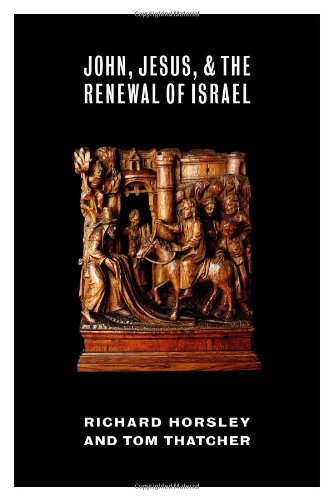
Horsley, Richard, and Tom Thatcher. John, Jesus and the Renewal of Israel. Grand Rapids, Mich. Eerdmans, 2013. 201 pp. Pb; $20.00. Link
Richard Horsley is well-known to New Testament scholars for his studies of Jesus that set Jesus in the social and historical world of the first century. Tom Thatcher has already contributed several excellent monographs on the Gospel of John (Greater than Caesar: Christology and Empire in the Fourth Gospel, Fortress, 2009). Both scholars are often associated with using the insights of economic and social sciences for understanding the world of Jesus as well as so-called “anti-imperial” research.
This new book intends to treat John’s gospel as a “coherent narrative” that comes from a formative community” (p.4). As such, the authors are not interested in the so-called high-Christology that occupies most studies of John’s Gospel in the last two centuries. While there may theology gleaned from John, Horsley and Thatcher are interested in reading Jesus against the background of the first century both religiously and politically. The authors indicate in their introduction that this book is only a “provisional sketch” of what might be a much larger project. Indeed, and under 200 pages of text with limited interaction with other scholarship, this book is clearly introductory.
While John’s gospel is not a source of theological reflection on the life of Jesus, it is also not a source for “tidbits” of historical information gleaned from a comparison with the Synoptic Gospels. While there is an interest in the historical Jesus, Horsley and Thatcher do not engage in the tedious application of criteria of authenticity. Rather, they have a general acceptance of John’s gospel as having the ring of truth. The Gospel as a “verisimilitude,” even if that cannot be verified via historical methods. In fact, the details of Jesus’ life in the Gospel are simply treated as real events set in a particular time and place. Since the goal of the book is a study of John’s presentation of Jesus as a social and political figure, what the “real historical Jesus” may have said or did is less important. The book includes a brief epilogue dealing with historical issues, but the bottom line is the general story of John is historical, although examination of every detail must wait for a more technical book (p. 178).
The book is also not interested in any sort of theory of composition of John. These theories can be complex and often distract attention from the text of John in favor of a critic’s theory. Whether there was a complex history of composition or not is not an issue for Horsley and Thatcher since they intend to read the whole gospel as a narrative.
Three reasons make a short book like this possible. First, the rise of narrative criticism over the last thirty years has shifted scholarly attention away from source and form criticism. More recent studies of John are willing to hear the whole story of the Gospel rather than fret over potential sources and redactions. Second, there are a host of recent studies on how an oral culture remembers and preforms traditions. Combined with a narrative approach to John’s Gospel, Horsley and Thatcher will argue that John presents the memory of Jesus’ mission as a “historical story.”
Third, there has been an increase in the study of the world of Roman Palestine in the first century. This study is historical, but the insights of other social sciences have been used to place the story of Jesus in an economic and political context. Richard Horsley has been at the forefront of this movement in the study of the Gospels, especially his Jesus and Spiral of Violence (Fortress, 1993); Bandits, Prophets, and Messiahs: Popular Movements at the Time of Jesus (T&T Clark, 1999); and Hearing the Whole Story: The Politics of Plot in Mark’s Gospel (Westminster, 2001). John, Jesus and the Renewal of Israel owes much to those earlier works.
The first two chapters of the book develop the first step of a suggested method for studying John (or any New Testament text, presumably). The historical and cultural context must be properly understood if the reader is going to understand John’s story of Jesus. In order to do this, chapter 1 surveys the history of Roman Palestine. Much of this material is condensed from Horsley’s earlier work, but there is enough detail to show that the area in which Jesus did ministry was divided culturally, politically, and economically. This divide is evident in several popular revolts and social disruptions threatening the elite in Jerusalem as well as Rome. Chapter 2 develops these themes further by sketching the hope for restoration found in some streams of Second Temple Judaism, from the Hasmoneans to the Sicarii.
The second stage of the study is to examine the literary aspects of a gospel. In order to do this, chapter 3 focuses on oral communication and how oral cultures communicated “historical stories. Chapter 4 begins with Mark’s gospel and Q as a sayings source in order to demonstrate how to “hear the whole story” (the title of Horsley’s 2001 monograph). Horsley and Thatcher argue that modern readers of John ought to “take the gospel stories as a whole” and “to focus on their overall portrayal of Jesus’ mission” (p. 63). This means careful study of Jesus’ interactions with his followers as well as the leaders of the people in Roman Palestine.
The third stage of the study is to bring the insights of the first to stages to bear on the actual story John tells. Chapter 5 is a brief overview of the content of the Gospel with an emphasis on setting, characters and plot. Chapter 6 then argues that the Gospel “fits the historical situation in which it was set” as far as can be determined. The story is grounded in an accurate picture of the economic and political world of first century Roman Palestine.
The chapter’s title is instructive: “Verisimilitude vs. Verification.” While it is ultimately impossible to verify every detail of the Gospel, the story reflects real historical realities in a way that does not raise suspicions. I do not think that this conclusion will please everyone, since more conservative readers will want to hear that John’s Gospel is absolutely historical, and less conservative readers will want to hear that the Gospel is full of anachronisms. Like the theology of the book, Horsley and Thatcher choose not to get bogged down in that kind of a study and simply state that the book is a fair representation of the mission of Jesus as it was recalled by the author of the John.
In the last stage of the study, Horsley and Thatcher describe what they see as John’s presentation of Jesus’ mission in Roman Palestine. Chapter 8 draws several inferences from Jesus; demonstration in the Temple to argue that Jesus is presenting his ministry (or, himself) as an alternative to the Temple in Jerusalem. They argue this from two angles. First, they examine the Temple action itself in the Johannine context (early in Jesus’ ministry as opposed to late). This means that the John intended Jesus’ mission to be understood through the lens of the Temple action. Second, there are a number of texts in John that present Jesus as having the same function as the Temple. It is well-known in Johannine studies that John 5-10 associate Jesus with the major feasts in Jerusalem, but in each case Jesus is a kind of alternative to those feasts. Third, the triumphal entry is described by Horsely and Thatcher as a “messianic demonstration.” Jesus proclaimed himself to be the messiah in this action and attempted to take a leadership role in a renewal of Israel. This is ultimately the reason for the execution of Jesus: Rome did not tolerate popular resistance movements.
Conclusion. This book is frustrating in its brevity. Horsely and Thatcher only sketch their method with a few examples, leaving the reader wondering about the details. But this is not a problem because the goal of the authors was simply to give an outline of a method that can serve as a template for further study. I was bewildered at times by the sections of the book devoted to Mark and Q, since the book is expressly about the Gospel of John. These sections are foundational, of course, and are drawn from Horsely’s prior work in Mark. It is rare that one reads a book on the Gospel of John as history, especially one that makes serious comparisons between Mark and John. As such, this short book might serve well as an auxiliary textbook for a college or seminary Gospels or Historical Jesus course where John’s Gospel usually receives less time than it deserves.
NB: Thanks to Eerdmans for kindly providing me with a review copy of this book. This did not influence my thoughts regarding the work.
 When Philip declares that he has found the Messiah, he describes Jesus in biblical terms: Jesus is the one whom Moses wrote about in the Law and the Prophets wrote about (John 1:43-45). That the Law and the Prophets testify to the messiah is clear from other New Testament texts. Early on the apostles drew together a number of texts which were proofs that Jesus was the Messiah, but their source for much of this material is Jewish thinking about what to expect in the Messiah.