Logos Bible Software has offered a free book each month for quite some time. Usually these were out-of-copyright classics that were widely available on the internet for free. But the last few months have been very good indeed. This month, Logos is giving away 300 Quotations for Preachers from the Puritans, by Bible Study Magazine contributor Elliot Ritzema. Ritzema served as an Old Testament editor for the Lexham English Bible and is a contributor to the Faithlife Study Bible. These 300 Quotations for Preachers are drawn from more than 70 authors including Anselm of Canterbury, Augustine of Hippo, Richard Baxter, Bernard of Clairvaux, John Calvin, G. K. Chesterton, John Chrysostom, Irenaeus of Lyons, Thomas à Kempis, Martin Luther, and more. The quotes appear with some scripture and the book includes a PowerPoint style slide for each quote suitable for church use (or spamming your facebook friends with Richard Baxter quotes).
In addition to this free book, Logos is also offering an “almost free” book, Study, Apply, Share: James (Lexham Press 2012). This is part of Logos’ own Pastorum Series and is written by Jeffrey E. Miller. This series is intended as a “sermon prep” jump starter,” including 5-7 questions with corresponding links to Logos resources two application ideas and two memorable worship service ideas as well as professionally designed slides with graphs and charts. The book is only 99 cents for a limited time. You can enter to win the full Pastorum Collection (Two Quotes for Preachers volumes and the Study, Apply, Share volumes on Mark, Luke, Philippians Hebrews and James, a $187 value).
Burridge begins this book with a discussion of the origin of the four gospels. Along with the normal sorts of things you would expect in an introductory chapter (source and redaction criticism, literary approaches), Burridge includes the symbolism associated with each Gospel writer in the early church, including the four creatures of Revelation 4. He has an interesting discussion of how that imagery was used by Jerome and (later) the Book of Kells to “illuminate” the Gospels. Burridge takes these symbols as a kind of “hermenutical key” (33). Since each symbol was recognized by the early church as the way the Gospel writer presented Jesus, Burridge attempts to take that “reception” seriously as he unpacks the main themes of each Gospel.
The book was first published in 1994 and is often called a “classic” book for Gospels studies. Eerdmans published the second edition in in America in 2005. In the preface to the revised edition, Burridge says that the new edition takes into account growing interest in “reception history” and makes used of the Revised Common Lectionary. In addition, he makes reference to the The Lord of the Rings films. A new third edition is due in August from Eerdmans. This will include a new introduction by Burridge but retains the second edition’s text and page numbering.
The price of 99 cents will not last long, so get on over to Logos and pick up this book soon.
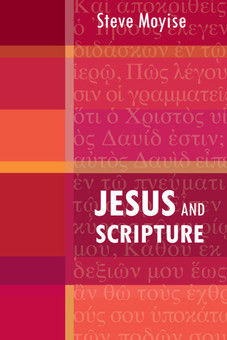
Logos Bible Software is offering another excellent book for their “Free Book of the Month” Promotion. Last year these were all out-of-copyright classics widely available on the internet for free. Last month they offered one of the Armchair Theologian series from Westminster John Knox Press, this month Steve Moyise’s Jesus and Scripture (SPCK, 2010), and printed in the US by Baker Academic in 2011. Moyise is a professor of biblical studies at the University of Chichester and has written a number of books on the use of scripture in Revelation and Paul. This 140-page book is an excellent introduction to how Jesus used scripture, beginning in Mark, then Matthew and Luke, and finally John. There are a few text-boxes throughout the book that offer brief definitions / expansions on some technical/scholarly issues (What is Q? The Criteria of Authenticity, etc.) While there is nothing ground-breaking in this little book, it is a very nice introduction to some of the problems of Historical Jesus studies, and Moyise is able to explain some difficult problems clearly and concisely.
After surveying the data in the Gospels, Moyise offers three chapters on various approaches to this material. The minimalist approach to Jesus’ use of Scripture (represented by Geza Vermes, John Dominic Crossan, and Marcus Borg). These scholars tend to reject much of the Jesus tradition, beginning with the apocalyptic material (Son of Man sayings, etc). Crossan and Borg are well known for reducing the number of sayings of Jesus to a bare minimum (hence, “minimalists”). It is not that these writers seek to marginalize Jesus, but as Moyise says, “they believe that the Gospel writers diminished Jesus by making him the mouthpiece for their own egocentric claim that they are now the people that God will rescue from the imminent collapse of the universe” (91).
The moderate approach (represented by James Dunn and Tom Wright) accepts far more of the sayings of Jesus as authentic, although there is an acceptance of the fact that some of the sayings have been “embellished” by later Gospel writers.There is also more acceptance of Jesus as an apocalyptic prophet of some sort, so Jesus’ own self understanding is based on texts like Dan. 7 , Zech. 9–14, Ps. 22 and Isa. 40–55. Not to give away the conclusion, but Moyise places himself on the side of the moderates (120-1).
The maximalist approach (represented by Charles Kimball and R. T. France) assumes that the Gospels represent a reliable account of what Jesus said and did, and that Jesus’ use of Scripture was analogous to other Jewish teachers of his day. Kimball especially focuses on Hillel’s seven rules as a way to describe Jesus’ teaching.
As a bonus, Logos is giving away a very nice six book collection of “Jesus Studies” published by SPCK (Baker or Westminster in the US). Each book in that collection is worth reading. Head on over to Logos Bible Software, get the free Logos book, and enter to win the whole collection.
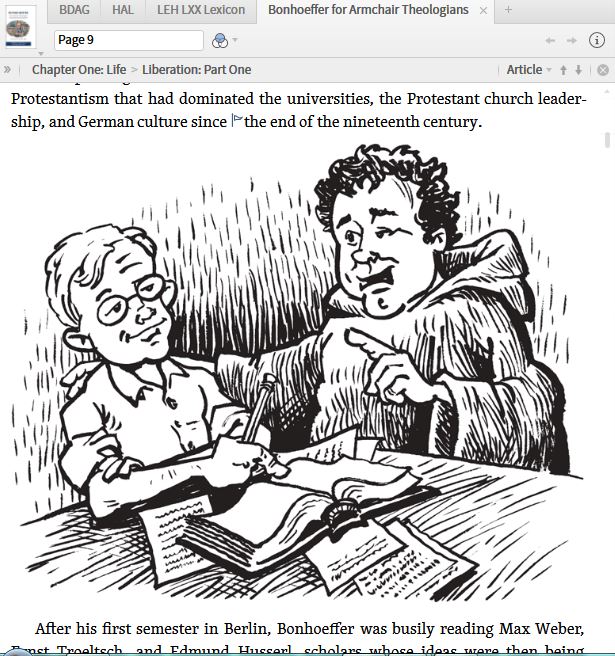
Logos Bible Software has offered a free book each month for quite some time. Usually these were out-of-copyright classics that were widely available on the internet for free. This month, however, they are offering one of the Armchair Theologian series from Westminster John Knox Press: Bonhoeffer for Armchair Theologiansby Stephen R. Haynes and Lori Brandt Hale. Haynes is no stranger to Bonhoeffer studies, having written The Bonhoeffer Phenomenon: Portraits of a Protestant Saint and The Bonhoeffer Legacy: Post-Holocaust Perspectives. He is currently Professor of Religious Studies at Rhodes College in Memphis and Theologian-in-Residence at Idlewild Presbyterian Church. Lori Hale is Associate Professor of Religion and Director of General Education at Augsburg College in St. Paul, Minnesota. Her University of Virginia dissertation was entitled “Love Your Enemies? Dietrich Bonhoeffer and the Question of the Other” and she has contributed numerous articles on Bonhoeffer.
The Armchair Theologian series is intended to give a brief overview of the ideas and contributions particular theologian. WJKP has thirteen volumes in the Logos Library format, and like other Free Books of the Month Logos is running a contest to win the set. The set includes volumes on Aquinas, Calvin, Augustine, Luther, Wesley, Barth, Jonathan Edwards, Martin Luther King Jr., Bonhoeffer, John Knox as well as three movements The Reformation, Heretics, Liberation Theology. (It does not appear that the latest int he series on the The Niebuhr Brothers is in the Logos format yet). These little books are quick and easy overviews that will help you understand the basics before wading into more detailed analysis. There are a number of illustrations by Ron Hill that add to the experience of reading these books. As always, all of the features of the Logos Library are available for reading this book, including real page numbers, highlighting, and the added benefit reading on both the desktop and iOS versions of Logos.
Logos is giving away a great resource for their first free book of 2014. F. W. Farrar’s commentary on Hebrews in The Cambridge Bible for Schools and Colleges series is a hand commentary on one of the more difficult books of the New Testament. Published in 1891 by Cambridge University, the series was intended as a collection of handbooks on the Bible and few approach even 200 pages in a small format (3×5 inches). But in the late nineteenth century, no one was writing 1400 page commentaries! The Cambridge series is valuable today because some of the best mainline scholars contributed to the series, such as S. R. Driver on Daniel.
Fredric W. Farrar was one of the finest scholars of his day. Farrar (1831-1903) wrote both a Life of Christ (1874) and a Life of Paul (1879) as well as numerous other books of theology and Church History. His History of Interpretation (1886, reprinted by Baker in 1961) was one of the first books I read on hermeneutics and aroused by interest in rabbinic exegesis. While some of his views on Hell would arouse the ire of conservatives, he was a careful exegete and extremely well-read in early church history as well as rabbinic exegesis.
The commentary on Hebrews is most valuable for the 50 pages introduction to the book of Hebrews. This section covers all the usual items expected in a New Testament introduction and gives an insight into what scholarship thought about Hebrews at the turn of the 20th century. On authorship, for example, Farrar rejects Pauline authorship and has a good survey of the arguments for and against Paul as the author the letter. After listing a series of observations about the author, Farrar concludes that “Apollos meets every one of the necessary requirements” (48). The body of the commentary moves phrase by phrase through the text, commenting on the Greek text, with occasional textual notes. When referring to the Hebrew Bible, words appear in transliteration, although a few are in Hebrew letters as well.
What I find remarkable about this commentary is the number if allusions to Philo, the Apocrypha, and other intertestamental sources. Despite the fact the book is well over 100 years old, Farrar is well aware of the intellectual context of the writer of Hebrews. This ought not be a surprise, given the breadth of his History of Interpretation.
Like many of the other books Logos has given away for free over the last two years, this is commentary is out of print and freely available from various sources around the web, such as the Internet Archive and Google Books. With the Logos book you will be able to read the book with all of the Logos tools available (searching, highlighting and note taking, etc.) All scripture is linked to your favorite English translation. In addition, clicking Greek and Hebrew words will launch your Greek or Hebrew Lexicons. At one point Farrar referred to a passage int he LXX, and Logos launched by Septuagint lexicon.
Another advantage to the Logos format is that it reads very well on an iPad. I have read books with Google Play and Kindle, but the best “reader” on the iPad is the Logos app. Any notes I make on the iPad are automatically synced so that they are available on my desktop (and vice versa).
 Logos Bible Software has offered a free book each month for quite some time. Usually these were out-of-copyright classics that were widely available on the internet for free. But the last few months have been very good indeed. This month, Logos is giving away 300 Quotations for Preachers from the Puritans, by Bible Study Magazine contributor Elliot Ritzema. Ritzema served as an Old Testament editor for the Lexham English Bible and is a contributor to the Faithlife Study Bible. These 300 Quotations for Preachers are drawn from more than 70 authors including Anselm of Canterbury, Augustine of Hippo, Richard Baxter, Bernard of Clairvaux, John Calvin, G. K. Chesterton, John Chrysostom, Irenaeus of Lyons, Thomas à Kempis, Martin Luther, and more. The quotes appear with some scripture and the book includes a PowerPoint style slide for each quote suitable for church use (or spamming your facebook friends with Richard Baxter quotes).