Hebrews 7 – Melchizedek and Typology

In Hebrews 7, a character from the Hebrew Bible is used by the writer as a way to talk about Jesus in the present age. This method of interpretation is sometimes called “typology.” As Karen Jobes states in Letters to the Church, this method attempts to understand earlier persons, events, and institutions drawn from the Hebrew Bible as anticipations of later persons, events, and institutions (48). Some events in the Old Testament are described in the New Testament as having anticipated the events of the New Testament. For example, the Passover Lamb is clearly an anticipation of the sacrifice of Christ, the lamb of the Passover can be called a “type” of Christ.   In the case of Melchizedek in Hebrews 7, the priest-king of Salem is described as a “type” of Christ.

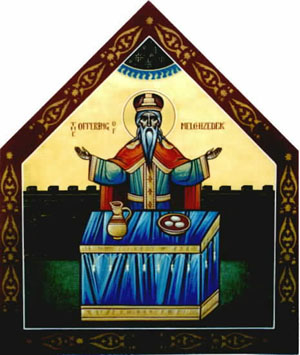
San Vitale basilica, Ravenna, MelchizedekWhat is “typological” in Melchizedek’s story, and what is not?  Two elements are highlighted by the writer of Hebrews – his name and his lack of genealogy. Not everything in Gen 14 is significant for the writer of Hebrews.  Noticeably absent from this “typology” is Melchizedek bringing food and wine to Abram.  Some in the early church took this as Communion and taught that Abram celebrated the communion with Melchizedek. The food and wine were simply part of the sacrifice and the blessing that followed and not a foreshadowing of the Eucharist.

The first point drawn from the Genesis story is the name Melchizedek, “King of Righteousness” and his title, “King of Salem,” meaning “King of Peace.” The name can mean “King of righteousness,” or “my king is righteous.”  Either way the emphasis is on righteousness. The city of Salem may be the city of Jerusalem, which probably means “foundation of peace.”  The combination of righteousness and peace is the element of the story that is significant to our writer, Jesus is the combination of righteousness and peace, and is able to bring both to the world in his death.

It was expected that the Messiah would be both a righteous ruler and a bringer of peace (Isa 9:6, Isa 32:17, Jer 23:5-6, 33:15)  Thus Melchizedek is a fit analogy for Jesus because Melchizedek combines both the king and priest into one person, and is called both the Righteous King and the Peaceful King, as is Jesus as the Messiah.

The second element drawn from Gen 14 is the fact that Melchizedek has no genealogy. The Genesis story introduces Melchizedek without any hint as to who he is, as it we are supposed to know who he is.  That there is no genealogy may be simply because there is no reason in the flow of Gen 14 to give the genealogy of Melchizedek.   There are quite a few characters who are introduced without genealogy, but since Melchizedek is a priest it is more significant.  The Law is quite clear that a priest must be from the tribe of Levi, later Ezra was quite careful to ensure that all of the priests who were serving could prove their genealogy.

The significance for the writer of Hebrews is not that his genealogy is not mentioned at all.  Reading this from the perspective of first century Hellenism, this would be understood as a claim of divinity. The gods are sometimes described as “without mother or father.”  The idea that the Messiah would be “without descendants” or ancestors may have been suggested by Isaiah 53:8a “By oppression and judgment he was taken away. And who can speak of his descendants?” Because of this fact he is a worthy analogy of Christ, a priest from an order other than Aaron’s Levitical priesthood.  Jesus was a priest, but not in the line of Aaron, he was from this independent line of priests, like Melchizedek.

The danger of a “type” is in taking the analogy too far and creating an allegory out of the original text.  Types are analogies, and as such they have some parallels, but the analogy breaks down if you press it too far. The early church loved typological interpretation, pressing details for hard that they were allegorizing every minor element of an Old Testament story into a spiritual meaning for the New Testament era.  In an effort to get behind the text and find the hidden meaning, the obvious meaning of the text was lost. There is no basis for most of the interpretations, for example, any four colors represent the four gospels, etc.

I find it troublesome to interpret stories from the Hebrew Bible as “types” today because I am not a prophet (nor the son of a prophet). Part of the problem is my Western “fear of allegory” as an interpretive method. Frankly, the writer of Hebrews would not score very high on a paper for my class using this sort of typological method. And that raises a question – what do we make of his argument about Jesus based on Melchizedek? His method was sound in the first century, but it is not really going to convince a modern skeptic.

Is there any way to use Hebrews 7 as a “guide” for interpreting scripture in a modern context?
Hebrews 7:1-3 – The Priesthood of Melchizedek

One of the more tantalizing problems in Hebrews is the identification of Jesus as a priest in the order of Melchizedek. Since the author of Hebrews is making the argument that Jesus is the ideal High Priest, someone might object that Jesus cannot be the High Priest since he is not from the tribe of Levi. No one from Judah could be selected as a priest, let alone a high priest. In order to solve this problem, Hebrews will identify Jesus as a priest in a different line, one that is superior to the tribe of Levi or the lines of Aaron and Zadok.

melchizedek2In the Hebrew Bible, Melchizedek is identified as both a priest and king of the city of Salem (Gen 14). After Abram rescues Lot from Mesopotamian invaders he is met by Melchizedek. He is simply identified as a “priest of God Most High” (כֹהֵ֖ן לְאֵ֥ל עֶלְיֽוֹן). He brings both bread and wine and blesses Abram, who gives the priest a tithe from the plunder.

He is mentioned a second time in Psalm 110, perhaps the most cited messianic Psalm in the New Testament. What is important for our reading of Heb 7 is that the Psalm connects the Davidic ruler to “the priesthood of Melchizedek.” Melchizedek was the priest-king of Jerusalem years before David captured the city and established it as his capitol. It is possible that David took over the title of “priest-king” of Jerusalem when he captured the Jebusite city. The kings of Judah could therefore be considered priests “in the order of Melchizedek.”

There were a number of interpretations of Melchizedek current in the first century, perhaps explaining why the author of Hebrews used this rather obscure character as an analogy for Jesus.  The Dead Sea scrolls make Melchizedek into a paradigm for the righteous remnant, awaiting the return of the Messiah.  He functions very much like Michael in Dan 12.  He is a defender of Israel who will return to punish those who opposed the righteous remnant. The Targum Jonathan argued that Melchizedek was Shem, the son of Noah.  In the genealogies of Genesis, Shem would outlived Abraham by 35 years.  The Jews sought to find a way to explain the great Abraham giving honor to Melchizedek, they did this by making him one of Abraham’s great ancestors. The philosopher Philo described Melchizedek as the “divine logos,” not God but God’s representative in this world

The reason for all this speculation is that there is not much said in Gen 14 about who Melchizedek.  That he worships the God Most High and was the king of Salem, presumably Jerusalem is remarkable. But how can the “line of Melchizedek” superior to Levitical priesthood?

The tithe that Abram gave to Melchizedek is used as a “proof” that Melchizedek is greater than the Levitical priesthood. In the Genesis 14 story it is unusual that Abram would tithe any of the plunder, although it was common for a portion of plunder to be given to the priesthood in ancient near eastern cultures. The writer of Hebrews draws out a further point from of the story:  since the Levitical priests are present in Abram, their ancestor, the Levitical Priests paid the tithe to Melchizedek themselves.

This is a fascinating albeit odd interpretation drawn from the Hebrew Bible. Reading only Genesis 14, one would never imagine that there was an “order of Melchizedek,” nor that the Messiah would be a priest like Melchizedek. But this is not Western, modern exegesis, but a style of reading the Hebrew Bible that would have “worked” in synagogues in the first century.  How “literally” should we take this “line of Melchizedek”?  Or is the writer using exegetical techniques that modern readers have (rightly) left behind?

Hebrews 3 – Jesus is Superior to Moses

The writer began by proving that Jesus is superior to the angels in chapters 1-2, and not who will show that Jesus is superior to Moses.  Why move from angels to Moses? For most modern readers, angels are superior to humans, so if Jesus is superior to angels, he would obviously be superior to Moses as well.

But it is important to read this argument in the context of first century Jewish Christianity.  For Jews living in the Second Temple period, Moses was the most significant person in salvation history. In Sirach (about 200 B.C.), Moses is described as equal to the “holy ones” or even God himself (as the Hebrew text of Sirach can be translated):

Sirach 45:1-2 …and was beloved by God and people, Moses, whose memory is blessed. He made him equal in glory to the holy ones, and made him great, to the terror of his enemies.

In addition, messianic hopes in the first century sometimes focused on the coming of a prophet like Moses. Hope for a “return of Moses” as messiah was so strong that at least one messianic pretender stopped the Jordan in a re-enactment of the crossing of the Red Sea. Matthew’s gospel is designed to highlight Jesus as a new Moses who goes up on the mountain and gives the people the Law–the Sermon on the Mount!

One might have offered a counter argument to the first two chapters of Hebrews: Jesus might be superior to the angels, but the ultimate servant of God was Moses, who gave the Law.  In the context of the first century, then, our author will argue that Jesus is a superior to even Moses as a servant of God.  Ultimately, this will lead to the conclusion that the covenant which Jesus made (the New Covenant) is superior to that of the Old Covenant made by Moses.  In verse two Moses is compared to Jesus, then he is subordinated to Jesus (verse 3) and by verse 5 he is contrasted to Jesus, negatively.

Moses and JesusThe author of Hebrews makes a “lesser to greater” type of argument. If Moses was faithful in God’s household in the previous age, how is Jesus be superior to him in the present age? First, Jesus is superior because he is the builder of the house.  Here the writer is making the point that Jesus is God, and because God is the designer of the administration that Moses presided over, he is therefore superior to him.

Second, Moses is a servant of the house, but Jesus is the son of the Builder, and therefore heir to the administration himself.  He is of a different class that Moses, beyond servant.  This takes into consideration the first argument of the book, that the angels were servants, but Jesus is the son.  Moses is a servant, but the word here is unique in the New Testament to Moses.  It is not a slave, but an “attendant,” one who “renders devoted service” (BDAG). The LXX uses the word for Moses in Num 12:7 (as well as Exod 4:10 and 14:31).

Moses was a servant of the first class, but he is still a servant of Jesus, and therefore subordinate to him.  What else in Hebrews 3 shows Jesus as superior to Moses?

Free Commentary on Hebrews from Logos

Logos is giving away a great resource for their first free book of 2014. F. W. Farrar’s commentary on Hebrews in The Cambridge Bible for Schools and Colleges series is a hand commentary on one of the more difficult books of the New Testament. Published in 1891 by Cambridge University, the series was intended as a collection of handbooks on the Bible and few approach even 200 pages in a small format (3×5 inches). But in the late nineteenth century, no one was writing 1400 page commentaries! The Cambridge series is valuable today because some of the best mainline scholars contributed to the series, such as S. R. Driver on Daniel.

F. W. FarrarFredric W. Farrar was one of the finest scholars of his day. Farrar (1831-1903) wrote both a Life of Christ (1874) and a Life of Paul (1879) as well as numerous other books of theology and Church History. His History of Interpretation (1886, reprinted by Baker in 1961) was one of the first books I read on hermeneutics and aroused by interest in rabbinic exegesis. While some of his views on Hell would arouse the ire of conservatives, he was a careful exegete and extremely well-read in early church history as well as rabbinic exegesis.

The commentary on Hebrews is most valuable for the 50 pages introduction to the book of Hebrews. This section covers all the usual items expected in a New Testament introduction and gives an insight into what scholarship thought about Hebrews at the turn of the 20th century. On authorship, for example, Farrar rejects Pauline authorship and has a good survey of the arguments for and against Paul as the author the letter. After listing a series of observations about the author, Farrar concludes that “Apollos meets every one of the necessary requirements” (48). The body of the commentary moves phrase by phrase through the text, commenting on the Greek text, with occasional textual notes. When referring to the Hebrew Bible, words appear in transliteration, although a few are in Hebrew letters as well.

What I find remarkable about this commentary is the number if allusions to Philo, the Apocrypha, and other intertestamental sources. Despite the fact the book is well over 100 years old, Farrar is well aware of the intellectual context of the writer of Hebrews. This ought not be a surprise, given the breadth of his History of Interpretation.

Like many of the other books Logos has given away for free over the last two years, this is commentary is out of print and freely available from various sources around the web, such as the Internet Archive and Google Books. With the Logos book you will be able to read the book with all of the Logos tools available (searching, highlighting and note taking, etc.)  All scripture is linked to your favorite English translation. In addition, clicking Greek and Hebrew words will launch your Greek or Hebrew Lexicons. At one point Farrar referred to a passage int he LXX, and Logos launched by Septuagint lexicon.

Another advantage to the Logos format is that it reads very well on an iPad. I have read books with Google Play and Kindle, but the best “reader” on the iPad is the Logos app. Any notes I make on the iPad are automatically synced so that they are available on my desktop (and vice versa).

The book is free from Logos through January, and Logos is giving away the 21 volume Cambridge Greek New Testament series.

Book Review: Herbert W. Bateman, IV, Charts on the Book of Hebrews

Herbert W. Bateman, IV. Charts on the Book of Hebrews. Grand Rapids, Mich.: Kregel, 2012. 266 pages, pb. $26.99. Link to Kregel.

When I first started teaching, I made a great deal of use of several “chart” books published by Zondervan. These books summarized large topics (Christological controversies, Old Testament Kings, etc.) in a simple, visually appealing format. Since the topics covered by these chart books were broad, the charts tended to be very general, although occasionally there was a page or two on a very specific topic, such as the date of the Exodus, etc.

Bateman Hebrews ChartsKregel has revived the idea of a “chart book with their“Charts of the Bible and Theology” Series. This new series is much more focused than the older Zondervan series.  The series already includes Mark Wilson on Revelation and Lars Kierspel on Paul’s Life, Letters and Theology. Herb Bateman’s contribution to the series is focused solely on the book of Hebrews. This book is 8 ½ by 11 inch and seems designed for copying and use in a classroom. The copyright page specifically states that no part of the book may be reproduced “except for classroom use.”

The book is divided into four sections, each with several subsections. About 50 pages are devoted to introductory questions.  Here Bateman collects data from both historic and modern commentaries on authorship, destination, recipients and date of Hebrews. For Hebrews, these are all topics which have generated considerable discussion. The data for authorship, for example, is presented several ways. Several charts list the suggested authors of the book by era, then several additional charts list arguments for (or against) the major candidates for authorship. What makes these charts valuable is the wealth of bibliographic information, citing not only the scholar’s name but the work in which the suggestion was made whether a monograph, commentary or journal article. I particularly liked the chart on the canonical placement of Hebrews (chart 26). I knew that Hebrews appeared after Romans in some manuscripts. Batemen lists them along with date and text-type, but also the other seven places Hebrews appears on other manuscripts.

I think that some of the charts could have been more efficiently designed. Chart 9, for example, lists the destination of the book in major, modern commentators in alphabetical order by the scholars last name. Since the vast majority of these commentaries support the consensus view that Rome was the destination of the letter, those might have been listed under one heading, with the dissenting views under a separate heading. The data is still very valuable for quickly surveying 20+ major commentaries from 1987 to 2010. Several charts struck me as “filler,” such as chart 15, a comparison chart of the date of all New Testament books in eight different New Testament Introductions. There are several charts on formation of the canon which are not particularly focused on Hebrews at all (chart 29, for example). While all of this is valuable information, it goes beyond the scope of a “chart on Hebrews.”

The second section of the chart book deal with Old Testament and Second Temple Period influences on Hebrews. There are several charts on Old Testament citations and allusions, with the data sorted in different ways. Batemen includes several charts showing the design of the Tabernacle and some summaries of Old Testament feasts as well as the elements of the Day of Atonement alluded to by Hebrews. This section contains valuable charts with relevant pseudepigraphical literature and the Dead Sea Scrolls with relevant parallels to Hebrews. Again, these are detailed and useful charts which summarize a great deal of information in a page or two. The charts on messianic figures in the Second Temple Period literature (charts 48-50) are very well done and contains a great deal of data on the topic in the literature of the Second Temple Period. There are a few “filler” charts in this section as well – the high priests of the early Hasmonean period (chart 45), Herod’s family tree (chart 46) and the high priests of the Herodian period (chart 47) are excellent collections of data (names, dates, and reference in Josephus), but their connection to the book of Hebrews is tangential at best.

Hebrews ChartsThe third section concerns the theology of Hebrews. These are perhaps the best charts for use in teaching the book of Hebrews in a classroom or Sunday School setting. Most take a theme in Hebrews and list the texts in the book which develop this theme. For example, Jesus and Wisdom (chart 63) and the “better than” statements in Hebrews (chart 67) work these themes through the book, giving many examples from Hebrews. . Some of these charts contain massive amounts of texts. “Titles Ascribed to Jesus in the New Testament” (chart 66), for example, includes all of the titles in Hebrews, but gives parallel texts in the Gospels/Acts, the Pauline Letters, and the General Epistles.

The fourth section of the book contains charts for exegesis. Many of these are parallel columns comparing the Hebrew Bible, the Septuagint, and Greek New Testament for specific citations. The value of these charts is for the exegete who wants to study how the writer of Hebrews cites Scripture, or perhaps adapts Scripture for his own use. This section also includes several charts comparing the manuscript evidence for the text of Hebrews. The major text variants in the book are included with some commentary drawn from Metzgar’s Textual commentary. Chart 103 has a list of words which are unique to Hebrews, in Greek alphabetical order, along with various translations of these unique words (KJV, NIV, ESV, etc.) This data is then repeated in chart 104, but it is arranged by chapter. These sections are about seventeen pages each, so they would be better described as an appendix than a chart.

The book concludes with sixteen pages of commentary on the charts. This section gives more information on the charts and perhaps should be seen as “suggestions for using this material.” Occasionally bibliographical material is included here so the reader can study the material on the charts in more depth. Bateman also provides eleven pages of bibliography broken into the sections found in the book.

Conclusion. There is a staggering amount of information in Charts on the Book of Hebrews. I think that Bateman has drawn together valuable information from a wide range of sources. The student of Hebrews will find sections of this book valuable for covering issues at a glance. Although there are some sections which I described as “interesting filler,” there is little in this book that is without value for the study of Hebrews. I think that some of the charts would be valuable as handouts for a Sunday School class or serious Bible Study. The theology section especially will help a teacher treat sections of the book of Hebrews which are quite difficult. I will be teaching Hebrews in the fall of 2013 as part of an undergraduate course on Jewish Christian literature and plan on making use of this book.

Note: Thanks to Kregel Academic for kindly providing me with a review copy of this book. This did not influence my thoughts regarding the work