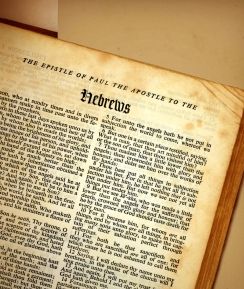
Hebrews 1 – Worship Jesus, the Firstborn

In Hebrews 1:6 the author says that God commands the angels to worship Jesus, his firstborn son.  The command to worship is drawn from the LXX of Deut 32:43 but seems to be blended with Psalm 97:7 (LXX Ps 96:7) and Psalm 89:27 (LXX 88:28). Ellingworth suggests Odes of Solomon 2:43b and 4QDt 32:43b are possible sources as well, although these two texts are probably alluding to the same texts as the author of Hebrews. The phrase “let all the sons of God/angels worship him” is missing in the Hebrew text, so the writer of Hebrews either is following the Greek of Deuteronomy or only has the Psalm in mind.

There are two issues with this verse that need to be addressed that have a bearing on Christology. First, the quote is introduced by a phrase calling Christ the “firstborn of God.”  The word “firstborn” could be taken to mean that Jesus was created or generated by God, so that Jesus was similar to God, but not the same substance as God himself. In fact, the Greek word πρωτότοκος (prototokos) does mean “first born,” but it often refers to the legal status as heir rather than birth order.

Rembrandt_AqedahIt is possible for the “first born” to be the literal first born child, but that is not necessarily the case. Jacob can be called the first born, even though he was not the literal first born, because he was the son of the blessing over his older brother. More importantly for the writer of Hebrews, the word πρωτότοκος was applied to David in Psalm 89:27 (LXX 88:28).

The second issue is the command to worship Jesus. In the original context of Psalm 97:7, worshipers of idols are put to shame by the glory of God revealed in creation. Since the idols are worthless, the gods/angels are commanded to worship God. The Hebrew Bible has כָּל־אֱלֹהִֽים, “all the gods,” the Greek of the Psalm has πάντες οἱ ἄγγελοι αὐτοῦ, “all his angels.” It is probably the case that the translator took the “gods” as “sons of God” and translated the phrase “angels,” a similar case is found in Psalm 8.

The important point is what the quote says: all the angels should (now) worship the Son. In this present age, the firstborn son ought to receive the worship that was reserved for God in the previous age. This would create a problem for a monotheistic Jewish thinker – how can Jesus be worshiped as God? God is commanding his angels to worship something other than himself, a violation of his own Law. The shema, after all, says that there is one God. The angels can only worship God himself, so the author of Hebrews is pointing to the fact that the Son is to be worshiped because he is God.

Is this a valid inference from the text of Hebrews? If a reader sets aside their views on the Trinity (either for or against it), does the writer of Hebrews intend to equate Jesus and God in some real way in this verse? What else is there in Hebrews 1 to support this assertion?

The Author of Hebrews – Why Not Paul?

As I suggested in a previous post, one of the factors we have to consider for the authorship of Hebrews is that the author was influenced by Paul or Pauline theology. Perhaps the simplest way to account for this influence is simply that Paul is the author of the book of Hebrews. While this is not a popular view today, the earliest traditions identify Paul as the author, but this has been questioned since the Reformation and is now only rarely defended.

Hebrews Meme

Why was Paul suggested as an author?  There may have been some desire to connect the letter with an apostle in order to argue in favor of including the letter in the canon.  A document that came from the apostolic circle would carry more weight than a document that did not. In addition, there are some Pauline elements to the book.

As the books of the New Testament we collected into book form (codices), Hebrews was often associated with the Pauline letters. The earliest copies from the third century place the book within the Pauline letter, right after Romans. Many early church fathers, especially the Alexandrian fathers, believed Paul wrote the book.  Clement of Alexandria (150-215) and Origin (185-253), for example, believed Paul was the author. By the end of the second century, Origen thought that the “weight of tradition” was behind Pauline authorship, but in the end said “only God knows” who wrote the book. He goes on to say “This writing is inspired even though we do not know who wrote it.” (See Eusebius, HE 6.25.11-13).

It was not until the Reformation that this teaching was doubted, first by Calvin, then by Luther.  More recently, detailed linguistic analysis has been done my Celsus Spicq, who concluded that “it is impossible from the linguistic point of view to attribute to Paul the direct paternity of Hebrews” (Cited by Ellingworth, Hebrews, 12). Since the book is anonymous and there is a mixed tradition about who the author might have been, perhaps it is better to agree with Origen as say “only God knows” who wrote the book.

David Allen Black has revived the Pauline authorship of Hebrews in a series of articles now summarized in a short book, The Authorship of Hebrews: The Cases For Paul (available for a mere$2.99 on Kindle). Black surveys the internal evidence for Pauline authorship by working through the book of Hebrews and showing potential parallels in Paul’s letters. Some of these are compelling; there are many words and phrases that appear only in Paul and Hebrews in the New Testament. But some of the parallels can be explained better as use of a common source. For example, In Hebrews 4:12-13, the Word of God is like a double-edged sword (μάχαιραν δίστομον), which Black says “seems to betray Paul (Eph 6:17). Certainly the word sword appears in both contexts, but in Paul it is the Sword of the Spirit, in Hebrews the Word of God is the sword. Paul omits the additional description of “double edged.” That word only appears in Hebrew 4:12 and three times in Revelation to describe a sword (although ῥομφαία is used, not μάχαιρα.  In the end, there are parallels, but nothing that forces the reader to assume Pauline authorship.

Another way to get the Pauline influence on the book of Hebrews is the suggestion that Luke used a synagogue sermon by Paul to write what we now know as the Book of Hebrews. This was the thesis of Andrew Pitts and Joshua Walker in an essay in Paul and His Social Relations (edited by Stanley E. Porter; Leiden: Brill, 2012). Pitts and Walker prefer to think of Luke as the editor of an oral presentation. In order to show this, they study ancient stenography and propose that it is at least possible that Paul is the source, Luke is the editor. This is an important essay since it avoids the objection that “linguistically” the book is not Pauline, while embracing the (at times) Pauline theology in the letter.

I think that both of these attempts are worthy of consideration since they take seriously the Pauline influence on the book of Hebrews. Pitts and Walker make a compelling argument for transcription of a synagogue sermon, but it is harder to support the claim that Paul was the origin of that sermon. It seems to move the authorship issue back a step to “who was the original speaker of this sermon?” Paul, Apollos and the usual suspects are all still possible.

The modern church is as bothered by an anonymous letter in the New Testament, but it may matter to some people that Paul did (or did not) write the book. What are the implications for reading the letter if Paul did (or did not) write the book?

Who Wrote the Book of Hebrews?

The best answer to this question is “we do not know who wrote the book of Hebrews.” It is an anonymous book and the earliest suggested author (Paul) is rarely defended today. This also means we know very little about when the book was written, the original audience, or where the author was when he wrote. This is remarkable since we can know all these things with a high level of certainty for many of Paul’s letters (especially Romans, 1-2 Corinthians or Galatians).

But there are a number of things we can know about the author of Hebrews from the book itself.

The author was a Jewish Christian, but undoubtedly a Hellenistic Jew. This would account for his detailed knowledge of the Hebrew Bible as well as his use of the Septuagint. The author regularly links verses together based on key words and themes to create chains of texts to support a his point. This method is found among the later rabbis and was probably the way a synagogue sermon was constructed.

The author was highly educated in both the Hebrew Bible and Hellenistic philosophy.  Scholars often point out the similarities between the book of Hebrews and the writings of the Jewish philosopher, Philo of Alexandria (30 B.C. – A.D. 50). It is possible the author was educated in Alexandria since he reads the Hebrew Bible in ways which are similar to Philo. But as James Thompson observes, the parallels between Philo and Hebrews are insufficient evidence to prove the author knew Philo or his exegetical techniques (Hebrews, 24).

The author  may have been in the second generation of the church.  Hebrew 2:3 implies that the writer has received tradition from others who are the witnesses of Jesus. While this could imply an individual living in the 60’s who not from Judea, it may only mean the author was not a follower of Jesus until after the resurrection. On the other hand, the writer could be someone who heard the message of Jesus as a youth from of the now elderly apostles, allowing for a date well past A.D. 70.

The author was influenced by Paul. It is hard to imagine a writer in the first century who has not heard of Paul, so this does not require him to be a companion of Paul or even part of the Pauline circle (Barnabas or Timothy, for example).  Unlike James, the author of Hebrews did not make a conscious effort to deal with similar topics as Paul (justification by faith) nor is there a direct reference to Paul (as in 2 Peter). Undoubtedly the writer read or heard Paul and knows his theology. This helps explain how a tradition of Pauline authorship might have developed in the first place.

None of these points should be controversial. As it turns out, there only a few people mentioned in the New Testament who fit this description. Other than Paul, the obvious candidate is Apollos since he is from Alexandria, was a well-educated Hellenistic Jew,  and had some influence from Paul or Pauline theology. But there are other candidates: Barnabas, Aquila and Priscilla, or even Timothy have been suggested as as potential authors of the book.

How do these four points help us to make sense of the content of Hebrews? To what extent does the author’s anonymity hinder (or help?) our understanding of the book.

Logos Free Book – John M. Frame, Salvation Belongs to the Lord

Once again the good folk at Logos are offering an excellent Free Book of the Month. This month Logos partners with P&R Publishing to offer John M. Frame, Salvation Belongs to the Lord: An Introduction to Systematic Theology (P&R, 2006) as a free addition to your Logos Library until the end of June. Salvation Belongs to the Lord: An Introduction to Systematic TheologyThe book is a substantial 382 pages based on Frame’s lectures for the Institute of Theological Studies. William Edgar said this book “is at once vigorously orthodox and sweetly pastoral. We can be grateful for such a powerful and clear exposition of the whole range of theology.”

In addition to the Free Book of the Month, Logos is offering Brian Vickers, Justification by Grace through Faith: Finding Freedom from Legalism, Lawlessness, Pride, and Despair (P&R, 2013) for only $1.99. This book is part of the Explorations in Biblical Theology series (ed. by Robert Peterson). Tom Schreiner comments in his forward to the book, “sets justification in the context of the story line of the Bible. He doesn’t just give us an abstract and sterile explanation of the doctrine. We learn how justification fits with the biblical story and how it fits with our story.” Both of these books are great additions for people interested in the Reformed side of Christian theology.

As always, you can enter to win the rest of the Explorations in Biblical Theology series (11 vols., a 139.95 value) in the Logos library. Both of these books are excellent additions to your Logos library, so make sure to add them to your library before the end of the month.

Verbum is offering the first two volumes of The Writings of Irenæus (including his most famous work, Against Heresies) for free Irenæus’s The Demonstration of the Apostolic Preaching for 99 cents. Verbum is part of the Faithlife family of companies, focusing on Catholic resources.  Verbum use your same Faithlife account, so these books are available to anyone with a Faithlife / Logos username and password.


Logos Free Book – Wolfgang Vondey, Pentecostalism: A Guide for the Perplexed

Pentacostalism-a-guide-for-the-perlexedOnce again Faithlife is offering a Free “Book of the Month” for your Logos library. For the month of July you can download a copy of Pentecostalism: A Guide for the Perplexed (Bloomsbury T&T Clark, 2013), by Wolfgang Vondey from T&T Clark. If you are not aware of the Guide for the Perplexed series, you should be. These are handy little volumes which cover the essential issues of an issue, along the lines of the Oxford “Very Short Introduction” series. This is not a “for dummies” series: the volumes I have used are serious introductions to cmplex topics. Vondey is a “German-born Pentecostal theologian who currently serves as Reader in Contemporary Christianity and Pentecostal Studies at the University of Birmingham, United Kingdom, where he also directs the Centre for Pentecostal and Charismatic Studies” (at least according to Wikipedia, he is.)

For a $1.99 more, you can supersize this free book and download a copy of T&T Clark Companion to Reformation Theology by David M. Whitford. Whitford is professor in the Religion department at Baylor University and contributed the A Guide for the Perplexed on Luther for T&T Clark. He contributes the first chapter in the volume, “Studying and Writing about the Reformation.” The rest of the chapters cover the following topics:

  • Chapter 2: Human Nature, the Fall, and the Will – Robert Kolb
  • Chapter 3: Revelation and Scripture – Ward Holder
  • Chapter 4: Justification – Carl Trueman
  • Chapter 5: Law and Gospel – Lubomir Batka & Anna Johnson
  • Chapter 6: Election – Chad Can Dixhoorn
  • Chapter 7: Sanctification, Works, and Social Justice – Carter Lindberg
  • Chapter 8: The Sacraments – Bryan Spinks
  • Chapter 9: The Church – Paul Avis
  • Chapter 10: Preaching and Worship – Anne Thayer
  • Chapter 11: Women, Marriage & Family – Karen Spierling
  • Chapter 12: Catechisms & Confessions of Faith – Karin Maag
  • Chapter 13: Church Discipline, Abuse, Corruption – Raymond Mentzer
  • Chapter 14: Eschatology, Antichrist, and Apocalypticism – Robin Bruce Barnes
  • Chapter 15: Political Theology – Volker Leppin
  • Chapter 16: Superstition, Magic & Witchcraft – Peter Maxwell-Stuart
  • Chapter 17: Radical Theology – Geoffrey Dipple
  • Chapter 18: Images and Iconography – Randall Zachman
  • Chapter 19: Martyrdom and Religious Violence – Haruko Ward

Part two of the book is entitled, “A Reformation ABC,” a mini-dictionary of important events and people for Reformation studies. I noticed the T&T Clark website has Whitford’s chapter as part one, the chapters as part 2 and the ABS as part three, Logos has only two parts (essays and ABCs). The content appears to be the same. At 471 pages, this is a great deal for $2.

As always, you can enter to win the three other volumes in addition to the free/almost free books in Logos’s T&T Clark Studies in Theological Systems (5 vols., $99 value). Enter early and often. Both of these books are excellent additions to your Logos library, so make sure to add them to your library before the end of the month.