
Hebrews 4:16 – Boldly, Before the Throne of Grace

The writer of Hebrews makes an inference from his assertion that Jesus is a High Priest: “Since we have a great high priest….let us approach the throne of grace with confidence” (4:16). The “throne of grace” in this verse is a reference to the presence of God. This may be a synonym for the Mercy Seat, the cover to the Ark of the Covenant that was in the Holy of Holies (Exod 25:17). While the word throne is sometimes used for an ornate chair and the words mercy and grace can both reflect the Hebrew word hesed, there is no other example of the Ark of the Covenant being called the “throne of grace.” Since the point of the passage is that the believer can enter into God’s presence, the analogy of the High Priest entering into the Holy of Holies on the Day of Atonement seems to almost require the reader to understand the Mercy Seat Ark as the “throne of grace.” But like most things in Hebrews, the writer might evoke the Ark of the Covenant or the Day of Atonement, but he has in mind the ultimate presence of God in Heaven, the “real throne of grace.”

Within the world of the metaphor, no Second Temple period Jewish person would even think of entering the Holy of Holies! Only a Jewish priest could enter the Temple, but only the High Priest could enter the Holy of Holies within the Temple. Even then, the High Priest entered only once a year and only after elaborate preparations. Even then, the High Priest did not approach the Mercy Seat with confidence; he was likely in fear for his life while preforming the functions of his office, knowing that he was as close to the presence of God as he could be in this life.  If he was found unworthy or if he was erred in his job he might be struck dead.

Yet the writer of Hebrews tells his readers that they can enter this most holy place with confidence. In the context of temple worship, this is a remarkable statement since every high priest did his duty on the Day of Atonement with a great deal of fear and trembling! To “enter with confidence” is not disrespect. The believer is not to treat God as a human or flippantly address God. The noun παρρησία (parrasia) can be translated “boldness,” as it is in the early parts of Acts when the Apostles “speak with boldness” about who Jesus was (Acts 2:29, 4:13, 14:19).

In this context confidence refers to the believer’s position in Christ that gives us a kind of “permission to speak freely” to God.  Since we have Jesus as our High Priest, we have a new relationship with God that allows us to be fully open and honest with God (cf. Eph 3:12). For example, in the military a commander might have certain people who are his close advisors. These people have the freedom to speak openly to their superior officer in a way that would not be acceptable coming from a private.

If we are in Christ, we can walk into God’s presence and speak to him what is on our hearts. The best example of this boldness is the prayers of the Psalms. Some Psalms question if God really listens to the prayers, others are boldly claiming promises made. Others frank expressions a depth of anguish and pain that is almost embarrassing. The writers of the Psalms do speak with God with confidence. This confidence and boldness is based on the fact that Jesus is our Great High Priest and he has done something as the High Priest that allows his followers his new access.

What are the implications of the boldness in the context of the original readers? How can we “bridge the gap” to apply this “boldness” to contemporary spirituality?

Hebrews 4:14-16 – Jesus as High Priest

The book of Hebrews emphasizes the priesthood of Jesus more than any other book in the New Testament. In fact, much of the argument of Hebrews 5-10 is based on Jesus as the High Priest. Two words of caution before discussing Jesus as a High Priest.

high priestFirst, the “high priesthood of Jesus” is based on the ideal form of priest found in the Hebrew Bible, not in the high priesthood as it actually functioned in the first century.  By the first century, the High Priest more a political figure that a religious leader.  Control of the temple and the priesthood gave the office a great deal of power, and this power usually led to great wealth. It is unlikely, however, that the writer of Hebrews has this sort of power in mind.  He consistently looks to the idea image (“the shadow”) from the Hebrew Bible in order to describe the “substance” of Jesus.

By way of analogy, we could study the office of president of the United States as it is described in the constitution, or by the way various presidents have functioned as president over the more than two centuries.  James Buchanan, for example, usually is ranked at the bottom of the list of presidents by historians, mostly for his handling of the issues which erupted into the Civil War. We would not, therefore, want to describe the office of president using Buchanan as our example!

In the same way, the high priests who held office in the first century were politically motivated and not particularly good examples of the way a priest ought to behave in his office. What is remarkable is that the book of Hebrews does not condemn the current High Priest as corrupt, nor does he say anything negative about the worship of the Temple other than it has been completed in Jesus.

Second, the word “priest” has connotations in English which are not present in the function of a Jewish priest.  We are not describing a Catholic or Orthodox priest, but rather the Jewish priest.  This modern sense of the word is not particularly helpful in understanding the priesthood in the Hebrew Bible.  The priest in the Jewish Temple was the mediator between God and man. As such, the office of priest foreshadowed the ministry of Jesus who was provides access to the throne of God for those who have entered into new life through him.

But Jesus is not just the High Priest, but the “great High Priest.” This was a title give to the High Priest Simon in 1 Maccabees (13:42, 14:27). This Simon was one of the founders of the Hasmonean dynasty and the first to take the title of both King and Great High Priest. His first year in power was “the yoke of the Gentiles was removed from Israel” (c. 142 B.C., 1 Macc 13:41). This combination of priest and king was an attempt to consolidate power into the one “office” in Maccabean revival of the kingdom in Judah.

How does the author of Hebrews distinguish Jesus as a high priest from the politically powerful priests of the first century?

Hebrews 3:7-19 – An Exhortation to Righteousness

This exhortation is based upon the experience of Israel as described in Psalm 95. The thing to avoid is a “sinful, unbelieving heart.  Heart in this case is not the emotions but rather the place of the will.  A “sinful and unbelieving heart” would imply that the person is unsaved.   The writer does not tolerate any within the congregation that are not believers, those persons are under God’s judgement and they are the ones that he is especially speaking to, in order that they do not bring shame to the church by recanting a faith they never shared.

If the unbelievers are Jews that “fall away” by returning to Judaism, how can the writer say that they are turning away from the living God?  The Jews do recognize God.  The point is that Judaism no longer presents the true revelation from God, it is inferior to the revelation that comes through Jesus in “these last days” (from 1:1-3).

A possible solution to the possibility of unbelief in the community of believers is that the “encourage each other daily.” The “daily” exhortation underscores the meaning of the word, this is an active effort on the part of the community of believers to help each other with their Christian walk.  There is a positive aspect to this word (encouragement), but also a negative aspect, a pushing toward spiritual excellence which may take the form of a shove!

In the modern church we tend to think of the pastor as a professional exhorter, as long as he doesn’t get too personal or call during dinner or the football game to exhort us.  Half an hour on Sunday is fine for most people (just don’t mention “sin”).  This text says that the community ought to encourage the community.  Mutual encouragement, but also exhortation – a sort of positive peer-pressure that encourages growth and development of a deeper relationship with God and each other.

The writer of Hebrews describes a whole church talking to each other and trying to keep each other from sin, a network of accountability that is virtually unknown in the modern church.

What are the people to encourage?  That we not be deceived by sin and harden our hearts. Sin is deceitful, it is seductive.  Satan does not appear as a slobbering evil dragon demanding your soul, he appears as an angel of light, a really nice guy with a good plan to help humanity, or maybe to help your family.  He takes the truth and twists it into a sin that looks pretty good!  Sin is a subtle deception, those are the best kind.

But if your community of believers is daily encouraging you not to harden your heart, it is much easier to do the right thing and avoid sin.  I am not sure modern Christian communities are very good at this encouragement.  On the one hand, they can become very legalistic and judgmental, even demanding of their members (to the point of being more like a cult than the Body of Christ).  On the other hand, some churches are so lax in this sort encouragement that there is no call to deal with the flesh, nor any preaching on sin in the life of the believer.  As they say these days, “it’s all good.”

It is not all good, it never was.  Believers need to return to this sort of mutual encouragement for the building up of the Body of Christ. Does is local church always an community? How might this section of Hebrews be used to transform personal relationships?

Hebrews 3:1-6 – Moses, the Servant

After proving that Jesus is superior to the angels in Hebrews 1-2, the writer moves to his second argument, that Jesus is superior to Moses.  Why move from angels to Moses? For most modern readers, angels are superior to humans, so if Jesus is superior to angels, he would obviously be superior to Moses. But it is important to read this argument in the context of first century Jewish Christianity.  For Jews living in the Second Temple period, Moses was the most significant person in salvation history. In Sirach (about 200 B.C.), Moses is described as equal to the “holy ones” or even God himself (as the Hebrew text of Sirach can be translated):

Sirach 45:1-2 …and was beloved by God and people, Moses, whose memory is blessed. He made him equal in glory to the holy ones, and made him great, to the terror of his enemies.

In addition, messianic hopes in the first century sometimes focused on the coming of a prophet like Moses. Hope for a “return of Moses” as messiah was so strong that at least one messianic pretender stopped the Jordan in a re-enactment of the crossing of the Red Sea. Matthew’s gospel is designed to highlight Jesus as a new Moses who goes up on the mountain and gives the people the Law (the Sermon on the Mount).

Charlton-Heston-as-MosesThe writer of Hebrews might be trying to counter an objection to the first two chapters of Hebrews: Jesus might be superior to the angels, but the ultimate servant of God was Moses, who gave the Law. In the context of the first century, then, our author will argue that Jesus is a superior to even Moses as a servant of God.  Ultimately, this will lead to the conclusion that the covenant which Jesus made (the New Covenant) is superior to that of the Old Covenant made by Moses.  In verse two Moses is compared to Jesus, then he is subordinated to Jesus (verse 3) and by verse 5 he is contrasted to Jesus, negatively.

The author of Hebrews makes a “lesser to greater” type of argument. If Moses was faithful in God’s household in the previous age, how is Jesus be superior to him in the present age? First, Jesus is superior because he is the builder of the house.  Here the writer is making the point that Jesus is God, and because God is the designer of the administration that Moses presided over, he is therefore superior to him.

Second, Moses is a servant of the house, but Jesus is the son of the Builder, and therefore heir to the administration himself.  He is of a different class that Moses, beyond servant.  This takes into consideration the first argument of the book, that the angels were servants, but Jesus is the son.  Moses is a servant, but the word here is unique in the New Testament to Moses.  It is not a slave, but an “attendant,” one who “renders devoted service” (BDAG). The LXX uses the word for Moses in Num 12:7 (as well as Exod 4:10 and 14:31). Moses was a servant of the first class, but he is still a servant of Jesus.

How does the author of Hebrews develop this Moses/Jesus typology? Does he intentionally denigrate Moses or the Law when he argues Jesus is superior?


Hebrews 1 – Jesus and the Angels

The first section of Hebrews develops an argument that Jesus was foreshadowed by various people and events in the Hebrew Bible. In chapter 3 he will contrast Jesus and Moses, perhaps the most faithful servant of God and certainly the person associated most with the Law. It is well known that Matthew uses a kind of Moses typology in his Gospel to show that Jesus is a teacher in the tradition of Moses yet superior to him.

It is therefore somewhat surprising that the book of Hebrews does not begin with the contrast with Moses.  After the introduction, the writer says that the Son who is seated at the right hand of the Majesty in heaven is superior to the angels (1:3). Following this statement, the writer constructs a lengthy comparison of Jesus and the angels, drawing on a series of texts from the Hebrew Bible (1:4-14, 2:1-9). Why start with the angels?

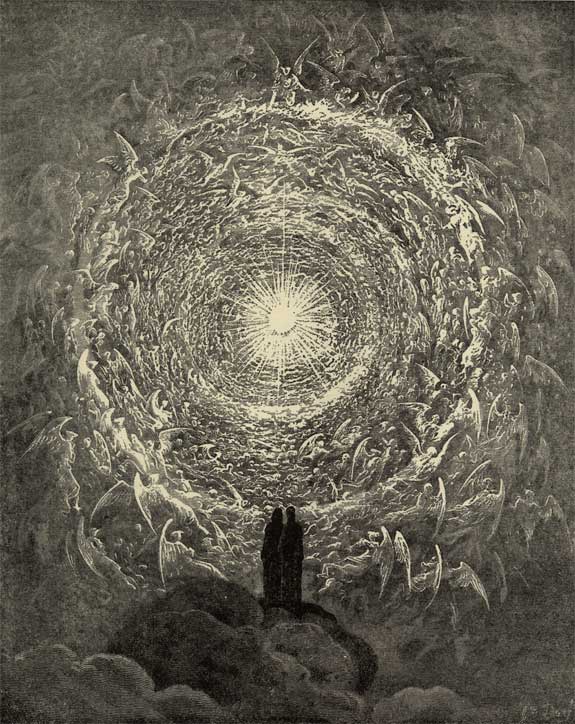
Dore AngelsAngels were very popular in Jewish mythology from the second century B.C. through the first century A.D.  A whole hierarchy of angels was developed along with some theological teachings that were not present in the Old Testament.  In the re-telling of Biblical stories writers often had angels performing acts that were acts of God in the Hebrew Bible.  Although the imagery is found in Daniel 10, the appearance of angels as glowing white, fiery, glowing, etc. was developed during this time as well.

Angels were associated with giving of the Law to Israel in early Judaism.  This tradition develops from Deut 33:2, where the “holy ones” accompany the Lord as he arrives at Sinai. “Holy ones” was taken to mean angels. In Acts 7:53, Stephen refers to the Law as “delivered by angels.” The Second Temple book Jubilees predates Hebrews and begins with a reference to the “angel of the presence” who wrote a text for Moses:

And he said to the angel of the presence, “Write for Moses from the first creation until my sanctuary is built in their midst forever and ever. And the LORD will appear in the sight of all. And everyone will know that I am the God of Israel and the father of all the children of Jacob and king upon Mount Zion forever and ever. And Zion and Jerusalem will be holy.” (Wintermute, “Jubilees,” in OTP 2: 54)

The tradition that angels delivered the Law is found in later Judaism as well:  “The presence of angels at the event of the giving of the law was a favourite bit of embroidery in rabbinic tradition, and was meant to enhance the glory of Sinai” (H. Schoeps, Paul, 182).  The emphasis in this literature is on the angels as intermediaries, delivering the Law to Moses.  When God revealed himself to Moses, he used angels.

Since the writer of Hebrews began his book by saying that God is new revealing himself through his Jesus, it is possible a Jewish reader might think of Jesus as an angel, like a Michael or Gabriel.  He must therefore begin by showing that Jesus is something other than an angel; he is “Son of God.”

One last observation:  Is this a “difference” between Jewish Christian literature and the Pauline Letters? Perhaps not. While Paul cannot be accused of emphasizing angels, he does use the same sort of language as Stephen in Gal 3:19: The law was “put in place through angels” (ESV).

Are there other reasons that the writer begins with a sustained argument that Jesus is superior to the angels in every way?