Brooks said this in 2004 to distance evangelicalism from ” the made-for-TV, Elmer Gantry-style blowhards” who the media calls “evangelicals.” He concludes his essay by saying “you can’t understand this rising global movement [evangelicalism] if you don’t meet its authentic representatives. Not Falwell, but Stott.”
Stott edited the New Testament volumes of the Bible Speaks Today series and wrote several of the commentaries. These are light, devotional commentaries which are aimed at the layperson either a small group setting or a personal reading. There are occasional references to the Greek and a few references to other scholarship. Pastors will enjoy reading this series as well as they prepare to preach and teach Scripture. For only $1.99 more, you can add Stott’s The Message of Ephesians in the same Bible Speaks Today series. Logos is also offering the Michael Wilcock’s two-volume Psalms commentary (2001) in the same series for $4.99.
You can also enter to win a seven-volume Stott Collection from Logos. These offers are only good through February. so head over Logos’s Free Book of the Month site ASAP and get these free (or almost free) resources.
Once again the good folk at Logos are offering an excellent Free Book of the Month. This month Logos partners with P&R Publishing to offer John M. Frame, Salvation Belongs to the Lord: An Introduction to Systematic Theology (P&R, 2006) as a free addition to your Logos Library until the end of June. The book is a substantial 382 pages based on Frame’s lectures for the Institute of Theological Studies. William Edgar said this book “is at once vigorously orthodox and sweetly pastoral. We can be grateful for such a powerful and clear exposition of the whole range of theology.”
In addition to the Free Book of the Month, Logos is offering Brian Vickers, Justification by Grace through Faith: Finding Freedom from Legalism, Lawlessness, Pride, and Despair (P&R, 2013) for only $1.99. This book is part of the Explorations in Biblical Theology series (ed. by Robert Peterson). Tom Schreiner comments in his forward to the book, “sets justification in the context of the story line of the Bible. He doesn’t just give us an abstract and sterile explanation of the doctrine. We learn how justification fits with the biblical story and how it fits with our story.” Both of these books are great additions for people interested in the Reformed side of Christian theology.
As always, you can enter to win the rest of the Explorations in Biblical Theology series (11 vols., a 139.95 value) in the Logos library. Both of these books are excellent additions to your Logos library, so make sure to add them to your library before the end of the month.
Verbum is offering the first two volumes of The Writings ofIrenæus (including his most famous work, Against Heresies) for free Irenæus’s The Demonstration of the Apostolic Preaching for 99 cents. Verbum is part of the Faithlife family of companies, focusing on Catholic resources. Verbum use your same Faithlife account, so these books are available to anyone with a Faithlife / Logos username and password.
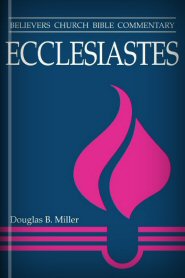
Logos Bible Software is offering a volume of the Believers Church Bible Commentary for free in August 2016. During this month you can add Ecclesiastes by Douglas B. Miller to your Logos library for free, and for $1.99 you can add Thomas R. Yoder Neufeld’s commentary on Ephesians (2002) in the same series.
According to Herald Press website, the Believers Church Bible Commentary is a “cooperative project of Brethren in Christ Church, Brethren Church, Church of the Brethren, Mennonite Brethren Church, and Mennonite Church.”
Each volume illuminates the Scriptures; provides historical and cultural background; shares necessary theological, sociological, and ethical meanings; and, in general, makes “the rough places plain.” Critical issues are not avoided, but neither are they moved into the foreground as debates among scholars. The series aids in the interpretive process, but it does not attempt to supersede the authority of the Word and Spirit as discerned in the gathered church.
Douglas Miller is the Old Testament editor for the series and professor at Tabor College, Hillsboro, Kansas. He has published many articles on Ecclesiastes as well as a monograph, Symbol and Rhetoric in Ecclesiastes: The Place of hebel in Qohelet’s Work (Atlanta: SBL, 2002). Thomas R. Yoder Neufeld is Professor Emeritus at Conrad Grebel University and wrote Killing Enmity: Violence and the New Testament (Grand Rapids, Mich: Baker Academic, 2011).
As always Logos is giving away a set of 26 volumes of the Believers Church Bible Commentary, a $432.99 value. Enter early and often.
You can also get Thomas Merton, Thoughts in Solitude as the Verbum Free book of the Month and Merton’s The Ascent to Truth: A Study of St. John of the Cross for 99 cents. Dostoyevsky’s Crime and Punishment is still the Noet Free book of the Month
Once again Faithlife is offering a Free “Book of the Month” for your Logos library. For the month of July you can download a copy of Pentecostalism: A Guide for the Perplexed (Bloomsbury T&T Clark, 2013), by Wolfgang Vondey from T&T Clark. If you are not aware of the Guide for the Perplexed series, you should be. These are handy little volumes which cover the essential issues of an issue, along the lines of the Oxford “Very Short Introduction” series. This is not a “for dummies” series: the volumes I have used are serious introductions to cmplex topics. Vondey is a “German-born Pentecostal theologian who currently serves as Reader in Contemporary Christianity and Pentecostal Studies at the University of Birmingham, United Kingdom, where he also directs the Centre for Pentecostal and Charismatic Studies” (at least according to Wikipedia, he is.)
For a $1.99 more, you can supersize this free book and download a copy of T&T Clark Companion to Reformation Theology by David M. Whitford. Whitford is professor in the Religion department at Baylor University and contributed the A Guide for the Perplexed on Luther for T&T Clark. He contributes the first chapter in the volume, “Studying and Writing about the Reformation.” The rest of the chapters cover the following topics:
Chapter 2: Human Nature, the Fall, and the Will – Robert Kolb
Chapter 3: Revelation and Scripture – Ward Holder
Chapter 4: Justification – Carl Trueman
Chapter 5: Law and Gospel – Lubomir Batka & Anna Johnson
Chapter 6: Election – Chad Can Dixhoorn
Chapter 7: Sanctification, Works, and Social Justice – Carter Lindberg
Chapter 8: The Sacraments – Bryan Spinks
Chapter 9: The Church – Paul Avis
Chapter 10: Preaching and Worship – Anne Thayer
Chapter 11: Women, Marriage & Family – Karen Spierling
Chapter 12: Catechisms & Confessions of Faith – Karin Maag
Chapter 13: Church Discipline, Abuse, Corruption – Raymond Mentzer
Chapter 14: Eschatology, Antichrist, and Apocalypticism – Robin Bruce Barnes
Chapter 15: Political Theology – Volker Leppin
Chapter 16: Superstition, Magic & Witchcraft – Peter Maxwell-Stuart
Chapter 17: Radical Theology – Geoffrey Dipple
Chapter 18: Images and Iconography – Randall Zachman
Chapter 19: Martyrdom and Religious Violence – Haruko Ward
Part two of the book is entitled, “A Reformation ABC,” a mini-dictionary of important events and people for Reformation studies. I noticed the T&T Clark website has Whitford’s chapter as part one, the chapters as part 2 and the ABS as part three, Logos has only two parts (essays and ABCs). The content appears to be the same. At 471 pages, this is a great deal for $2.
As always, you can enter to win the three other volumes in addition to the free/almost free books in Logos’s T&T Clark Studies in Theological Systems (5 vols., $99 value). Enter early and often. Both of these books are excellent additions to your Logos library, so make sure to add them to your library before the end of the month.
It can be argued that the material in Ephesians 4-6 and Colossians 3-4 reflect an early form of apostolic teaching or catechism material. The terms kerygma and didache are used to distinguish between two types of apostolic message. Kerygma is the “preaching” material of the gospel for sinners (Christ’s death and resurrection), while didache is the teaching material aimed at the person that has already accepted this message and is concerned with the living out of that message in terms of ethical behavior.
This may imply some pre-existing documents that eventually are used in the production of the New Testament books, although these types of materials also circulated orally. The kerygma material, for example, may include 1 Corinthians 15:3-5 or Phil 2:5-11. But this is not to say that there was any single document called “kerygma” – the word simply refers to the material that was used in evangelism by various preachers in the early church.
The same applies to the term didache. There would have been a core of teaching that Paul used in establishing churches and training leaders. That material would have been generally the same in every church (i.e. qualifications for elders and deacons) but flexible enough to adapt to a slightly different cultural situation (the difference between the qualifications list in 1 Timothy and Titus, for example, show some adaptation for the situation on Crete where Titus was to appoint elders). By the end of the first century a short book of church practice known as Didache did circulate, although the contents are not quite the same as this collection of material.
This core of teaching is found as early as Acts 2:42, where we are told that the new converts were devoted to the daily instruction of the apostles. Since all of these converts in the early part of Acts are Jews, and likely observant Jews in Acts 2, the need for ethical instruction would have been less of a priority than instruction in the teachings of Jesus (i.e. doctrine – Christology (who was Jesus, what did he teach) and Eschatology (the Christ is returning very soon). It is not unlikely that at this stage that the stories of Jesus’ acts and his teachings began to be passed from the Apostles to their disciples.
What are the implications that Paul might have used and adapted a kind of “standard teaching” in these two letters? Does this “early Christian standard” of ethics help us understand how the Church was teaching ethics in the first century?
Some bibliography: E. G. Selwyn, The First Epistle of St. Peter, 363-466; Philip Carrington, The Primitive Christian Catechism; A. M. Hunter, Paul and his Predecessors; C. H. Dodd, The Apostolic Preaching and its Developments; Everett F. Harrison, “Some Patterns of the New Testament Didache” BSac V119 #474 (Apr 62) 118-129; V. P. Furnish, Theology and Ethics in Paul, 68-111.