The New Perspective on Paul: Judaism as a Religion of Grace

There are a few battleground ideas and texts on which the New Perspective differs from the traditional view. First and foremost is the nature of Judaism in the first century. From the traditional perspective, Judaism was a legalistic religion which required works for salvation. This was often stated but rarely proven, especially in popular presentations. The Pharisees are described as hand-wringing legalists who sought to burden others with onerous laws which made little sense. Perhaps there is an undercurrent of anti-Semitism here, but more often than not this mischaracterization is simply the result of ignorance of what Jews actually believed in the Second Temple period.

At the WallSanders turned the assumption that Judaism was a legalistic religion on its head – Judaism was in fact a religion centered on God’s grace, as demonstrated in his election of Israel as his people and his gracious gift of the covenant. Of critical importance is the election of Israel as God’s people and the covenant He made with them. Philo states: “Yet out of the whole human race He chose as of special merit and judged worthy of pre-eminence over all, those who are in a true sense men, and called them to the service of Himself, the perennial fountain of things excellent” (Spec. Laws 1.303). Similar statements of Israel’s election are common in nearly all the literature of the second temple. Equally common are statements about the covenant God sought to initiate with the people he had chosen. Sanders cites Pseudo-Philo: “I will give my light to the world and illumine their dwelling places and establish my covenant with the sons of men and glorify my people above all the nations” (Bibl. Antiq. 11.1f, JBP, 264).

Israel’s election is confirmed by God’s gift of the Law and his requirement of obedience to that law. Everything we know about Judaism in the Second Temple Period is predicated on the fact that God gave the law and he required his people to obey. Because Israel is chosen and given a Law and the responsibility of obedience, she is liable for both rewards and punishment; to experience both God’s justice and mercy. God cannot let an evil-doer escape. He is all-knowing and punishment is certain (Antiq. 1.14; 3.321, 4.286).

Perhaps the most controversial point in Sanders’ view of common Jewish theology is that Judaism was a religion of grace. As noted above, the Christians often describe Judaism as a works-salvation in contrast to Paul’s salvation by grace alone. Everything in Jewish religion seems to point to the grace of God in this life. Whatever one has, whatever one is, it is only by the grace of God. One did not do the various “works of righteousness” (circumcision, food traditions, but also shema, prayer, wearing tefillin, etc.) in order to receive grace; rather one did them in response to the grace already received.

If this is a correct understanding of Judaism, then it seems to me that it is rather a” Pauline” way of expressing ethical obligations. Or maybe Paul is rather still Jewish in his ethical teaching! Paul never says one can be right with God on the basis of good works, it is only by God’s sovereign choice to adopt the believer as a member of his family that we can be saved: by grace through faith. But it is well know that Paul also gives many ethical and moral commands which he expects from his churches. These are not requirements to be saved, but the natural response of those who are “in Christ.”

To summarize this point for Sanders: Election is what placed the Jews “into” the covenant; obedience is what “keeps them in.” There are a number of mechanisms which are used to deal with disobedience, all of which are expressions of God’s grace. There is nothing Israel did to merit this election. Israel is given every help possible by God’s grace to assist them in the “keeping in” element.

Bob TefillinBut is this a wrong view of Second Temple Judaism? Perhaps Sanders has overstated his case in some respects. For example, a book like Fourth Ezra demands that the Law be kept perfectly and the Essenes certainly are an example of a group that demands rigorous attention to the demands of the Law. In the New Testament, Jesus does describe the Pharisees as legalists (Matt 23) and Paul is arguing against some form of legalism in Galatians. In addition, there is a certain attraction to legalism since it defines the steps one must take in order to be right with God. There were Gentiles who converted to Judaism and tried to keep the Law as perfectly as possible. That Paul must deal with Gentiles wanting to keep the Law in several letters ought to be evidence of the attraction of legalism.

On the whole, I think Sanders is correct that Judaism in the first century was a religion of grace, but there was also a strong attraction to legalism among both Jews and Gentile converts to Judaism (and later, Christianity). A major cornerstone of the theology of the Hebrew Bible is the gracious loving-kindness of God, his hesed. Nowhere in the Hebrew Bible do we read of someone who claims to be burdened down by the impossibly heavy load the Law. Rather, keeping the law is the proper response to a gracious God. The big difference between Paul and Second Temple Judaism is his view of Gentiles keeping the Law.

F. F. Bruce on Paul’s Conversion

F. F. BruceThis series on the New Perspective on Paul has generated several conversations (online and in real life). I was chatting about F. F. Bruce with a colleague today and he asked me if F. F. Bruce could be considered “New Perspective.” My initial thought was that Bruce did most of his work before the NPP was well-known, although I notice that he cited E. P. Sanders 23 times in his commentary on Galatians, Dunn appears a few times, but Bruce wrote on Galatians well before Dunn’s commentary was published in 1993.

Commenting on Galatians 3:10, Bruce sees Paul’s conversion as a decisive break from legalistic Judaism:  “Paul’s confrontation with the risen Christ on the Damascus road after his grounding in Judaism, and the new understanding of salvation-history which sprang from that confrontation, compelled him to see the legal path to salvation closed by a barrier (which he would not have refused to identify with the cross) which carried a notice reading: ‘No road this way.’”  F. F. Bruce, The Epistle to the Galatians (NIGTC; Grand Rapids, Mich.: Eerdmans, 1982), 160.

I would say that is solidly “Old Perspective”!

F. F. Bruce was a careful exegete and he is certainly not importing his personal conversion experience into his reading of Paul. It is simply the case Paul saw his own Gospel as a major break from his previous way of life in the Judaism of the Second Temple Period.

That is not to say that Paul rejected Judaism, however. In may very well be that he thought of himself as reforming Judaism with a “new understanding of salvation-history.” As I said in the previous post, Paul’s experience is unique in salvation history.

The New Perspective on Paul: Did Paul Convert to Christianity?

Critics of the traditional view of Paul’s theology often note that Paul’s experience is described in terms of Augustine’s conversion or Luther’s struggle against the Roman church. Both men found their experience parallel to Paul’s and meditated deeply on what God did in their lives to release them from the weight of their guilt.

Conversion of Saint Paul (Caravaggio)For many readers, this might sound like a foolish question.  Acts 9 describes Paul’s experience on the road to Damascus as a dramatic conversion from chief persecutor of the church to evangelist for the Church. In Phil 3:4-11 Pau describes his previous way of life in Judaism as worthless in comparison to his new life in Christ. That seems like a “conversion” experience from “being Jewish” to “being Christian.”

Another classic text that seems to describe a conversion experience is Romans 7:7-25. In this text Paul describes his struggle as the Wretched Man who tried to keep the Law but failed, and only found salvation in the freedom that comes through Jesus Christ. The traditional view reads this text as referring to Paul’s own spiritual and psychological conversion. If Romans 7:7-25 deals with Paul’s apparent struggle with sin prior to his conversion, then we do have a spiritual and psychological reversal in Paul’s conversion. Paul is described in the traditional view as a Pharisee that struggled with sin and the guilt of not being able to keep the Law. His conversion releases him from the weight of the guilt of his sin; he experiences justification by faith and converts from Judaism to Christianity.

The New Perspective on Paul calls this traditional view into question. James Dunn has built on the work of Krister Stendhal to argue that Paul did not experience a conversion from one religion to another. Rather, Paul received a call of God that is quite parallel with the prophetic calls of the Hebrew Bible, especially that of Jeremiah. The Damascus Road experience was a theophany, not unlike what Isaiah experienced in Isaiah 6. Paul experienced the glory of God and was called to a prophetic ministry. Paul never left Judaism, Stendahl argued, he remained a faithful Jew who was fulfilling the role of being the “light to the Gentiles” from Isaiah. (Not all scholars who are associated with the New Perspective agree, N. T. Wright still talks about “Paul’s Conversion” in What Saint Paul Really Said.)

Dunn points out that Paul stayed “zealous,” but instead of zealous for the Law, he because zealous as the “light to the Gentiles” (“Paul’s Conversion,” 90). This view of Paul’s conversion is that he does not “found a new religion” but rather a new understanding of the Jewish Law. His gospel is a new interpretation of the Hebrew Bible and Judaism. Paul may not have changed parties within Judaism: he went from a Pharisee who did not believe Jesus was the messiah to a Pharisee who did believe Jesus was the messiah.

Young LutherThe problem with this new view of Paul’s experience on the road to Damascus is that it does not do justice to the radicalness of Paul’s Gospel! To reject circumcision even for Gentile converts is not a minor re-interpretation of the Jewish Law. His Law-free gospel for the Gentiles was a radical change, and a change that was wholly unanticipated in the prophets. The reaction of the Jews in Acts is the key for grasping how radical Paul’s gospel was. When Paul announces that God has called the Gentiles to be saved without being circumcised, the Jews vigorously oppose Paul, attempt to have him arrested and (later in Acts) they attempt to kill him for what they see as a radically blasphemous revision of the basics of the Jewish faith.

I think that Phil 3:7-8 make it clear that Paul is not just moving to another party within Judaism, but rather that he is rejecting his Pharisaic roots completely. He is breaking with his past way of life and his past theology. While there are many points of comparison between Paul’s theology and Judaism, there are significant radical breaks with the Judaism of the first century. While it is possible Paul thought he was staying within Judaism, his contemporaries disagreed. (I suspect that includes not a few Christians Jews who disagreed with his view of the Law for Gentiles.)

But it is also problematic to think that Paul is converting from Judaism to Christianity. Paul seems rather clear in Galatians that he was called by God to be the apostle to the Gentiles in a way that is quite distinct from the apostles in Jerusalem that were called by Jesus. He stresses his independence clearly in Galatians and in Ephesians 3 he is quite clear that he has a special commission as the apostle to the Gentiles.

Paul never “joins the Jerusalem church” nor does he receive his commission from them (again, see Gal 2). He seems to be called by God to do something quite different – to be the apostle to the Gentiles. Despite the expansion of the apostolic witness to Hellenistic Jews and God-Fearers, the Twelve do not appear in Acts to do ministry outside of the house of Israel. Galatians 1-2 seems to be saying that there was a tacit agreement between Paul and Peter marking the “boundaries” of their ministerial territory. Paul will go to the Gentiles and Peter to the Jews.

It is therefore probably best to see Paul’s Damascus Road experience as both a conversion and a call. I agree that Luther and others hear their own conversion in Paul’s Damascus Road experience. But to think of the categories “conversion” and “call” in modern Christian categories is a mistake; Paul’s experience in Acts 9 is quite unique in salvation history.

Bibliography: There is a huge bibliography of essays and monographs on this issue; the critical articles include: J. D. G. Dunn, “‘A Light To the Gentiles’ or ‘The End of the Law’? The Significance of the Damascus Road Christophany for Paul” in Dunn, Paul, Jesus, and the Law, 89-107. See also Seyoon Kim, The Origin of Paul’s Gospel (Grand Rapids, Mich.: Eerdmans, 1982); After Kim was critiqued by J. D. G. Dunn and others, he responded in a number of articles that are collected in Paul and the New Perspective: Second Thoughts on the Origin of Paul’s Gospel (Grand Rapids, Mich.: Eerdmans, 2002).

The New Perspective on Paul: What Was the Old Perspective?

Before examining the challenge of the new Perspective on Paul, it is important to have some understanding of what the traditional on Paul view is. At the foundation of Sanders’ critique of the standard view of Paul is that Luther read Paul through the lens of his own struggle with sin and his battle with the Pelagian / semi-Pelagian Roman Catholic Church which claimed one could earn merit before God by preforming good deeds.

Luther Nailing ThesesI will start with the observation that I find much of what is written on the traditional view is more or less Systematic Theology with respect to method. This is not necessarily a bad; Luther and Calvin simply did not “do biblical theology” quite the same way it is done today. They were simply unable to examine the historical and cultural background to Pauline literature. They did in fact return to the text of Scripture, but they did so in order to serve a developing theological reformation. In addition, they were waging a theological (and political) battle. For two centuries following the Reformation, church scholars were busy shoring up the theological edifice of the Reformation and not particularly interested in “what Paul really meant.”

DSSAnother factor is the vast wealth of material modern scholarship has available for study as compared to even the last century. A great deal of literary evidence from the Second Temple Period has been published in the last fifty that was unknown to the Reformers or anyone studying Paul prior to E. P. Sanders. The Dead Sea Scrolls are an obvious example, but the publication of Charlesworth’s two volumes on the Old Testament Apocrypha and Pseudepigrapha have allowed students of Paul to read Jewish texts that were popular when Paul wrote his letters. All of that literary evidence needs to be read and evaluated as potential background to Paul’s letters.

With this in mind, I want to use Stephen Westerholm seven-point summary of what he calls the “Lutheran” Paul. He arrives at these points after examining the Pauline theology of Augustine, Luther, Calvin and Wesley. I summarize his points here and offer some commentary.

  1. Human nature was created good, but has become corrupted by sin and is unable to please the Creator. This entails the idea that all those who are in Adam are also in his sin. As Romans 5 clearly indicates, Adam’s sin is somehow imputed to his descendants so that all humans have a sinful nature which separates them from a holy God.
  2. Humans must therefore be “justified by divine grace” through faith, apart from works. This is the cornerstone of the Reformation: since humans do not merit salvation, they can only be saved by a sovereign act of a gracious God.
  3. This justification by faith leaves humans with nothing to boast before God. A text like Eph 2:8-9 shows that Paul’s view was that no person could stand before God as their judge and claim to have done anything to merit salvation, either before or after they were justified.
  4. Even though humans are justified by God’s grace, they are still expected to do good works. There is an unfortunate misunderstanding that some theologians in the reformed tradition think that after justification, a believer may sin all they want. It is clear from Paul’s letters that he expects believers to behave in a certain way, but does he ever threaten them with the loss of salvation?
  5. The Law was given to awaken the awareness of sin in humans. The role of the Jewish law is the burden of Galatians. Paul argues there that the believer is not required to keep the Law since it only functioned as a guide until God acted decisively in Jesus.
  6. Sin is still a reality in the life of the believer. Westerholm comments that there is a different in the way Wesley or Luther deal with the problem of sin, nevertheless they recognize that humans still sin even after they are justified before God.
  7. Divine grace may or may not be irresistible. Again, this varies between Luther / Calvin and Wesley. The very act of having faith may constitute a “work” which can be seen as a human contribution to salvation.

For the most part, I read this list and want to shout “Amen!” after the first five points, and I have some strong opinions on the last two where there is divergence in the various streams of the Reformation. These theological points, when properly defined, are a solid theological response to the growing influence of Pelagianism in the church in the sixteenth century (or the early twenty-first century for that matter). With respect to the first five points, I believe I could support each statement with enough proof-texts in Paul to show that this general outline is “Pauline.”

The challenge of the New Perspective is to start with the text in the proper historical climate. Is it possible that this tight outline of systematic theology is not what Paul intended at all?

Bibliography: Stephen Westerholm, Perspectives Old and New on Paul: The “Lutheran” Paul and his Critics (Grand Rapids, Mich.: Eerdmans, 2004), 88-97.

The New Perspective on Paul: An Introduction

In the fall I will be teaching Pauline Literature and Theology at the undergraduate level. In order to prepare for this semester, I re-read some texts that I have found valuable in the past, but also a few new books on Paul and his theology. Pauline studies have taken on new life in the last twenty years, primarily due to the rise of New Perspective on Paul. In two recent popular level books on Paul from Zondervan, the New Perspective is not far from the surface. In Four Views on the Apostle Paul (edited by Michael Bird, 2012), Douglas Campbell represents what he calls a “post-New Perspective” on Paul, although in that particular book he is the scholar who most resonates with this view of Paul and his theology. In Four Views on The Role of Words at the Final Judgment (edited by Alan Stanley, 2013), James Dunn represents a “New Perspective” view of works, but Thomas Schreiner must deal with that view in his presentation of the traditional reformed view.

E. P. SandersIn fact, it is hard to imagine a work on Paul’s theology which does not address the so-called “New Perspective on Paul” (NPP). Since Ed Sanders published Paul and Palestinian Judaism in 1979, a landslide of books have been published developing and modifying his ideas. The 2010 meeting of the Evangelical Society was almost entirely devoted to a discussion of the New Perspective, especially as expressed in the writings of N. T. Wright. I heard papers decrying the New Perspective as an attack on the assured results of the Reformation (one paper concluded with a lengthy quite of the Westminster Confession, as if that somehow proved the point being argued!) I have also heard papers from Wright Fan-Boys taking his ideas as if he has somehow become the Pope of Evangelicalism.

Usually these sorts of scholarly arguments are confined to the Academy. Several factors have dragged the New Perspective out of the University or Seminary classroom and into the popular media. First, the growing popularity of N. T. Wright over the last ten years has brought these ideas to the public’s attention. Wright has attempted to communicate at the popular level both in print and in his many speaking engagements every year. Second, since Wright is perceived as a representative of the New Perspective, he has come under fire from advocates of the traditional view of Paul’s theology. This too has taken place in more popular media than most academic debates. John Piper wrote a popular book which sought to correct Wright, although he more or less defends the traditional view of justification by faith. Wright responded with a book intended for laymen, Justification. Third, in the last seven years the phenomenon of “the Blog” has propelled otherwise arcane theological debates into the public eye. Bloggers do not have the same level of accountability as a major publisher and are far more likely to describe Wright as an arch-heretic bent on destroying God-Ordained Reformation Churches.

This sort of thing is picked up by pastors and teachers in local churches and trickles down to congregations. As a faculty member teaching in a conservative institution I am regularly asked what I think of Wright’s books. Rarely does the person asking the question know who James Dunn is, and they never have any idea who E. P. Sanders is nor do they have any real familiarity with the main issues in this debate.

That is the purpose of revising this series on Reading Acts. The New Perspective is not a dangerous idea which will destroy the heart of Christianity, although it will force a reconsideration of some of the assumptions of the Protestant Reformation. This is not to say it will turn Protestants into Catholics. As Wright frequently says, all he is trying to do is to continue the reformation by being faithful to Scripture and accurately describing Paul’s theology. Of course, that is what advocates of the traditional formulation are doing too.

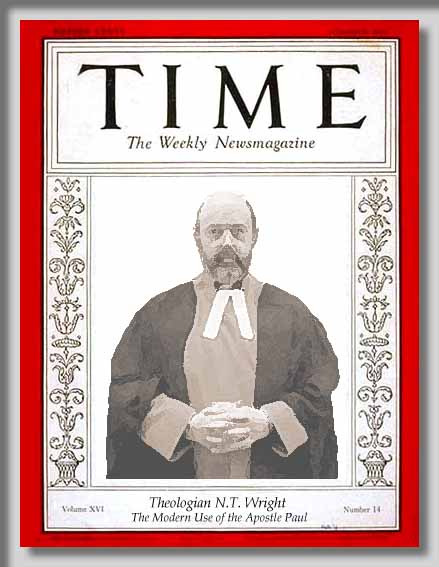
NT Wright on Time

Yes, This is Fake

I find the reactions to Sanders, Dunn and Wright somewhat bewildering, mostly because I do not work within a context of a Protestant Reformed denomination. I have always resonated with a more Calvinist view of salvation, but I am not bound by a commitment to a confession nor do I have a strong affinity for Luther and the reformation, although that is probably because my tradition moved beyond the reformation in Eschatology and Ecclesiology. I agree with Wright that there is nothing wrong with “reforming the Reformation,” Calvin and Luther would want the discussion of Pauline theology to continue and make use of all of the evidence available today.

Because this is an important issue, I am going to devote five or six postings to the New Perspective in anticipation of my Pauline Theology and Literature class I will be teaching this fall. Here is my plan for this series, although I might add one or two more topics before I am finished. Feel free to suggest a potential topic for the series.

I will admit that this is a brief overview. Each of the topics ought to be a chapter of a book (they probably will be, eventually!) I am confessing up front that this series is woefully inadequate for a full understanding of the topics. For this reason I will provide a list of other resources for each post “for further study.” My goal is to provide a brief orientation to the New Perspective on Paul so that a student may read other works on the New Perspective with some context.