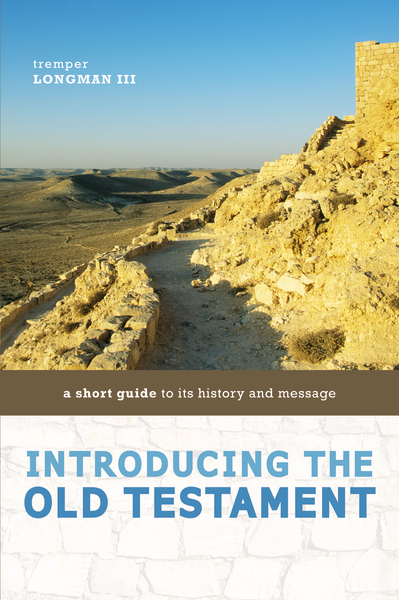
Book Review: Tremper Longman, Introducing the Old Testament.

Tremper Longman, III. Introducing the Old Testament. Grand Rapids, Mich.: Zondervan, 2012. 192 pages, pb. $14.95.

This book is a handy guide to the books of the Old Testament, ideal for students or laymen who want to get an brief overview of the Hebrew Bible. It is an unfortunate fact that the Old Testament is ignored in contemporary preaching and that most laymen have very little idea what is in the first two-thirds of their Bible.  This little book will help fill this gap in Christian discipleship.

For each book of the Old Testament, Longman provides a summery of the contents of the book. This is usually the longest section of the chapter, moving quickly through the book. Remarkably, there is no separate outline, something which is expected in this kind of primer.

After the laying out the contents of the book, Longman briefly treats authorship and date. Authorship is not much of an issue for many books of the Old Testament. Isaiah and Jeremiah have longer sections than Joshua. After authorship, there is a section entitled “genre,” although sometimes this goes beyond identifying the genre of a book. For example, Longman deals with minimalist / maximalist views of Israel’s conquest in Joshua. Other times the genre section is only a short paragraph.

Following genre, every book has a unit entitled “Connections: How does this book anticipate the Gospel” In this section Longman ties the content of the book the New Testament story of Jesus. These are not fanciful or strained, but (in my view) represent real connections. When I noticed that these connections were in every chapter, I immediately went to Song of Solomon as a litmus test of how fanciful Longman’s connections to the Gospel might be. Longman is clear that the Song of Solomon is about human love, and he refuses to allegorize the book. He merely states only that Paul used a marriage metaphor in Eph 5:21-33, so this book could “inspire us to think about the intimacy we enjoy in Jesus.”

There are occasional excursuses, one on the purpose of Kings (p. 66-68) and another on “theological history” (p. 84-85). The genre of the Psalms section is a nice introduction to forms of Hebrew poetry.

These introductions are a little more than one expects to read in a good Study Bible (the ESV Study Bible, for example). Personally, I find the introductions too short, but that is because I would rather read Longman’s Introduction to the Old Testament. I suspect for many people this book will be a handy introduction to books of the Bible which are less familiar.
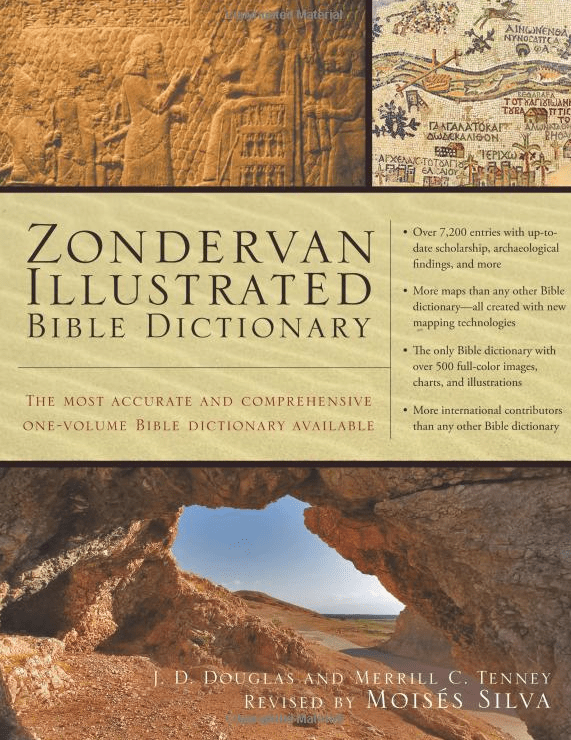
Book Giveaway Winner!- Zondervan Illustrated Bible Dictionary

The third book giveaway in May is a brand new copy of the Zondervan Illustrated Bible Dictionary by J. D. Douglas and Merrill C. Tenney, ed. Moises Silva (Grand Rapids, Mich.: Zondervan, 2011). Using a highly scientific method involving random.org, the winner is:

geobme

Congrats Geobme, I need you to contact me with your shipping information and I will get the book out to you ASAP.  (for email, I am Plong42 at gmail dot com).  On the topic of contact info, last week’s winner LLM needs to contact me with your shipping address. I poked around your blog a bit looking for it, but did not see it.

Stay tuned for another give-away.

I reviewed the Zondervan Illustrated Bible Dictionary about a year ago, check out this link for the full review.

Book Giveaway – Zondervan Illustrated Bible Dictionary

I have finished by May-Term class and now can devote my attention to other important things, such as grading papers from that May-Term class and giving away a few more books on this blog.

To celebrate the middle of the month of May, I am giving away a brand new copy of the Zondervan Illustrated Bible Dictionary by J. D. Douglas and Merrill C. Tenney, ed. Moises Silva (Grand Rapids, Mich.: Zondervan, 2011.  I reviewed the book a year ago, check out this link for the full review. This new release from Zondervan is more than a re-packaging of the venerable Zondervan Pictorial Bible Dictionary (Merrill, 1963) or the New International Bible Dictionary (Douglas, 1999).

The dictionary contains  more than 7,200 entries covering historical and geographical topics, but also general theological issues as well (Jesus, Sin, Bible translation, etc.)  At 1571 pages, this is a significant tool which will meet the needs of most laymen and most pastors.  While it is impossible to call a book this size “handy,” it will likely be the first book off the shelf for most pastors and lay-teachers.

To have a chance at winning this book, leave a comment mentioning your favorite Bible Dictionary of All Time, or at least your name.  I suppose some other snarky comment will do as well.  I will announce the winner picked at random on May 23, one week from today.

Zondervan Titles for Logos

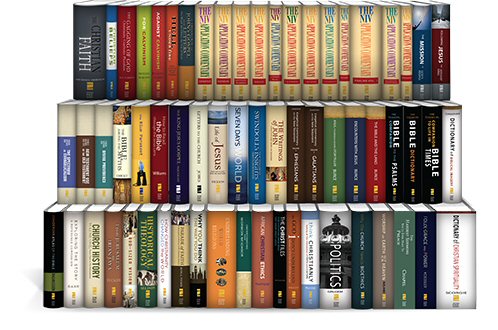
Logos Bible Software announced today they are adding 63 new titles published by Zondervan to the Logos Library.  This includes two volumes of the new Zondervan Exegetical Commentary series, Ephesians by Clint Arnold and Galatians by Thomas Schriener.   Several commonly used textbooks are in this collection including Karen Jobe’s Letters to the Church (Hebrews-Jude), Kosetnberger’s Theology of John’s Gospel, and Marvin Pate’s Writings of John and the Apocalypse. The NIV Application Commentary for the Old Testament is part of this new set of titles, Logos has offered the New Testament series for some time.

I am using Jobes’ Letters to the Church for a class at the moment and three of my students are using the Kindle version.  A major frustration for me is how a student cites a Kindle book since there are no page numbers.  If the book were read in the Logos format, this is not a problem since Logos includes proper page numbers and footnotes.  Perhaps a more difficult problem for Logos to overcome is cost.  The “list price” for Letters to the Church is $44.99, Amazon will sell it for $29.24 new, or $17.99 on Kindle. I am not sure what the Logos final price will be for the book, but it will be hard to beat the Kindle price, even with the generous Logos student discounts.

You can pre-order all 63 for $899.95, which is not quite a 50% discount. There are several smaller bundles available for pre-order at a significant discount.  Some of the collections are odd (McKnight’s Gospel of King Jesus and the Blue Parakeet are in a biblical studies bunlde with Pate and Jobes, although I would not considered these particular McKnight titles “biblical studies.” Kosetenberger  ended up in the Theology Bundle with Michael Horton and Wayne Grudem, probably because the title had “theology” in it.

The addition of a significant number of Zondervan titles is good news for Logos and for those who use an iPad or Andriod tablet for reading.

Zondervan Illustrated Bible Dictionary – Book Review

Zondervan Illustrated Bible Dictionary.  J. D. Douglas, Merrill C. Tenney, ed. Moises Silva (Grand Rapids, Mich.: Zondervan, 2011).  $29.95, hardback; 1517 pages.

This new release from Zondervan is more than a re-packaging of the venerable Zondervan Pictorial Bible Dictionary (Merrill, 1963) or the New International Bible Dictionary (Douglas, 1999).  Nor is this merely a stripped down version of the recent five-volume revision of the Zondervan Encyclopedia of the Bible (ZEB).  This Dictionary gives a brief gloss for many items that the larger Encyclopedia provides support and additional documentation. This Dictionary is not a replacement for a multi-volume work like the Anchor Bible Dictionary or the ZEB. There may be places where the brevity of the work is frustrating, but that is the nature of a single-volume dictionary.  This work has enough definition to help a Bible reader understand historical, geographical and cultural elements in the text as they read.

The introduction indicates that 1,800 new articles have been added.  There are now more than 7,200 entries covering historical and geographical topics, but also general theological issues as well (Jesus, Sin, Bible translation, etc.)  A handy feature for the non-professional is the inclusion of Goodrich-Kohlenberger numbers for all Greek and Hebrew words.  This allows someone without biblical languages to use other Zondervan resources to do further study.  For example, in the article on loving-kindness (p. 862),  hesed appears in transliteration and the GK number (H2876) can be used to look hesed up in the New International Dictionary of Old Testament Theology and Exegesis.

One of the first things I noticed is that the articles are all unsigned.  The introduction explains that this is a result of the blending of two dictionaries into one, then an extensive editing of all the articles.  Rather than engage in Source and Redaction Criticism to determine who wrote what, the names of the authors have been omitted.  I would have preferred to see signed articles (even if that means two authors), but I understand the rationale for deleting the names of authors.

Most of the 500 full-color photographs are provide by James C. Martin, author of the Visual Guide to Bible Events.  They are well-produced and relate well to the text of the Dictionary. I also like the fact that the photographs are not over-used, rarely do two pages in a row have photographs and they never are larger than a half-page, most are far smaller than a half-page.  There are only a few charts, including overviews of biblical books (author, historical setting, purpose and contents) and a few Old Testament or New Testament chronological charts.  The 75 full-color maps are from the Zondervan Atlas, although they are rarely larger than a quarter page in size.  The book-blurb on Amazon indicates that there is a Scripture index included, but in fact it is not included.  I am not sure how useful a Scripture index is for a dictionary and it would have increased the length of the book considerably.  Since this is a Zondervan product, all scripture is NIV or TNIV, although the spellings of common names are retained from the KJV.

The book is printed on thin, non-glossy paper.  I appreciate this since many of the recent Zondervan reference books (like the ZEB) have been printed on glossy paper.  This is better for reproducing photography, but I find the pages glare and I am not as happy marking notes on the glossy paper.  I will also point out that this book does not have a dust jacket, rather the boards are illustrated as a dust jacket might have been.  This is the trend for many recent hard back books and is probably motivated by marketing concerns, but that does not mean I have to like it.

At 1571 pages, this is a significant tool which will meet the needs of most laymen and most pastors.  It is an attractive and well-designed book and a worthy successor to the one-volume dictionaries edited by Douglas and Tenney.  With a street price of about $20, the book is also a great value.  A Kindle version is available for $16.99.  While it is impossible to call a book this size “handy,” it will likely be the first book off the shelf for most pastors and lay-teachers.