Here is a great “community price” deal from Logos, thirty “classic” books on Parables (and miracles, a few on the Sermon on the Mount), currently priced at $30. My experience is that these things usually do go for the suggested price, making the cost a dollar a book. A few of these might be overpriced at $1, but the volume by H. B. Swete is good (a series of lectures at University of Cambridge in 1908). I would like to at least read Siegfried Goebel (1883, T&T Clark, 480 pages). The two books by William Arnot are both substantial volumespublished in 1893. A. C. Gaebelein is an early dispensationalist and the book is really a booklet / pamphlet. At the very least he represents a form of dispensationalism that is all but dead almost 100 years later. I do not recognize many of the names, for $1 a book I will at least look them over.
All thirty are out of print and (likely) all available through Google books, but the Logos format is worth paying for (searching, indexing, etc.) My guess is that a few are egregious allegorizors, A. B. Bruce for example “builds on the foundation of Trench.” But I bought the set for Swete and Goebel alone, and I enjoy comparing approaches on Parables – these thirty are not in my library and I will enjoy reading them in the Logos format.
When Logos gets enough “bidders” they will produce the books, there is no charge until they ship the books via download. Check out the list of books, and bid what you want.
This parable is an interesting example for parable study since it is often dismissed as a creation of the later church to explain the long-delay of the return of the Lord. The parable is an allegory created by Matthew to explain why Jesus did not return as quickly as anticipated. For example, Eta Linnemann said that this parable “is certainly a creation of the early Church. A Christian prophet or teacher unknown to us uttered it in the name and spirit of Jesus.” (Parables, 126).
I suggest this parable should be read in the context of the other parables in Matthew 24-25, as well as the whole of Jesus’ teaching in the Temple his final week. The parable was intended to use common typology for Israel’s relationship with God found in the Hebrew Bible. For example, the relationship of God and Israel is pictured in the Old Testament as a marital relationship (Isa 54:4-6, 62:4-5, Ezek 16, Hosea).
If we follow Blomberg’s method for interpreting parables, then the bridegroom is the central character, the two sets of bridesmaids are the contrasting characters. This would imply strongly that the bridegroom is God / Jesus, since in most of these sorts of parables God is in that central position. The ten virgins or bridesmaids would then refer to the followers of Jesus who are waiting for his return. Five are prepared for a long interim, the other five are not.
But other elements are not intended to be typological at all. For example, the oil is sometimes equated to good works, or the merchants with the Church. (If you want to be ready for the return of Jesus, go and do good works in the Church?) This is very “preachable,” but I am not at all convinced that was Jesus’ original point.
What makes the bridesmaids “wise” or “foolish”? It cannot be that they fell asleep since both the wise and foolish get drowsy and fall asleep. The delay was so long that normal life had to go on. The issue is that the foolish five are unprepared for the long wait. The type of lamp they used would need to be refueled when the groom arrived. By preparing themselves, the five wise bridesmaids are allowed to join the groom and enter into the wedding feast.
But what about the unprepared virgins? Why are they judged harshly? The shutting of the door is an indication of final judgement: there is no longer any way for them to get into the kingdom, they have missed out. The groom’s response to their please is that he does not know them.
The groom’s response is exactly what Jesus said in Matthew 7:23 and is a rabbinical formula used to dismiss a student. The implication is that they had the same opportunity to be ready, and that since they were not ready at the right time, they will have no part in the kingdom. They remain outside, in the dark. The fact is, they were always in the dark and only thought that they would enter into the Wedding Feast.
This is yet another example in Jesus’ teaching of a shocking reversal. Those who think that they ought to be in the kingdom do not get in, they remain on the outside. I think that the context supports this reading – what else do you seen in Jesus’ final week that supports this conclusion? Who should we identify as the “wise” and “foolish” in the immediate context of the parable?
In a previous post, I tracked the shift in Parables studies away from the allegorical methods of the medieval church to the “one point per parable” method of Adolf Jülicher. In the next several posts I want to talk about a few other scholars who developed Jülicher’s ideas in the twentieth century (Dodd and Jeremias) and a short note on the rise of literary studies of parables beginning in the 1960’s, using Robert Funk and John Dominic Crossan as examples. In the last few installments of this series I want to cover several studies on the parables published since 1990 which treat the parables as coming from the teaching of historical Jesus, yet also allow for some insight on a literary level, such as Craig Blomberg, Kenneth Bailey and now Klyne Snodgrass.
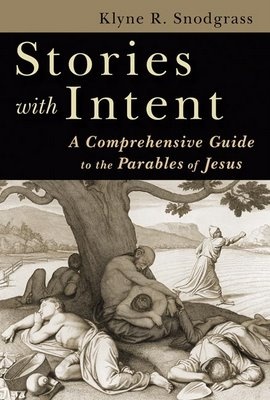
The subtitle of Klyne Snodgrass’s Stories with Intent is “A Comprehensive Guide to the Parables of Jesus.” This is certainly the case! At over 800 pages, this book is the largest book on parables produced in many years (pages 570-770 are endnotes and the bibliography runs to 45 pages!) Snodgrass has written several important articles on parables and his The Parable of the Wicked Tenants is a detailed study of this important parable. (Originally published in the WUNT/2 series, I noticed that Wipf & Stock have an inexpensive reprint of the book.)
Snodgrass provides about sixty pages introducing the usual topics expected in an introduction to the parables. As he states in the introduction, he is not offering a new method for interpreting the parables (31). What sets Snodgrass apart is his assumption that the parables are the authentic voice of Jesus and he rarely discusses matters of authenticity.
He is also skeptical of attempts to reconstruct earlier, simpler versions of the parables because this assumes that there was an original form which differs from the form as it appears in the gospels. In addition, reconstructions also assume that anything allegorical was added to that original form by the later church, created to deal with internal problems in the Gospel writer’s church situation. Frequently the context of the sermon is dismissed a priori as a creation of the evangelist, as are the concluding lines which interpret the parable. These assumptions, Snodgrass argues, do withstand criticism. There are no fixed laws of transmission as was once assumed, and the now standard rejection of allegory by modern interpreters simply does not take into context the of Second Temple Period literature (where allegorical elements were often included in parables).
Snodgrass therefore studies “each parable in its own right with regard to form and content” (35). His goal is to set aside tedious arguments about sources and original forms and read the parable as we have it on the page as accurately as possible. In order to do this, he provides a 22 page introduction to what a parable was in Second Temple Period Judaism and in the Greco-Roman world. Jesus’ parables stand more in the tradition of the rabbinic parables, but there are clear differences as well.
In the body of the book, Snodgrass arranges the parables are into topics (parables about prayer, about Israel, about the kingdom, etc. ) For each parable he provides a section entitled “Issues Requiring Attention.” This is a list of exegetical and theological issues that any interpreter must treat when reading this particular parable. For a pastor preparing a sermon, this section clarifies the main ideas which are important; for the student, here is an outline of issues for a paper! Following this section he lists all of the potential “source material.” This includes Second Temple Period literature, rabbinic parallels and Greco-Roman sources. This is a goldmine of material, often the important lines are reproduced, sometimes they are simply summarized.
Following this background material are “Textual Features Worthy of Attention” (key words to study, interesting syntax, etc) and “Cultural Features” (elements of background to study). Once again, this provides the interpreter with a number of tips on what is important in the parable (and perhaps by their commission, what is not so important).
The main section for each parable is the “Explanation of the Parable.” This takes the form of a number of questions and answers working through the main points of the parable. In this section he interacts with the Greek New Testament (in transliteration) as well as with key modern interpreters of the text. While he does draw on the literature of the Second Temple Period, he ignores (for the most part) church interpretation. His focus is purely canonical, not historical. He provides a bibliography for each parable, including both better commentary sections and journal articles. Occasionally German and French resources are included, but the emphasis is purely on English scholarship.
In the final section, Snodgrass offers some hints on how to “Adapt the Parable” for use in a sermon or Bible study. Here one hears Snodgrass’s pastoral heart – this material on the parables is not to be purely academic without any application!
Stories with Intent has become my “first off the shelf” for parables, although some readers may be lost in all of the details. I cannot imagine trying to teach or preach the parables of Jesus without consulting this book. The most helpful element in the book is Snodgrass’s questions, leading the reader in the right direction, without answering all the exegetical questions possible. Again, that might frustrate some readers who do not have the time or inclination to dig into these things themselves.
With respect to method, I find Snodgrass’s rejection of form-critical assumptions helpful. While Dodd and Jeremias remain bright lights, Snodgrass calls into question whether they really illuminate the text as we have it. In addition, while Snodgrass occasionally cites some of the literary studies (Funk, Crossan, Via), he does nothing that looks at all like the postmodern studies popular in the late 1960s.
Is his skepticism of the assumptions of earlier studies valid? Does his method actually “work” for reading the parables accurately?
Bibliography: Klyne Snodgrass, Stories with Intent. Grand Rapids, Mich.: Eerdmans, 2008.
In a previous post, I tracked the shift in Parables studies away from the allegorical methods of the medieval church to the “one point per parable” method of Adolf Jülicher. In the next several posts I want to talk about a few other scholars who developed Jülicher’s ideas in the twentieth century (Dodd and Jeremias) and a short note on the rise of literary studies of parables beginning in the 1960’s, using Robert Funk and John Dominic Crossan as examples. In the last few installments of this series I want to cover several studies on the parables published since 1990 which treat the parables as coming from the teaching of historical Jesus, yet also allow for some insight on a literary level, such as Craig Blomberg and now Kenneth Bailey.
Kenneth Bailey approaches parables as fair representations of the culture of the Mediterranean world of the first century. Bailey’s method is unique because he reads the parables through the eyes of modern Middle Eastern readers with whom he has lived for many years. Bailey thinks the culture of the Mediterranean world has not changed that much since the first century and many of the unusual elements of the parables can be explained by paying attention to the eastern culture from which the stories first arose. This “oriental exegesis” attempts to read the parables as Oriental churchman have throughout the centuries (Poet and Peasant, 29). In order to do this, one first must know the ancient literature and be able to assess it properly.
The most controversial point of Bailey’s method is his insistence that the culture of present Middle Eastern culture is archaic and accurately reflects the culture of the parables. Life changes slowly in the Middle East and it is intentionally traditional. Therefore some cultural phenomenon observed today may in fact go back to the first century.
This observation is not new, although the sorts of memoirs which were published in the late nineteenth century as travelers began to visit the Middle East are of varying value. What Bailey seeks to contribute is a method and control for the study of present culture as a window for understanding the first century. Books are of less value to Bailey than personal interviews with people who have spent at least twenty years in the Middle East collecting observations orally, in Arabic. Bailey has found 25 dialogue partners who satisfy this requirement and are also biblically literate enough to understand the point of the questions he put to them concerning the parables.
A second methodological consideration is what Bailey calls “theological clusters.” Bailey believes that Jülicher’s belief about the relationship between allegory and parable has been proven false, although the idea that a parable makes a single point persists. Bailey argues that parables are intended to evoke a decision, but the response to a parable is informed by a “theological cluster,” each element of which may be examined separately (Poet and Peasant, 41). It is the point at which all of the theological themes come together that a single response is evoked. A single response is different than a single meaning, the meaning may vary from listener to listener, but there is still only one response.
Bailey illustrates this with the Parable of the Sower. The response is “hear the word of the kingdom and bear fruit.” But there are at least four theological points made by the parable which contribute to this response: The kingdom is like a seed growing slowly; God’s grace includes sowing the seed where the ground is unprepared; fruit bearing is an essential part of the kingdom; there is the hope and assurance of a harvest in spite of difficulties. All of these theological motifs (and perhaps others) converge to illicit the response to the parable intended by Jesus.
Bailey has been rightly critiqued because he draws very little from rabbinic parallels. Bailey brackets this evidence since it is extremely hard to date evidence from post-Mishnah Judaism, but relies on evidence from modern Mediterranean culture. If the general lines of the culture have survived since the first century in practice, then those cultural elements one finds in the literature like the Talmud may very well be an accurate reflection of first century culture.
Charles Hedrick offers a number of criticisms of Bailey’s methodology which ultimately question the value of the study (Hedrick, Parables as Poetic Fiction, 45-46). Hedrick’s most important criticism is the chronological distance of Bailey’s sources. Is it reasonable to think that the Mediterranean culture Bailey experienced in the twentieth century is an accurate representation of the culture of the first century?
In addition, Hedrick points out that Bailey ignores the Islamization of Palestine. For the last 1400 years Islam has ruled Palestine in some way, but when Jesus lived in Israel it was ruled by the Romans through a Jewish bureaucracy. It is a stretch of the imagination to think that Islamic bedouin of the modern era have the same sorts of practices that the Jewish peasants of Galilee did. Yet anyone who has spent any amount of time in the Middle East knows that bedouin culture is extremely conservative and has only recently has tradition been eroded by the modern world (cell phones and blue jeans, mostly!)
Despite these criticisms, I find Bailey’s books stimulating and insightful. He has a slightly different perspective that most writers on parables and in almost every case I find his comments helpful for teaching and preaching the parables.
Are the criticism of Bailey’s method fair? If there is a problem, perhaps what seems very “preachable” is not accurate – but is the use of contemporary cultural observations valid?
Bibliography:
Poet & Peasant; and, through Peasant Eyes: A Literary-Cultural Approach to the Parables in Luke. Combined ed. Grand Rapids, Mich.: Eerdmans, 1983.
Jacob & the Prodigal: How Jesus Retold Israel’s Story. Downers Grove, Ill.: InterVarstiy, 2005.
The Cross & the Prodigal: Luke 15 Through the Eyes of Middle Eastern Peasants. Downers Grove, Ill.: InterVarstiy, 2005.
Jesus Through Middle Eastern Eyes: Cultural Studies in the Gospels. Downers Grove, Ill.: InterVarstiy, 2008.
In a previous post, I tracked the shift in Parables studies away from the allegorical methods of the medieval church to the “one point per parable” method of Adolf Jülicher. In the next several posts I want to talk about a few other scholars who developed Jülicher’s ideas in the twentieth century (Dodd and Jeremias) and a short note on the rise of literary studies of parables beginning in the 1960’s, using Robert Funk and John Dominic Crossan as examples. Since 1990 there has been a wave of commentaries on the parables from writers who take the parables as historical, coming from the teaching of historical Jesus, yet also allow for some insight on a literary level. I start with Craig Blomberg simply because I find his approach to parables extremely helpful. In addition, his book Interpreting the Parables had remained in print for more than 20 years and was just published in a Second Edition from InterVarsity Press.
Craig Blomberg has developed the interpretation of parables which is an evangelical return to the allegorical method, albeit with clear limits. The parables were intended to have some level of allegory by Jesus himself. This allegory is along the lines of that found in the rabbinic parallels to the parables. By way of method, Blomberg argues the interpreter should only attempt to find a “point” for each character of the parable, normally three characters, sometimes two with an implied third. This point or lesson is stated in propositional language and is understood to be the intention of Jesus when he original gave the parable.
Blomberg is not advocating the kind of polyvalence represented by Crossan but he does seem to open the way for a metaphor to function as a more or less fluid literary device. The meaning of the metaphor is, however, to be found within the text and is a part of authorial intent rather than an open-ended reader-response hermeneutic. In a very real way, Blomberg is advocating limited multiple meanings, specifically only those meanings which were intended by Jesus in the first telling of the parable in a real historical context.
The Prodigal Son an excellent paradigm or prototype of the most common pattern of three point parables (the so-called monarchic pattern). The title of the parable is misleading since if places the focus on the son that leaves. The parable might very well have been titled “The Forgiving Father” or “The Hardhearted Brother” based on the characters in the story. If a parable can only make one point, then the parable of the Prodigal son must be interpreted in such a fashion so as to downplay two of the three major characters. Is the story about repentance? Is the story about forgiveness? Is the story about acceptance? It appears that all three of these themes are present. The interpreter following Jülicher would seek to formulate a single theme that somehow was broad enough to cover all three of the themes above. Blomberg argues that this will water down the message, making it so general that it is of very little value. By allowing one application for each main character the interpreter is free to work all three themes.
Blomberg is not adverse to allegory. For example, in reading the Parable of the Ten Bridesmaids he struggles to determine which elements should be allegorized and which not. Since the bridegroom is a common Old Testament symbol for God, and the preparation for the banquet may be seen as allegorical since it is highly unusual for the women to be unprepared given the tendency for the wedding party to be late. It may be also possible to see the wedding banquet as a reference to the kingdom since this is a metaphor used in Jesus teaching elsewhere, and the parable seems to make the shutting out of the banquet parallel to Jesus’ shutting out of the hypocrite from the kingdom in Matthew 7:21. Blomberg calls the oil an“allegorical waver,” or more specifically the attempt of the unprepared virgins to borrow some oil from the prepared virgins. Blomberg states that the importance of this feature may or may not have some significance.
Blomberg represents an evangelical response to the literary studies of Funk and Crossan in that he treats the parables as capable of more than one meaning. He establishes controls for what elements of a parable may be used for application and which should not be “allegorized” in order to refrain from the wild interpretations of church history or more radical literary readings. By limiting his “points” to one per character, Blomberg methodologically limits himself when approaching other elements of a story.
Does Blomberg’s method allow for multiple interpretations and authorial intent? How is this “one point per character” a helpful control on allegory?
Bibliography: Craig Blomberg, Interpreting the Parables. Downers Grove: Inter-Varsity Press, 1990; second edition, 2012.
 Here is a great “community price” deal from Logos, thirty “classic” books on Parables (and miracles, a few on the Sermon on the Mount), currently priced at $30. My experience is that these things usually do go for the suggested price, making the cost a dollar a book. A few of these might be overpriced at $1, but the volume by H. B. Swete is good (a series of lectures at University of Cambridge in 1908). I would like to at least read Siegfried Goebel (1883, T&T Clark, 480 pages). The two books by William Arnot are both substantial volumespublished in 1893. A. C. Gaebelein is an early dispensationalist and the book is really a booklet / pamphlet. At the very least he represents a form of dispensationalism that is all but dead almost 100 years later. I do not recognize many of the names, for $1 a book I will at least look them over.