Book Review: New Documents Illustrating Early Christianity Volume 10 (Part 1)

S. R. Llewelyn and J. R. Harrison, with E. J. Bridge, ed. New Documents Illustrating Early Christianity Volume 10. Grand Rapids, Mich.: Eerdmans, 2013, 269 pp., paperback, $40.00.  Link

After a more than ten year wait, a new volume of the New Documents series has finally been released. New Documents Volume 9 came out in 2002, covering Greek inscriptions of interest to Early Christianity published in 1986-87; this new volume covers 1988 through 1992. To give you some perspective on how important this series is, I did a search in A Greek-English Lexicon of the New Testament (BDAG), the current edition of the standard lexicon for New Testament Studies in English. There were 354 hits in 323 articles in the lexicon. BDAG only included material through volume 8 of the New Documents series. The New Documents series provides a database on which future lexical studies will rely.

Because this is such an important book, my review is quite long.  I have therefore decided to break it into two parts, the second appears here.
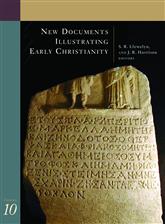
NewDocs 10For those unaware of the New Documents series, it began under the editorship of G. H. R. Horsley in 1981. E. A. Judge was a contributor to that first volume and now serves as the director of the project. He wrote the preface to the first volume explaining the rationale for the series. Since the publication of Deissmann’s Light from the Ancient Near East (1908) and Moulton and Milligan’s Vocabulary of the Greek New Testament illustrated by the Papyri (1930), there has been a flood of new published papyri documents and inscriptions, many which are important to historians of early Christianity as well as interpreters of the New Testament. The New Document series proposed to survey newly published material and collate that material into a single printed volume as a “fresh digest of the ancient evidence.”

That first volume covered documents published in 1976.  After more than thirty years, the series now has ten volumes which cover published material through 1992.  The tenth volume covers more years than the last and contains about 50 pages more in the main section than volume nine.  In addition, Volume ten contains six cumulative indices for volumes 6-10, including subjects, words (sub-divided into Greek, Latin, Hebrew and Aramaic), ancient authors, inscriptions, papyri, and biblical works (sub-divided into Hebrew Bible, Apocrypha, Pseudepigrapha, Qumran, Rabbinic literature, and the New Testament).  My suggestion to E. A. Judge and the New Documents project is to merge the index for the first five volumes with this index and move the whole thing online. That would allow scholars to search the whole series from a single index, and the index could be edited and expanded.  In addition, moving the indices online would save nearly 100 pages in this volume which could be used for additional articles!

Each volume is sub-divided into sections, although the sections are unique to each installment.  For example, volume nine had two long sections for inscriptions and papyri; volume ten divides the material topically. Each entry begins with an entry number and a title for the article.  The entry begins with a physical description of the item including location, media (papyri, inscription, etc.) and suggested date. A transcription of the text is printed with the translation in a parallel column. The author of the article then provides a running commentary on the item, intentionally drawing out implications for the study of the New Testament or Early Christianity (the stated goals of the series).

In the first section of Volume 10, E. A. Judge contributes two articles on Philosophy. The second describes an inscription on a marble block from Philadelphia (Lydia) from the early first century.  The inscription celebrates a person who has become wise, but more interesting is the arrangement of the site where the inscription was found.  There is a narrow, straight path between illustrations to the left of ἀσωτία, distractions to wisdom (Luke 15:13,the prodigal son, Eph 5:18, Titus 1:6, 1 Peter 4:4), and illustrations to the right of ἀρετή, excellence of character (Phil 4:8). This illustrates the “two ways” found in a number of philosophical and biblical texts.  Judge suggests that the arrangement of the site illustrates Jesus’ metaphor of ethical life as the “narrow way” (Matt 7:13-14).

There are three articles on magic, including an interesting note on “overcoming the strong man” by J. R. Harrison. This article describes an inscription on a cameo dated A. D. 25-50 calling on Iao and Adonai (Greek transliteration of names for the God of the Hebrew Bible) to protect the wearer, one Vibia Paulina. All of the names on this early first century amulet are found in later magical texts, indicating that these sorts of “power words” were used to ward off evil.  This illustrates the use of “Jesus whom Paul preaches” in Acts 19, but also the words of the demon in Mark 1:24. In that text the demon indicates that he has knowledge of Jesus’ real name, the “Holy One of God.” The amulet uses the phrase “holy name” as one of the powerful names invoked to protect the wearer. Harrison points out a close parallel: “I know you Hermes, who you are and where you come from and what your city is, Hermopolis” (PGM VIII 13).

Conclusion (Part 1). Even though I plan to continue this overview of the book tomorrow, let me conclude this first section by saying that virtually every section of New Documents Volume 10 is worthy of attention.  The entries make for fascinating reading and they all contribute to our understanding of the world of the New Testament and early Christianity. I highly recommend this volume to students and scholars. Every serious library should own all ten volumes of this important series.

Book Review: Douglas S. Huffman, The Handy Guide to New Testament Greek

Huffman, Douglas S. The Handy Guide to New Testament Greek. Grand Rapids, Mich.: Kregel, 2012, xvi + 112 pp., $16.99, paperback.  (Link to Kregel)

Douglas Huffman introduces his book as a “ready reference” for those who have finished their first year of Greek. This includes second year Greek students, but also pastors and teachers who are in need of a quick reference for reading the Greek New Testament.

Handy Guide to New Testament GreekThe book is divided into three parts. The first part (about half the book) summarizes the grammar of the Greek New Testament. This includes the sorts of things covered in a first year Greek class. He includes noun and verb charts, but also useful charts for on other elements of grammar. The section concludes with a chart of the principle parts for the most common irregular verbs. While most Greek students are required to memorize these unusual forms, the chart is a helpful reminder since principle parts are among the first things forgotten by first year Greek students!

In the second part of the Handy Guide Huffman summarizes syntactical categories, typically covered in a second year Greek Course. He treats nouns by listing various nuances of the cases, listing them, providing a brief definition, and a single biblical example. For students wading through Dan Wallace’s Greek Grammar Beyond the Basics, these single page summaries are very helpful. While Huffman does not use exact lists from Wallace or any other New Testament Grammar, he does include the major categories and the terminology is close enough that students should be able to use the Handy Guide to quickly find the most likely syntactical description before turning to the more complete, advanced grammars. I would love to see a guide book like this include page numbers to Wallace, BDF, or other intermediate grammars. However, this probably would move the book beyond the “handy guide” status. This section has brief summaries of conditional sentences and a nice section on identifying participles. Huffman has a “participle identification chart”(page 80), although it seems a bit complicated to me. (To be honest, I do not think I have seen anyone come up with a flowchart that makes identifying participles any easier.)

The third part of the Handy Guide is perhaps the most useful to my students, although the section is a mere 23 pages. Huffman offers a simple overview of how to do sentence diagrams, including technical, phrase, semantic, and “arcing” diagrams. He steps through the basics of phrasing in two pages, then provides some examples from the Greek New Testament. His method looks a lot like what Mounce does in his Graded Reader, but I found his brief presentation quite helpful.  I would have liked more in this section, but what Huffman does provide a good introduction / reminder for students.

There is nothing new in this little book, but anyone who have done some Greek work will find it a “handy guide” indeed. The book is convenient and logically arranged. I appreciate both the high quality paper and binding of the book. Since it is the sort of book which will be consulted frequently, the higher quality will not wear out as fast. For example, I have been through three copies of Trenchard’s New Testament Vocabulary now, and my original Old Testament Hebrew vocab lists (published in the 80s) has completely disintegrated. Huffman’s Handy Guide is both useful and built to last.

My first thought when receiving this book was to compare it to William Mounce’s Biblical Greek, A Compact Guide (Zondervan, 2011), which I reviewed when it was released in 2011. Students who used Mounce in their first year may be more attracted to the Compact Guide, and it has a bit more material that Huffman’s Handy Guide, including a short lexicon and more principle parts.

Huffman’s Handy Guide to New Testament Greek delivers exactly what it promises, a handy summary of the things a first year Greek student ought to have learned, but may need a little refreshing.

Thanks to Kregel for providing a copy of this book to review.

Background to the Gospels: Part 2 – Hellenism

A second important element for the background of the Gospels is the pervasiveness influence of Hellenism after Alexander the Great. Hellenism refers to Greek language and culture, and as Mark Strauss comments in Four Portraits, “Alexander’s enduring legacy for New Testament background is his promotion of the process of Hellenization” (96). After Alexander everyone in the Near East were in some respects “hellenized.” They spoke Greek, Greek fashions were dominant, certain features were expected in “Greek cities” (gymnasiums, theaters, etc.)  If a city or region rejected these sorts of things, they were considered backwards.  To be “Greek” was be a citizen of the world.

The struggle against Hellenism is the “plot” of the intertestamental period – how will the Jews react to this new culture imposed by foreign occupiers?  How can one keep “Jewish Traditions” in a world which is increasingly Greek (or later, Roman)? There will be some Jews who are as completely hellenized as possible, yet others will resist and cling to Jewish traditions.  These were factors which led to the Maccabean Revolt in 165 B.C. as well as the Jewish Revolt against Rome in A.D.66.

There are several indications that many Jews accepted Greek culture. Jews with Greek names are common. The most obvious example is that of Onias II and his brother Joshua. This priestly family battled for control of the high priesthood in the years leading up to the Maccabean revolt. Joshua took the Greek name Jason and attempted to re-found Jerusalem as a Greek city, complete with a gymnasium near the temple.

In reaction to growing Hellenism, the Hasidim, or “pious people,” did not want to have anything to do with Greek culture.  They believed that Jewish culture was from God and that anyone that adopted Greek ways was committing idolatry and apostasy. This conservative movement will develop into the “parties” of the New Testament period including the Pharisees, Sadducees and the Essenes.

These problems did not end when Rome absorbed Palestine into the empire. Some Jews had no problem with the Romans. Herod the Great, for example, was more Roman than Jewish. The Sadducees could work with the Romans to maintain power in Jerusalem. The question was not “should we Hellenize,” but “how far can we Hellenize and remain loyal to God?” For example, everyone spoke Greek, if you wanted to communicate to the culture around you (sell your goods, travel, etc), Greek was unavoidable. But is it permissible to study the Hebrew Bible in a Greek translation? There were many Jews who did not speak or read Hebrew, the only way to hear God’s word was through the Greek translation (the Septuagint).

In the background of the whole New Testament is a struggle between conforming to a foreign culture (Greek, Roman) and clinging tenaciously to the boundary markers of Judaism (Sabbath, circumcision, food traditions, monotheism). What I find interesting is that Jesus never rejects these boundary markers and they rarely come up in his teaching. He has some rather pointed criticisms of the Pharisees and their Sabbath and cleanliness traditions, but he does not reject Judaism in favor of Hellenism.

There is the same sort of struggle Christians have in a contemporary setting. We cannot avoid the world; even the Amish interact with non-Amish world! But how far that cultural engagement can go without destroying the core values is always one of the main topics of discussion for the Church. Does the background plot of the New Testament help with this struggle?

Logos 4.3 – Liddell and Scott Upgrade

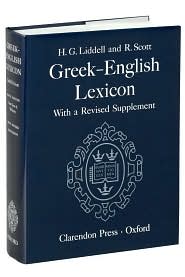
The Logos Library has included Liddell and Scott’s Greek-English Lexicon, Ninth Edition for many years.  L&S is the standard lexicon for Classical and Koine Greek.  It is a massive book (over 2000 larger-format pages with tiny print).  When the Perseus Collection was announced many people observed that the older L&S Lexicon was not included in the collection, likely since Logos sells the full lexicon as a Logos resource.

When I started Logos this morning I noticed that it downloaded an updated version of Liddell and Scott.  It has been upgraded to launch Perseus Collection resources if available.  For example, I selected at random the word ἡμιολιος, which means something like “half as large as.”  It does not appear in the NT so BDAG is not going to have an entry for this word.  If I float over the  Hdt.5.88 in the entry, Logos supplies me the text in a floating window in Herodotus Book 5, paragraph 88.  If I click on the entry, Herodotus launches to 5.88 in English. Several other resources are tagged in the same entry, Xenophon, Anabasis, Plato, Laws and Timaeus, Polybius, Histories,  Arrianus Historicus (Greek only), and a few others.  Diodorus Siculus Historicus is tagged in one case (19.65), but not in another (15.44).  This resource only appears in the Perseus collection in Greek, so Logos naturally goes to the Greek text.  Texts which are not in the Perseus collection are (obviously) not tagged.  Logos will identify the abbreviation for you, but there is no link.

The classical Greek resources in the  Perseus collection now launch Liddell and Scott if it is installed.  As I observed earlier, Greek lexicons are arranged in a pre-determined order.  If a word appears in Bauer, then BDAG/BAGD will launch when you double click on a word.  If it does not appear in Bauer, then Liddell and Scott will launch, or whatever other lexicons you have purchased and installed.  You can re-arrange this order to suit your needs.

Unfortunately, references to papyri are not tagged even if they appear in the Duke Papyri collection. For example, in the entry for ᾰ̓δελφοσύνη, “fraternal,” is a referent to CPR 5.23.5.  CPR refers to the Corpus Papyrorum Raineri, which is part of the Duke Collection.  This is a 23 volume set, although not all the volumes are included in the Logos resources since they are not included in the Perseus collection.  I was able to open CPR, find volume 5, document 23, and line 10 quickly, although Liddell and Scott is not tagged  to launch this resource automatically.  Even without tagging, I cannot stress enough how valuable the Duke Collection is for exegesis.  There is no way I could have checked this resources locally.  The closest University withholding this series is and hour and a half away and has the books on microfiche only.  Individual volumes go for $150 or more on Amazon if they are available at all.  Even though a few volumes are available through Google Books, they are not particularly usable since they are PDF images rather than searchable texts.

The bad news is that the full Liddell and Scott Greek-English Lexicon is expensive.  (But then so is the paper copy!) Logos also sells the Intermediate Liddell and Scott (seventh edition), sometimes known as “Middle Liddell” since there is an even smaller glossary drawn from the larger L&S (“Little Liddell”).  For the most part, the references in the Intermediate L&S are not to specific texts but only to authors (Herodotus, Plato).  The Intermediate lexicon is a part of the Original Languages bundle, unfortunately the full Liddell and Scott is not included in any bundle.

Logos 4.3 and the The Perseus Collection – First Look

About a month ago Logos Bible Software announced the release of the Perseus collection, a massive library of Greek and Latin resources for classical studies along with English translations, lexicons and other secondary resources.  The Perseus collection itself has been around the internet for years, but Logos has taken the individual books are converted the text to their book format.  This means that the text is indexed and searchable in the Logos Library system. More importantly, they have tagged much of the Greek text so that lexical and syntactical information appears in the same way it does for the Greek New Testament or LXX.

Logos graciously allowed me to download four of the collections early so I could “kick the tires” (they really said that) and provide some basic review and comment on the usefulness of the Perseus Collection.  While I have just scratch the surface of this massive collection, I can say with confidence that it is well worth your time and effort to download the books and learn to use these resources as a part of the Logos library.  Since the books are free, there is no financial reason not to get the Collection!  I plan several more installments to this review, including some comments on the usefulness of the Collections for biblical research and the usability of the Collections on an iPad.  I will review the Duke Papyri collection in a separate installment since it merits special attention.

Classics Workspace

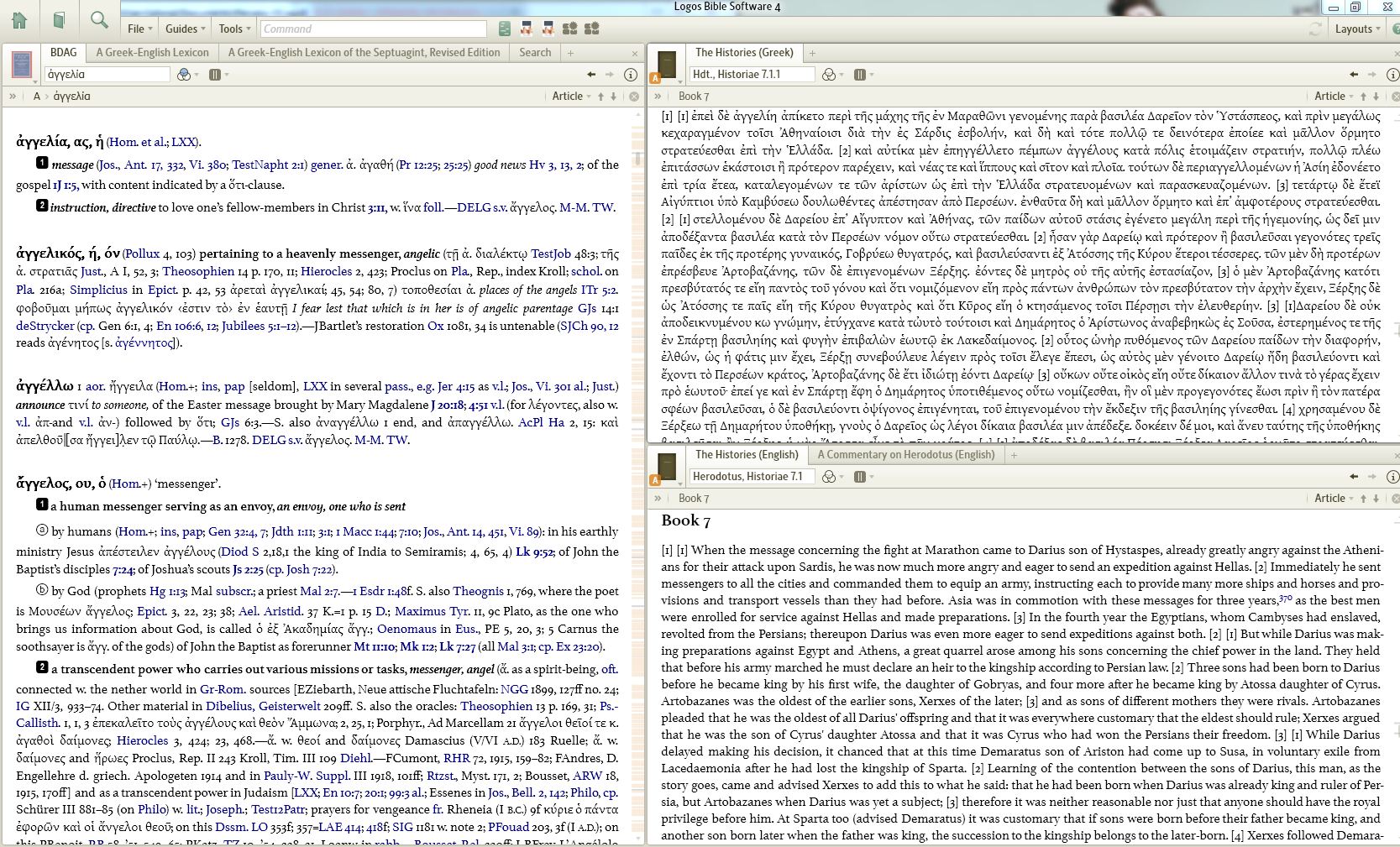
To test the Perseus collection, I created a workspace with lexicons in a left panel and texts in the right panels.  I have the Greek text on top and the English on the bottom.  I have the texts linked so as a move the Greek, the English syncs up automatically.  I recommend you create a workspace for classics study that you like and save it for easy recall.  I chose Herodotus as a test case, with the English translation by A. D. Goodley and Commentary by W. W. How.  I navigated to book seven, section one, Darius’ response to his defeat at Marathon.

The Greek text functions exactly like the Greek New Testament normally does in Logos.  First, hover over a word and the form is identified in a box at the bottom of the Greek window. These identifications will be as accurate as anything else in Logos, I rarely quibble with the parsing provided.  I did notice that the perfect passive participle of χαράσσω which appears in the first line was identified correctly, but the box contained all three possibilities for the case ending (masc acc, neut nom or acc). As a result, the identification runs across the entire screen!

Double click on a word and a lexicon will launch.  I have BDAG set up as the first in my list of lexicons, so if the form appears in BDAG, Logos  will go right to that entry.  If the word is not in BDAG, Logos will proceed to the next lexicon in your preferred lexicon list.  This caught me off-guard at first because χαράσσω is not in BDAG, but it is in LEH, the Septuagint lexicon.  Logos did not look in Liddell and Scott since that is third in my list.  Usually when I work in the New Testament I am more likely to check LXX usage.  For classical work, I recommend changing the order of resources so that BDAG and Liddell and Scott are the top two resources.

Word Study

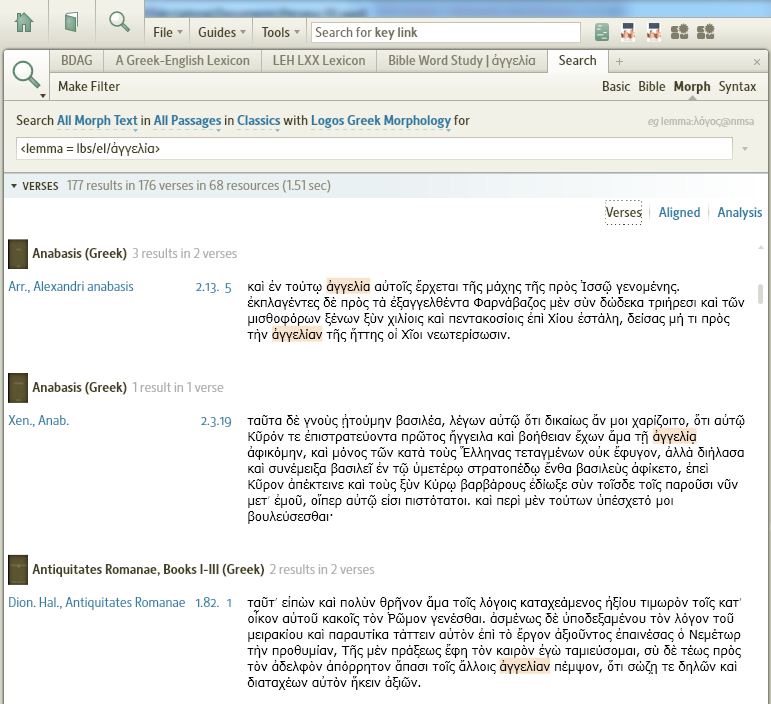
Select a word, right click and then select Bible Word Study.  I chose ἀγγελία for this example, the third word in book 7.  The word only appears twice in the New Testament, both in 1 John.  The Bible Word Study tool only gives details for New Testament usage, but it will provide links to all lexicons in your library (Liddell and Scott, Louw and Nida, but also TDNT, or EDNT).  At the bottom of the page there is a list of uses of the word in other Greek resources you might own:  LXX, the Apostolic Fathers, Pseudepigrapha, Josephus, Philo, and now, Classics. In the case of ἀγγελία, there are 177 other uses of the word in resources labeled Classics. I click on Classics to open the list, and Logos will build a concordance-style list showing the word in context.  These entries are all click-able so I can go to the greater context.

This is impressive, but several observations come to mind.  I would love to have the English and Greek books paired so that they automatically launch together.  Most people who use this library will not read Greek well enough not to need the English to make sense of the context.  It is easy enough to open the library and launch the English translation, but automatic is better.  The opening the list took a bit longer than I would have liked, but that may have had to do with the number of resources I had open at the time. Third, I am not sure this category includes all the texts in the new Perseus collection.  My example search found 177 examples in 68 resources (in 1.51 seconds).  I know that there are more Latin than Greek resources, but it is possible there are a few which are not included in the collection, or that all the resources have yet to be tagged.  I know the Papyri are not tagged.  Still, I have 177 examples of ἀγγελία in classical sources to comb through.

I have barely scratched the surface of this collection, suffice to say that these classical Greek texts work as well as any Greek text in Logos.  If you have not already pre-ordered the Perseus collection, now is the time.

Edit:  Here is Jim West’s review of the Perseus Collection, with quite a few additional screen shots.