I just received the new UBS Greek New Testament, Fifth Edition with the NIV in the mail today from Zondervan. I obviously have not spent much time with the books since it is only just released, but I will offer a few “first impressions.” This is not a Greek Readers Bible or an interlinear, but a full edition of the newest text from the United Bible Society and the latest edition of the NIV (2011). If you like those two editions of the New Testament, you will likely like this new Bible.
First, when the volume was announced my immediate question was about the textual critical apparatus. I was worried these extremely important notes would be sacrificed in order to print two New Testaments in a handy format. Thankfully the notes are all present and in exactly the same format as the other editions of the UBS Greek New Testament. I did not check every page, but every note I checked was present. I would not have recommended the Bible if the textual notes were removed.
Second, the UBS 5 text is placed on one page facing the NIV. Since the UBS text includes textual critical apparatus, the English side has about a third of a page blank (sometimes a half page). This is a good space for note-taking!
Third, I think the physical size and shape of the Bible are an improvement over my UBS 4. The paper is a bright white, by UBS 4 was a kind of cream color. I am not sure which I like better, but the print (both in terms of color and typeface) in this new edition is very readable and clear. The book is the same size as the older Bible although it is 1750 pages (plus another 81 pages in the introduction) compared to the UBS 4’s 918 (plus another 203 for the glossary in the case of my UBS 4).
The Introduction includes prefaces to the first through fourth editions and the introduction to the fifth edition (74 pages) and the Preface to the NIV (7 pages).
One thing I noticed was missing—there was no card with manuscript dates! The information appears in the introduction, but I miss the traditional trifold card tucked into the front of my Bible. The spine of my Bible is off-center, which might be a trigger for some of the more OCD Greek specialists.
Overall I am well-pleased with the new UBS Greek New Testament with the NIV. Those who are do not like the NIV will probably not appreciate this combination appealing, but for many this will be their new Greek Bible of Choice. It will make a good textbook Bible for Greek reading classes, although students should be issued screens to cover the NIV translation for doing their homework.
Comfort, Philip Wesley. A Commentary on the Manuscripts and Text of the New Testament. Grand Rapids, Mich.: Kregel, 2015. 443 pp. Hb. $29.99. Link to Kregel
Philip Comfort is well known for his many publications on New Testament textual criticism and especially for his work with papyri. His latest contribution is a running commentary on the text of the New Testament with a special emphasis on evidence drawn from the papyri. While it is not required that this commentary should be used along with Comfort’s early work The Complete Text of the Earliest New Testament Manuscripts (with David Barrett, Baker, 1999) or his revision and expansion in The Text of the Earliest New Testament Greek Manuscripts (Tyndale, 2001).
This new commentary is similar to Bruce Metzger’s companion volume to the United Bible Society Greek New Testament. Metzger only commented on the variants as they appear in the UBS textual apparatus by giving a brief report of the reasoning behind the committee’s decision. Occasionally there is a dissenting opinion from one of the editors of the UBS. Metzger’s goal is to explain why a particular reading is more likely than another. There are two editions of Metzger’s Textual commentary, the first comments on the variants in the third edition of the UBS Greek New Testament, the second is keyed to the fourth UBS Greek Bible. Since there are many variants no longer listed in the fourth edition, it is necessary to have both volumes available.
Comfort offers a 23-page introduction to the manuscripts of the New Testament. As expected, his main interest is the papyri, especially several examples he considered to represent the original reading of the New Testament. Although he briefly discusses Epp’s canons of internal textual criticism, Comfort gives priority to manuscript evidence (31). In addition to prioritizing the papyri, Comfort is one of the few text critics to give the nomina sacra, abbreviations of sacred words in the manuscripts. Words such as Lord, Jesus, Christ, and God are regular written as a shortened form of the word with a line over the letters to indicate an abbreviation. A significant section of the introductory chapter and an appendix are devoted to the importance of these sacred words.
The second introductory chapter is an 83-page annotated list of manuscripts of the New Testament. Entries include the designation of the manuscript, original publication (editio princeps) and current location. Comfort then suggests a date for the manuscript along with a brief explanation of this date where necessary. Finally, Comfort offers an assessment of the manuscript for textual criticism. For p2, he states the Greek-Coptic manuscript is too small to assess textual affinities,” for others he concludes they contain “fairly reliable texts” (p70, for example). Comfort includes 127 papyri listed in the UBS/NA editions as well as four others not assigned an official number (Egerton Gospel, for example). He offers similar annotations for significant Uncial manuscripts (Sinaticus, Vaticanus, etc) and a few minuscules (usually families). He offers short introductions to versions (translations) and a simple list of key church fathers. Except for the papyri, this is not a complete list and Comfort suggests Aland for a comprehensive introduction.
Since this book is not tied any one edition of the Greek New Testament, Comfort’s comments are on readings found in the manuscripts rather than why one reading is preferable to another. Since his comments are brief, he is able to list more variants than appear in the UBS textual apparatus. Using John 1 as an example, the UBS text lists variants in verses 3-4, 4, two in 13, 18, 19, 21, 26, 28, 34, 41, and 42. Comfort’s commentary only includes two of these variants, but includes eight other variants, all of which are found in the NA edition. With the exception of verse 18, all his comments are brief observations citing the nature of the variant as well as the presence of a nomina sacra. For significant textual problems such as the long ending of Mark, John 7:53-8:11, or the doxology in Romans 16:23, Comfort offers a more extended discussion.
Despite the fact the book is a commentary on Greek manuscripts, all Greek is transliterated and variants are cited in English. A typical entry begins with the reference followed by an English translation of what Comfort takes to be the original wording of the text in question. Following this heading Comfort offers support from the manuscripts, versions or church fathers. These explanations are brief and to the point, making it easy for a student to check variants as the read their Greek Bible.
This is a sharp looking book designed to be a companion of the UBS and NA28 Greek New Testaments. It is well-bound and printed on thin but quality paper with a sewn in book-mark (like a Bible). Since it is designed to be used as a manual, Kregel should be thanked for printing the book with durable materials.
Conclusion. Philip Comfort’s method for evaluating manuscripts will not appeal to everyone who works in textual criticism. Some of his early books were heavily criticized for being overly optimistic about papyri manuscripts and dating some of these texts too early. But that sort of critique is typical of people who do textual criticism. The two introductory chapters are a convenient collection of material which will aid anyone trying to make sense of a textual variant. There are very few books on textual criticism which give such an important place to identifying nomina sacra. Since the commentary is based on English with all Greek in transliteration, a layperson with limited Greek skills can use this volume without too much difficulty.
Metzger’s textual commentaries will still be the first off my shelf, but this resource from Comfort will be a close second.
NB: Thanks to Kregel for kindly providing me with a review copy of this book. This did not influence my thoughts regarding the work.
Campbell, Constantine R. Advances in the Study of Greek: New Insights for Reading the New Testament. Grand Rapids, Mich.: Zondervan, 2015. 253 pp. Pb; $34.99. Link to ZondervanA Short Interview with Campbell
Campbell’s Advances in the Study of Greek intends to fill a significant gap in the education of a student of New Testament Greek. Most first year Greek classes are concerned with the details of the language (vocabulary and basic syntax). If students move on to intermediate Greek they are only introduced to linguistics in a very general sense.
Chapter 1 is a history of Greek studies beginning the nineteenth century with George Winer. The chapter consists of short paragraphs describing a particular scholar’s contribution to the field. For the modern linguistics, Campbell includes two pages on Saussure and another page and a half on Noam Chomsky. He considers Porter’s (1989) and Fanning’s (1990) to be “genuine advances in Greek scholarship” in the modern era (45).
Chapter 2 introduces the reader to linguistic theory, although the majority of the chapter is on functional linguistics as applied the study of New Testament Greek. The field of linguistics is rarely taught as a part of a New Testament Greek curriculum primarily because the focus of these classes is pragmatic exegesis of a text for sermon preparation. Campbell recommends Cotterell and Turner (IVP, 1989), Silva (Zondervan, 1990) and Black (Baker, 1995) as the best introductions for New Testament students.
Chapter 3 covers lexical semantics and lexicography. While most students are familiar with a lexicon such as Bauer (BAGD or BDAG) and possibly Louw and Nida, very little time can be spent in a basic Greek class looking at the methodologies used to create these resources. Most students treat a lexicon like a menu of possible meanings; they scan down the list until they see something that sounds about right. Campbell reviews the comments made by Frederic Danker and John A. L. Lee on the practice lexicography in order to show the difficult problem of defining words.
Chapter 4 deal with one of the more obscure issues for a student of New Testament Greek, deponency and the middle voice. One of the more difficult things for beginning Greek students to understand is the middle voice, primarily since it does not do much of anything. Throughout the twentieth century grammarians have slowly questioned describing the middle voice as “deponent,” culminating in Bernard Taylor’s paper in the Danker Festscrhrift (Biblical Greek Language and Lexicography, Eerdmans, 2004). Taylor’s complaint is the Latin category deponent was imported into Greek grammars. This issue was taken up at a 2010 SBL session in which all four presenters agreed the standard definition of deponency is flawed and ought to be replaced. Aside from the apocalyptic sign of four presenters at SBL agreeing on something, the issue is still undecided.
Chapter 5 wades into debate over verbal aspect, “the most controversial and volatile area of research in Greek studies today” (131). Campbell wrote a short monograph on this issue (Basics of Verbal Aspect, Zondervan, 2008) and some of that material is briefly summarized here. Verbal aspect refers to the kind of action (Akionsart) described by the tense of a verb. Most of the focus has been on the aorist although Campbell includes the perfect tense in this chapter. After briefly surveying the work of a dozen studies of Akionsart in recent years, Campbell shows how this often obscure topic relates to narrative structure and “planes of discourse.” While there is more work to be done, Campbell admonishes students of New Testament Greek to be engaged in this on-going discussion.
Chapter 6 covers idiolect, genre and register. Dialect refer to the style of a group, idolect refers to the style of a single writer. As Campbell observes, it is possible to read a few lines and recognize N. T. Wright or John Calvin because they have linguistic and syntactic features that characterize their writings. Genre and register are sometimes synonymous, but Campbell uses register to narrow genre to a particular situation. He uses the online genre of a blog as an example. Some blogs are personal journals intended for friends and family, but others are official statements from major news outlets like the New York Times. The genre is a “blog” while the register is the particular application of the genre. Applying this to the study of the New Testament, Campbell observes that genre and form account for “convergent aspectual patterns” (why things are similar in the gospels or Pauline literature) while idiolect and register account for “convergent aspectual patterns” (why things are different in the gospels or Pauline literature). These observations may be beneficial when examining the Synoptic Problem or the authenticity of epistles.
Chapter 7 and 8 form an introduction to discourse analysis, a field which has grown more popular in the past few years. Campbell first describes the system developed by M. A. K. Halliday, then contrasts this method with Stephen Levinsohn and Steven Runge. Discourse analysis goes beyond the sentence to understand the pericope, paragraph and wider units of a text. It is a holistic approach that tries to look at the big picture before moving to the details associated with exegetical method. As he has throughout the book, Campbell begins with a short survey of discourse analysis (SIL, Nida, Louw, etc.) Levinsohn uses connectives and other signals in the text to indicate how the text flows. His often obscure method has been critiqued by Stanley Porter, in fact, many of Campbell’s own criticism is drawn from Porter. Levinsohn’s student Steven Runge applies his method to the entire New Testament and some of his tools are available only through Logos Bible Software. Runge is more functional and he has applied his method to the entire New Testament. Campbell considers Runge’s work a “significant step forward for the advancement of discourse analysis with New Testament studies” (189), although there are some limitations because of his focus on sentence and clause rather than larger units.
Chapter 9 discusses the pronunciation of Greek, suggesting Erasmus may not have been correct (or was even joking) when he developed his system for pronouncing Greek. In fact, Campbell observes it is difficult to mount a serious argument in favor of the Erasmian pronunciation (204). It is simply inaccurate and any defense of the system is purely pedagogical (Dan Wallace, for example). Chris Caragounis, for example has challenged the pronunciation of some of the letters (β, γ, δ, ζ, θ, χ, η, υ, ω) as well as some of the diphthongs. Campbell provides a chart based on John A. L. Lee’s work with several alternative pronunciations, such as β as “v as in van.”
Finally, chapter 10 makes a series of suggestions for teaching Greek as well as how to maintain the formal education is over. Campbell weighs several methods for learning Greek such as Rod Decker’s Koine Greek Reader (Baker 2014) and immersion methods like Randall Buth’s Living Koine Greek (Biblical Language Center, 2007).
Conclusion. I have tried to introduce some of these issues in my second year Greek classes, but to this point there is no single textbook which incorporates basic syntactical issues like verbal aspect with linguistics and discourse analysis and even more obscure topics like pronunciation and idiolect. This book would make an excellent supplementary textbook in a second year Greek class since it introduces topics students will encounter as the advance in their language skills.
NB: Thanks to Zondervan for kindly providing me with a review copy of this book. This did not influence my thoughts regarding the work.
Wallace, Daniel B. Senior Editor, Brittany C. Burnette and Terri Darby Moore, Editors. A Reader’s Lexicon of the Apostolic Fathers. Grand Rapids, Mich. Kregel, 2013. 250 pp. Hb; $34.99. Link to Kregel
A Reader’s Lexicon is different than a traditional lexicon. Rather than sorting the words alphabetically, a reader’s lexicon glosses words by chapter and verse so that someone trying to read through a particular text can get a quick gloss for a word rather than looking it up in a traditional lexicon. This makes for a faster reading an unfamiliar text. When I was taking Greek in College some students (certainly not me!) cribbed their assignments with Sakae Kubo’s A Reader’s Greek-English Lexicon of the New Testament. While that book is still available through Zondervan, it has been supplanted by Reader’s Editions of the Greek New Testament from the United Bible Society and Zondervan. Words appearing less than 40 times in the Greek New Testament are glossed at the bottom of the page, allowing a person with a year of Greek to read quickly and make sense of the text.
This new book edited by Dan Wallace is a companion to Michael H. Burer and Jeffrey E. Miller’s A New Reader’s Lexicon of the Greek New Testament (Kregel, 2008). Wallace is clear that the hard work for this Lexicon was done by two former students, Brittany C. Burnette and Terri Darby Moore. In fact, they are listed as editors on the cover the book, Wallace is the Senior Editor of the project.
The Reader’s Lexicon of the Apostolic Fathers offers a running glossary of words thirty times or less in the New Testament. Wallace explains that most students who approach the Apostolic Fathers have already done work in the New Testament and should better grasp of the vocabulary than users of most New Testament Reader’s lexicons.
A Reader’s Lexicon is an important tool for gaining experience as a reader of Greek. A native English speaker can read through a book worrying too much about the definitions of words. When we encounter words we do not know, we infer the meaning from context or by parallels to other words we do know. For a beginning Greek reader, reading a paragraph of Greek can be frustrating since there are so many words that are unknown and sometimes un-guessable from context. A Reader’s Lexicon’s purpose is to facilitate faster reading so that the meaning of the whole document becomes more clear.
The Lexicon uses the Greek text of the Apostolic Fathers found in the popular edition by Michael Holmes (Baker, 2007), but will be useful for any Greek text of the Fathers (Loeb editions, etc.) The editors of this lexicon have used Bauer’s Greek-English Lexicon (BDAG; Third edition, Chicago, 2000), Lampe’s Patristic Greek Lexicon (Oxford, 1961), Liddel and Scott’s Ninth Revised edition (Oxford, 1968), the revised five-volume edition of Lightfoot’s Apostolic Fathers (Baker, 1981), and Michael Holmes’s translation of the Apostolic Fathers (third edition, Baker, 1999).
A word about glosses: A gloss is not a definition. If someone is studying a text in detail, there is no excuse not to go to the lexicons and do a proper study of the word. A gloss is simply a quick hint at the word’s meaning without any other comment. This is the difference between “what you learn for your vocabulary quiz” and reading an entry in BDAG. As most second year Greek students learn, there is far more to a word that the brief line from the back of a vocab card.
The Lexicon format is simple. Under the chapter and verse, the reader will find glossed words in bold, followed by a series of numbers and a brief gloss. The numbers refer to occurrences in the book, in the author and in the Apostolic Fathers collection. For a single author, only the book and total appear. So for the Didache 1:1, the word διαφορά is followed by 1, 3 and the gloss difference. The word appears only once in Didache and three times in the Fathers. For Ignatius’ Letter to the Philadelphians 1:1, ἀνήκω is followed by 1, 3, 11 and the gloss to exult. This means the word appears once in this letter, three times in Ignatius, and eleven times in the collection. All words appear in their lexical form, not the form that appears in the text. In the case of Ignatius’ used of ἀνήκω, the letter has an aorist participle (ἀνήκουσαν). The student ought to be able to connect inflected form to the lexical form in the glossary in most cases.
Conclusion. This Lexicon does exactly what it claims to do, provide enough vocabulary for the intermediate Greek student to read the Apostolic Fathers in Greek. It is not a full lexicon nor does it claim to be. It is an excellent companion to any edition of the Apostolic Fathers. One potential objection to the need for such a book is the proliferation of lexical aids on the computer. Logos and Accordance provide not just glosses for the Apostolic Fathers, but links to BDAG and other lexicons. The computer based texts not only offer glosses but the texts are full tagged with parsing information so that even a beginning Greek student can crib their way through the text of the New Testament or Apostolic Fathers. What need is there a physical book containing this information?
In my opinion, computer programs can cheapen reading Greek (or Hebrew) to decoding a secret message. Certainly anyone can click on a word and see a lexicon or a syntactic description of a word. But that is no guarantee that there is any understanding of what the word means in context or how a syntactical construction ought to be understood. A generation ago people decoded Greek using Strong’s numbers, but that is not reading Greek and it surely does not yield a good understanding of the text. A Reader’s Lexicon of the Apostolic Fathers will help a student really read a text with understanding so that they can begin to make sense of this wide range of literature. If you really want to read the text, A Reader’s Lexicon of the Apostolic Fathers will help you with that goal.
NB: Thanks to Kregel for kindly providing me with a review copy of this book. This did not influence my thoughts regarding the work.
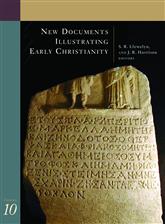
S. R. Llewelyn and J. R. Harrison, with E. J. Bridge, ed. New Documents Illustrating Early Christianity Volume 10. Grand Rapids, Mich.: Eerdmans, 2013, 269 pp., paperback, $40.00. Link
This is the second part of my review of New Documents Volume 10.Here is the first part, which includes an overview of the book up to the first two sections.
J. R. Harrison has four articles under the heading “Cult and Oracle,” including a papyri describing how Artemis overcame an evil sorcerer. The inscription is from a white marble slab from Ephesus, dated to A.D. 165. The article interacts with Clint Arnold’s Magic in Ephesus, which tends to describe Artemis as a demonic goddess, and R. Strelan’s Paul, Artemis, and the Jews of Ephesus, which argues Artemis is associated with salvation from evil spirits. On the whole, this long article favors Strelan (summarizing his arguments concisely). The inscription says that the temple of Artemis was a place of much gladness and that the goddess rescued the city from an evil magician who brought down a plague on the city.
There are two sections on Public life in the Greco-Roman world. Entry 11 describes a marble inscription in Latin and Greek honoring Augustus for sponsoring the paving of a street in Ephesus 22/21 B.C. While the inscription itself was discovered in 1958, an article appeared in 1991 which used this inscription to illustrate benefaction in the Roman world. Twice in this brief inscription the gift which Augustus made to the city of Ephesus is described as χάρις, a “gift.” The source of the gift is the Empire and the “sacred revenue” of the Temple. As Harrison points out, Augustus became “an iconic example of beneficence” and a model for other benefactors to follow. Later, Tiberius would be called “the benefactor of the world.” Since the Emperor and Empire was a source for huge sums of money, provincial elites in Ephesus found ways to exploit their patronage and line their own pockets. Harrison cites an edict dated A.D. 44 which indicates that selling the office of priest of Artemis was a lucrative trade. Harrison suggests that this benefaction (and corruption of the system) illustrates Paul’s use of grace-language in Ephesians as well as his frequent used of wealth metaphors in the book. “Paul’s language of ‘wealth’ in Ephesians could also be profitably looked at against the background of the wealth of the Artemis cult” (61).
Four articles comprise the section entitled “Household.” D. C. Barker describes an Egyptian divorce agreement dated A. D. 177, on papyri. Among the fascinating details is the fact that the wife Aphrodisia is 21 years younger than her husband, Ptolemaios. From census records Barker points out that 83% of men were older than their wives, from one to thirty years older. One of the more fascinating articles in this section is entitled “Every Dog Has Its Day.” The text is from a limestone sarcophagus from Termessos (Psidia). This is a eulogy for pet dog, Stephanos, written by the owner Aurelia Rodope. She “wept for the dog and buried him as a man.” Harrison discusses the popularity of pet dogs in the Roman world, stating that some “Mediterranean peoples were besotted by the small white long-coated Melitaen” (127). There are many examples from Gerco-Roman literature as well as inscriptional evidence that dogs were often fed from the table. This devotion to dogs as pets seems to stand in contrast to Jesus’ attitude toward the Syro-Phoenician in Mark 7:26. It is customary to emphasize more negative the Jewish attitude toward Gentiles; they are “dogs.” But Harrison points out that the image of a dog could be taken as positive, indicating that after the children are fed (the Jews) it is appropriate for the dogs (the Gentiles) to receive food.
Five articles are collected under the heading “Judaica,” including a pay slip for a Roman soldier at Masada and comments on two well-known items, the Temple Warning and the Babatha Archive. The Babatha archive is a collection of documents found at Nahal Hever (near En-Gedi). The documents are her important legal papers” and date to about A.D. 125. The documents were stored before the Bar Kokhba revolt, perhaps hinting that she participated in the revolt. The burden of this article is to compare the documents to Roman Law, especially with respect to marriage, divorce, polygamy, and guardianship. Babatha was a “second wife” to her husband Judah, leading G. Rowling to suggest that polygamy was not only practiced by the upper echelons of society, but may have been practiced in traditional rural areas as well (151).
Finally, three articles comprise the section on Christianity. Two of these are fourth century papyri letters from Oxyrynchus and illustrate early Christianity. Item 28 is a “Difficult Request (?) to ‘Beloved Father’ Diogenes.” It is clearly Christian because the words for Lord and God are abbreviated as Nomina sacra. The letter was written by Barys to Diogenes. Barys describes himself as a “brother” and Diogenes as “father.” Such language for social or religious relationships is common in the Greco-Roman and Jewish world, as it is in the New Testament. In addition, Barys refers to Diogenes as “lord” (κύριε), perhaps indicating that Diogenes has a higher status than Barys. Bridge points out the use of κύριε for a religious leader in Matt 9:28, 17:15, etc.) The letter would perhaps shed light on Paul’s letter to Philemon, especially since Barys uses the word λιτουργία (spelled λειτουργία in the NT). While the word can refer to public service, Paul used it in Phil 2:17, 25, 30 for service within the church, and in 2 Cor 9:12 for Christian giving. In the end, Bridge concludes that this letter is “two Christians in communication, one of whom has authority over the other, on the ‘secular matter’ of public service.”
Conclusion. Virtually every section of New Documents Volume 10 is worthy of attention. The entries make for fascinating reading and they all contribute to our understanding of the world of the New Testament and early Christianity. I highly recommend this volume to students and scholars. Every serious library should own all ten volumes of this important series. I look forward to additional volumes in the series, although my preference is that the next volume arrives sooner than ten years from now.
Thanks to Eerdmans for kindly providing me with a review copy of this book. This did not influence my thoughts regarding the work.

 Second, the UBS 5 text is placed on one page facing the NIV. Since the UBS text includes textual critical apparatus, the English side has about a third of a page blank (sometimes a half page). This is a good space for note-taking!


You must be logged in to post a comment.