Urban Christianity in Rome

Christianity came to Rome through the Synagogue, likely from Jews who heard the gospel while in Jerusalem as early as Pentecost. Paul wrote Romans in the second half of the 50s to already existing congregations which have separated from the synagogues or were formed outside of the synagogues of Rome.

Jewish population Rome began as early as the Hasmonean delegation to Rome in 161 B.C.E, but grew rapidly after 63 B.C.E., many Jews prospered and gained freedom and citizenship. They were located in the Transtiberinum, Campus Martius, the Suburba, and Ostia (Rome’s port-city) by the first century.

Thirteen synagogues (five for certain, eight debated based on inscriptions) have been identified from the second and third centuries B.C.E., named for the most part after persons or the location, such as Augustus or Agrippa, possibly the Herodians.  Synagogues were small ethnic enclaves and collegia organizations. Evidence for the church developing out of the synagogue is found in Romans 16.  Aquila and Priscilla are Jewish, as well as Andronicus, Junian and Herodion who are identified as Jewish (7, 11), the names Mary and Aristobolus may also indicate a Jewish origin.
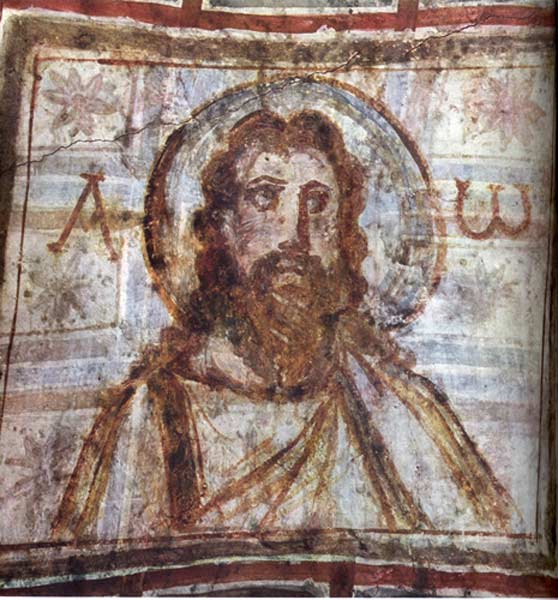
Christ_with_beard

Christ from catacombs of Commodilla

According to Acts 18:2 and Suetonius (Claudius 25.4) Jews were expelled from Rome in A.D. 49 (although Dio Cassius dates the edict of Claudius to A.D. 41).  Just who was expelled is debated. It is hardly all Jews were expelled given the population of Jews in Rome It seems likely those thought to be the ringleaders causing the riots were expelled, which would be the Jewish Christian evangelists. It is certain that by A.D. 49 there were potentially violent debates among Jews over who Jesus was. These disturbances were bad enough to attract the attention of the authorities, similar to Paul in Philippi and Thessalonica.

How many congregations of Christians existed in the mid-50s can be determined from the names in Romans 16. Peter Lampe argues for at least five different Christian “islands,” possibly as many as many as eight. For example, in Rom 16:3-5 Pricilla and Aquila are greeted along with those in the church which meets in their house (τὴν κατʼ οἶκον αὐτῶν ἐκκλησίαν). There are other Christian names listed who probably did not belong to the same congregation (or they would be listed with the others), so at least two more churches could be implied.

What does this mean for reading Romans? The Christians in Rome have been preaching Jesus as Messiah for many years before Paul wrote to them and they have suffered for the message of a crucified Messiah. Even if there are ten congregations in Rome, and even if there are 50 members of those ten congregations, there are only 500 believers in the largest city in the Empire. Christians are meeting in small locations (homes, workshops, etc.) and are a tiny minority in the city.

Paul is therefore writing this presentation of the Gospel to congregations who need to be reassured the Gospel of Jesus Christ in the face of potential isolation and persecution. Romans presents Paul’s Gospel of the grace of God in a clear way in order to encourage these congregations. What specifically in Romans might speak to the situation of these tiny islands of Christianity?


Bibliography: Peter Lampe, From Paul to Valentinius.  Minneapolis: Fortress Press, 2003.

 

Factions in Rome (Part 3) – Marcion

Marcion also was able to develop a following in Rome between 140-150 because of theological toleration.  Marcion (From Sinope in northern Turkey, 110-160) was active in Rome from 140-150.  Hippolytus claims he was a son of the bishop of Sinope, and was at one time ordained as a bishop himself.   By trade, Marcion was a ship-owner, specifically a naukleros.  Under Trajan (d. 117)  there was almost non-stop war, and shipowners were pressed into service of the government.  This was such a problem that by the time of Hadrian (d. 138) most of these demands were reversed and benefits given to shipowners (specifically, freedom from municipal liturgies). Lampe suggests that “under Hadrian, the situation of a shipowner was at its best” (242).

MarcioniteMarcion was therefore a wealthy man, and when he came to Rome he gave the church 200,000 sesterces.  This was the value of a small manor in Rome at the time (Marital 3.52), or a middle sized farm.  The amount needed to buy into the equestrian rank at the time was 400,000.  This was therefore a sizable contribution!

That he was a naukleros helps to explain why he was in Rome with time available to write and debate theology. The naukleros was the owner of the ships, but he did not necessarily need to travel with them, he is not a “sailor” or a “captain,” he is the wealthy company owner.  This also gives him opportunity to travel and spread his theology after he leaves Rome in 150.  This money was returned to him when he was excommunicated, possibly financing the spread of his theology to other areas.

While often styled as a gnostic in secondary literature, Marcion was a biblicist who “barricaded himself with a canon of scripture” (Lampe).  His theology was motivated by defining what scripture was authoritative (Paul, and his version of Luke); he also represents a complete break with Judaism in that he rejected the Hebrew Bible entirely.   He allegorized what scripture he did retain.

There is no spirit of Hellenism in his work at all! He appears to have had no training as a philosopher or as a rhetorician.  Gager has argued that Marcion’s rejection of allegory is an indication of philosophical training, but this misses the point since many philosophers in the second century were allegorizing Plato and Homer.  Marcion’s theology was motivated by the Problem of Evil, but his answer is nothing at all like one might find in the contemporary philosophical schools on the issue.  His arguments indicate that he had no formal philosophical training.

The real problem was how to deal with Marcion.  Obviously what he taught was not “orthodox,” his Bible was not what the rest of the churches used, and his view of God and Jesus was completely out of step with the church and scripture.  But there was no real “central authority” which could act to silence Marcion.  The heresy of Marcion was a factor leading to the development of a monarchic bishop in Rome.

Factions in Rome (Part 2)

In the years after Paul, factionalism increased.  Since the churches in Rome were isolated, there was little control on doctrine.  Individual teachers were free to interpret whatever scripture they had in whatever way they saw fit.  The factionalism we discussed in a previous post could result in creative theology, for good or bad.

Divided Church 2A positive example is Justin, who held meetings in a room above a bathhouse. Justin is well known from Apology, Dialogue with Trypho, and the Acts of Justin’s Martyrdom. He was a philosopher, although his education was not excellent – he began with a Stoic teacher, followed a peripatetic teacher until he demanded pay, then he failed an exam to be a student of a Pythagorian.  He has a general, eclectic education, cites various poets and philosophers, but has some geographical and historical problems.  Literary style is good, but not great.  He seems to have had philosophical lectures rather than rhetorical lessons. He arrived in Rome in 135 and converted to Christianity.  His Dialogue claims to take place during the Bar Kohkba rebellion in 135.  He had rooms above a bathhouse where he instructed students, and maintained the pallium, “mantle of a philosopher” until his martyrdom.

Justin tried to present Christianity as a philosophy, “Christians worship God with their intellects” (Di. 1.6.2, 12.8, etc.) That Christianity was a philosophy was accepted by no less that Galen, although Celsus refused to use the word for Christianity (it was sofiva to Celsus, and Christians were sophists, usually a pejorative use of the word.)   For the most part Justin was treated as a philosopher by Romans, but few (if any) philosophers investigated the claims of Christianity.

Justin’s influence was to encourage a philosophical strain in the theology of the second century, Tatian and Euelpistus both were (neo) platonic in perspective.  While present day theologians debate whether this is a good thing, in the second century it had the positive effect of making Christianity more acceptable to the educated and higher social classes.

A negative example are the Valentinians. Valentinus (c100-c160) was in Rome for 15 years, (as early as 136, as late as 166) and was considered for the position of bishop about 143 (according to Tertullian, Ad. Val iv).  He was born in Egypt and educated in Alexandria; he died on Cyprus after having left Rome.  He was a highly educated man with a brilliant mind; we wrote in a beautiful poetic language.  Lampe (295) finds his style parallel to Plato.  His philosophy is generally platonic.  He seems to know Timaeus well, and interprets this work in the style of the neo-paltonists.

Two inscriptions found in Via Latina indicate that there was at least one Valentinain congregation in this affluent suburb.  This indicates (for Lampe) that there was a house church in Via Lampe which was Valentinian in orientation; no other traces of Valentinian house churches appear elsewhere in the city.  The marble inscription uses imagery which must be Christian (praising the father and son) and likely Valentinian (entry into the bridal chamber, a sacred meal, baptism, etc.)   A gravestone inscription was also found in Via Latina which also uses Valentinain imagery (again, the bridal chamber, washings, the “angel the great counsel”)

Valentinian theology was quite esoteric and obviously gnostic.  Highly dualistic, they saw the world as evil, the believer was by nature alienated from the world.   This sort of early gnosticism is an attempt to support Christianity with a philosophical foundation, but in doing so, Valentinus moved away from scripture.  Marcion, on the other hand, represents a sort of “back to the Bible” movement — in an extremely negative sense!  More on Marcion next time.

Factions in Rome (Part 1)

Factionalism was a problem for the Roman congregations before Paul.  Romans 14:1-15:7 indicates that there are some in Rome who considered food laws important enough to be a matter of contention, while others are not taking the food laws as applicable in Christ.

Romans 14:5-7 One man considers one day more sacred than another; another man considers every day alike. Each one should be fully convinced in his own mind. He who regards one day as special, does so to the Lord. He who eats meat, eats to the Lord, for he gives thanks to God; and he who abstains, does so to the Lord and gives thanks to God.

This may indicate divisions between Jewish Christians and Gentile Christians we have seen already by Acts 15 and Galatians.  Given the small size of congregations and immense population in Rome, it is likely that the churches functioned as islands of believers (to use Lampe’s word), perhaps initially ethnic enclaves.

Assuming that Philippians was written while Paul was in prison in Rome, it is possible to learn several things about the state of Christianity in Rome in the early 60’s.

Philippians 1:12-14 Now I want you to know, brothers, that what has happened to me has really served to advance the gospel. 13As a result, it has become clear throughout the whole palace guard and to everyone else that I am in chains for Christ. 14Because of my chains, most of the brothers in the Lord have been encouraged to speak the word of God more courageously and fearlessly.

Philippians 4:22 All the saints send you greetings, especially those who belong to Caesar’s household.

We know that Paul was influential in the household of Caesar.  He states that the whole palace guard has heard the gospel, presumably from solders converted while they were guarding him.  These guards would have been gentiles converted from paganism, as opposed to Jews converted within the synagogue. This indicates that Paul is continuing his two-part mission, to the Jew first and then to the Gentile.

Divided ChurchThat Paul had success among the Gentiles encouraged the local Roman church to also engage in a similar ministry. As we observed earlier, there was good reason for the Jews to avoid contact with the gentiles based on their expulsion under Claudius in A.D. 49.  Romans seems into indicate that the church in Rome was made up of a series of small house churches (Dunn calls them apartment churches, which is more accurate since the poor did not live in houses!)

There is some evidence in Philippians of factionalism.  Phil. 1:15 says that some people preach the gospel out of “envy and rivalry” and “false motives.” These opponents of Paul try to stir up trouble for Paul while he is in prison, possibly indicating that there are at least some who “preach the gospel,” meaning that Jesus is the Christ, the crucifixion and the resurrection, etc., but they are doing so in a way that is “against Paul.”  This may be personal, but it may also be theological. (Or some combination of the two, of course!)

This may indicate that they disagree with the more radical elements of Paul’s theology, that Gentiles come to Christ apart from the Law, without converting to Judaism.  It may be that these rivals opposed Paul and perhaps even disagreed with the Jerusalem council (or, were ignorant of it; or, did not feel that they ought to be bound by it). That there are Jews who would still oppose Paul in Gentile inclusion may indicate an earlier date for Philippians, or that the issue of Gentile inclusion remained a major sticking point for the early church.

It may be something of a surprise to find that there were some congregations in Rome that were openly hostile to Paul, that seems to be the evidence of the book of Philippians.

There is a bit more evidence of factionalism in 1 Clement.  This letter was written A. D. 95-97 by Clement, a bishop in Rome.  The church of Rome was undergoing persecution when the letter was written (1:1, 7:1) but still felt it important to contact the Corinthian church.  According to tradition, Clement was the third bishop of Rome, although it is not at all clear that there was a single unbroken line of bishops who exerted any kind of authority over all of Roman Christianity before the year A. D. 200.

Clement wrote this letter on behalf of the church of Rome to the church of Corinth for the purpose of advising them on certain church matters.  The letter was considered to have had some level of authority, although we do not know how it was received by the Corinthians.  For our purposes here, 1 Clement 5 is the key text, although Clement returns to Paul in chapter 47.

1 Clement 5:5-7 Because of jealousy and strife Paul by his example pointed out the way to the prize for patient endurance. (6) After he had been seven times in chains, had been driven into exile, had been stoned, and had preached in the East and in the West, he won the genuine glory for his faith, (7) having taught righteousness to the whole world and having reached the farthest limits of the West.  Finally, when he had given his testimony before the rulers, he thus departed from the world and went to the holy place, having become an outstanding example of patient endurance. (Translation by Holmes, p. 33.)

While Clement’s evidence is a bit later than Paul’s time, there is at least some evidence of the fact that Paul face opposition in those two years he was in Rome under house arrest.

The Church in Rome before Paul

Chronologically, Romans 16 provides the earliest glimpse at the character of the churches in the city of Rome before Paul arrived.   Christianity came to Rome through the synagogues.  It seems likely that Jews who heard the gospel while in Jerusalem at Pentecost returned to Rome and continued to fellowship in synagogues until at least A.D. 49, when Claudius “expelled the Jews.”  Paul wrote Romans in the second half of the 50’s to already existing congregations which have separated from the synagogues or were formed outside of the synagogues of Rome.

Paul in RomeEvidence for the church developing out of the synagogue is found in Romans 16.  Aquila and Priscilla are Jewish, as well as Andronicus, Junian and Herodion who are identified as Jewish (7, 11), the names Mary and Aristobolus may also indicate a Jewish origin.

According to Acts 18:2 and Seutonius, Claudius 25.4, Jews were expelled from Rome in A.D. 49 (although Dio Cassius dates the edict of Claudius to A.D. 41, Acts and Seutonius both agree with the early date).  Just who was expelled is debated, it is hardly possible to have the whole population expelled given a Jewish population of 30,000 at the time.  It is possible just the ringleaders were expelled, people such as Aquila and Priscilla.

Perhaps only a single synagogue engaged in the rioting over Chrestus and was completely expelled.  The bottom line is that by 49 there were lively debates among Jews over who Jesus was and these debates were violent enough to attract the attention of the authorities.  Romans implies that some Jews returned by the mid-50’s, specifically Aquila and Priscilla.  By the time Paul writes Romans, there are Jewish Christian congregations, perhaps mixed Jew and Gentile congregations, and maybe a purely Gentile Christian congregation.

How many congregations of Christians existed in the mid-50’s can be determined from Romans 16, Peter Lampe argues for at least five different Christian “islands,” but probably as many as eight, based on the following data:

  • The phrase “those with them” plus a proper name is used five times in Romans 16 (5, 10, 11, 14, 15). This may indicate Paul knows of five separate house churches in Rome.
  • There are other Christian names listed who probably did not belong to the same congregation (or they would be listed with the others), so at least two more could be implied.
  • Paul lived in Rome in a rented house, likely constituting an eighth congregation.
  • There is no central meeting place for these congregations.  Paul hosts at least one in his house, perhaps others met with him at other times for instruction and debate.  It is not too much of a stretch to imagine Paul engaged in the sort of ministry he had in Ephesus, teaching and debating the scriptures in an informal “school” at times when people could visit – afternoons and evenings.
  • In addition, there is nothing which requires a “church” to meet only on Saturday or Sunday, in ten different locations at general the same time.  It is possible that ten congregations meet at various times and in various places during the week, and even some individuals attending multiple churches.

The congregation size of a house church would vary depending on the home in which the church met.  I would suggest that the churches initially met on the analogy of a Synagogue, where ten men coming together to study the scripture constituted a synagogue. If this is the case, by the time Paul arrives in Rome in the early 60’s, there could have been only a few hundred Christian in a city of millions.

Yet in only a few years Christianity has grown to the point that Nero can use the “strange superstition” as a scapegoat for his fires.  By the 90’s Christianity has spread to even the imperial family, forcing Domitian to persecute Christians in Rome.

Bibliography: Peter Lampe, From Paul to Valentinus: Christians at Rome in the First Two Centuries (Minneapolis: Fortress, 2003).