2 Timothy 4:3 – Enduring Sound Doctrine

Paul knows that in the very near future there the churches he has founded will not want to “endure sound teaching.” But the word“endure” sounds as if we have sit through long and unpleasant sermons!

The verb Paul uses (ἀνέχω) can have the sense of enduring something that is onerous or difficulty, such as persecution (2 Thess 1:4; 1 Cor 4:12), and in one instance it is used for accepting a legal complaint (Acts 18:14), something like “pleading guilty.”
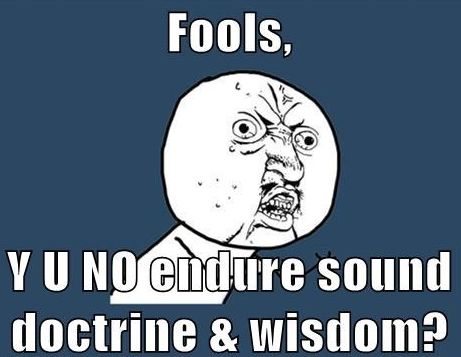
EndureIn the context of Timothy’s commission to preach the word and exhort everyone to godly living, perhaps the sense of “accept a legal complaint” is what Paul has in mind. Rather telling all Christians that they must endure long and boring sermons, Paul means that the opponents will refuse to accept healthy teaching because it is an indictment against them. They cannot stand to hear it because it points to their own shortcomings spiritually.

Paul once again describes good doctrine as “healthy” (1 Tim 1:10; Titus 1:9, 2:1; using the participle of the verb ὑγιαίνω as an adjective). People are craving teaching that is like “junk food,” it might make you feel good in the short term, but in the long run it will make you unhealthy and perhaps even kill you!

The time is coming, Paul warns, when people will want to hear things that their “itching ears” want to hear. These people will ignore the truth, wandering off into myths. This verb (κνήθω) only appears here in the New Testament and the Greek Old Testament. “The participial phrase probably means “in order to have their ears tickled” (EDNT 301; the word appears in Plato for literal scratching of an itch (Philebus 46c, 51d).

Even in English we use the word “itch” for some desire that we need to satisfy. Applied to the preaching of the Word of God, it implies that these people will want to hear the Scripture taught, but they will want to hear things that make them feel good, things that “satisfy their itch.” In the context, this is esoteric teaching, teaching that is more interested in dark secrets of “conspiracy theories” rather than the plain (and convicting) Word of God.

This is a very convicting text, and one that is very applicable to modern church experience. There are many people (myself included) that like a particular sermon (or preacher) because the “get something out of it.” It says something that they want to hear, or maybe something that they already believe. I love it when a preacher says something I already agree with because it confirms my thinking.

Boring

As a college teacher, I am always amazed how often students do not want to confront new ideas. They want to know that the things their Jr.High youth leader taught them were true. On the other hand, as a college teacher it is very easy for me to present strange and esoteric things in class. Saying “mimetic” and “intertextual” makes you sound smarter, right?

In every church, there is a set of vocabulary or a few key doctrines that pastors are required to trot out from time to time to keep people in the church happy and to give the appearance that they are still teaching “healthy doctrine.” This might be a good doctrine, a solid teaching; but it also might be a particular social position, or political idea.

But my guess is that Paul often taught the Scripture in a way that made people squirm. It made them uncomfortable to be told that God is their father and he expects them to be honorable children in the household of God. It is far easier if God would just give me a list of items I can achieve or rules I can keep. I am certain that Jesus’ teaching made people very uncomfortable; he confronted people directly over their hypocrisy.

Why is it that we (Christians) do not want to be made uncomfortable when the Word is preached?

Self Deception – 2 Timothy 3:13-15

MontebankThe opponents in Ephesus stand in contrast to Paul’s record of suffering (v. 13) It is Paul and Timothy’s opponents who are the imposters. The noun (γόης) Paul uses here is a common way to describe an opponent in a philosophical debate. The noun originally referred to a sorcerer (T.Sol 19:3 uses it for a witch, Hdt, Hist. 7.791.2 for magicians, sometimes it refers to a “juggler,” [Aeschines, Ctes. 137], presumably because they do some sort of distracting act while they pick the pockets of the crowd).

By the first century it was used to describe a swindler, a con-man who uses some kind of deception to gain a profit from his audience. I think of the character from old Western movies, the “snake oil salesman.” The Greek writer Demosthenes uses the word with this sense: “for fear I should mislead and deceive you, calling me an artful speaker, a mountebank, an impostor, and so forth” (Dem., 18 276).

Ironically, these deceivers succeed in deceiving themselves! This is also a common way of describing sophists and charlatans in Greco-Roman world (Dio Chrysostom, Orations, 4.33). The way to avoid these sorts of people is proper “divine” education (4.29).

Dio Chrysostom, Orations 4.33 If, however, he falls in with some ignorant and charlatan sophist, the fellow will wear him out by leading him hither and thither, dragging him now to the east and now to the west and now to the south, not knowing anything himself but merely guessing, after having been led far afield himself long before by impostors like himself.

Similarly, the way to avoid the self-deceptive teaching of the opponents in Ephesus is to devote oneself to divine teaching through the Scripture which has been given by God.

Paul encourages Timothy to “continue in what he has learned” from the Scriptures (vv. 14-15). Timothy was trained in the scripture from a young age. Jewish family, reading the Old Testament in Greek (most likely). While the opponents are progressing into more esoteric “deep” knowledge, Timothy is told to remain where he is. He has already learned the truth and has been convinced that it is the truth. There is no need for him to dabble in the “myths and genealogies” of the opponents.

The Jews regularly referred to their scriptures as “sacred writings,” Paul can only have in mind here the Old Testament. At this point in history it is unlikely that the Gospels were circulating as Scripture, perhaps Paul’s churches cherished his letters as authoritative. But the New Testament as we know it simply does not exist yet!

Paul says that Timothy was “raised on the Old Testament.” We know that his mother was Jewish and it is likely that he was taught the Old Testament, perhaps having some training in the Septuagint and Hebrew Bible in a synagogue. I doubt that Paul selected Timothy as a missionary companion if he was totally ignorant of the Bible prior to coming to faith in Jesus!

The remedy for self-deception, for Paul, is an absolute reliance on the Scripture for faith and practice. While the opponents in Ephesus pursue fruitless “myths and genealogies” Timothy is to remember what the Scriptures plainly teach and pursue righteousness.  I suspect if people actually read the Bible, they would not tolerate the sorts of “teaching” that passes for popular Christian preaching!

What is an “Approved Workmen”? – 2 Timothy 2:14-16

In 2 Timothy 1 Paul has told Timothy to model his life and ministry after Paul, recalling the examples of both his family (Lois and Eunice) and Paul’s co-worker Onesiphorus. He ought to avoid the example of the false teachers in Ephesus, namely Phygelus and Hermogenes (1:15) and Hymenaeus and Philetus (2:17).

In order to avoid these faithless men, Timothy is to train the elders to be “approved workmen” (2:14-19). In fact, Timothy is to be an approved workman before he trains others. Like Paul’s warning to Titus, Paul warns Timothy to avoid quarreling about words or other theological babble. On the one hand, this is a difficult command since one has to have defined the “core” of the Christian faith very well in order to decide what qualifies as “babble.”

ApprovedOn the other hand, sometimes the theological “babble” seems fairly obvious, mostly since it is the sort of thing people are passionate about! (Like the famous definition of pornography, I may not be able to define it, but I know it when I see it!)

“Do your best” (ESV) in v. 15 has the sense of being diligent in fulfilling an obligation (σπουδάζω), “make every effort” (BDAG). The KJV translated this word “study,” a word which has shifted considerably in modern English. The verb is used in Gal 2:10, for example, for the reminder to care for the poor. In Eph 4:3 Paul says that the believer ought to “be eager” to maintain the bond of unity. It is used twice in 2 Peter with the sense of diligence in spiritual development (1:10, 3:14). This word stands in contrast to being “diligent” in senseless theological babble. While the opponent in Ephesus is busy with their “endless myths,” Timothy is to be busy presenting himself as God’s approved workmen.

Timothy is to be an approved workmen, properly handling the word of God. 2 Tim 2:15 is classic verse for modern “noble Bereans” since it implies that the maturing person of God will become increasingly able to read the scriptures with intelligence and confidence. We sometimes talk about “learning a trade.” The more one works at being a carpenter, for example, the better one gets.

Osteen GrinningThe analogy is excellent since studying the Bible is a skill and an art. There are technical elements which can be taught and learned (parsing Greek verbs, reading background studies, finding parallel texts, etc.), but there is an art to knowing what to do with that information! An unskilled carpenter can build a bookshelf with boards and a few nails, but a master carpenter builds an excellent piece of furniture that is of great value.
The modern church has created a class of professional Bible interpreters. This gives the impression that the Bible is too difficult to fully understand without professional training. People in churches want to leave Bible reading to the professionals, the approved workmen. But this is not at all Paul’s point here. Timothy (and by analogy all believers) ought to be busy training themselves as best they can to handle the Bible correctly so that they will avoid the errors that are plaguing the churches in Ephesus.

This is the point of the phrase “rightly dividing” in the KJV. That translation is also not helpful, since the word refers to guiding the word of truth along a straight path (BDAG). Perhaps Pual has in mind a Roman Road that moves from one point to its goal, without any unnecessary deviation. So too the believer ought to read and study the Bible without being turned aside by wordy debates or impious talk.”

Paul’s point is that we ought to use the Scripture in a way that it was intended: do not twist scripture to make it say what you want it to say, or would prefer it to say. This raises several problems with contemporary church life. A growing majority of Christians are biblically illiterate and unable to read the Bible properly. They take verses out of context and claim the Bible teaches things which it does not. An additional problem is people do not think very deeply about issues, preferring to repeat what they have heard on talk radio (or worse, facebook!)

What You Heard From Me – 2 Timothy 1:13-14

Second TimothyPaul was “appointed a preacher and apostle and teacher” of the Gospel (1:11). This description of Paul’s ministry is similar to 1 Tim 2:7. The “preacher” in the ESV is better a “herald,” or “proclaimer.” This is a person who is appointed to deliver a particular message, in Paul’s case, from God. The language is a little different in 1 Tim 1:18, 6:20 and 2 Tim 2:2. In these later books, Timothy is encouraged to guard or protect the deposit given to him. Like the old “town crier,” Timothy is to take this deposit of tradition and accurately proclaim it to his community.

Paul mentions things passed down to him in his other letters. Two traditional elements were handed down to him from the apostles: 1 Cor 11:2 (the Lord’s table) and 1 Cor 15:1 (witnesses to the resurrection). In 2 Thess 2:15 Paul encourages the congregation to “stand firm” in the traditions which Paul delivered to them. Even in his earliest letter, Paul considers his gospel a tradition which cannot be modified (Gal 1:14).  It is likely that Paul alludes to the words of Jesus in 1 Thess 5, words that are eventually collected in Matthew’s Olivet Discourse.

Paul is clear, however, that much of what he preached he received directly from Jesus through a special revelation. For some doctrines, this is a direct revelation that could not be deduced from the Hebrew Bible. For example, in 1 Thess 4:13-18 Paul says that the Lord himself gave him the revelation of the rapture. That Jews and Gentiles are saved into a single body without requiring the Gentiles to keep the Law is a “mystery” which was not revealed in the Hebrew Bible. In Galatians 1:11-12 Paul claims that the Gospel he preaches is “not of human origin” but rather “received by revelation.”

For some of Paul’s teaching, he may have been led by the Holy Spirit to interpret biblical texts differently, or to combine texts from the Hebrew Bible in unique ways which supported the idea that Jesus is the Messiah or that salvation is apart from works. Romans 4 indicates that the story of Abraham could be interpreted in a way that supported Paul’s gospel – this is exegesis guided by the Spirit of God. Much of the argument of Galatians is based on applications from stories in Genesis. Paul was trained as a scholar and interpreted Scripture in his sermons and letters in a way consistent with other Jewish teachers of his day.  This “interpretation of scripture” is part of the tradition Timothy is to guard and pass along.

In some cases the tradition is handed down from the apostles through Paul, to Timothy and then to the qualified elders in Ephesus. In other cases Paul is the source. But in either case Paul commands Timothy to guard this tradition carefully and to pass it to the next generation of believers.

Suffering as Godliness – 2 Timothy 3:10-12

In contrast to the false teachers, Paul lists his own suffering as an example of what will happen to anyone that wants to live a godly life (vv. 10-12).  This is somewhat surprising for contemporary Christians who are fed a steady diet of “health and wealth” gospel – if you are really spiritual and doing everything God requires, you will be blessed, you will be happy, healthy and wealthy.  That is the exact opposite of Paul’s point in this passage.  Paul knows that his Gospel is the truth because he has suffered physically as a result of his preaching of Jesus.

It might seem odd, but Paul recalls his first missionary journey as an example of his suffering. He specifically has in mind the persecution he faced in Asia Minor (Acts 14). In Antioch, Paul is opposed by Jews from the Synagogue, who follow him to Iconium to harass him. Paul was attacked in Lystra, stoned and left for dead (Acts 14). Perhaps these persecutions were chosen because he was “left for dead,” or perhaps this period continued to haunt him in his ministry for some time.

Honk for Jesus

While that physical attack was important, Paul has in mind the constant treat from the Jewish community throughout that first journey as well as the threats to his churches reflected in the book of Galatians.  The attack on Paul’s character reflected in Paul’s early letters may have been more painful than the physical pain he faced in Lystra.  It appears that some of Paul’s opponents described him as unqualified to preach the gospel (Gal 1) or worse, as a charlatan (1 Thess 2, for example).

A potential problem with this review of Paul’s ministry is that it all occurred on the first missionary journey, before Timothy began to travel with Paul (Acts 15). This is sometimes used to argue that the letter of 2 Timothy is a pious forgery.  The writer introduced a historical error by saying that Timothy witnessed these events himself.  On the other hand, Timothy was from Lystra himself and joined Paul mission with the full knowledge that Paul is often persecuted physically and opposed by very powerful people where ever he preaches the Gospel!

Paul states very clearly that everyone who desires to live a godly life in Christ Jesus will be persecuted . This is a common theme throughout the New Testament: Jesus was persecuted and so too will his followers face similar trials.  Galatians 5:11 indicates that Paul was persecuted because he was preaching that the Gentiles were not under the Law.  The immediate background is his troubles in Asia Minor to which he alludes here in 2 Timothy (cf. Rom 8:35, 1 Cor 4:12, 2 Cor 4:9, 12:10, Gal 4:29, 5:11, 2 Thess 1:4).

If Timothy’s desire is to live a godly life, he will in fact face some sort of trial or  persecution.  Paul knows that Timothy is at the moment facing a difficult time because of the false teachers in Ephesus, even if that has not developed into a physical persecution at this point. This text is clear that the one who is “in Christ” will suffer like Christ.  Perhaps this is an indication that the opponents in Ephesus are not really “in Christ,” they simply do not suffer!

Imagine what would happen in Evangelical Christianity if people really believed that they should suffer for Jesus rather than expecting to be wealthy because of their faith. When was the last time you took a rock to the head because of your faith in Jesus?