Main Themes in Matthew 8-12

Matthew 4:23-25 and 9:35 form an inclusio, a frame around the Sermon on the Mount (ch. 5-7) and the authority/miracle stories (ch. 8-9), forming a major unit in the Gospel of Matthew. (Click here for an index of all Sermon on the Mount posts.) At the end of the Sermon on the Mount, the people are amazed because Jesus teaches with authority. In Matthew 9:35, they are amazed at Jesus because he does things with authority.

After collecting Jesus’s teaching on the Law in the Sermon on the Mount, Matthew collects ten miracles (nine healings) to demonstrate that Jesus is the Servant from Isaiah 53:4. In the Septuagint the servant “carries our sins and suffers pain for us, and we regarded him as one who is in difficulty, misfortune, and affliction” (LES2). These themes are clear in Matthew 8-9, Jesus heals people who are on the fringes of society because their illnesses are associated with uncleanliness and sin. Similar to the blindman in John 9, someone might have asked what the leprous man did to deserve such a painful punishment. Jesus disconnects sin and illness in these stories. This is clear in Matthew 9:1-8 when Jesus forgives a man’s sin without healing him first; the teachers of the Law consider this blasphemous since only God can forgive sin and false because the man was still paralyzed.

Interspersed into this collection of miracle stories are sayings of Jesus and reactions from crowds, the disciples, teachers of the law and Pharisees. In most cases, people who should not understand who Jesus do (a centurion, 8:9-9; demons 8:28; tax-collectors, 9:9-13; blind men, 9:27). Those who should recognize his healings as signs the messianic age has come do not understand Jesus (anyone in Israel, 8:10-12; the disciples, 8:23-27; teachers of the law, 9:3; John the Baptist’s disciples, 9:14; Pharisees, 9:34).

These reactions to Jesus anticipate a series of conflict stories that follow in Matthew 10-12. People begin to react to Jesus as the Messiah in various ways, but the climax ins the Pharisees rejecting Jesus and declare he is working his miracles under the power of Beelzebub. Jesus says this rejection is blasphemy against the Holy Spirit, a sin that will not be forgiven int his age or the age to come (Matt 12:32). Matthew 12 ends with Jesus’s family asking to speak with him (12:46-50). In Mark 3:20-21 his family wants to take him home because they think he has lost his mind, although that detail is omitted in Matthew 12.

For example, in this first section of Matthew 8-9, a leper, a gentile, and a woman with a fever, people who are unclean with respect to ritual purity under the Law, are healed. Jesus touches a leper, speaks with a Gentile, and touches a woman. All three actions would render Jesus unclean by the standards of the Pharisees, who lived as much as possible in a state of perpetual ritual purity.

Just as the Sermon on the Mount subverts expectations about the Law and how one lives out their lives as Jews in the Second Temple Period, Jesus will challenge the beliefs of other teachers (especially the Pharisees) with respect to discipleship (who can be a follower of Jesus looks much different than who can be a follower of the Pharisees!) He declares that “many will come from east and west and recline at table with Abraham, Isaac, and Jacob in the kingdom of heaven” while the “sons of the kingdom” will be thrown in the outer darkness where “there will be weeping and gnashing of teeth.”

Those who think they belong in the kingdom of Heaven (sitting at the head table with Abraham) will not enter the kingdom at all, while those who should not be in the kingdom (lepers, Gentiles and a women with a suspicious disease) will not only get in, but they will be the honored guests!

John 6:1-14 – What is the Point of the Leftovers?

Looking at the huge crowd gathered to hear him, Jesus asks his disciple Philip where they could possibly find enough food to feed the large crowd. As happens often in John’s Gospel, Jesus knows exactly what he is about to do so this question is a test for the disciples (John 6:6). Marianne Meye Thompson acknowledges the verb used here can refer to a temptation or trap, but in this cases it is better “examine, try, prove” (John, 140).

Fish and BreadOnce again in the Gospel of John someone misunderstands Jesus’s question and fails to anticipate the miracle. Philip points out the impossibility of buying that much food: “Two hundred denarii” worth of food would not be enough! This is more than a half-year’s wages, so Philip’s point is “we don’t have that kind of money, Jesus.” He is thinking of literally feeding the crowd, Jesus is talking about spiritually feeding the crowd the “bread of life.”
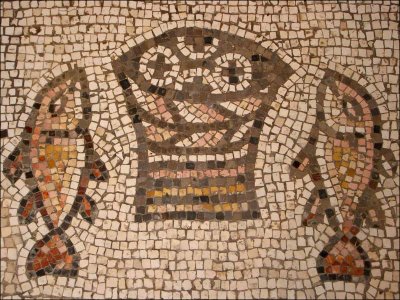
Another disciple who is only mentioned in the Synoptic gospels, Andrew, finds a boy with a small lunch. Andrew probably did not think the food could be shared, he was pointing out the impossibility of finding enough food for the crowd. The fish were probably small pickled fish (not a sardine, but something similar). No one would carry a pair of rainbow trout in their satchel on the outside chance they were needed to feed a crowd!

Jesus takes this small amount of food, offers thanks, and then distributes the food to the crowd. The crowd sees that is a miracle and wonder what kind of prophet Jesus is. They have in a mind a tradition drawn from Deut 18:15-18 that another prophet like Moses will come into the world. Moses fed the Israelites manna in the wilderness, in a similar way Jesus gives bread to a new Israel in a new wilderness.

Deuteronomy 18:15-18 (ESV) “The LORD your God will raise up for you a prophet like me from among you, from your brothers—it is to him you shall listen— 16 just as you desired of the LORD your God at Horeb on the day of the assembly, when you said, ‘Let me not hear again the voice of the LORD my God or see this great fire any more, lest I die.’ 17 And the LORD said to me, ‘They are right in what they have spoken. 18 I will raise up for them a prophet like you from among their brothers. And I will put my words in his mouth, and he shall speak to them all that I command him.

It is possible this miracle is an allusion to Elisha (2 Kings 4:42-44). In 2 Kings the prophet Elisha feeds 150 men with a small amount of food. There are similarities, but the more important allusion is to the wilderness period of Israel’s history.

The food provides enough for all the crowd to eat until they are satisfied and still have twelve baskets left over. Consider these are poor people who are given free food and allowed to eat as much as they want. I think they probably overate and maybe stuffed a few leftovers in their pockets to take home to the family.

The point of the leftovers? “This is the ample provision of the Lord who declared, ‘My people will be filled with the bounty’ (Jeremiah 31:14)” (Carson, John, 271). Just as Jesus provided plentiful excellent wine at the wedding in Cana (John 2:1-12) and healed a man who was crippled for thirty-eight years (5:5-6), now Jesus provides enough food everyone is satisfied and there are plenty of leftovers. Like the wine at the wedding in Cana, Jesus is revealing for those who have ears to hear that he is the host of an eschatological banquet, like the manna in the wilderness God is providing new bread for his people. But as Jesus will say later in John 6 this “bread of life” is his own body which will be given for them (6:48-51).

John 6:1-14 – Feeding the 5000

The Feeding of the Five Thousand appears in all four Gospels.The details in John are in some ways more detailed. For example, the role of Andrew and Philip are unique to John, in the synoptic gospels the disciples who ask Jesus about the crowds are anonymous. The use of the disciples to react to Jesus is typical of John, as is the mention of the words and deeds of other disciples outside of Peter, James and John.

Fish and Bread, Feeding the 5000

That this event occurs at the time of the Passover is extremely important for understanding the point of the miracle. Passover celebrates the rescue of Israel out of Egypt. God sent plagues on the Egyptians and took his people out into the wilderness where he provided for them both food and water. What is more, the rescue from Egypt at Passover marks the beginning of Israel as a nation.

John wants to present Jesus as a “prophet like Moses” in this section. It was Moses who provided food to the people of Israel in the wilderness after the first Passover and then led the people through the waters of the Red Sea. In Exodus 16 God provides for the people of Israel with manna and quail.  Jesus provides food then walks on the water. There is even a parallel in the reaction of the crowds – the crowds  “murmur” in 6:41 in such a way that implies that they have not really understood the miracle.

When Jesus provided food for a large crowd of Jews in a wilderness location, consciously re-enacting the original Passover. Like celebrating the fourth of July in America, celebrating Passover evoked a nationalistic spirit even in Galilee. Perhaps because many in Galilee thought of themselves as “occupied” by the Romans, Passover could easily develop anti-Roman sentiment.

This miracle could be taken as the beginnings of a revolution. When he seats people in groups he is organizing the people into “tribes” just as Moses did. The crowds in fact misunderstand the sign in just this way and try to force Jesus to be a king. As D. A. Carson said, “In the light of v. 15, where the people try to make Jesus king by force, it is easy to think that, at least in John, the specification of five thousand men is a way of drawing attention to a potential guerrilla force of eager recruits willing and able to serve the right leader” (Carson, John, 270).

The crowd thinks that Jesus is the Prophet, a messianic figure, a second Moses who leads Israel into the wilderness and provides manna for them. Isaiah 40-55 makes us use of the original wilderness period to describe the return of Israel from Exile.  There seems to have been a general feeling among the people, perhaps especially in Galilee, that the exile was still going on because Israel’s king had not come nor has the whole nation been gathered back to the land.

This nationalism would have been especially strong during the Passover. Israel was remembering his origins. Families were re-enacting the inaugural Passover meal in their homes and talking about what God has done for them in the Exodus and journey to the land. It is very easy to see what the people thought, Jesus is like Moses, gathering a force in the wilderness which could be used to secure the land, in this he is a new Moses. But Jesus is also a new Joshua- the people of Galilee were willing to take up arms to liberate the nation.

After Jesus explains that his kingdom is not going to be an armed rebellion, the crowds begin to fall away and even Jesus’ own disciples begin to grumble about this “hard teaching” (6:60-66) .  The verb used in verse 61 (γογγύζω) is used for the complaints of the Israelites in the wilderness period (they were “murmuring”). Just like Israel in the past, present Israel is complaining, questioning whether Jesus is the true messiah or not.

The Twelve, however, remain faithful (6:67-69).  Peter is the disciples who responds that there is no one else to follow since Jesus has the words of life.  The inner circle is committed to following Jesus since there is no life (water, bread) anywhere else.  If that is true, Peter says, “What other teacher are we going to follow?” If Jesus is the teacher who has the truth, it is because he is also God incarnate – once again, who else are they going to follow?  They know the truth, they cannot now turn to any other teacher.

Indeed, what other teacher are we going to follow?

Jesus and Purity (Part 1: Hand Washing)

In Mark 7:1-5 the Pharisees question Jesus over his lack of attention to the tradition of “hand washing” before meals. Jesus’ disciples do not wash their hands before a meal in order to avoid ritual purity, presumably the question directed at Jesus implies he was not requiring his disciples to follow a “tradition of the elders” (v. 5).

“Unclean hands” or “defiled hands” (ESV) refers to the state of impurity with respect to the Law. If one touched something unclean and then touched clean food, the clean food may become unclean. If that is the case, then a person could be eating unclean food even if the food was permissible in the Law. The Pharisees are accusing Jesus of behaving in a way that would make him unclean with respect to their traditions.

HandWashingR. T. France comments Mark’s description of the Pharisee’s practice is a “broad-brush, unsophisticated account which conveys a general sense of meticulous concern to avoid defilement” (Mark, NIGTC, 281). Mark is explaining only very generally the practice of the Pharisees with respect to washing hands before meals. France also points out that it is impossible to know if hand-washing for ritual purity before meals had become the norm for all people at the time of Jesus.

When challenged for his non-practice of “the tradition of the elders” (κατὰ τὴν παράδοσιν τῶν πρεσβυτέρων), Jesus quotes Isa 29:13. The verse is part of a long oracle of woe spoken against Judah and Jerusalem. Isaiah is looking forward to the judgment of God on Jerusalem because of the half-hearted worship in the Temple. While they did the ritual correctly, their hearts were not right with God and as a result the nation would go into exile. By quoting this verse, Jesus is comparing the present leadership of Israel (the Pharisees) to the generation responsible for the exiles. The Pharisees are right to be aware of ritual purity and cleanliness, but they have made their interest in purity an end to itself. Their hearts are still far from God, despite their perfect obedience.

What is Jesus doing here? Is he intentionally ignoring the tradition of the Pharisee because it is not biblical? Was this a “mission strategy” intended to draw the sinner into a relationship with Jesus?  Is he trying to challenge these traditions, or is he simply eating a meal with sinners? When Jesus ate at the house of a Pharisee, did he wash his hands as we expected? I would expect that he did, simply because a Pharisee might not eat with Jesus if he had not washed his hands prior to sitting down to eat.

A more interesting question (to me) is why the Pharisees think that Jesus ought to submit to their tradition of hand-washing. I think that Jesus was teaching things which resonated most with the Pharisees and there is at least a possibility that they thought he was “one of them.” Jesus is described as discussing the Law with Pharisees and weighing in on issues like a Rabbi (divorce, for example). Clearly Jesus was not living as a Pharisee, attempting to maintain Temple purity at all times. Theologically he was “conservative,” but socially (from the Pharisee’s perspective) he was permissive.

Non-Jewish Christianity has always been perplexed by this passage since we Gentiles tend to smugly dismiss Jewish practice with little thought to what application this non-practice by Jesus might have for modern Christians. If Jesus were to visit a contemporary church, what practices might he ignore because they are simply external rituals without any real change of heart? (If Jesus did visit my church, I would hope he did not bring his whip!)

Jesus the Exorcist

…Jesus exorcisms were not merely isolated incidents of compassion for individuals oppressed by malevolent forces.  They were direct confrontations of the power and the presence of the Kingdom of God.  The success of Jesus’ assaults indicated that the head of that evil kingdom had already been bound, making possible the spoiling of his domain. David George Reese, “Demons” in ABD 2:141.

As with his healings, Jesus commands the demons to leave without invoking an authority.  It was common for exorcists of the first century to use powerful names in order to force demons out In Acts 19:13-16 the names of both Jesus and Paul were invoked as “power names” to cast out demons.) In Testament of Solomon 11, Solomon interrogates a demon who appears “like a stately lion. The demons identifies himself as “The Lion-Shaped Demon, an Arab by descent” who “sneaks in and watches over all who are lying ill with a disease and I make it impossible for man to recover from his taint.” In addition, this demon has legions of demons at this command at the time of the setting sun.  When Solomon asks how he can be cast out of a person, the demons replies “By the name of the one who at one time submitted to suffer many things (at the hands) of men, whose name is Emmanouel, but now he has bound us and will come to torture us (by driving us) into the water at the cliff. As he moves about, he is conjured up by means of three letters.” (Translation by D. C. Duling, in James H. Charlesworth, The Old Testament Pseudepigrapha, 1:972–973.)

JesusCastingOut_satanJesus does not make any elaborate preparations for an exorcism. In contemporary literature, the exorcist often did a number of rituals.  For example, in the book of Tobit the angel Raphael instructs Tobias on how to cast out his bride’s demon:

Tobit 8:1-3  When they had finished eating, they escorted Tobias in to her. 2 As he went he remembered the words of Raphael, and he took the live ashes of incense and put the heart and liver of the fish upon them and made a smoke. 3 And when the demon smelled the odor he fled to the remotest parts of Egypt, and the angel bound him.

Jesus does not even pray to expel demons. In the DSS  Genesis Apocryphon, Abram prays to cast out a demon. In this expansion on Gen 12:10:20, Abram prays for “all the cities of Egypt” afflicted with plague after he lied about Sarai The King of Egypt asks Abram to “pray for me and for my household so that this evil spirit will be banished from us.” Abram prays and lays his hands on the king, and the “plague was removed from him; the evil [spirit] was banished [from him] and he recovered” (1QapGen, column 20).

Is there any connection between Second Temple Period messianic expectations and the exorcisms? Usually scholars cite Isaiah 61, especially the “prisoners being set free.” But Graham Twelftree expresses doubt that these passages have been read correctly since there is also the idea of Satan being active until the end of the age in the Gospels.  There is a two-stage defeat of Satan being described in the gospels, the first mission of Messiah render the power of Satan useless, it is in his second coming that he will judge him and consign him to the Lake of Fire. He uses texts like Isaiah 24:22 (shut into prison then after many days released.)