The Messiah and the Miraculous Feeding

The Feeding of the 5000 is one of only a few stories appearing in all four Gospels. Jesus miraculously feeds a large crowd and intentionally evokes several images from the Hebrew Bible in order to reveal something about himself. The authors of the Gospels include the story as part of their presentation of who Jesus is.

Fis and LoavesFirst, is introduced in a way that recalls Israel’s history. “Sheep without a shepherd” reflects an image used for Israel in the Hebrew Bible (Num 27:17; 1 Kings 22:17; Ezek 34:5). The miracle itself is not unlike Elisha in 2 Kings 4:42-44, who fed a crowd of 100, some would draw an analogy to the manna in the wilderness in the book of numbers (Moses fed the people in a wilderness place as well both with manna and quail.)

When the disciples point out to Jesus that the place they are in will not be able to meet the physical needs of the crowd, Jesus tells the disciples to feed the people. They assume that Jesus is speaking about physically feeding them, and respond that they could not possibly buy the food required to feed a crowd of that size.  Did Jesus mean literal food here?  Probably, but on a more subtle level he is setting up the miracle. Jesus has them recline on the “green grass” then provides them with their food.  The way of telling the event highlights the people as sheep who have found their true shepherd, Jesus makes them lie down in a green pasture and provides them with their daily needs.

This is an important event, important enough to be included in all four Gospels.  What makes it so significant? This event is an anticipation of the Messianic Banquet. There are two events in Hebrew Bible this miracle may evoke.  In both cases the food is literal, and the provision is from God.  God provides food for his people. In Exodus 16 God provides for the people of Israel with manna and quail. Elisha feeds 120 men in 2 Kings 4:42-44.

At least some Jews expected the return of manna at the beginning of the messianic age. In The Syriac Apocalypse of Baruch (2 Baruch), the great chaos monsters Behemoth and Leviathan will be slaughtered and fed to those who have survived to until the time the Anointed one appears. Then…

“the earth will also yield fruits ten thousandfold. And on one vine will be a thousand branches, and one branch will produce a thousand clusters, and one cluster will produce a thousand grapes, and one grape will produce a cor of wine. And those who are hungry will enjoy themselves and they will, moreover, see marvels every day. 7* For winds will go out in front of me every morning to bring the fragrance of aromatic fruits and clouds at the end of the day to distill the dew of health. And it will happen at that time that the treasury of manna will come down again from on high, and they will eat of it in those years because these are they who will have arrived at the consummation of time.” (Translation by A. F. J. Klijn, in James H. Charlesworth, The Old Testament Pseudepigrapha, 1:630–631.)

If there was indeed an expectation among some Jews that the long exile would soon be over and a true shepherd would appear to lead Israel as Moses did in the wilderness, then it makes sense manna would return in the eschatological age since manna was the food provided by God for his people in the Wilderness, the place where God first made Israel his people. If Jesus is claiming to be the Messiah expected by the prophets, it follows that he would intentionally evoke the expectations of people living in Galilee in the first century. 2 Baruch is written sixty years after Jesus, but it was constructed on the foundation of the same Hebrew Bible Jesus and his contemporaries used.

Is Jesus intentionally alluding to stories from the Hebrew Bible in order to call attention to his own role in the presence of the kingdom? Is this an “already” aspect of the kingdom? If this is the case, then what is this miraculous feeding saying about Jesus?

The Significance of Healing Miracles

Mark Strauss says Jesus’ miracles were not “showy demonstrations of power or even proof of his identity. They are manifestations of the in-breaking of the Kingdom of God, a foretaste and preview of the restoration of creation promised by God” (Four Portraits, 466). I agree Jesus did not do miracles simply to draw a crowd or entertain people. While Strauss is correct the miracles are indications the Kingdom of God is present in the ministry of Jesus, in most cases Jesus did a miracle in order to reveal something about himself as the Messiah. This is slightly different than “proof of identity” since none are strictly speaking proof Jesus is the Messiah or his ministry is an in-breaking of the Kingdom of God. They are hints toward the truth for those who “have eyes to see” (Matt 13:14-15).

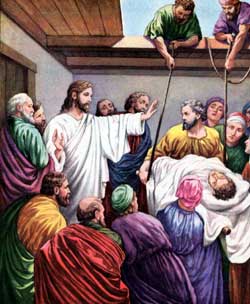
Healing_paralyzed_man

The healing in Mark 2 is an example of a miracle as self-revelation. Jesus heals a crippled man, but the reason he does so is to reveal something about who he is to both the outsiders (Pharisees and scribes) but also to the insiders (his disciples who already believe) and the larger crowd who are in-between these two extremes. The challenge of this miracle is: “Who is this man, Jesus?”

Jesus returns to Capernaum and attracts a very large crowd at Peter’s home. A paralytic is brought to Jesus by some friends to be healed. Since they cannot enter the home because of the crowd, the men go onto the roof and break a hole large enough to lower the man on a pallet into room where Jesus was. The roof of a typical home at the time of Jesus was a sun dried mud thatch, so the very “to dig” is quite appropriate.

There was a relationship between sins and birth defects in the minds of the Scribes and Pharisees. Jesus may be attacking this misconception of sin by forgiving the sin without healing the man. In the ancient world, an extreme illness or birth defects was considered to be the result of sin, either on the part of the sick person or on the part of the person’s parents or grandparents. (The disciples ask about a blind man in John 9:1-2.) Not only do all the people observing this believe this to be true, but the man himself probably believed that his sickness was the result of sin.

Forgiveness of sin and healing typically go together in the Hebrew Bible and Second Temple Period Judaism. In 2 Chron 7:14, God forgives the sins of Israel and “heals their land.” Similarly, Psalm 103:3 connects forgiveness with the healing of disease, and in Isaiah 19:22 the Lord responds to Israel, hears their pleas and heals the nation.

It is most startling to notice that Jesus claims to forgive sin by his own authority. This is the action of Jesus that elicits the strong reaction from the religious leaders that are observing Jesus’ actions. He did not say, for example, “in the name of God your sins are forgiven,” but rather simply, “your sins are forgiven.” Jesus himself is forgiving the sins as if he were the one offended by them.

Jesus says to the teachers of the law: Which is easier, to say ‘your sins are forgiven’ or ‘rise and walk’?” It is just as easy to say one as the other. Jesus point is that saying is the easy part, doing is the difficult part. Jesus says that he will not only forgive the man’s sins, but he will heal him, so that the teachers of the Law might know that he has the authority to do those things. There is a significant bit of theology packed into this statement. Authority is power, ability, and permission to do something.

Jesus healed in order to signal the beginning of the messianic age and to prove to the Jewish leadership that he was the Messiah. That Jesus calls himself the Son of Man in this section important since it is likely an allusion to Daniel 7, where “someone like a son of man” is given authority to rule. In a sense, Jesus is drawing together three lines of evidence for his divinity. He forgives sin, he is about to heal a lame man, and he claims to be the Messianic Son of Man.

If we were to examine all of the healing miracles in the Gospels, we might find they all are some sort of self-revelation by Jesus. Other than general statements that Jesus healed many people, are there any healing stories that do not reveal something about Jesus’ nature and/or the nature of the Kingdom of God?

What other healing-miracles in the Gospels reveal something about who Jesus is?


Miracles and History

The so-called criterion of authenticity can applied to the miracle stories.  For example, all strata of the tradition indicate that Jesus did miracles, including Mark, Q, M/L, and John.  This ought to satisfy the criterion of Multiple Attestation since miracles appear in all of the various forms suggested by form criticism.  Given the methodology of even the Jesus Seminar, one can confidently conclude that Jesus had the reputation as a miracle worker, that he claimed to do miracles, healings, etc.

Healing a Blind ManThe criterion of plausibility argues that an event is more likely historical if it is a plausible event.  If this is applied to the miracles, many will dismiss miracles because they do not seem plausible.   What is or is not plausible is highly subjective, and very often implausible events actually occur.  To me, it is implausible that anyone claiming to be a messiah in the Second Temple Period would not do miracles.  While the modern worldview would dismiss miracles as implausible, the Second Temple Period would require them if Jesus was to be taken seriously as the messiah!

This is the sort of thing that Anthony Le Donne suggests in his The Historical Jesus (Grand Rapids, Mich.: 2011).  There are many memories of Jesus acting as a healer or exorcist, even raising the dead. These memories are in a wide range sources, and there is variation among these sources.  Le Donne refers to this as memory refraction – people are the same events with slight variations, but the main contours of the event are the same.  These variations actually increase the likelihood that a given event is historical (130).  In the case of Jesus’ miracles, not only are there variations on the same event, but many miracles around given themes (healing, exorcism  etc).

The criterion of embarrassment is more helpful.  If a deed seems like it might have been an embarrassment to the growing theology of Jesus, and they passed it along anyway, it has a greater claim to validity.  The healing of the woman with the flow of blood, for example, has Jesus healing the woman without really consciously thinking about it, the power just “went out of him” and he did not know who it was that touched him.

In addition, Jesus was known to have been a man of prayer, yet there are no stories in which Jesus prays in connection to a healing.  If the early church were going to create or enhance the prayers of Jesus (which they very well may have), it is remarkable that they did not create prayers to be added to the miracles of Jesus. This means that Jesus did not heal in the same way Jewish holy men healed, through prayer and ritual.

In short, it is historically plausible that Jesus was known as a miracle worker during his own lifetime, even if the modern thinker dismisses the possibility of miracles.  Do these sorts of “criteria” for authenticity work for miracles in Jesus’ ministry.

Or is this a case of “preaching to the choir”?  For example, what is the difference between my argument here and saying, “lots of people think Santa brings the presents at Christmas so it must be true”?

Mark 11:12-14 – Cursing the Fig Tree

After the Triumphal entry, Jesus returns to Bethany for the evening. As he is approaching Jerusalem the next morning, he sees a fig tree and expects to find a bit of fruit to eat, but there is none. Jesus then pronounces a curse on the fig tree, telling it that it will no longer bear fruit.

What is the meaning of the cursing of the fig tree? This is a symbolic action, dealing with more than a tree that does not bear fruit. The context supplies the clue, Jesus enters the temple and condemns it as a den of thieves, setting up the conflict stories as he teaches in the temple.

The fig tree is barren, a frequent symbol in the Old Testament of Israel’s unfaithfulness (Isa 28:4, for example), or God’s judgment (Jer 7:20, Hos 9:15-16). The most likely allusion is to Isaiah 6. There, the prophet describes Judah as a tree that will be cut down, but a remnant will remain (Isa 6:13). Judah would fall, but a tiny remnant will remain. Jesus has already quoted Isa 6 to describe his teaching in parables, so it is not a surprise that he would enact a parable with this fig tree based on Isaiah 6.

Jesus is looking for fruit in a place he has every right to find fruit, but does not find it. In the same way, he came to the nation looking for fruit, but did not find any. The religious establishment is a barren fig tree that is about to be cut off. Where did Jesus have every right to find a fruitful religious heart in Israel – the temple. Mark inserted the Temple demonstration into the narrative of the fig-tree to bring out the theological point of the Fig Tree sign.

On the third day after the curse is pronounced (and after the events in the temple), the disciples see the tree and note that it is dead – withered from the roots up. There are a number of Old Testament allusions here (Ho 9:16, Job 18:16, 28:9, 31:12, Ezek 19:9 ). The nation has gone past the point of no-return, they have rejected the Messiah.

But is there a “righteous remnant” as was the case in Isaiah 6:13? There are two ways of looking at this. First, we could read this as a curse upon Israel as a whole. They will no longer be God’s people and they are about to be replaced by the church. This is possible, but it seems to me to be theologically driven. Obviously from this side of the events it appears that the church replaced Israel, this parable talks about Israel being “cursed”, so it must predict the coming church. I would like to avoid this as anachronistic – Jesus is saying something about his ministry at that moment in history.

A second, better way to look at the meaning of this parabolic action is to see the religious establishment as “under the curse” and that they are being replaced by Jesus’ disciples. This is why Mark inserts the Temple demonstration into his “Markan Sandwich,” he is point to the meaning of the curse of the fig tree. Jesus came to his own people and they have rejected him. He created a new Israel with twelve disciples (twelve tribes) who will receive the promised New Covenant.

Mark 2:1-12 – Sin and Healing

That Jesus did miracles is the claim of every layer of tradition in the New Testament. Even non-biblical writers describe Jesus as a healer. But Jesus did not heal people to gain an audience or to generate interest in his mission, he never asked for anything from those he healed. Jesus did not want “prayer partners” who regularly give to his ministry. Jesus healed in order to reveal something about himself. The healing in Mark 2 is an example of this “healing as self-revelation.”

Jesus returns to Capernaum and attracts a very large crowd at Peter’s home. A paralytic is brought to Jesus by some friends to be healed. Since they cannot enter the home because of the crowd, the men go onto the roof and break a hole large enough to lower the man on a pallet into room where Jesus was. The roof of a typical home at the time of Jesus was a sun dried mud thatch, so the very “to dig” is quite appropriate.

Mark 2:5 says “When he saw their faith,” referring to the friends of the paralytic. But rather than heal the paralytic, Jesus forgives the man’s sins. The paralytic does not demonstrate faith, at least to our knowledge, nor did he ask for his sins to be forgiven. Jesus pronounces the man’s sins forgiven in order to make a point about himself – the miracle here is a revelation of who Jesus is.

There was a relationship between sins and birth defects in the minds of the Scribes and Pharisees. Jesus may be attacking this misconception of sin by forgiving the sin without healing the man. In the ancient world, an extreme illness or birth defects was considered to be the result of sin, either on the part of the sick person or on the part of the person’s parents or grandparents. (The disciples ask about a blind man in John 9:1-2.) Not only do all the people observing this believe this to be true, but the man himself probably believed that his sickness was the result of sin.

Forgiveness of sin and healing typically go together in the Hebrew Bible and Second Temple Period Judaism. In 2 Chron 7:14, God forgives the sins of Israel and “heals their land.” Similarly, Psalm 103:3 connects forgiveness with the healing of disease, and in Isaiah 19:22 the Lord responds to Israel, hears their pleas and heals the nation.

For most of the original audience, it is  startling that Jesus claims to forgive sin by his own authority. in fact, Jesus;s claim to have forgiven the man’s sin elicits a strong reaction from the religious leaders observing Jesus’ actions. Jesus did not say, for example, “in the name of God your sins are forgiven,” but rather “your sins are forgiven.” Jesus himself is forgiving the sins as if he were the one offended by them rather than God.

Noticing their thoughts, Jesus says to the teachers of the law: Which is easier, to say ‘your sins are forgiven’ or ‘rise and walk’?” It is just as easy to say one as the other. Jesus point is that saying is the easy part, doing is the difficult part. Jesus says that he will not only forgive the man’s sins, but he will heal him, so that the teachers of the Law might know that he has the authority to do those things. There is a significant bit of theology packed into this statement. Authority is power, ability, and permission to do something.

Jesus healed in order to signal the beginning of the messianic age and to prove to the Jewish leadership that he was the Messiah. That Jesus calls himself the Son of Man in this section important since it is likely an allusion to Daniel 7, where “someone like a son of man” is given authority to rule. In a sense, Jesus is drawing together three lines of evidence for his divinity. He forgives sin, he is about to heal a lame man, and he claims to be the Messianic Son of Man.