Colin Hemer identifies four “areas of tension” in the church of the late first century. Each of these bullet points are worthy of a chapter of a book, here is a short summary:
Christianity and the Imperial Cult. The context of the imperial cult in Revelation 2-3 and the growing influence of Domitian would have put Christians under pressure to either conform or face some form of persecution. While this may have not been as organized as modern preachers make it out to be, Christians would have been viewed with suspicion if they did not participate in the imperial cult.
Christianity and the Pagan world. This is especially seen with regard to the social life of Greco-Roman cities. How does a practicing Christian “fit” in pagan society? Could a Christian participate in a civic event like athletic games if those games were dedicated to a god? Could they eat food at a festival if it had been used in a sacrifice to a god?
The Church and Judaism. It is possible the church had grown far enough away from Judaism by the end of the first century that the differences were quite clear. How does a Gentile who believes Jesus is Messiah relate to a Jewish faith still looking forward to the Messiah?
Different sub-Christian Groups. These early “heretical” groups within the church disagreed over authority, which may indicate the possible influence of Docetism and antinomianism. The church needed to develop internal discipline and expel teachers not conforming to apostolic teaching or ethical expectations.
The application of these tensions to the present church seems obvious. First, how does the church of the post-Christian word 21st century interact with culture which is frequently based on a world view completely at odds with the biblical worldview?
Second, how does the modern church relate to the “historic church”? Obviously our doctrine is based on the historical creeds of the church, but to what extent ought we “pull away” and create a new, post-modern church?
Third, how does the modern church deal with anti-Christian influences such as syncretic mixtures of Christianity and other world views? For example, can we have a “Christian / eastern world view”? Is there a possibility of a post-modern Christianity?
Last, how does the modern church deal with fringe elements within the church itself? How tenaciously should we hold to the foundational documents of denominations which are hundreds of years old and perceived as not particularly relevant to the modern situation?
I suppose each of these points is worthy of a sermon. Despite the fact that Revelation is usually mined for end-time prophecies or is used to fuel conspiracy theories on YouTube, John’s pastoral point was much different. Christians living in Asia Minor in the first century were under enormous pressure to conform to the imperial society. Revelation challenges the readers to hold on to what is true and good and pure, since the Lord Jesus is returning soon.
Bibliography: Colin Hemer, The Letters to the Seven Churches of Asia in their Local Setting (Grand Rapids, Mich.: 1989).
The second and third chapters of Revelation contain the letters to the seven churches. These letters are probably the most familiar chapters in Revelation since they are the most easily applied to the modern church, and can be “preached” without difficulties found in the rest of Revelation. You can go on tours of the seven churches and there are innumerable charts and graphs on the internet that claim to properly interpret the “real meaning of the seven churches.”
Since Revelation is a book of prophecy, it was once thought the seven letters were prophetic of the entire scope of church history from the beginnings of the Apostolic Church (Ephesus) through the apostasy of the last days (Laodicea). They may be letters to real churches but there is a “deeper” meaning to these letters which unveils the history of the church. Naturally these interpreters see themselves living in the final period. The church of the “last days” will be like the lukewarm Laodicean church. For example, Jesus is outside the church knocking on the door, asking to come into the church, implying Jesus is not a part of the “present day church.”
Interpreters who approached the book of Revelation with the historical method spent a great deal of effort trying to determine which “eras” of church history are present in each of the seven churches. This was popular at one time even among Dispensationalists who otherwise avoided allegorical interpretations. John Walvoord, for example, sees this approach as shedding “much additional light” on the study of the seven churches (Revelation, 52-53).
I disagree with these schemes since they obscure the most important theological teaching of Revelation 2-3. These letters were written to real churches and are intended to be real communications with those churches. The letters are a literary device used by John to communicate certain teachings to the entire church. They are addressed to real churches with real problems, but they are intended to be read by the whole church. An analogy to the book of Amos is often made, since Amos begins with prophecies against 7 nations, ending with Israel and Judah. Just as those prophecies would not have been delivered separately than the rest of the epistle, the letters in Revelation would not have been intended to circulate separately from Revelation. In fact, David Aune suggests that these letters may never have circulated at all (Revelation, 1:119).
It is far better to read these churches in the context Asia Minor in the late first century. Each letter contains allusions to the culture and location of the city addressed. Using the example above, Laodicea is did not have a good water supply. Unlike other cities nearby, they did not have therapeutic hot springs nor a fresh water spring. Hot water or cold water are both positive, helpful resources. Laodicea had tepid water that was not useful for very much at all. This explains the use of lukewarm in Rev 3:16. In 3:17 the Laodicean church thinks they are prosperous, but they are really wretched, poor, blind and naked. Laodicea was known for both eye-medicine and a textile industry. This is irony based on the culture of the city of Laodicea.
Other metaphors are more obscure (Satan’s throne, Rev 2:13 or the synagogue of Satan in 3:9 are particularly difficult). But the solution is not to be found in the history of the church or some allegorical teaching pulled out of the text without any knowledge of the social world of the first century.
Why do some people not take this history, geography and social setting into consideration when they read Revelation? The main reason is because it is hard work! It takes some effort to be fully aware of the history of these seven cities, most preachers do not have the time to do the additional reading to become aware of the background. This is unfortunate, because the message of the seven churches is even more applicable to the modern church when read against the background of a Greco-Roman Asia Minor of the first century.
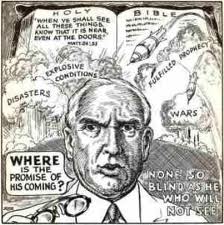
The theological term for the end times is eschatology, the study of last things. This includes not only the return of Christ and the kingdom, but also “personal eschatology,” what happens to individuals after death, what judgments await the believer and the unbeliever. I think that the study of the “end times” has mutated into “what is going to happen to those people left behind after the Rapture?” While I do believe in a Rapture / Tribulation / Second Coming scheme, I think it is more helpful to see the overall themes of Revelation rather that try to get ever detail of the Tribulation lined up on a chart.
I want to let Revelation speak for itself as much as possible, and to do that the book must be read in the context of the Hebrew Bible and Second Temple Jewish expectations. John is remarkably consistent with the Judaism of his day, with the exception of identifying Jesus as the Messiah.
The most general teaching of Revelation concerning personal eschatology is that the righteous are to be rewarded and the unrighteous are to be condemned. This is consistent with the Hebrew Bible. When the messianic age begins, there is a judgment of the nations and of Israel. Not everyone participates in the messianic age, as a text like Isaiah 25:6-8 makes clear. While many will gather on Zion to participate in the inaugural banquet at the beginning of the age, Israel’s prototypical enemy Moab will be trampled in the mud (25:10-12). Jesus also described the beginning of the new age as a harvest, where the wheat will be gathered into the barn (where it belongs) and the weeds gathered and thrown on a fire (where they belong). This theme of eschatological separation is common in Jesus’ parables (Matt 13:24-30, for example).
Prior to the beginning of the eschatological age, the Hebrew Bible expects a time of persecution of the people of God. In a book like Daniel, this period of persecution will separate the true Israel from the false. The capture of Jerusalem by the Babylonians initiated a long sequence of conflict with pagan rulers which reached a climax during the reign of Antiochus IV Epiphanies. The struggles of the Maccabean period become a paradigm for future persecutions.
In Revelation, there is a persecution of those who refuse to worship the beast or take his mark. Revelation 13:7 describes this as a “war on the saints” which will result in the death of many who are followers of Christ (13:10, 20:4). This persecution is a time when a choice must be made to worship the beast (taking his mark) or to worship the Lamb. There is no middle ground, the time of great persecution is a sifting of the true followers from the false.
In Revelation 20, there is a judgment at the beginning of the Kingdom of God, or the eschatological age. John’s vision turns to a scene of thrones, thrones for those who were martyred during the tribulation, and thrones for those that endured until the end. In this vision, it is the souls of those who were faithful during the tribulation that sit upon thrones. The souls that John is seeing in these verses are those that were under the altar in 6:9 crying out to God asking to be revenged for their death at the hands of the beast and his kingdom.
With respect to the future, then, Revelation promises that God will judge with justice. Those who persecute will be judged and separated from the Kingdom of God, while those who were persecuted will be vindicated and enter into that Kingdom.
Bird, Michael F. Are You the One Who Is To Come? Grand Rapids, Mich.: Baker, 2009. 207 pages, pb. $24 Link to BakerLink to Logos
Some scholars argue that Jesus himself did not intend to call himself a messiah, or even that he denied being the messiah. Anything that might be taken as “messianic claim” is dismissed as a secondary addition to the text by the early church as they told and re-told the story of Jesus in the light of their belief in the resurrection. The “post-Easter” Jesus became the Christ. By the time the Gospels were written, a belief that Jesus was the Messiah had taken root and the story of Jesus was written in a way to make him into a messiah. But the “Real Jesus” himself never claimed to be the messiah.
Michael Bird addresses this question in Are You the One to Come? He states at the very beginning of the book that “the historical Jesus understood his mission, ministry, vocation…in messianic categories” (11). The first chapter of the book provides a short orientation to previous scholarship on Jesus as the Christ. Bird observes that the “well-word position” that Jesus never claimed to be the messiah is not as strongly held as it once was, primarily as a result of the so-called “Third Quest” for the historical Jesus (27) I would add here, the research into the Second Temple Period initiated by the New Perspective on Paul. In the last 50 years scholars like E. P. Sanders and N. T. Wright have explored the diversity of Jewish beliefs, including their messianic expectations. What Bird attempts to do in this book is to argue that Jesus saw himself in Second Temple Period messianic categories. The source of the Christology of the early church was Jesus himself.
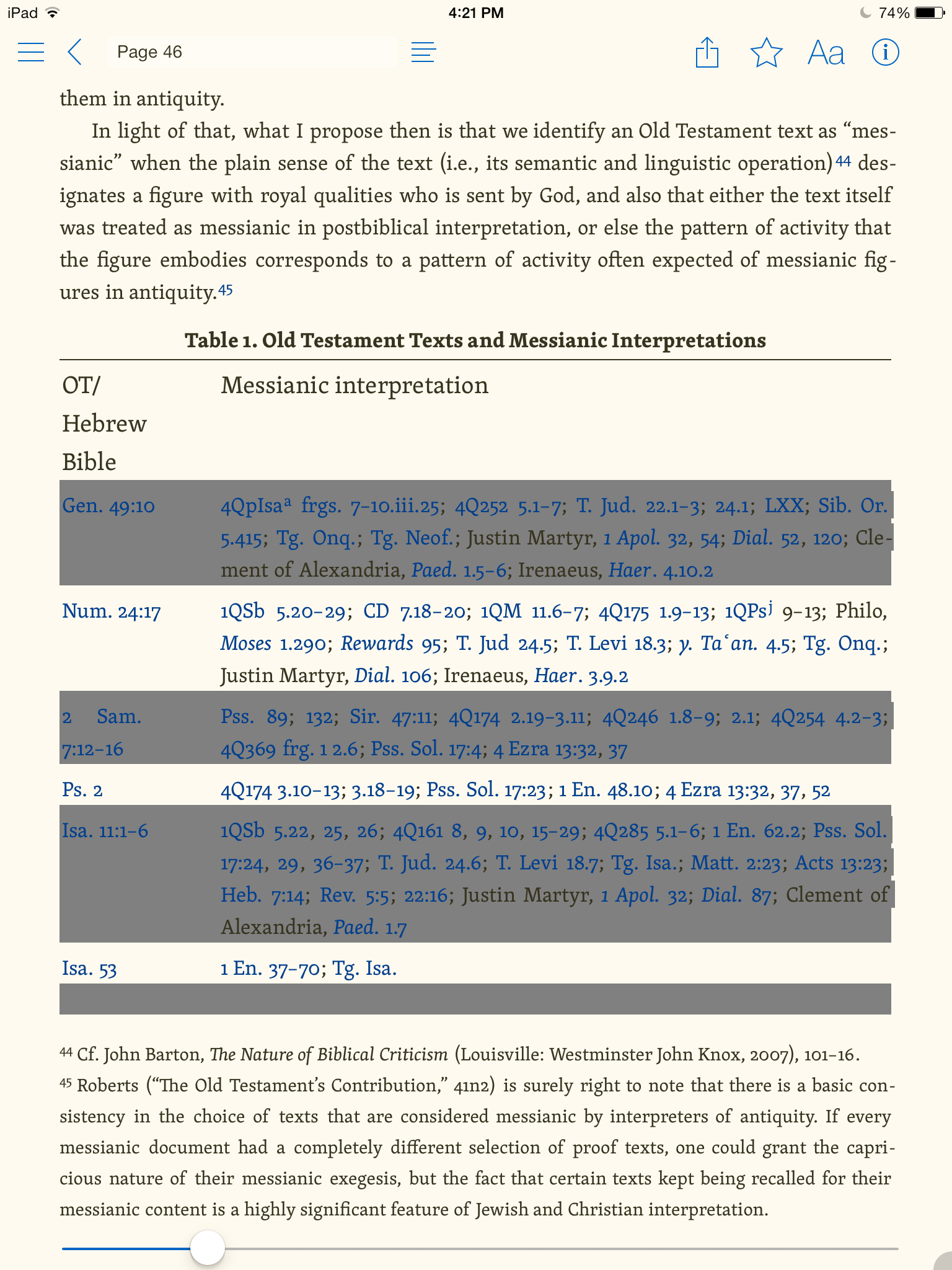
Bird’s second chapter surveys messianic expectations in the Second Temple Period. This is a very broad topic since there is a massive the primary literature from the period illustrating a variety of expectations. He begins with by tracing the development of messianic ideas through the Hebrew Bible, then shows how these expectations were sometimes enhanced by the translations of the Hebrew Bible into Greek and Aramaic. Citing Numbers 24:7 as an example, Bird argues that the translators of the LXX “created Messianism” by combining texts to create an exilic hope for national deliverance (45). In order to show that messianic expectations were high in the first century, Bird lists and briefly describes how the Qumran Community interpreted the messianic texts from the Hebrew Bible and how some of these texts were used by “messianic pretenders” both before and after Jesus. This trajectory from the Hebrew Bible through the Second Temple period provides the context for Jesus’ messianic self-understanding.
Chapters three and four are subtitled: “a Role Declined?” and “a Role Redefined?” In the third chapter, Bird examines the evidence often used to argue that Jesus did not claim to be the messiah, primarily the post-resurrection faith that developed into the Christology of the Church and the “Messianic Secret.” But if Jesus did not claim to be the messiah, there is no good explanation for the sign on the cross, “King of the Jews.” That seems to imply that Jesus was in fact claiming something that could be understood as messianic.
Chapter four is the heart of the book. Here Bird looks at the evidence from the Gospels that Jesus’ whole career was “performatively messianic” (78). By this he means that Jesus did not necessarily claim to be the messiah, but rather that he acted out the sorts of things expected by the messiah. I expected the chapter to discuss Jesus’ miracles as a sign of the new age, or the feeding of the 5000 as an enactment of the Good Shepherd image, the triumphal entry and Temple action, or even table fellowship as a messianic banquet (which Bird does mention several times in the chapter). Rather than a catalog of “performative acts,” Bird first has an excellent discussion of Jesus’ self-reference as the Son of Man, a saying of Jesus. He argues persuasively that the title is drawn from Dan 7:14, but also that Jesus combined that title with the “smitten shepherd” metaphor in Zechariah 13:7. Jesus as a suffering Messiah is means by which Jesus enters into eschatological suffering on behalf of others.
Second, Bird argues that Jesus is not just the Son of Man, but he is the anointed Son of Man. After has been active for some time, the imprisoned John the Baptist asks if Jesus is the “One Who Is To Come.” Jesus’ response is an allusion to a series of texts from Isaiah describing the messianic age as a time when the blind will receive sight, the lame will walk, the lepers are cleansed, etc. Here Jesus answers John’s question “obliquely but affirmatively” (101). Bird then shows that these sorts of messianic expectations were present at Qumran (4Q521) “despite the protests of several scholars” (103). In fact, this chapter concludes with a short survey of the “I have come” sayings in the gospels.
Third, Jesus’ preaching of the Kingdom of God implies the presence of a King, and in the much of the literature of the Second Temple period, the “dividing line between king and messiah is very thin” (105). Returning to the sign on the cross, it seems obvious Jesus must have preached something that caused the Romans to treat him as a rebel, or a supposed “king of the Jews.” There are many allusions to David and Solomon as well that support the claim that Jesus thought of himself as a King/Messiah.
I suspect that some readers will take issue with these three points since they are embedded in the teaching of Jesus. The Son of Man sayings are often rejected by historical Jesus scholars (especially in the more extreme practice of the Jesus Seminar). The same is true for the programmatic statement in Luke 4; critical scholars will deny that Jesus could read and Luke created the whole scene to portray Jesus as a “scholar” who reads and interprets Scripture. Bird does not get too distracted by “authenticity” questions, but he makes some use of the “criteria of authenticity” (e.g., multiple attestation, p. 109). The classic historical Jesus scholar is not going to like this since he uses the criteria to show the sayings are likely authentic. At the same time, the use of these criteria is falling out of favor with some scholars.
Are You The One To Come? (Logos on the iPad)
In the fifth chapter Bird addresses the difficult problem of a crucified messiah. Even Peter had a difficult time reconciling Jesus’ claim to be the messiah with his insistence that he would go to Jerusalem and be crucified. When Peter makes his climactic confession in Mark 8:27-30, Jesus does not correct him by denying that he is the messiah, but rather he provides further definition of what the messiah’s mission will include when they finally arrive in Jerusalem. Here Bird examines the anointing at Bethany, the Triumphal Entry and the Temple action as performative messianic claims. The arrest, trial and crucifixion are only explicable if Jesus had claimed something messianic in that last week (if not his whole career to that point). In the final part of this chapter (and anticipating his final chapter), Bird argues that the earliest followers of Jesus remembered Jesus life and teaching after his death and resurrection and began to re-tell the story of Jesus as the “anointed one” who fulfills the prophetic plan of Isaiah in his ministry (146). Jesus was never remembered as a martyr, but rather a crucified messiah, something that simply does not appear in any strand of Second Temple period Judaism.
In the last chapter of the book is a brief sketch of “messianic Christology.” This chapter is not a Christology in the traditional sense, but rather a set of implications drawn from the previous study. If Jesus did indeed claim to be Israel’s messiah, then he did so “from Israel and to Israel.” Jesus cannot be understood properly outside of the context of the story of the Hebrew Bible.
Conclusion. This book appeared while I was working on my dissertation on the messianic banquet, so I quickly read through the book looking for material that I could use in that project. Much of the material in the first few chapters was familiar since I was working through similar issues. When I was asked to review the book as a part of the Logos Library I was able to re-read the book more slowly in order to catch the overall flow of the book.
The book would make an excellent college or seminary textbook in a Gospels class since it does an excellent job describing the variety of messianic expectations in the Second Temple Period. It is not overly technical, although some of the details from the Dead Sea Scrolls might be overwhelming to some readers. The footnotes provide a rich bibliography for readers who desire to dig deeper into messianic expectations in the Second Temple Period.
Additional Comment: I read this book in print, but it is also available as part of the Baker Jesus Studies collection from Logos Bible Software. The Logos version includes real page numbers and the reader can take advantage of the note-taking and highlighting tools in Logos. One advantage to the Logos reader is that all scripture references are linked to you preferred Bible, including the Apocrypha, Pseudepigrapha and Dead Sea Scrolls if you own those books in your Logos library. If you do not have those books, clicking an abbreviation will float a window identifying the meaning. For example, click on 1QM and a window appears telling you this is the War Scroll. If you download the book to your iPad for reading with the Logos app, all footnotes appear on the page you are reading along with the real page numbers.
NB: I purchased the physical copy of this book from my local bookseller, but thanks to Logos for kindly providing me with an electronic review copy of this book. This did not influence my thoughts regarding the work.
This is some exciting news: My book is now available through Amazon and the Wipf & Stock website. The book retails for $33, but Amazon and Wipf & Stock have it discounted. The Kindle version is only $9.99 and claims to have real page numbers. I have not seen a Kindle version yet. If you live in the Grand Rapids area, I have a few copies in my office if you want to get one directly from me. If you do get the book, leave a nice review on Amazon, I would appreciate that.
The full title of the book is Jesus the Bridegroom: The Origin of the Eschatological Feast as a Wedding Banquet in the Synoptic Gospels. The book is an edited version of my dissertation. As I was working on my dissertation, people would ask what I was writing on. I usually said “an intertextual study on messianic banquet imagery in the Synoptic Gospels.” After a moment of awkward silence, I clarified: “Jesus said the Kingdom of Heaven is like a Wedding Banquet – what’s up with that?”
The book attempts to study the marriage metaphor / motif in the teaching of Jesus. There are a few places in the Synoptic Gospels where Jesus describes the Kingdom of Heaven as a Wedding Banquet, Matt 22:1-14 and 25:1-13 are the most obvious texts. But there are a few places where Jesus describes himself as a bridegroom, and a marriage metaphor appears in a number of other places. My proposal is that Jesus combined the metaphor of an eschatological banquet with the common Old Testament marriage metaphor and described his ministry as an ongoing wedding banquet to which all Israel is now invited. The long period in the wilderness is over and it is time for Israel to return to her Bridegroom.
In order to make this case, I apply what might be called an intertextual method to traditions or set of metaphors. The “text” in this intertextual study is the Hebrew Bible, but that text was heard by Jesus’ original listeners rather than read. They knew the metaphors because they heard them taught in their homes and synagogues. Jesus used these metaphors because they were current, but by combining them to describe himself, he created a new image of the eschatological age as a wedding banquet.
I first examine the eschatological “victory banquet” motif in the Hebrew Bible, starting with Isa 25:6-8 (ch. 3), the use of the Wilderness Tradition in Isaiah 40-55 (ch. 4), and the Marriage Metaphor in Hosea, Isaiah and Jeremiah (ch. 5). I trace the development of these three themes through the Second Temple Period in chapter 6, and finally apply that database to the sayings of Jesus in chapter 7.
There are a few things that you will not find in this book. First, I did not cover John’s gospel, although there is much there that can be described as “wedding motif.” My reason for this omission are simple-the dissertation was already too long to include another major section on John’s Gospel! Second, there is nothing in this book on the application of the Bridegroom metaphor to the church. I wanted a study of Jesus’ use of the metaphor, not the (much) later theological development of that metaphor. Again, the reason for this is simply that I was writing a New Testament dissertation, doing “biblical theology” rather than “systematic theology.” I wanted to focus on the teaching of Jesus and the origin of the wedding banquet metaphor.
Obviously I would love for you to buy a copy, but that is not always possible. Here’s how you can help get the word out for me:
Request that the book be added to your college, university, or seminary library.
 The application of these tensions to the present church seems obvious. First, how does the church of the post-Christian word 21st century interact with culture which is frequently based on a world view completely at odds with the biblical worldview?