James K. Hoffmeier, The Prophets of Israel: Walking in the Ancient Paths

Hoffmeier, James K. The Prophets of Israel: Walking in the Ancient Paths. Grand Rapids, Mich.: Kregel Academic, 2021. 398 pp. Hb. $36.99   Link to Kregel Academic   

James K. Hoffmeier is emeritus Professor of Old Testament and Ancient Near Eastern History and Archaeology at Trinity Evangelical Divinity School and previously Professor of Archaeology and Old Testament at Wheaton College. In addition to working on the Akhenaten Temple Project in Luxor (1975 to 1977), he was director of excavations at Tell el-Borg, Sinai (1998-2008). He has written numerous books of biblical and archaeological topics, including Israel in Egypt: The Evidence for the Authenticity of the Exodus Tradition (Oxford, 1996), Ancient Israel in Sinai: The Evidence for the Authenticity of the Wilderness Tradition (Oxford, 2005) and Akhenaten and the Origins of Monotheism (Oxford, 2015).

Hoffmeier, The ProphetsIn a brief introduction to the book, Hoffmeier explains this book covers the usual literature expected in an introduction to the prophets, but places greater emphasis on the prophets in their literary context and the historical background that provided an impetus for their message. Hoffmeier describes himself as a “practicing field archaeologist,” so it is no surprise he emphasizes archaeological data for “setting the stage on which the drama of the biblical history is played out” (13). Archaeological and geographical data allow for more accurate and complete view of biblical narratives, which places the reader in a better position to make informed theological decisions.

Chapter 1 is a general introduction to the Hebrew prophets. Hoffmeier defines the role of a prophet within the Hebrew Canon in contrast with other ancient near eastern prophets and the Oracle at Delphi. He also observes that the Hebrew prophets differ in terms of prophetic method (no divination, augury, etc.). Hoffmeier traces the development of prophecy from Moses as a foundation, focusing on the importance of the Exodus and Sinai covenant, through the writing prophets. He rightly points out the writing prophets did not focus on the distant future, as is popularly assumed. They looked back at the Sinai covenant and the Exodus events in order to address their own historical situations.

Although not typically included in introductions to the prophets, chapter 2 is devoted to pre-writing prophets. Beginning with prophets like Deborah in the book of Judges, he briefly comments on Samuel, Gad, Nathan, Ahijah and Shemaiah (prophets of the split kingdom), and Elijah, Elisha, and Micaiah (prophets in the northern kingdom of Israel). He also includes three female prophets, Isaiah’s wife, Huldah and the ultra-obscure Noadiah (Neh 6:14).

Chapters 3-7 survey the writing prophets. Hoffmeier divides the prophets more or less by centuries, although chapters three and four both cover eighth-century prophets, subdivided into the northern kingdom of Israel and southern kingdom of Judah. For each chapter, he sets the prophet into a proper historical context in the books of 1-2 Kings. this requires a lengthy excursus on the Assyrian invasion (701 BC), including a detailed examination of the Lachish relief to illustrate the siege of this city. Hoffmeier defends traditional dates for each of the prophets and the unity of the prophetic books. For example, in his discussion on the authorship of Isaiah, he lists the usual arguments for multiple authors and then responds to each in detail. For Hoffmeier, Isaiah is a two-volume anthology of the ministry of the eighth-century prophet. Regarding the book of Daniel, he deals with the usual historical challenges for the book and leans towards identifying Darius as Cyrus the Great (following D. J. Wiseman), although he certainly entertains the other options. He quotes with approval R. K. Harrison’s statement that the Qumran literature “demonstrates that no part of the Old Testament canonical literature was composed later than the 4th century B.C.” (327). He places the book of Jonah in his chapter on eighth-century prophets. The book of Joel is post-exilic, written after the completion of the temple (after 515 B.C.).

Another unique element of Hoffmeier’s introduction is a final chapter on New Testament prophets (Chapter 8). The chapter is brief, only about fifteen pages. For the Gospels, he covers John the Baptist, Simon and Anna (Luke 2), and Jesus as a prophet. For Acts and epistles, he has a brief discussion of prophecy in the early church, such as Paul’s vision (2 Corinthians 12) and Agabus (Acts 11:28). There is less on early church prophecy than I expected. For example, something might have been included on 1 Corinthians 12-14 as the major discussion of early church prophecy in Paul’s letters. But this is an introduction to the prophets of Israel and the chapter is intentionally brief. Wisely, there is no discussion on the continuance of prophecy in the church after the Apostolic age. Hoffmeier covers the Book of Revelation in a brief two pages, with most of that devoted to Patmos.

What is missing? The book could have included a unit on the rise of apocalyptic as a prophetic genre, focusing on Isaiah 24- 27 portions of Ezekiel, Zechariah, and Daniel. The unit could briefly trace the trajectory from the Old Testament antecedence through the Second Temple period to the apocalyptic found in the Book of Revelation, since New Testament prophecy is part of this content of the book. Since apocalyptic literature has one foot in the Old Testament and another in the new, this chapter would have made a good transition between his discussion of the Old Testament prophets and a discussion of church prophecy.

The book is lavishly illustrated with stunning photographs, maps and sidebars. It is a pleasure simply to browse the book and look at the pictures! For example, in chapter one, there are twenty-five photographs and maps and six sidebars in only 32 pages. Todd Bolen contributed many photographs and the maps from drawn by A. D. Riddle. But many of the photographs are Hoffmeier’s own.

Each chapter concludes with study and discussion questions suitable for short papers or online discussion forums in a classroom setting. Although there is a six-page bibliography, there are no indices for the book.

Conclusion. Hoffmeier’s The Prophets of Israel is an excellent introduction to biblical prophetic books, suitable for both undergrad and graduate level courses. Interested layperson could pick up this book and use it to introduce themselves to prophetic literature in the Old Testament.


NB: Thanks to Kregel for kindly providing me with a review copy of this book. This did not influence my thoughts regarding the work.
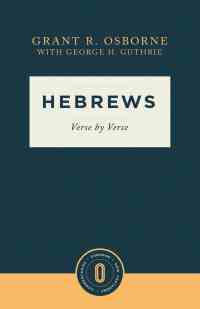
Giveaway Winner: Grant Osborne, Hebrews

Hebrews CommentaryNot as many entries for this one as usual, I blame November for this. Too many distractions (SBL, Thanksgiving, etc.) So the winner of the Grant Osborne’s Verse by Verse commentary on Hebrews is Claire Cannon. Congrats, even though she did not give her favorite Hebrews commentary. If she had, I am sure it would have been F. F. Bruce, his was the runway best of the best from the other commenters.

I reviewed Grant Osborne’s commentary on Hebrews in his Verse-by-Verse series here.

If you didn’t win this book, check back later today for another giveaway.


A New English Translation of Strack and Billerbeck, Commentary on the Talmud, ed. Jacob N. Cerone, trans. Joseph Longarino

Strack, Hermann L. and Paul Billerbeck, A Commentary on the New Testament from the Talmud & Midrash, ed. Jacob N. Cerone, trans. Joseph Longarino, vol. 3. Bellingham, WA: Lexham Press, 2021. Bellingham, Wash.: Lexham Press, 2021. 1008 pp.; Hb.  $64.99; Logos Digital edition $59.99  Link to Lexham Press

Originally published between 1922 and 1928 as Kommentar zum Neuen Testament aus Talmud und Midrasch, Lexham Academic is publishing Strack and Billerbeck in English for the first time. Originally over 4,000 pages in four volumes, Volume 1 of the original work covered just the Gospel of Matthew (at over 1,000 pages). Volume 2 covers Mark through Acts, and Volume 3 covers Romans through Revelation. For various reasons, Lexham is releasing the third volume first in both print and digital Logos Library formats, and there are no plans to publish volume 4.

Strack and Billerbeck

This new edition was translated by Joseph Longarino and edited by Jacob N. Cerone. Jacob N. Cerone is a doctoral candidate at the Friedrich-Alexander University at Erlangen-Nuremberg. He edited and translated Jorg Frey, Qumran, Judaism, and New Testament Interpretation (WUNT 2/424; Mohr Siebeck, 2019). He recently published Daily Scriptures: 365 Readings in Hebrew, Greek, and Latin (Eerdmans 2021) and is the editor and translator of Adolf von Harnack, The Letter of the Roman Church to the Corinthian Church from the Era of Domitian: 1 Clement (Pickwick, 2021). Joseph Longarino finished his Ph.D. at Duke, “The Weight of Mortality: Pauline Theology and the Problem of Death.”

How important is Strack and Billerbeck? Someone might see “published in 1922” and think this is an old, outdated resource. Despite being nearly a hundred years old, Str-B is frequently cited in commentaries. I used the Logos to search for references to Str-B. In the second volume of Davies and Allison’s ICC commentary on Matthew, they cite Str-B 127 times. In the ten volumes of TDNT, there are 3,667 citations of this four-volume commentary. George Foot Moore described this word as “an immense collection of parallels and illustrations from all parts of the rabbinical literature, in trustworthy translation, with the necessary introductions and explanations” (cited by Baird, 422). In introducing this new edition, David Instone-Brewer calls the Commentary a “rich compendium of Rabbinic sources that help illustrate the language and thinking of many of the authors and initial readers of the New Testament” (xxi).

What is A Commentary on the New Testament from the Talmud & Midrash? Strack and Billerbeck present their purpose in writing the commentary:

We did not intend to present an actual interpretation of the New Testament, but that which is understood on the basis of material from the Talmud and Midrash; we intended to present objectively the beliefs, the ideas, and the life of the Jews in the time of Jesus and earliest Christianity.… We protest emphatically against the idea that a conclusion should be drawn about actual or alleged views prevailing in contemporary Judaism on the basis of the material collected here (Kommentar zum NT aus Talmud, l: vi., cited by Baird , 419).

Joachim Jeremias described the importance of this work: “A field of research basically important for the understanding of the Gospels, which was previously a terra incognita, accessible only to a few specialists, the Jewish environment of Jesus and the early church has been opened for general use to the theological world since 1922. Through it, a new basis for New Testament exegesis, especially of the Gospels, was created” (Jeremias, “Billerbeck,” TRE 4:641, cited in Baird, 419).

Use and Abuse of Strack and Billerbeck. The reception history of Str-B is worthy of a scholarly article. Instone-Brewer warns in his introduction that “easy access to all these texts can be both a valuable research tool and a source of temptation for lazy scholarship” (xxiv). This was Samuel Sandmel’s complaint in his famous article “Parallelomania” (JBL 81 [1962]: 8–11).

What shall we make of the five immense books which constitute the Strack and Billerbeck Kommentar zum Neuen Testament aus Talmud und Midrasch? Let us grant that it is a useful tool. So is a hammer if one needs to drive nails. But if one needs to bisect a board, a hammer is scarcely useful. I would state here that Strack-Billerbeck has misled NT scholars devoid of Rabbinic learning into arrogating to themselves a competency they do not possess” (8-9).

Sandmel though Str-B was “shaped as though its compilers were out of touch with NT scholarship” and “misleads many into confusing a scrutiny of excerpts with a genuine comprehension of the tone, texture, and import of a literature” (9). In fact, the fundamental problem is the work is too Christian: “Where Jesus and the rabbis seem to say identically the same thing, Strack-Billerbeck manages to demonstrate that what Jesus said was finer and better” (11).

Similarly, E. P. Sanders thought using Str-B led scholars to think they were appealing directly to the sources when they were citing the Commentary itself. For Sanders, Billerbeck “has distorted the clear meaning of the text or has prejudiced a question by his selection” (Paul and Palestinian Judaism, 42). Sanders thought there was a clear Lutheran bias in the Commentary work that skewed Jewish soteriology and implied Judaism in the Second Temple period had a “works for salvation.” This is a “ground zero” for the New Perspective on Paul: Lutherans like Strack and Billerbeck misunderstood Judaism and created a tool used by lazy scholars who did not read the material for themselves, thus perpetuating the error.

Instone-Brewer disagrees with Sanders’s assessment in his introduction, suggesting Sanders himself selected examples that prejudiced his view of Str-B. When the Commentary is read as a whole, “it becomes clear that the authors certainly do not imply that Jews, in general, believed that salvation came from personal effort” (xxviii). Even though James Dunn accepts these criticisms of the work, “they do not destroy the value of Strack-Billerbeck” (“They Set Us in New Paths,” 204). However, a quick search of Dunn’s Jesus Remembered indicates only five direct references to the Str-B.  William Baird concludes, “for the understanding of Judaism, the weakness of the commentary is built into the design: Rabbinic material is presented in parallel to NT texts; the Christian sources are the lens through which Jewish teaching is viewed” (421).

Dating the Rabbinic sources is the biggest problem for Str-B. The Mishnah dates to at least AD 200, and the Babylonian Talmud to at least the sixth century. But both works contain traditions that are much older. Each rabbi cited in the Mishnah and Babylonian Talmud needs to be dated accurately, a daunting task for experts in the field, let alone scholars dabbling in Rabbinic material. This is important since one cannot state a particular Rabbinic saying that illustrates Paul’s thought if it dates 500 years after Paul. Even if a saying is attributed to an early rabbi (Hillel and Shammai, for example), the tradition was not written until after AD 200. It may not illustrate first-century thinking or practice. In fact, as Instone-Brewer comments in the introduction, much of this material is not datable (xxxvi).

Instone-Brewer’s introduction has a list of rabbis found in the Mishnah with suggested dating by century. Rabbis quoted most often are printed in bold.

Strack and Billerbeck


Using Strack and Billerbeck in Logos Bible Software. I opened Str-B in Logos and synced it with my current Bible. Since Volume 3 covers the Epistles through Revelation, I opened my New Testament to 1 Corinthians 7:16 and Logos synced Str-B to that section, specifically the line, “Or how do you know, husband, whether you will save your wife?” Str-B lists the following:

Genesis Rabbah 17 (12A): It once happened that a pious man was married to a pious woman; but they did not acquire any children from each other. Then they said, “We are of no use to God.” They got up and separated from each other. He went and took a godless wife, and this woman made him godless. She went and took a godless husband and made him righteous. You see that everything depends on the woman.

t.Demai 2.17 (48): R. Simeon b. Eleazar (ca. 190) said in the name of R. Meir (ca. 150), “It once happened that a woman was married to a ḥaber (a member of a Pharisaic covenant with the law) and tied the tefillin around his hand. Then she married a tax collector and tied the customs slip on his hand.”

Genesis Rabbah is not tagged, but the reference to Tosefta tractate Demai is. There is a cross-reference to Volume 2 of the commentary (John 7:49, but this is not yet available in Logos, and references to the Babylonian Talmud, b. ʿAbod. Zar. 39A and b. Bek. 30B. Since I happen to own the Neusner translation of the Talmud, I can click the link and open directly to the passage. Alternatively, I can hover over the reference, but usually Talmud references are to whole pages, so I almost always click and scroll down until I find the exact lines I want. I did look these up and found a discussion of a wife who meticulously keeps the Law, helping her husband.

Regarding dates, Genesis Rabbah is a collection of midrash (rabbinical interpretations) on Genesis written AD 300-500. Although this quotation might illustrate what Paul has in mind in 1 Corinthians 7:16, one cannot state this with any certainty at all. The Tosefta dates to the late second century, so the same warning applies. The significant section in the reference to the Babylonian Talmud (b. ʿAbod. Zar. 39A) is a saying attributed to R. Simeon b. Eleazar (before AD 200).

Strack and Billerbeck refer to much more than Rabbinic literature. There are many cross-references to Old Testament texts. They cite Josephus and Philo, as well as books from the Apocrypha and pseudepigrapha. For example, on Revelation 6:1 they cite 1 Enoch 47:2; 90:20, and 4 Ezra 6:20. On Revelation 6:12, they cite 2 Baruch 70 and the Sibylline Oracles 5.528. In each case, the English translation of these works is from Str-B’s German, so there are slight differences when compared to modern translations. Logos tags all references, so if you own Charlesworth’s Old Testament Pseudepigrapha, clicking the link opens the passage in context. All references to Josephus and Philo are tagged as well. It is occasionally frustrating that references to excurses in other volumes are unavailable, but these will be updated when the first two volumes are complete.

The more resources you own, the better Strack and Billerbeck work in the Logos environment. Since I have added Neusner’s translation of the Mishnah, the Jerusalem and Babylonian Talmud, and the Tosefta, I can click on many of the links in the commentary and read the reference in context (often leading me down a deep rabbit hole). If you do not own a version of the Mishnah or Talmud in Logos, you cannot click to read the saying in context. (Neusner’s Mishnah is not expensive; the Babylonian and Jerusalem Talmud are fifty volumes and are more expensive, but reasonably priced for 25,000 pages!)

Conclusion: Is this new English translation of Strack and Billerbeck worth the investment? This is not a reference work for the casual reader. It is a major tool intended for serious Bible students and scholars. For many, an English translation of Strack and Billerbeck opens up a new world of Rabbinic literature for the first time. However, with great power comes great responsibility. Utilizing Strack and Billerbeck can significantly enhance one’s understanding of the Jewish background of Jesus, Paul, and the rest of the New Testament. But it is a tool that may lead to unintentional consequences and misreading the Rabbinic literature.

Lexham is publishing English translations of the first three volumes of Strack and Billerbeck, releasing the third volume first (on November 3, 2021) and volume 2 in May 2022. As of this writing, there is no release day for Volume 1. You can download the original German version of Strack and Billerbeck on archive.org. Browsing the free German version might convince you that this new English translation is worth the investment.


Bibliography: Samuel Sandmel, “Parallelomania,” JBL 81 (1962): 8-11; E. P. Sanders, Paul and Palestinian Judaism (Philadelphia: Fortress, 1977), 42-44; James D. G. Dunn, “They Set Us in New Paths VI. New Testament: The Great Untranslated,” ExpTim 100 (1989): 204; William Baird, History of New Testament Research, Volume Two: From Jonathan Edwards to Rudolf Bultmann (Minneapolis, MN: Fortress Press, 2003), 417-21.

NB: Thanks to Lexham Press for kindly providing me with a review copy of this book. This did not influence my thoughts regarding the work.

Book Giveaway: Grant Osborne, Hebrews: Verse by Verse

Book Giveaway: Grant Osborne, Hebrews Verse-by-Verse

A couple of weeks ago I reviewed Grant Osborne’s commentary on Hebrews in his Verse-by-Verse series. Thanks to the kindness of Lexham Academic, I have an extra copy of the book to give to a reader of this blog.

Hebrews CommentaryGrant Osborne’s Verse by Verse commentary on Hebrews is the twelfth in the series and the first published after Osborne’s death in November 2018. The commentary was nearly complete when he died, missing only summary sections on chapters 10-13, commentary on the final verses of chapter 13, and the introduction. Osborne requested Lexham allow George Guthrie to finish the commentary. Even though George Guthrie is a well-known Hebrews scholar himself, the commentary belongs to Osborne.

Osborne’s commentary readable for academic readers, yet the layperson will have no trouble working the commentary as they read Hebrews. Like other volumes in this series, Osborne achieves his goal of helping pastors to “faithfully exposit the text in a sermon.”  Go read the rest of the review, I make some comments on Osborne’s views on the

If you want a free copy of this book, leave a comment with your favorite Hebrews commentary and your name and email (if it is not in your profile already) so I can contact you if you win. I will put all the names in a spreadsheet, randomize them, then use a random number generator to select a winner on November 29, 2021 (two weeks from today).

If you don’t win this book, check back for another giveaway starting November 29 (after Thanksgiving).


Book Giveaway Winner: The Manifold Beauty of Genesis 1

Genesis 1A couple of weeks ago I reviewed Gregg Davidson and Kenneth J. Turner, The Manifold Beauty of Genesis 1: A Multi-Layered Approach (Grand Rapids, Mich. Kregel, 2021). Thanks to the kindness of Kregel Academic, I have an extra copy of the book to give to a reader of this blog. Sixteen people left comments, so I but those names into Excel, randomly sorted them, then generated a random number on random.org. The winner of the book is….

Ian Renwick

Good job Ian, the random winds of evolutionary fate have landed you an copy of Manifold Beauty. I will sen you and email asking for shipping info and I will get the book out ASAP.

I will launch another giveaway a bit later today so stay tuned. As they say on YouTube, subscribe to the blog to get updates.