When Paul talks about the struggle to do what the Law requires in Romans 7, is he reflecting on his own experience as a Jew? Alternatively, Paul may be speaking of his post-conversion struggle with sin. It is even possible that Paul is speaking hypothetically, not using his own experience as a guide. Who is the Wretched Man in Romasn 7:24?
Cranfield (Romans 1:344) lists seven possible interpretations of the “I” in chapter 7:14-25:
- It is autobiographical; Paul is describing his own present Christian experience.
- It is autobiographical; Paul is describing his own past Christian experience.
- It is autobiographical; Paul is describing his own pre-conversion experience in the light of his current Christian faith.
- It presents the experience of a non-Christian Jew, as seen by himself.
- It presents the experience of a non-Christian Jew as seen through Christian eyes.
- It presents the experience of a Christian who is living at the level of the Christian life that can be left behind, who is trying to fight the battle on his own strength.
- It presents the experience of Christians generally, including the very best and mature.
Cranfield sets aside the second possibility as impossible in the light of Philippians 3:6b and Gal 1:14. The fourth possibility is rejected because it contradicts the view of the Jewish “self-complacency” described in chapter 2. The use of the present tense tends to argue against the second and third options. The present tense is too sustained throughout the section for this to be a historical present for vividness. The order of the sentences argues against 2-6. If verse 24 is the cry of an unsaved man, then all of the preceding material should also be before salvation.
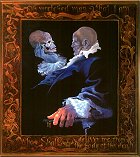
The Wretched Man
There are problems with thinking that the “Wretched Man” is Paul’s pre-Christian experience based on recent studies of Judaism by E. P. Sanders and others. This “New Perspective on Paul” argues that Judaism was not a “works for salvation” religion and that “rabbi Saul” would not obsessed about his lack of perfection in following the Law. I suppose it is possible that Paul was a particularly obsessive follower of the Law, but it is also popular scholarship that reads Luther’s own struggle into the passage.
The problem, for Cranfield, in accepting either the first or seventh option is that they present a dark view of the Christian life and one that seems to be incompatible with the concept of the believer’s liberation from sin as presented in 6:6, 14, 17, 22, and 8:2. But it is important to understand that the very fact that there is a struggle indicates that the Spirit of God is present in the writer’s life, for without the Spirit he will never realize that he is in sin and struggle to remove himself from that state. He observes it is “relatively unimportant” that we choose between the first or seventh option since they are virtually the same thing. If it is autobiographical, then Paul struggled with sin as a very mature Christian. Is that possible? While we might think a mature Christian has risen above the wretched struggle, that is not true.
What is the significance of this passage to the believer? We can learn from this passage that it is clear that if Paul himself struggled with sin, then we should realize that we, too, will struggle with sin. In fact, I think there is more danger in “not struggling” than being content in your walk with God.
The sin of complacency is far more dangerous than we might think.

 First, if we are in fact saved by grace without obedience to ritual or law, then why should we not “sin that grace may abound”? This appears to have been a problem for Paul since he addresses in in several of his letters. Paul did not teach his followers they were free from all moral restraint. In fact, Paul will include several chapters in Romans on what the Christian life ought to look like. Although someone might accuse Paul’s followers of living as though they had no moral boundaries, this was not the point of his Gospel.
 In order to show how justification “works,” Paul alludes to Genesis 3, Adam’s rebellion against God in the Garden. Genesis 3 indicates the penalty for eating from the tree of the knowledge of good and evil is death, and Genesis 5 demonstrates that result since all of Adam’s descendants die. This is the only genealogy which includes the phrase “and then he died.”
 Our present/future justification means we can rejoice in our suffering (5:3-4). The verb translated “rejoice” is the same as boasting in the previous verse (καυχάομαι). Suffering is typically not something a Roman person would boast about, and a Jewish person might associate suffering with the curse of the law. But Paul says those who are in Christ ought to boast in both our future hope and our present suffering. Why?
 Character produces hope (ἐλπίς). Our developing character produces hope, knowing that the suffering is entirely worthwhile. By way of an analogy, people who train for an athletic context suffer physically from their training. Someone training to run the marathon in the Olympics must change their entire lifestyle in order to compete at that level.
 Our experience of peace, however, is a present tense verb (ἔχομεν), having been justified in the past, we are now in a state of peace with God. I should mention the famous textual variant here, some manuscripts read ἔχωμεν, a subjunctive verb rather than indicative. This alternate reading is supported by both