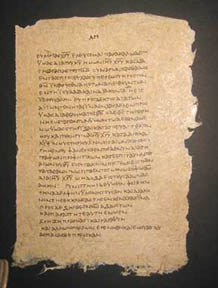
The Purpose of Hebrews

One of the problems with reading Hebrews is identifying the date and recipient of the letter. I am fairly well convinced that the recipients were in Rome, living just before the Neroian persecutions.  I think the standard arguments for this position are solid.  Jobes (Letters to the Church) makes the point that the book does not use the destruction of the Temple as a “proof” that the Old Covenant has been replaced by the New.  In addition, the church has “not yet suffered to the point of shedding blood” (12:4).  If the recipients are in Rome, then the letter must refer to a time prior to Nero’s persecution of Christians (A.D.64), but after Caligula Claudius expelled Jews (A.D. 49).

Given this context, the recipients struggle with the promises of Christian faith.  If Jesus is the true sacrifice and the fulfillment of the promises of the Hebrew Bible, why have they suffered so much?   As J. W. Thompson says in his Hebrews commentary, the book is written to “reorient a community that has been disoriented by the chasm between Christian confession of triumph and the reality of suffering it has experienced.”

This is not apologetics in the modern sense.  The author does not argue against Judaism nor does he state that Judaism was bad or wrong in any way.  Rather, the writer constructs a positive argument for Jesus’ superiority to various elements of Judaism; he is superior because he is the fulfillment of these things. (He is the substance to which the shadow pointed).

If I am right about the context of the book and the recipients have suffered for their faith already (and are about to suffer even more so under Nero), then the readers may very well have struggled with the shame of suffering in a culture which did not see suffering as a virtue. Within a Jewish context, suffering is sometimes seen as a result of sin, or at the very least, a lack of blessing from God.  We only need to look at the discussion in the book of Job to see that there was a lively discussion of why humans suffer.  If Christians are right and Jesus has triumphed, then why are his followers not blessed?  Why are they suffering?

Within a Greco-Roman context, Christians were not seen as successful because they suffered.  Roman thinking was very much based on honor and shame, of one suffered shame and humiliation in public, one cannot be described as successful!

The book therefore addresses a very real problem.  If Jesus is already seated at the right hand of the Father, why is it that Christians suffer shame and persecution?  Christians are not “of this world,” they are part of the real, unshakeable reality which is not of this world at all.

The theological dissonance which the book of Hebrews addresses is certainly applicable to the church today, especially in America.   Evangelical American Christian can be described as “triumphant,” especially in the last half of the 20th century.  Evangelical churches expanded greatly and had a greater impact on culture than at any time in history.

We very well may be past that now.  Studies indicate that the church is still growing, but at a pace which is slower than the general population.  We are beginning to lose ground and we have in many ways lost our voice in the public square.   Perhaps this is due to Christians who have humiliated themselves and brought shame to the cause of Christ, or because some very bad people chose to use evangelical Christianity as a way to advance political careers or other agendas.

Lukan Authorship of Hebrews

Here is a new book from Broadman & Holman by David Allen which argues that Luke is in fact the author of Hebrews.  It is not out until June, but I am already looking forward to hearing what Allen has to say.  (I saw the announcement originally on Polumeros, a blog devoted to all things Hebrews.)

What I think is most interesting is that B&H lists this book as part of the NAC Studies in Bible and Theology series. I have enjoyed the NAC series and highly recommend most it as a reflection of good Evangelical scholarship.  A supplement series with the same attention to quality is much appreciated.

The Old Testament in Hebrews

One cannot help but be impressed by the knowledge of the Hebrew Bible displayed by the writer of Hebrews.  What is more, he handles scripture in a subtle way which brings out nuances of meaning which are not obvious to the casual reader.  George Guthrie’s article on the Old Testament in Hebrews gives three uses of scripture in the book of Hebrews.  Chain Quotations and Example lists are fairly straightforward, so I will focus on midrash here.

Midrash is a method of interpretation which uses key words to make connections between texts.  These connections are often surprising.  Texts are connected on the basis of similar vocabulary and similar themes.  Guthrie points out that in Hebrews 10:5-7 the author of Hebrews quotes Psalm 39:7-9 (LXX) and builds his argument around the words “then” and “will.”  In fact, then word “then” is used to imply that “the old order has been set aside” and has been replaced by a new order in Jesus (Guthrie, 843).

Hebrews 7 does some remarkable things with the text of Genesis.  Melchizedek’s priesthood is superior to the Levitical priesthood because he was the “King of Righteousness,” he has no genealogy, and Abraham tithed to him.  He is therefore an eternal priest who is superior to Levi, since Levi was present in Abraham when he gave a tithe to Melchizedek.  I think that if your pastor tried to do this sort of exegesis next Sunday Morning, you might have some objections! Yet here in Hebrews we have a sort of exegetical maneuver which argues Jesus is superior to the Levitical priesthood, employing a method recognized by Jewish scholars of the day.   Read Genesis Rabbah, 43:6, 56:10 for similar comments to Hebrews.

Midrash-like techniques are found in Paul and Jesus as well some of the apostolic fathers.  If this was a legitimate method of interpretation in the first centuries of the church, why do most Christians reject it as an inappropriate way to read the Bible? Perhaps we do not reject it as much as we like to think.

Frequently midrash is described as a form of intertextuality.  Intertextuality is a bit of a buzz word in biblical studies a the moment, perhaps because it sounds a bit like trendy post-modern literary hermeneutics.  Many have pointed out that scholars who describe their method as “intertextual” are really working with the same sorts of principles as Jewish midrash and are not at all doing post-modern intertextual studies.  This is a valid criticism, although most New Testament scholars will stop short of creating a midrash.  Most of us are content to find the method used in Hebrews.

I suspect that it is the pastor  who “does midrash” as he seeks to explain the text of the Hebrew Bible to a congregation, although I doubt many pastors consciously try to create new meaning from a text by finding key words and connections between texts.  While some may be legitimate, most of the time they do not bear up to close study.

Bibliography: G. Guthrie, “Old Testament in Hebrews,” pages 841-850 in The Dictionary of Later New Testament (Downer’s Grove: Inter Varsity Press, 1997).

Endure, in the Light of the Future (Hebrews 10:32-39)

In Hebrews 10:32-39 the writer of Hebrews invites his readers to “recall the former days,” likely a reference to the time just after the accepted Christ.  The writer wants the readers to recall what they have already suffered so that they might continue to endure in the present.  What have they already endured?

They endured struggle with suffering. Whenever people in the Roman world accepted Christ, they necessarily rejected the culture of the Roman World – their gods associated practices.  For this they suffered some level of persecution.  The book of Acts demonstrates that the Greco-Roman world did in fact “fight back” against the Pauline mission in Philippi, Thessalonica, and Ephesus.

They were publicly exposed to reproach and affliction. While some commentators have connected this with the persecution of Nero, this does not seem to be the case.  It may refer to the Claudius’ decree expelling Jews from Rome; or it is a general comment that describes the experience of many Christians in the first century.  The noun used for reproach (ὀνειδισμός) is used only a few time sin the New Testament, most importantly for the suffering of Jesus in Rom 15:3 (citing Ps 68:10), and similarly in Heb 11:26 (Moses’ reproach in Egypt).   The word-group has the connotation of “loss of standing connected to disparaging speech” (BDAG), perhaps a reference to rumors and lies spread about Christians which led to their loss of property in the community.  The verb translated “be shamed” (θεατρίζω) is only used here in the New Testament and includes a public shaming, the related noun has to do with a theater or public spectacle.  The suffering described is not “behind closed doors,” but rather in front of the whole community.

They had compassion on those in prison. Those who have been arrested and placed in prison must be cared for by friends and family.  The Roman world did not usually imprison people for punishment, so they were in prison until they face trial.   Compassion on the prisoner is part of the duty of a disciple of Jesus (Matt 25, for example, Philippians).

They joyfully accepted plundering of their possessions. The readers “welcomed” the loss of their property, with the connotation of friendliness.  Imagine if someone was losing their home to a creditor and their property was being repossessed, and they helped carry their stuff to the trucks and served the workers coffee and donuts!  We cannot know how the readers were joyful or if they acted in this way to the ones who were attacking them, but the idea here is that they did not fight the loss of property because they know where their treasure truly is kept.  These people who lost property could do so because they knew they had a “better possession” which is real, abiding. This word will also re-appear in 11:26 describing Moses loss of position in Egypt.  In fact, this verse anticipates Moses as an example of one who suffered great loss for the cause of Christ.

All of this suffering is not simply in the past (when they were first enlightened). They are in fact suffering now, and perhaps the writer is concerned that their ongoing suffering will cause some of the readers to become discouraged to the point of “shrinking back.”

The faith of these early Christians is remarkable since I think that most American Christians would “shrink back” well before they were publicly shamed or lost property on account of their faith.  If it was going to cost you money, position, or status to attend a church meeting, would you be as eager to attend a service?   Or would you give up meeting together in order to avoid suffering?  Frankly I think that most of us would find a convenient excuse to avoid suffering, since we make those excuses now without external pressure.

Jesus and the Heavenly Sanctuary

Jesus is superior because he ministers in the “true tent” as opposed to the earthly “copy and shadow.”  He is not a priest in the earthly tabernacle or temple, but rather in the “real tabernacle” which is in heaven.  This text alludes to Exodus 25:40 which indicates that the original tabernacle was built after a pattern which was revealed to Moses on Mt. Sinai.

In Exodus Moses received the plan for the Tabernacle from God.  The noun tabnit means something like “an architectural plan” often with the connotation that the item which is designed follows the pattern of something else.  An idol, for example, is in the pattern of a person or animal (Deut 4:16-18, referring to “graven images.”)   In the Greek translation, the word is tupos, a pattern or plan.  But in philosophical writings the word can have the sense of archetype, the ideal thing after which something is patterned.

As with other elements of Israel’s history, the writer of Hebrews is creating a typology between the earthly, historical fact of the tabernacle and the heavenly, “substance behind the reality.”  The writer is explaining that the heavenly is greater than the earthly, therefore the heavenly priest who ministers in the heavenly sanctuary is superior to the earthly.

It is significant that 8:2 states that the earthly tabernacle was set up by the Lord, alluding to Num 24:5-6 (describing the loveliness of the tents pitched by the Lord).  The immediate reference is to the tabernacle, but all of creation is the “tent pitched by the Lord” (Isa 42:15; 40:22).  The tabernacle was a kind of replica of Eden, decorated with trees and guarded by Cherubim.

Does this imply that there really is a “heavenly sanctuary”?  Possibly, since the idea of a heavenly sanctuary is common in both the Hebrew Bible and in the Second Temple period literature.  Ezekiel 40-48 is most obvious example, but see also Jub 31:34, 1 Enoch 90:28f., 1QSb 4.24ff, (Mark 14:58 may also be included here, although this comes on the lips of false witnesses at the time of Jesus’ trial.)   But the point the writer is trying to make is that just as the copy is inferior to the original, so too the earthly copy is inferior to the heavenly perfection.  If Jesus is a high priest in that heavenly sanctuary, then his priesthood and sacrifice are also therefore superior.

Ellingworth (Hebrews, 408) sees this passage as a reversal of the intent of Exodus 24.  There, Moses had a copy of the perfect model from heaven, therefore the worship in the tabernacle was superior to any other form of worship.  Here in Hebrews, he argues, the copy Moses made is inferior to the heavenly reality in Jesus. But these may not be mutually exclusive points, Moses’ tabernacle was superior to all forms of worship in the Ancient world, but now in Jesus the “substance” of Jesus’ ministry is greater than the shadow of Moses’ ministry.

The writer therefore sums up the argument so far in the book (Jesus and his high priesthood are superior to the levitical priesthood) and anticipates the major point of this chapter – that the covenant under which Jesus operates is superior to the old.