That Jesus did miracles is the claim of every layer of tradition in the New Testament. Even non-biblical writers describe Jesus as a healer. But Jesus did not heal people to gain an audience or to generate interest in his mission, he never asked for anything from those he healed. Jesus did not want “prayer partners” who regularly give to his ministry. Jesus healed in order to reveal something about himself. The healing in Mark 2 is an example of this “healing as self-revelation.”
Jesus returns to Capernaum and attracts a very large crowd at Peter’s home. A paralytic is brought to Jesus by some friends to be healed. Since they cannot enter the home because of the crowd, the men go onto the roof and break a hole large enough to lower the man on a pallet into room where Jesus was. The roof of a typical home at the time of Jesus was a sun dried mud thatch, so the very “to dig” is quite appropriate.
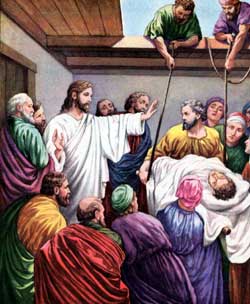 Mark 2:5 says “When he saw their faith,” referring to the friends of the paralytic. But rather than heal the paralytic, Jesus forgives the man’s sins. The paralytic does not demonstrate faith, at least to our knowledge, nor did he ask for his sins to be forgiven. Jesus pronounces the man’s sins forgiven in order to make a point about himself – the miracle here is a revelation of who Jesus is.
There was a relationship between sins and birth defects in the minds of the Scribes and Pharisees. Jesus may be attacking this misconception of sin by forgiving the sin without healing the man. In the ancient world, an extreme illness or birth defects was considered to be the result of sin, either on the part of the sick person or on the part of the person’s parents or grandparents. (The disciples ask about a blind man in John 9:1-2.) Not only do all the people observing this believe this to be true, but the man himself probably believed that his sickness was the result of sin.
Forgiveness of sin and healing typically go together in the Hebrew Bible and Second Temple Period Judaism. In 2 Chron 7:14, God forgives the sins of Israel and “heals their land.” Similarly, Psalm 103:3 connects forgiveness with the healing of disease, and in Isaiah 19:22 the Lord responds to Israel, hears their pleas and heals the nation.
For most of the original audience, it is startling that Jesus claims to forgive sin by his own authority. in fact, Jesus;s claim to have forgiven the man’s sin elicits a strong reaction from the religious leaders observing Jesus’ actions. Jesus did not say, for example, “in the name of God your sins are forgiven,” but rather “your sins are forgiven.” Jesus himself is forgiving the sins as if he were the one offended by them rather than God.
Noticing their thoughts, Jesus says to the teachers of the law: Which is easier, to say ‘your sins are forgiven’ or ‘rise and walk’?” It is just as easy to say one as the other. Jesus point is that saying is the easy part, doing is the difficult part. Jesus says that he will not only forgive the man’s sins, but he will heal him, so that the teachers of the Law might know that he has the authority to do those things. There is a significant bit of theology packed into this statement. Authority is power, ability, and permission to do something.
Jesus healed in order to signal the beginning of the messianic age and to prove to the Jewish leadership that he was the Messiah. That Jesus calls himself the Son of Man in this section important since it is likely an allusion to Daniel 7, where “someone like a son of man” is given authority to rule. In a sense, Jesus is drawing together three lines of evidence for his divinity. He forgives sin, he is about to heal a lame man, and he claims to be the Messianic Son of Man.
