Paul’s Jewish Heritage (Philippians 3:4-6)

Was Paul a Jew? Most Christians think of Paul as Christian,and probably one who believes just like they do. This is a mistake: one of the most important starting points for the study of Paul is the simple recognition that Paul was a Hellenistic Jew who was born in the Diaspora, yet received training in Jerusalem from the prominent teacher Gamaliel.  While this seems to be a rather obvious observation, scholarship has drifted between two poles, Paul the Greek and Paul the Jew. By describing Paul as a “Hellenistic Jew who was born in the Diaspora,” I hope to avoid either extreme.

Paul’s claim in Philippians 3:4-6 is that he is a proper Jew: circumcised on the eighth day indicates that he comes from a family that is keeping the Jewish traditions despite living in Tarsus. It is possible there were Diaspora Jews who did not keep this tradition or even did not circumcise their sons. The reference to being a member of Israel connects Paul to the covenant as a member of Abraham’s family. Paul was not a Jew pretending to be a Greek, but rather a Jew who was well aware of his heritage as a child of Abraham.

Paul also boasts about his heritage as a member of the tribe of Benjamin. This is significant since not every Jew in the first century could claim to know they were from a particular tribe. Paul’s Jewish name “Saul” is taken from the first king of Israel, from the tribe of Benjamin, and Paul’s teacher in Jerusalem, Gamaliel, was also from the tribe of Benjamin.

The phrase “Hebrew of the Hebrews” in Philippians 3:4-6 can be taken in several ways. This phrase may mean that Paul was born of true Jewish blood, that there is no Gentile in his linage. It is sometimes suggested that Paul is referring to his ability to speak and read Hebrew. Not all Jews spoke the language, especially in the home. If there is an increasing specificity in the list of descriptions, then Paul is claiming to have come from a conservative Jewish family who maintained their distinctive Jewish pracices even though they lived in Tarsus, far from Jerusalem.

As J. B. Lightfoot once observed, Paul is making a progressive argument. A convert to Judaism may be circumcised. A few proselytes might claim a tribal affiliation, but Paul is a pure-bred true Jew! Paul is clear this heritage is of no value now that he is “in Christ,” but it seems obvious Paul’s Jewish heritage is one of the major factors behind his successful evangelism.

Pamela Eisenbaum provocatively titled here 2009 book Paul was not a Christian (Harper One, 2009). She argues Paul is best understood in a Jewish context. As her book argues, Paul’s letters are only Christian because Christians chose to canonize them. According to Eisenbaum, there are not many distinctly “Christian” elements in the books, he is a Jew concerned with how other Jews understand a particular messianic claim (namely, that Jesus of Nazareth was the messiah). On the one hand, I am not at all persuaded by the book (obviously Paul was a Christian!), but she does make the point well that Paul is not a Christian in the sense that a post-Reformation follower of Jesus is a Christian. I doubt Paul would fit in at a meeting of the Evangelical Theological Society or the Southern Baptist Convention.

But Paul is certainly cannot be described as a traditional Jewish teacher following in the footsteps of his mentor Gamaliel. By following Jesus, Paul in some sense departs from Second Temple Judaism as we know it. Ye how far does Paul depart from his heritage? In some ways his theology is certainly radical, but perhaps not as radical as often assumed.

Selling in the Temple?

It seems strange that there were vendors set up in the Temple courts selling animals.  Usually Christians think of these people in a very negative light, since Jesus does run them out of the place and calls then a bunch of thieves.  Christian preachers sometimes over-emphasize that the sellers were taking a very high profit from the Passover visitor who must by an animal at the Temple.  I myself am guilty of drawing an analogy to buying food at an airport, it is always more expensive since there is no free market.

But is this a fair reading of these “sellers and money changers”?   Who are these people selling animals and changing money in the Temple?

It was very difficult to travel to Jerusalem with a lamb for the Passover sacrifice. If it was injured or found to be in some way unclean, then the worshiper would not have a sacrifice for the festival. To assist people in their Temple authorities sold “pre-approved” lambs for people traveling from the Diaspora for the Passover Festival.

The sellers are vending oxen and pigeons along with sheep. These might be thought of as the high and low end of the sacrifice scale. A wealthy man may choose to sacrifice an ox while a poor person could only afford a pigeon. Doves were required for women making a cleansing sacrifice, only the High Priest was required to make a sacrifice of a bovine. Both of these types of sacrifices would be difficult to deliver to Jerusalem, especially if the worshiper was traveling from a distant city such as Ephesus or Rome. It would be virtually impossible to bring an ox that distance, a pigeon might not last the whole trip!

These sellers are therefore providing a reasonable service to travelers arriving at the Temple. The pilgrim could be sure that they could purchase an acceptable animal once they arrived at the Temple.

Why would they sell the animals in the Temple courts? Ed Sanders questions whether anyone would sell animals in the court of Gentiles since there would be a great deal of straw, excrement, and noise – all of which would be offensive to the worshipers entering the Temple. There were shops outside the Temple which could be used to sell animals and change money.

Von Wahlde, however, points out that Sanders may be correct for normal times in the Temple service, but during Passover such a huge number of sacrifices were required that it is possible that booths were allowed in the court of the Gentiles in order to handle the crowds. None of the Gospels imply the whole Gentile court was given over to the selling of animals.  Perhaps a larger area was open for sales during the Passover, at other times sales were prohibited.  Either way, for the most part these sellers were providing a service most people found helpful.

If this is true, what was Jesus problem with the sellers and money changers?

Peter and Diaspora Jewish Christians

Like James, Peter’s first letter appears to reflect a Jewish Christianity. Surprisingly, this is not the majority opinion. In his brief notes on 1 Peter in the ESV Study Bible, Thomas Schriener comments that “Most scholars are convinced that the recipients of 1 Peter were primarily Gentiles” (ESVSB 2402). Carson and Moo (Introduction, 647) assume a mixed congregation. Raymond Brown (Introduction, 720) also sees the target audience of 1 Peter as “Gentiles who have been heavily catechized with a strong appreciation of Judaism.”

There are several indications that Peter is addressed to Jewish Christians congregations, which may include God-Fearing Gentile converts, but I would prefer to see these primarily Jewish Christian churches.

1 Peter 1:1 addresses “the elect” who are “scatted” (1:1, NIV). Both words are significant in that they point to a Jewish audience. The “Elect” is a common self-designation in Judaism. They are the nation which God chose (via Abraham, or in the prophets, when he rescued the nation out of Egypt). “Scattered” is the Greek diaspora, the Diaspora. This was a word used frequently to describe Jews loving outside of the Land, including those regions addressed in 1 Peter 1:1.

These elect believers are described as being in exile (ESV). This word is better translated as “sojourners,” or “strangers.” The Greek parepidamos is rare in the New Testament, occurring here, 2:11 and Heb 11:13 referring to the children of Abraham (LXX Gen 23:24, LXX PS 38:13, 39:12 ET). The synonym paroikos appears in Acts 7:6 with a similar sense.

If one sees the addressees of 1 Peter as Gentile, then these descriptions must be taken as metaphors. It is assumed that the church is New Israel, and so Christians like Peter picked up on language once applied to the Jewish Diaspora and re-apply it spiritually to the Church (as Schreiner does in ESVSB 2405). If Peter, like James, is writing a letter to other Diaspora Jews, then there is no reason to take the language referring to anything other than Jewish believers.

There are several other examples of letters to Jews in the Diaspora. In Jer 29:4-23 a letter is sent to Jews living in Babylon. Similarly, 2 Baruch 78-87 imagines a similar letter sent from Baruch after the fall of Jerusalem. The first chapter of 2 Maccabees is a letter sent to Alexandrian Jews. James should also be included in this list, as well as the book of Hebrews, which is addressed to Jews living in Rome in the mid first century, although the word Diaspora does not appear there. It is therefore Peter stands in a tradition of Jewish writers and leaders writing to Jews in the Hellenistic world. to encourage them in their belief and practice.

What difference would reading 1 Peter as addressed to Hellenistic, Diaspora Jewish Christians make as we read the text of 1 Peter?

Acts 12:1-2 – Why Did Herod Kill James?

The Herod mentioned in Acts 12 as a persecutor of the apostles was Herod Agrippa I (10 B.C.- A.D. 44). He was the grandson of Herod the Great and was educated in Rome. He was a friend of the imperial family but supported Caligula as the successor to Tiberius and was imprisoned. When Caligula became emperor, Agrippa was released and was given the title of King and the territories formerly held by Herod Philip and Lysanias, and later the territory given to Herod Antipas. Agrippa was a key figure in persuading Caligula to rescind his order to place an image of himself in the Temple (JW 2.206-13, Antiq. 19:236-47).

Herod Killed JamesWe are not told why Herod persecuted the church in Jerusalem, although it may be that he was, in some respects, interested in his “Jewish roots.” This piety was demonstrated upon his return to Judea. He donated a golden chain, given to him by Caligula when he was freed from his imprisonment, to the Temple. In addition, he sponsored a large number of Nazarite vows in the temple (Antiq., 12.6.1, Schürer 2:155).

During a Sabbath year, Agrippa read from the book of Deuteronomy and was moved to tears when he read the words of Deuteronomy 17:15, forbidding the appointment of a stranger over the “brothers” (i.e., a non-Israelite over Israel.) The crowd which witnesses this responded, “Thou art our brother!” (See m.Sota 7.8). According to Josephus:

“He loved to live continually at Jerusalem, and was exactly careful in the observance of the laws of his country. He therefore kept himself entirely pure; nor did any day pass over his head without its appointed sacrifice.” Antiq. 19.7.3

Schürer argues that Agrippa was favorable to the Pharisees and even, to some extent, a Jewish nationalism (2:159). This may be plausible given his zealous persecution of the Jewish Christians in Acts 12.

James’ death occurs about eleven years after Stephen’s stoning (Acts 7), probably around A.D. 41-42. Agrippa may have been motivated toward this persecution by zealous Pharisees (like Paul) who sought to suppress Jews who taught that Jesus was resurrected from the dead. It even appears that the people of Jerusalem no longer support Jewish Christians. Witherington makes this point: the city of Jerusalem has “turned against” the Jewish church (Acts, 386 ).

A further motivation for James’s summary execution may be the apostles’ messianic claims. If Caligula was inclined to demand his image be honored in the Temple, then perhaps messianic fervor among the Christians was high. Jesus himself predicted an “abomination which causes desolation” similar to the offenses of Antiochus IV Epiphanes (Dan 9:25-27, Mark 13:14, and parallels).

Agrippa is, therefore, acting like a pious devotee of the Jewish faith by pursuing the leaders of the Christian community who promote the teaching that Jesus is the Messiah. If this is true, how does it play out in the overall themes we have been seeing in Luke? Is Herod the “ultimate fringe” of what it means to be Jewish?

Bibliography: David C. Braund, “Agrippa” ABD 1:98-99; Schürer , 2:150-159.

Acts 9:43 – Peter and Simon the Tanner

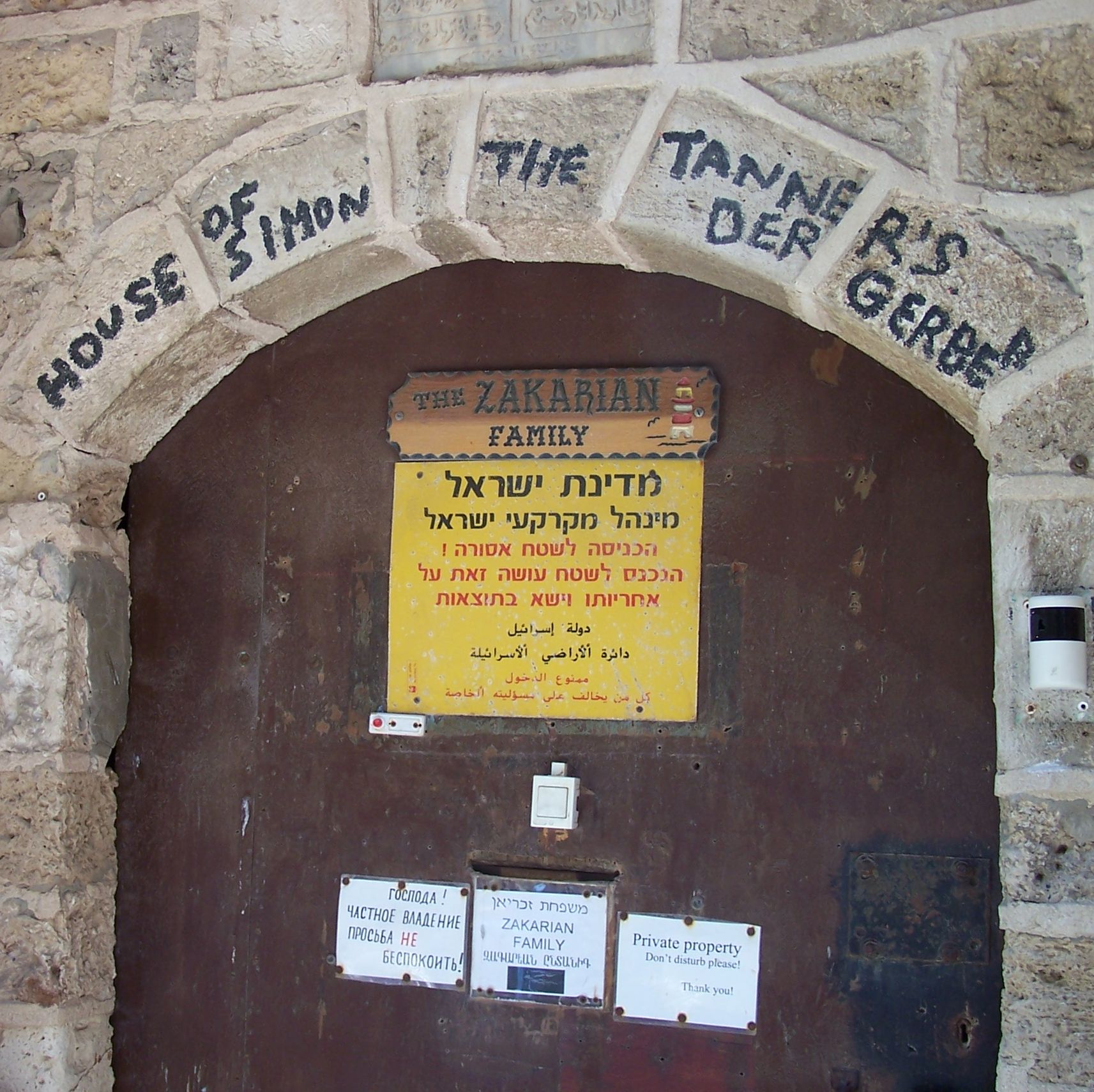
At the end of chapter 9, Peter stays in Joppa at the home of Simon “the Tanner” (v. 43). It is significant that Peter would accept hospitality from Simon since the occupation of leather-worker (a tanner, βυρσεύς) was considered to be unclean by the Pharisees.

Simon the Tanner's Door

Traditional Site of Simon’s House

A tanner was one of the most unclean trades in any ancient society, the nature of their work kept them in a state of ritual uncleanliness (Lev 11:35), and the process of tanning leather resulted in a state of physical uncleanliness. The rabbis mention tanners or tanneries in the context of other “unclean things.” In m.Meg 3:2, a tannery is in the same category as a bathhouse and public urinal; in m.Ket 7:10 a tanner is lumped together with “he who is afflicted with boils, or who has a polypus, or who collects dog excrement.” Because of the stench of the tanner’s shop, most towns required that the tanner had to live on the outskirts of town, downwind! The Mishnah states “They put carrion, graves, and tanneries at least fifty cubits away from a town. They make a tannery only at the east side of a town” (m.Batra 2:9).

It is possible that Simon owns a tanning business and does not work the trade himself. But business appears to be good for Simon since he is able to open his home to Peter. The home is large enough to have a gate and courtyard far enough away from the house that Peter did not hear Cornelius’ men arrive (10:17-18).

That Peter shares hospitality with Simon is significant. Just like Jesus, he is eating and drinking with the outcast, people who are Jewish but on the fringe of society from the perspective of Temple purity and Pharisaical tradition. While tanners are never included in the list of outsiders with whom Jesus eats, they might very well be in the same category as tax collectors and prostitutes.

It is therefore quite curious that Peter hesitates when he is told to God to Cornelius in chapter 10. This is a testimony to how far Jews and Gentiles were separated culturally. Peter has no problem staying in the home of a tanner who was unclean, yet will not enter the home of a Gentile God-fearer, someone who was likely more “clean” than the tanner, with respect to the Law. The difference, of course, is that even if Cornelius was a God-Fearer, he was still an uncircumcised Gentile.