Acts 18 – Corinth in the First Century

Paul’s ministry in Corinth is his biggest success up to this point in Paul’s missionary career. The Romans founded a colony on the site of ancient Corinth in 44 B.C. The new city of Corinth was populated by freed slaves (Strabo (8.136) cf., Appian (Hist 8.136)). Socially this means that the new population has been given freedom, a fresh start, and the opportunity to advance far beyond what they might have hoped for as slaves.

Temple of Apollo at Corinth (January 2019)

The town was laid out in the Roman style, completely ignoring the layout of the old city, although the forum follows the outline of the old agora. The cardo (main street) cut through the old city. All of the architecture and design reflected the Roman style, not Greek. Even the Greek temples were “modernized” after the fashion of the Romans, including an imperial cult temple overlooking the forum.   The foundations of the temple were higher than the other temples, even that of Apollo. The settlers were making it clear that Corinth was to be a Roman city, loyal to the Empire rather than the memory of the Greek city of Corinth.

The buildings for the Isthmia Games were done in a Roman style and Roman games were added to the Greek contests. The first Isthmian Games of New Corinth were held sometime between 7 B.C. and A.D. 3. in honor of L. Castricius Regulus, who had re-built the athletic facilities of Corinth. Regulus offered a banquet to all the inhabitants of the city to honor the games. These games are important to an understanding of the problems of the Corinthian letters since the games were not simply athletic events.  They were dedicated to the gods, the chief of which was the Roman Emperor Nero himself. It was in the A.D. 50’s that the city of Corinth was honored with an Imperial Cult center. This is a major factor in Paul’s arrest and hearing before Gallio.

It is the combination of the games and imperial cult that put enormous pressure on the Corinthian church. The whole city would have participated in the banquets honoring the Roman Emperor, the elite of the city would be invited to the most important banquet honoring the Emperor as a god. There are both political and spiritual aspects to consider in refusing to attend this meal or social events like it.

The city of Corinth was an important cosmopolitan city in the middle part of the first century. It was economically stable, attracting a wide range of businesses from all over the Empire. Paul established the church in this city for this very reason. Once Christianity takes hold in Corinth, the local churches themselves can continue the mission of spreading the gospel throughout the region. Yet of all of Paul’s churches, this one seems to have had the most difficulties assimilating Christianity and their culture.  For this reason Corinth is probably the church of the New Testament that is most like the modern church.

In choosing as one of his main missionary centers a city in which only the tough were reputed to survive, Paul demonstrated a confidence oddly at variance with his protestations of weakness. Corinth, however, offered advantages that outweighed its dangers. In addition to excellent communications, the extraordinary number of visitors (Dio Chrysostom, Or. 37.8; Aelius Aristides, Or. 46.24) created the possibility of converts who would carry the gospel back to their homelands. In contrast to the closed complacency of Athens, Corinth was open and questioning, eager for new ideas but neither docile nor passive, as Paul’s relationship with the Christian community there amply documents (Murphy-O’Connor, ABD 1:1138)

What are the potential implications for modern mission strategy? Paul targeted one of the most modern of the urban centers in the world at the time. Should this speak to where we plant churches? How we plant churches?

Acts 18 – Success Breeds Jealousy

After several very difficult experiences in Philippi and Thessalonica and an unfruitful visit to Athens, Paul finally experiences some good success in Corinth. After preaching in the synagogue he establishes a church that includes several key converts. Luke lists Titius Justus, a god-fearing Gentile and Crispus, the leader of the synagogue.  Both of these were leaders in the synagogue and would have been valuable to Paul as leaders in a new church. A third convert is implied in Romans 16:23 – Erastus, the “director of public works” (NIV) or city treasurer. If Erastus was a convert at this time he would have brought some wealth and prestige to the church. In addition to these converts, Aquilla and Priscilla were in Corinth and eventually the teacher Apollos

art-thou-jealous-muchPaul may have been concerned his success would breed a violent back-lash from the synagogue, as it had in Thessalonica. In fact, Paul has seen this happen before.  The normal pattern is for him to enter the synagogue and face serious persecution.  He is not afraid for his own life, in fact, he seems more than willing to suffer physically for the Gospel.

1 Cor 2:3-4 indicates that Paul was afraid his ministry was destined for failure.  He does not yet know of the fate of the Thessalonican believers, perhaps even Berea is unknown to him.  Athens likely did not result in a church.  Will Corinth go just as badly?  Yet in 1 Cor 2, Paul claims that any success in Corinth was based solely on the power of the Holy Spirit, not his own rhetorical ability.

In Acts 18:9-10 Luke tells us that Paul has a vision in which the Lord tells Paul that he will not be harmed in the city of Corinth and that there are many people in the city that are “the Lord’s.”  There are three short, related commands: Do not fear, continue to speak, and do not be silent.

If these commands reflect Paul’s mood prior to Silas and Timothy’s return, then it is possible that Paul considered, like Jeremiah before him, to remain silent and not open himself up to further persecution (Jer 20:7-12).  But like Jeremiah, Paul cannot keep the Gospel to himself, he must be what he is, the light to the Gentiles.  Even if this means he will be persecuted.  This vision encourages him to continue, since his Gospel message will be received in Corinth. He will remain in the city 18 months, Paul’s longest place of ministry since his commission from Antioch in Acts 13.

An important observation here is Paul’s success was met with increased jealousy and persecution. Paul was obedient to his calling yet he was still suffering. Why is this? To what extent is Luke describing a successful ministry as a persecuted ministry? Compared to what some modern Christians seem to think, this is the opposite of what to expect. Yet for Paul, suffering confirmed he was doing exactly what God called him to do.

Acts 15:40 – Why Silas?

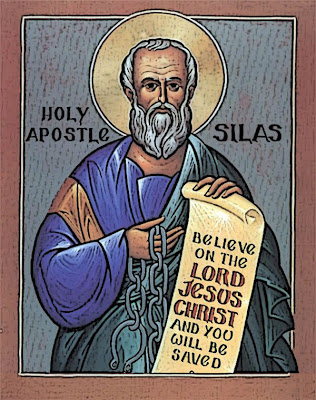
Silas was a Jewish Christian who appears to have been active in the Jerusalem church, assuming that the Silas mentioned in 15:22 is the same man (see Witherington, Acts, 473.).  That Luke should mention a character in one context then pick him up again later is a common feature of the book.

Silas, companion of PaulSilas is likely an Aramaic form of the name Saul. The Silvanus of 1 Peter 5:12 is likely the same man since Peter would have know Silas from Jerusalem.  Silas is mentioned frequently in Paul’s letters, 2 Cor 1:19, and he is a “co-sender of the Thessalonian letters (1 Thess 1:1 and 2 Thess 1:1).  It is therefore suggested that he functioned as a secretary for Paul in the writing of these letters (and perhaps others). 1 Thess 2:6 refers to the “apostles of Christ,” which may imply that he was considered an apostle like Barnabas, although not from the Twelve.

Silas was a Roman citizen since Acts 16:37 implies that he was imprisoned illegally. This would seem to imply he was a Hellenistic Jew.  His name confirms his: he is also known as Silvanus, a Roman cognomen meaning “wood,” and the same name as the Roman god Silvanus, a life-giving deity (Gillman, “Silas,” in ABD 6:22).

He traveled with Paul for most of the second missionary journey.  In Acts 17 he and Timothy returned  to Berea and Thessalonica while Paul continued on to Athens and  Corinth.  R. C. Campbell suggests that since Silas was able to return to these locations indicates that Silas was “less controversial” than Paul (ISBE Rev, 4:509).  This might be true, but it may be that Silas was more acceptable to the Jews socially and theologically than Paul.  What is remarkable is that after he joins Paul in Corinth, he drops out of the story.

B. N. Kaye suggested that Luke used Athens and Corinth to signal a shift in Paul’s strategy: “Luke is pre-occupied with the re-direction of Paul’s mission from the synagogue where it  is directed towards the Jews, to a house where it is directed explicitly, though not exclusively, to the Gentiles” (25).  This shift to the Gentile mission in Corinth receives a confirmation when Paul is vindicated in court before Gallio. I would add that Corinth is Paul’s most successful church up to this point in Acts, although there are a host of problems associated with non-God-Fearing Gentiles coming to Christ.

So why Silas?  Like Barnabas, he was a Hellenistic Jew yet he was firmly rooted in the Jerusalem church.  Paul seems to have wanted a companion who was “acceptable” to Jerusalem, perhaps to preempt any criticism of his Gentile mission by the more conservative elements of the Jerusalem church.  Paul would therefore represent the Antioch churches, Silas the Jerusalem churches, implying that any mission to the Gentiles was co-sponsored by both centers of Christianity.  Does Silas depart after Paul makes his declaration in the synagogue in Corinth?  We cannot know for sure, but it is possible this he he reacted against Paul’s turn to the Gentiles, similar to John Mark after the incident on Cyprus.

Bibliography: Bruce N.Kaye, “Acts’ Portrayal of Silas,”  Novum testamentum, 21 (1979): 13-26.

Comments on “Corinth – City of Sin”

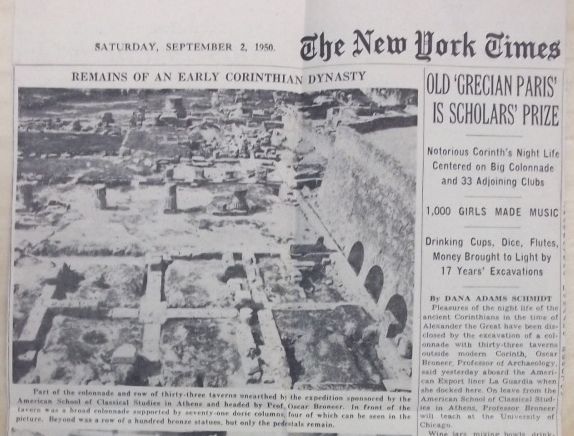
David Pettigrew left a comment on my Corinth – City of Sin post last week pointing out a recent post on the blog, Mediterranean Palimpsest .  This is a  summary of the Dallas DeForest’s work in the Oscar Broneer papers stored at the Blegen Library.  Broneer was a Swedish archaeologist who specialized in Corinth.  Among the many things in the archive is a New York Times article dates Sept 2, 1950 describing the ancient city of Corinth as an “Old Grecian Paris” and a “modern day Miami Beach.”  DeForest says:

In fact, his excavation of the Stoa made the front page of the New York Times on September 2, 1950. In many ways, the title (and subtitles) announce the article’s perspective: “Old ‘Grecian Paris’ is Scholar’s Prize; Notorious Corinth’s Night Life Centered on Big Colonnade and 33 Adjoining Clubs; 1,000 Girls Made Music; Drinking Cups, Dice, Flutes, Money brought to Light by 17 Year’s Excavations.”

To misquote Dr. Strangelove, a fella could have a pretty good time with all that stuff.  Dice and Flutes?  I imagine a fundamentalist preacher in 1950 read that and assumed playing cards and billiards were Corinthian inventions.

Obviously this is a bit of popular newspaper journalism, leading with the exciting news before getting to the actual details.  It did surprise me, though, to see the  the media in 1950 making the same sort of “Corinth was a city of sin” as preachers do today. It is possible that the popular commentators heard these sensational reports while they were in seminary and simply passed them along as fact.  It was in the NY Times, so it must be true, right?

This brings me to Pettigrew’s site, Corinthian Matters.   He has some comments which are along the same lines as my post, but adds:  “it made me wonder how much Broneer himself was responsible for forming certain images of Corinth (e.g., the sex capital of the ancient world) that recent scholarship has problematized or disproved.”   A easy enough way to test this theory would be to read popular commentaries on 1-2 Corinthians prior to 1950, if the sin-city tag is found in a 19th century commentary, the Broneer is not the originator.

Perhaps the moral of the story is that scholars ought to be very careful when the attempt to use public media, your speculations may outlive you!