Book Review: Fant and Reddish, Lost Treasures of the Bible

Fant, Clyde E. and Mitchell G. Reddish. Lost Treasures of the Bible: Understanding the Bible Through Archaeological Artifacts in World Museums. Grand Rapids, Mich.: Eerdmans, 2008. 471 pages, 12 color plates, pb. $28.00, Kindle Edition $15.40.

This book something of a guide to biblical antiquities which are housed in major museums around the world. As such, it is a “greatest hits” of archaeology illustrating the history and culture of the Bible. Some are completely contextual (creation and flood myths), others bear directly on the text of the Bible (Hezekiah’s tunnel inscription or Caiaphas’s Ossuary). All of the entries in the book are housed in museums, but that does not make them easy to find. Fant and Reddish provide a very helpful index sorted by museum. If one were going to visit the British Museum, for example, the index would provide a nice list of“must see” items for the student of the Bible. The entry for the artifact provides locations in the museum as well as item number to assist a visitor (or museum guide) in finding the artifact.

There ten categories of artifacts, arranged more or less chronologically from Creation Myths through the Roman period. The last category is entitled “Sensational Finds: Genuine or Forgery” and really only includes three recent and well-known forgeries (the James Ossuary, the Ivory Pomegranate, and the Baruch Bulla). Each entry has the item name, a category (clay tablet, seal, wall relief), then list of basic facts including provenance and current location, including the museum item number where available. A black and white photograph accompanies nearly every entry. Fant and Reddish then provide several paragraphs of description of the item, often including the circumstances surrounding the origin find. Finally, every entry has a section describing the biblical importance of the artifact. Many of these artifacts are documents, including cuneiform tablets and ostraca. In most cases key selections from these documents is provided in translations from ANET or COS.

Fant and Reddish dismiss so-called “scholars who twist the data to ‘prove’ the Bible” (xviii). This is a fairly clear dismissal of “biblical maximalism,” but may be more aimed at the sorts of popular books and websites which claim to have found Pharaoh’s chariots or some other spectacular find. While distancing themselves from this sort of popular sensationalism, they do provide a rather friendly list of artifacts which are extremely complementary to the text of the Bible. Even where there is opportunity for taking a “biblical minimalist” position, they usually reject it outright or simply state that there no evidence for the more negative view. For example, the Enuma Elish is not a source for the creation story of Genesis (p. 6) and the narrative of Sargon II’s birth is not the source for Moses’ birth narrative (although they do state that the author used “elements common to various legends” to “creatively tell the story of the birth of Moses,” p. 49).

In the explanation of the artifacts Fant and Reddish often report the circumstances of the find. These are interesting to me personally, since many of the major finds housed in museums come from a time when archaeology was more wild and edgy. Archaeologists of the nineteenth-century such as Charles Warren, Charles Clermont-Ganneau or Leonard Wooley lived in a time when one could buy a mummy’s head on the streets of Cairo or completely expose a mound searching for tombs stuffed full of treasures. Those days are gone (thankfully, these men also did a great deal of damage), but there is a sort of swashbuckling romance to the story of the discovery of the Moabite stone, for example.

The items covered by the book are all excellent choices, but there are a few oddities. The Epitaph of Uzziah (140-2) is clearly Hasmonean and likely has nothing to do with Uzziah. The plaque was found in the Russian Orthodox Monastery on the Mount of Olives, not a cave dating to the 8th century B.C. There is one unprovenaced seal (Shebnayau, 142-4), a category which could be expanded greatly. But an unprovenanced seal or bulla is an invitation for forgery! Occasionally the authors include long texts from the Bible which are not particularly helpful (Ezra 5:2-6:12, more than a full page!) I am not sure that statues of Alexander the Great and the Roman emperors qualify as “lost treasures” since these are apt to be well displayed. In addition, including Trajan seems to “go beyond” the Bible. Likewise the inclusion of the Winged Victory of Samothrace (a location Paul may not have visited) and the Corinthian synagogue inscription (as late as the 5th century A.D.!)  These two items are important, but tangential to the theme of the book.

Conclusion. This is an excellent book for general readers interested in archaeology as background for the Bible. Whether it is used in conjunction with a visit to a major museum or not, Lost Treasures provides the reader with good descriptions of the most important artifacts illustrating the world of both the Old and New Testaments.

Heading to Israel (2012 Version)

GBC Israel 2009

I am leaving on December 31 to lead a tour in Israel and Jordan.  This is my fifth trip to Israel since 2005 and I am looking forward to this one a great deal.  This trip is a bit different since most of the group are adults as opposed to college students.  (I suppose that means less uphill walking and more frequent bathroom breaks!)  After visiting in May, I am also looking forward to cooler temperatures in the desert.  I hope to visit Southern Temple and City of David excavations since they have been “in the news” quite a bit lately.

One of the highlights of my tours is spending a few days at Tamar, an archaeological part south of the Dead Sea.  The site is small but unique, with remains from the Iron Age (include a small Solomonic Gate and a four-room house), an Edomite shrine, a Roman bath and store rooms, a Turkish water system, a building once used as a jail during the British mandate, and an Israeli bomb shelter.

Look for frequent updates from Israel and Jordan over the next two weeks!

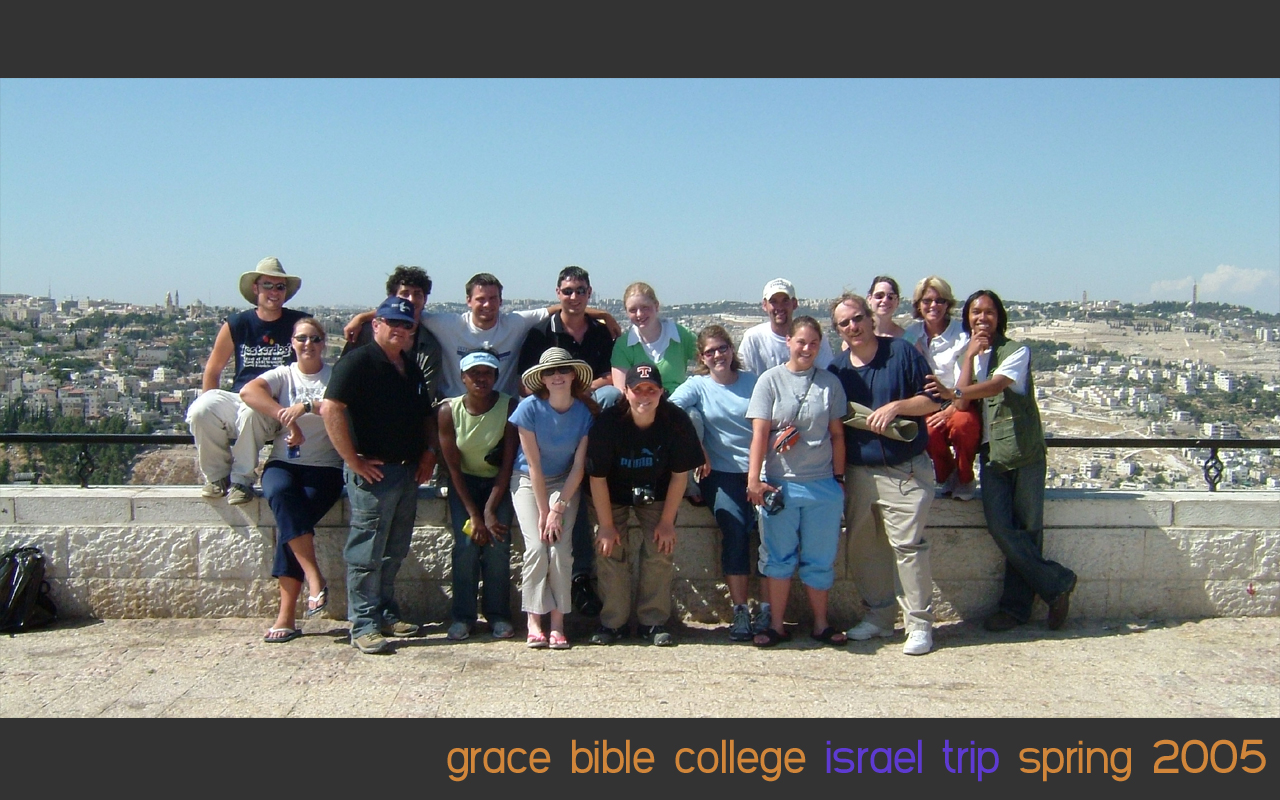
GBC Israel 2005

A Temple-Purity Token?

Back in October I posted a short note on the money changers in the Temple.  Money needed to be changed to an acceptable currency before it could be given to the Temple.  Popular preaching usually states with confidence this is because Roman coins were blasphemous, so they were exchanged for Tyrian shekels. The usual explanation for Jesus’ anger with the money changers is that they were gouging the “tourists” with an exorbitant exchange rate.  This overlooks the fact that the Tyrian shekel had an image of Melkart / Heracles as well as an eagle.  The reason the Tyrian shekel was required was that it was the most pure silver coin available.  Nevertheless, some sort of coin exchange was required before a worshiper entered the Temple.

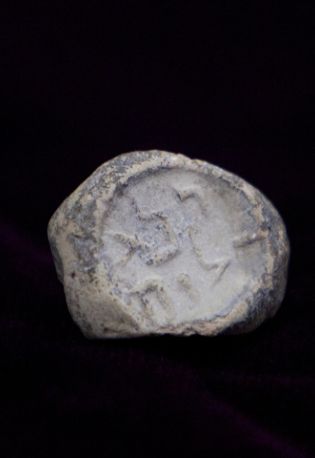
An odd seal or “token” was recently discovered in Jerusalem with the words “pure to Yahweh.”  Ronny Reich described as a seal placed on an object which was dedicated to the Lord.  This would explain why it is a bullae, a clay seal impression.  On the other hand, George Athas suggests on his blog that this seal is a kind of exchange token for use in the Temple.  This would ensure than the worshiper had an accurate exchange rate with the proper coinage and that the coinage was “acceptable” for use in the Temple.

I like Athas’ suggestion, but I am not sure a clay seal could be used for a handful of coins which would be immediately taken into the Temple and “spent” as a tithe or offering almost immediately.  A more durable chit would be more likely in that case.

The seal strikes me as not unlike the common l’melek seal.  This impression is found on jar-handles indicating that the contents of the jar are reserved for the king, perhaps as a tithe / tax.  Perhaps this seal was placed on an item being given to the Temple as an offering. People may have given all sorts of things to the Lord through the Temple aside from money (food, wine, etc.), these items could be marked as set-aside to the Lord with this sort of seal.

Book Review: Jodi Magness, Stone and Dung, Oil and Spit

Jodi Magness, Stone and Dung, Oil and Spit: Jewish Daily Life in the Time of Jesus. Grand Rapids, Mich.: Eerdmans, 2011. xv., 335 p., 24 p. B&W illustrations, pb. $25.   Link to Eerdmans

Stone and Dung, Oil and Spit: Jewish Daily Life in the Time of Jesus is an excellent book and well worth reading.  However, it lives up to its own subtitle.  I am not sure any book can live up to that particular goal simply because the sources for common, daily life of the first century are so limited. This is a problem with haunts every attempt to describe the way people lived in ancient times: normal people did not leave much behind to study.  The poor did not journal their daily lives, nor did they leave behind a great deal for archaeologists to study.

Nevertheless, Magness proceeds through several categories of daily life and describes them via literary and archaeological data.  Each chapter begins with a few citations from the Hebrew Bible, Josephus, the Dead Sea Scrolls, or a rabbinic literature.  Then she turns to the archaeological record, usually showing that the literary descriptions are more or less accurate.  Each chapter attempts to tie the practice to an episode in the life of Jesus.  Topics include purity and the practice of ritual washing (mikveh), food, household items, dining customs, Sabbath observance, coins, clothing, oil and spit, toilet habits, and burial customs. An underlying theme throughout every chapter is a concern for purity.  The chapters on food and household items, for example, have a great deal of material on avoidance of uncleanliness.

Magness’ method can be illustrated by her description of the tzizit (fringes on the edge of one’s cloak) she begins with the Hebrew Bible, then moves through the Dead Sea Scrolls, the Mishnah, the Talmud, and an early Christian writer (Justin). She then describes an episode in the gospels which describes Jesus a wearing a fringe or tassel (Matt 9:20-21 and par.)  There is scant archaeological evidence for the practice in the first century, but it is possible that an unfinished tzizit was discovered in the Cave of Letters (112).  Literary sources help to illuminate archaeology, archaeology helps illuminate the literary sources.  This method is repeated for every topic covered in the book.

Magness is an archaeologist, so it is no surprise that her material on physical data is extremely rich.  Unfortunately, there are only a few sites to illustrate many of the practices covered in the book.  Magness is an expert in Qumran archaeology (see her Archaeology of Qumran and the Dead Sea Scrolls), so it is natural that her illustrations should be drawn from this important site.  The second site which Magness uses is the so-called Burnt House in Jerusalem.  This is an important archaeological site since it is an aristocratic (priestly?) home near the Temple which was burned in A.D. 70.  There is a wealth of household objects which illustrate a number of practices described in this book.

While Magness does refer to other sites, I wonder if the practices at Qumran and the home of an elite member of the aristocracy really illustrate“daily life” at the time of Jesus.  Sadly, there is just not that much available to illustrate how a poor Jewish villager in the Galilee lived, and that is the “daily life” most Christians are going to want to illustrate.

What is remarkable about Stone and Dung is the wealth of literary sources compiled for each topic. Every chapter is a treasure trove of texts drawn together around a topic.  Selections for the Talmud seem to be drawn from “early” authorities, although dating a saying in the Talmud is always a problem. Nevertheless, her selections are judicious and placed along side other first century voices which mitigate any serious dating problems.  I particularly like her use of the New Testament as a serious source.  She is not interested in showing that the New Testament is wrong about descriptions of daily life.  In fact, most often the New Testament describes Jesus as a “typical Jew” and living within the traditions of the Second Temple Period.

In addition to these primary resources, Magness provides detailed documentation in her endnotes.  In fact, the text of the book ends on page 186, the notes run from 187-270 and the bibliography from 271-305!  The fact that they are endnotes frustrates me, but the style makes the main text much more accessible for the non-professional.  I appreciate several detailed indices.  There are 24 pages of black and white illustrations including photographs of archaeological items and pottery figures.  Some of these look like they are repeated from her book on the archaeology of Qumran, but they are quite helpful in illustrating the material evidence.

This book is important because most people because people have so many preconceived notions about how “it was back in Bible times.” Most of these mental images are based on Sunday School lessons or bad Hollywood productions.  The value of a book like this is to set the stories of the Gospels into their proper context.  Without that cultural context, we miss the real depth of the story.  I recommend Stone and Spit, Oil and Dung to anyone interested in the culture of the times of Jesus.