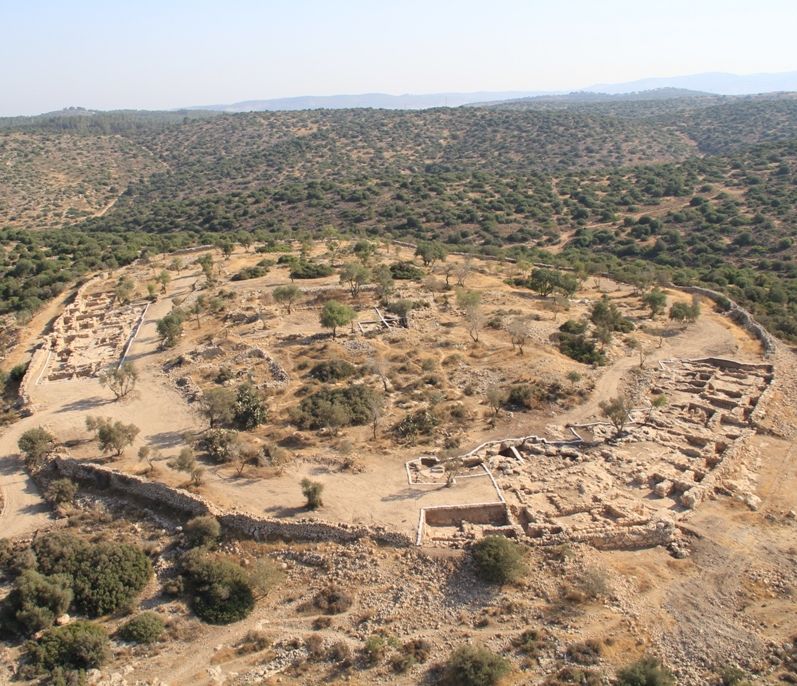
Khirbet Qeiyafa in the Valley of Elah. The Valley of Elah is the site of the well-known story of David and Goliath (1 Sam 17). The valley is about 18 miles southwest of Jerusalem, the ruins of Qeiyafa are on top of a hill that borders the valley to the north. The small settlement was protected by a casement wall and two gates, but was destroyed. The site is significant for several reasons. First, it is certainly an Israelite site dating to the early Iron age, or the kingdom of David. It is along the border of Judah and Philistia, indicating that there were indeed tensions along that border during the time of David requiring a military post to guard the valley.
The most significant artifact to be found at Qeiyafa is a small ostracon (pot sherd) with some early Hebrew writing on it. William Shea offers a unique translation of the text which recognizes that some of the letters are in fact pictograms. His suggested translation of the first two lines is a command to the king to “not make two servants of the judge and the prophet” (604). He suggests that the text was “written in a time of transition” from local judges and prophets to kings. These lines would be advice to a king to not usurp the tradition roles of the judges or the prophets. As Shea puts it, the judge and the prophet may have diminished in authority when the monarchy was established, but they were to continue “independent of the king” (610).
There are other suggested readings of the text, some differing a great deal from Shea’s reconstruction. For example, Gershon Galil of the University of Haifa renders the second and third line as“judge the slave and the widow and the orphan and the stranger.” Despite the variety of suggested readings, they all sound like advice to the king, whether that advice sounds like the voice of a prophet or a sage. After reading 2 Sam 23:1-7 and Prov 31:1-9, I would suggest that whatever the Qeiyafa Ostracon is, it represents advice to a young king on how to rule wisely. This advice reflects a transition from the rule of Judges to Kings, exactly as 1 Samuel records.
Introduction. I have been asked to give a “top ten archaeological finds” list on a few occasions. There are in fact far more major finds that I would be able to list in a single article or seminar. The list of inscriptions and other monuments mentioning biblical characters in the Old Testament is quite long given the relatively minor status of Israel in the ancient Near East. For the New Testament, the archaeology of Ceasarea, Bet-Shean, Sephoris, and Tiberias shows the Roman influence on Jewish life during the time of Jesus. The Dead Sea Scrolls are of monumental importance for understanding the Jewish religion in the first century. I have chosen to focus the attention of the rest of this paper on just two examples from the Old Testament and one from the New Testament which are both important as biblical history, but are also relatively recent and exciting.
The City of David in the Silwan Valley. The City of David was a Jebusite citadel captured by David in 2 Sam 5:6-9. There were a number of structures built along the ridge from the Temple Mount down to the end of the Kidron and Hinnom valleys. The City of David is best known for Hezekiah’s Tunnel, a tunnel cut through the stone to reach the Gihon Spring at the bottom of the valley. The Siloam Inscription was found in this tunnel in 1880 and has been in Istanbul since 1890. The inscription is one the most important artifacts ever found in Israel since the inscription commemorates the place where workmen joined the two tunnels, connecting the City of David to the Pool of Siloam at the bottom of the hill. Robert Coote comments that “it is the nearly unanimous view of historians that the Siloam tunnel is Hezekiah’s conduit, and that the inscription in it was written shortly before 701 B.C.E.” The tunnel is mentioned in 2 Kings 20:20 and 2 Chron 32:30, and is alluded to in Isaiah 22:11. It is unfortunate, on the one hand, that the inscription does not mention Hezekiah. But, on the other hand, any mention of Hezekiah might have been grounds for claiming that the inscription is a fake or dates from a later time.
Recent excavations at the City of David have uncovered hundreds of bullae, or seal impressions dating to the eighth and seventh centuries B.C. These impresses are seals placed on a papyri document as a legal seal. That so many of these little seals have been found is an indication that there was an administrative center which houses a large number of legal documents. It is likely that a fire destroyed the archive, burning the paper but hardening the seals. One seal bears the name “Gemaryahu ben Shafan” (Jer 36:10) and another seal discovered in 2008 appears to have the name Gedeliah, son of Pashur, an administrator in the last days of the kingdom of Judah (Jer 38:1). In summer of 2011 a small golden bell was discovered near the bottom of the valley. The bell may have been sewn into a priestly garment in the first century (Exod 28:33), although it is not certain that the bell came from a priest nor is it clear when the bell was made (it likely dates to the late Second Temple Period, much nearer the time of Jesus than Solomon!)
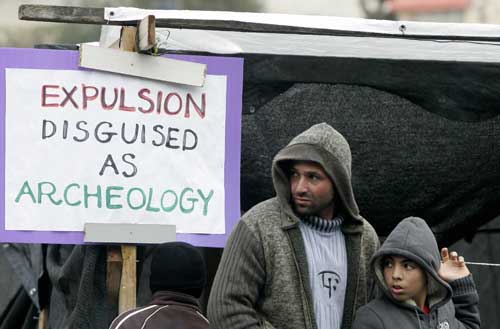
The excavations at the City of David are a good example of the politics of archaeology in Israel today. Since the archaeological work runs along the border of the village of Silwan. Israeli archaeologists are constantly expanding their work, crossing into a village which is historically Arab. In 1967 the neighborhood was annexed by Israel, but the residents consider this an occupation. They view the work of archaeology as a kind of cultural imperialism since the work is done by Israelis for the purpose of proving that Jerusalem is a Jewish birthright. (Whether anyone actually does archaeology for this reason is debatable, but that is the perception in Silwan!) Any further encroachment into the valley will be met with resistance, yet there is much to be learned by working in the valley. Likely there is no solution, whatever compromises are reached will be entirely political.
Unfortunately, people tend to expect too much from archaeology. It would be nice if archaeologists discovered a tablet in Egypt which said something like, “I am glad I finally let those people go, Moses is such a nag….signed Rameses II.” Yet even if we did have such a remarkable artifact, many will remain unconvinced of the claims of the Bible. Unfortunately, there will be no proof-positive which convinces all the doubters. There are two reasons for this.
Jessica and her Major Find
The first reason is the nature of archaeological finds. Rarely do archaeologists find anything which specifically supports a particular story. The vast majority of things found by archaeologists are rather mundane. For every spectacular find like the Dead Sea Scrolls, there are tens of thousands of pottery shards discovered. The average person thinks an archaeologist is like Indiana Jones, having great adventures and finding golden idols or ancient writings. In 2011 a group of GBC students worked for a few hours on an archaeological site, sifting an area of a dig. We discovered pottery, a bucket’s worth for our morning’s effort. For the layman, the pottery is rather boring, but for the archaeologist it is quite exciting! The pottery can tell us a great deal about the people who lived at a site, although there is rarely anything in the pottery which can be described as a “biblical proof.”
We also might want to think about the sorts of things which potentially could be preserved which support biblical stories. For example, what sort of evidence would Abraham leave behind which could be discovered today? I doubt there are tent-spikes out there with “if found, please return to Abraham” inscribed on them. The earliest stories in the Old Testament are such that direct archaeological confirmation is unlikely.
Another factor is that the archaeological record is extremely incomplete. As a science archeology is relatively young and the methods used for digging have developed a great deal over the last 50 years. Since digging destroys the site, archaeologists must decide where to dig and how deep they should dig. If something significant is found, rarely will they attempt to go any deeper since that would destroy whatever was found. Because of this, a site is rarely excavated completely.
There are many reasons for this selectivity, but a primary reason is finances – it is very expensive to run an archaeological dig and there are not very many which have any real “pay-off” in terms of public interest. Let me offer a couple of examples from my experience in leading tours to Israel. I have spent time at a location in the Negev which is likely the location of Tamar, a small border town mentioned in 1 Kings. The small site has a great deal to see, but because of the location, it rarely attracts many visitors. As a result, no one really invests much money in the site. On the other hand, Megiddo is a rather spectacular site in the Jezreel Valley. The city is also mentioned in 1 Kings in the same context as Tamar, but because of the location of the city it is of far more importance. Megiddo has been excavated since the mid-1920’s and boasts some of the more spectacular archaeological sites in Israel. This includes a well-preserved water system which tourists may walk through. Because it is close to the main highway, the Israeli Antiquities Authority is able to put a great deal more money into the site as a “tourist attraction.”
The second issue concerns the politics of modern archaeology in Israel. For some in Israel, any archaeological find which supports a Jewish claim on the land or Temple Mount is immediately suspect. When a fragment of a stele with the phrase “house of David” was found at Tel Dan, several scholars immediately declared it was a fraud simply because it proved that there was a “house of David” in the seventh century B.C. When it became clear that the stone fragments were not planted by an Israeli, the same scholars tried to re-read the text so that it did not refer to the house of David at all. When a major find does occur, the immediate suspicion is that the artifact has been created by the Israelis in order to bolster their claim to the land. Imagine the impact of the discovery of evidence of a the first Jewish temple, prior to 586 B.C. Such a discovery would be denied by some because of the political implications and accepted by others on equally political grounds as a support for a Jewish homeland. Unfortunately, several artifacts have been proven to be fakes, or at the very least modifications of real artifacts to make the more valuable.
So what can we expect from archaeology? Aside from the occasional spectacular find, archaeologists regularly confirm the general history and culture of the biblical world. There are a number of important finds from the last 20 years which confirm Israel’s presence in the land from early Iron Age and the destruction of both Samaria in 722 B.C. and Jerusalem in 586 B.C. There is an impressive list of biblical names found in Assyrian records or other monuments. Recent excavations around the City of David, just outside the Old City of Jerusalem have found post-exilic Jewish building projects. Around the southern end of the Temple Mount on-going excavations have uncovered first-century streets, the remains of shops and other buildings which serviced visitors to the Temple, including a number of ritual baths (mikvoth). All of these sorts of “mundane” finds go a long way in illustrating how people lived in the ancient world and almost always confirm the history and culture of the Bible.
In summary, expecting too much from archaeology is almost as bad as expecting too little. By expecting to find a golden tablet inscribed with David’s name claiming the Temple Mount as his everlasting possession goes far beyond what archaeology is able to prove. On the other hand, archaeology does in fact go a long way in confirming the Bible’s presentation of the history and culture of both the Old and New Testament.
[I was asked to give a short presentation on the Bible and Archaeology for a Pastoral Leadership Conference on 4/19/12. This and the next several posts are the substance of that talk.]
Not a Real Archaeologist
Introduction. While I am not an archaeologist, I have developed a local reputation for knowing a bit about archaeology, likely as not as result of leading five tours to Israel which focus on the history and archaeology of Ancient Israel. I am highly interested in the topic of “biblical archaeology,” or better, the archaeological record of Israel. Most people have no idea what an archaeologist does, probably because the only archaeologist most people know is Indiana Jones. Since he is a creation of Hollywood, he may not be the best model for what an archaeologist does.
When I was asked to give this presentation, I was assigned the topic rather broadly. I want to focus on three main points, First, what value is the study of archaeology to the busy pastor? Frankly, there are a great many things demanding your attention, why should the work of archaeologist be of interest to you? Second, I want to clarify our expectations. Unfortunately, archaeology cannot live up to our hope of finding “absolute proof” which we can fling into the face of the atheist. There is much that archaeology can teach us about the context of the Bible, but only if we are asking the right questions. Finally, I want to outline a few recent discoveries which do in fact provide a great deal of context for understanding the Old and New Testament.
First, popular media tends to promote “sensational finds” which challenge the Bible. Most recently, James Tabor and Simcha Jacobovici made headlines by claiming to have found an ossuary decorated with a fish, implying that it was Jonah’s fish and that the image was a reference to the resurrection. The tomb at Talipot was also promoted as the “Jesus Tomb” since a number of ossuaries were found with names similar to Jesus and his disciples. The findings of Tabor and Jacobovici have been discredited (the fish is a wine jar, their photograph was sideways and edited so the handles were not visible), but the media reports scholarly response to these sensational claims less prominently, if at all. For example, my local newspaper, The Grand Rapids Press, ran the Washington Post story with the headline “Another Lost Burial Site? Filmmaker Claims Tomb Linked to Jesus; Followers.” They did report that some scholars doubted the claim in the article, but the headline is all most people read.
Second, we all want to be able to claim that “archaeology proves the Bible.” When archaeologists first started exploring what was then called Palestine, they did so with a Bible in hand, often with the stated goal of finding proof of biblical stories. We want to be able to say to our congregation that “archaeology has proven that this story is true.” But this motivation can lead to making claims which are not accurate.
Third, people in your congregations are smart and can check facts quickly. In the age of smart phones and iPads, anything you say from the pulpit can be checked on the internet instantly. For example, there is a persistent story that the wheels of the Egyptian chariots were found in the Red Sea near Nuweiba, in the Sinai. These stories come from one pseudo-scholar who has no proof of the claim other than his own underwater photographs, which are not even that clear. If you claim that this is a fact of history and members of your congregation double check on your claim, they will find that the evidence for the discovery is simply missing. I think most pastors would not cite the Shroud of Turin or some fanciful report of the discovery of a piece of the True Cross as “proofs of the Bible
As pastors, we have an awesome responsibility to correctly interpret the Bible and communicate it powerfully to a fallen world in desperate need of the message of Grace found in the Bible. When we pass along false stories as if they are true, even if our motivation is good, we dishonor God by being lazy. If we knowingly pass on a story we know is false, then we are liars and the truth is not in us!
We have a responsibility to speak the truth. This means, no apocryphal stories!
Evans, Craig A. Jesus and His World: The Archaeological Evidence. Minneapolis: Westminster John Knox, 2012. 208 pages, $25. Amazon.
Craig Evans’ new book on the historical Jesus targets a popular audience bombarded with sensational reports in the media claiming to have “found” the real tomb of Jesus or some artifact which “proves” the origins of Christianity to be invalid. The timing of the publication of this book is interesting. It is scheduled to be released on March 16, at the height of the Easter season. Other publishers are already released their “tomb of Jesus” books and the Discovery Channel will undoubtedly begin to show repeats of the Gospel of Judas or Tomb of Jesus “specials.” Even news programs will interview biblical experts like John Dominic Crossan of the Jesus Seminar to describe the “real burial” of Jesus. Given all of the hype about the Tapliot Tomb in the last two weeks, perhaps WJK Press should get this book into the stores more quickly.
Evans’ book provides a brief moment of sanity during all this Easter hype. Evans is a distinguished scholar and author or editor of dozens of books on Jesus, the Gospels, and the general background of the first-century. While most of his writing has been for the scholarly community, this book is clearly aimed at laymen and pastors who are looking for a solid historical evaluation of the evidence being twisted by popular media. In the introduction Evans says that “this book was not written to prove Jesus really existed or that he was really Jewish after all,” but rather to show “what light contemporary archaeology sheds on Jesus teaching and the world.”
This is true, but is clearly aiming at people he calls “internet skeptics” and other popular level books on Jesus. He interacts with Crossan (Excavating Jesus) and the rather fringe idea that Jesus was more like a Cynic philosopher than a Jewish rabbi. Several times he seems to be taking shots at the Naked Archaeologist Simcha Jocobovici, especially in the appendix on the Talpiot tomb. While his tone is generally kind, he is quite dismissive of this sort “pop-scholarship” (and rightly so!)
The book is divided into five chapters, although the topics are quite varied. Chapter 1 describes the city of Sepphoris as a model for a typical Roman city in the first century. There are two goals in this chapter. First is to demonstrate that Nazareth was not a sleepy little village isolated in the Galilean hills. It was a village only a half day’s walk from Sepphoris and on the main road from Caesarea to Tiberius. In fact, the whole of Galilee was far more intergreated into the Roman empire than is usually thought. Second, this chapter interacts at length with Crossan’s theory that Jesus encountered Cynic philosophy at Sepphoris. In order to defuse Crossan’s evidence, Evans marshals a great deal of evidence that Sepphoris was a thoroughly Jewish town prior to A.D. 70, but more Greco-Roman after A.D. 70. One example of this comes from the garbage dump. Prior to 70, there are no pig bones, after 70 30% of animal bones come from pig. This means that the Sepphoris Jesus might have visited was not a hotbed of Greco-Roman philosophy, but a fairly observant Jewish community.
Chapter 2 deals with the presence of Synagogues in the first century. Far more evidence for first century synagogues exists now than even 40 years ago, it is somewhat simply not possible to claim that the Gospels are anachronistic when the portray Jesus teaching in a synagogue. Chapter 3 deals with literacy in the world of Jesus. Here Evans argues rather persuasively that even the Galileans were far more literate than is usually thought (or claimed by Crossan). Evans says that he finds “an illiterate Jesus harder to explain than a literate one.” Chapter 4 concerns the ruling priests in Jerusalem, dealing with the archaeology of Jerusalem prior to A.D. 70. In his final chapter, Evans provides a wealth of data on Jewish burial practices. The bottom line in this chapter is that the Gospels describe the burial of Jesus quite typically, there is nothing anachronistic or strange about these stories. In fact, they have the “ring of truth” to them.
This is the first book I have reviewed by reading it entirely as a Kindle book. Rather than a Kindle device, I used the Kindle app on my iPad. For the most part this is not difficult, but for a scholarly book there are some problems with Kindle. First, there are no real page numbers. Some of my students are using Kindle and citing by “location,” which is impossible to track since I have no idea how large / small their text is. In addition, I do not receive copies of textbooks for class use in both physical and Kindle format. Second, footnotes are unavailable as I read. This book had end notes, but there is no easy way to jump to the note and return to your place in the text. I have read books with footnotes, and they are inserted in odd places, disturbing the flow of the text. Third, while I could view the photographs in the book, the text accompanying the photo looked as if it was part of the main text. One I caught on to this I could figure out the difference between caption and regular text, but it was not always easy. Perhaps some of these format issues are a result of the pre-publication nature of this book, but I suspect that reading scholarly books on the Kindle is not yet a viable option for most people.
But none of this should distract from the quality of this book. It is easy to read and covers a wide variety of topics of interest to laymen and pastors as they studying Jesus. I think that pastors especially will find this book helpful as they deal with questions from their congregation which begin “I saw a show on the Discovery Channel last night that said….”
[NB: This review is based on the Kindle version of a pre-release of the text. WJK Press offered the text to me via Netgalley.]
 Khirbet Qeiyafa in the Valley of Elah. The Valley of Elah is the site of the well-known story of David and Goliath (1 Sam 17). The valley is about 18 miles southwest of Jerusalem, the ruins of Qeiyafa are on top of a hill that borders the valley to the north. The small settlement was protected by a casement wall and two gates, but was destroyed. The site is significant for several reasons. First, it is certainly an Israelite site dating to the early Iron age, or the kingdom of David. It is along the border of Judah and Philistia, indicating that there were indeed tensions along that border during the time of David requiring a military post to guard the valley.
 There are other suggested readings of the text, some differing a great deal from Shea’s reconstruction. For example, Gershon Galil of the University of Haifa renders the second and third line as“judge the slave and the widow and the orphan and the stranger.” Despite the variety of suggested readings, they all sound like advice to the king, whether that advice sounds like the voice of a prophet or a sage. After reading 2 Sam 23:1-7 and Prov 31:1-9, I would suggest that whatever the Qeiyafa Ostracon is, it represents advice to a young king on how to rule wisely. This advice reflects a transition from the rule of Judges to Kings, exactly as 1 Samuel records.