The Good Shepherd – John 10 and the Hebrew Bible

John 10 begins with the closest thing to a parable we find in the Gospel of John. While parables are common in the other three Gospels, John does not record a single parable. In this passage, Jesus uses an extended metaphor drawn from the common experience of tending sheep. If the audience had not tended sheep themselves, they knew that these things were true from their experience.

Good_ShepherdJesus chose this metaphor intentionally since the image of a shepherd is used in the Old Testament frequently for the leaders of the nation. The are bad shepherds who are not leading the people “beside still waters” (Psalm 23) The people are like “sheep without a shepherd” (Matt 9:36). In contrast, Jesus leads the people into the wilderness and provides food for them (the feeding of the 5000), seeking out the lost sheep wherever they are (Luke 15:3-7) and ultimately laying Jesus will lay down his life down on behalf of his flock.

What is more, this image of a true shepherd is a messianic image found in the Old Testament. Moses led sheep for 40 years in the wilderness before God called him to lead the people of Israel out of Egypt, and the ideal King of Israel was David, who was first a shepherd before his was a king. Psalm 23 has messianic overtones (“The Lord is my shepherd”), but Ezekiel 37:24-28 is the most clear use of a shepherd metaphor for the coming Messiah, the true son of David and ideal shepherd who replaces the bad leaders who have led the people into danger but do nothing to save them.

The image of a God as a shepherd is found frequently in the Old Testament. God is described as a shepherd for his people (Gen 48:15, 49:24, Ps 23:1, 28:9, 77:20, 78:52, 80:1, Isa 40:11, Jer 31:10) and the people of Israel are regularly refer to as the sheep of God’s pasture (Ps 74:1, 78:52, 79:13, 95:7, 100:3, Ezek 34:31). It is possible that Jesus had Ezekiel 34 in mind, but the fact that the image of an ultimately good shepherd who will lead God’s people back to the land appears in Isaiah 40 and Jeremiah 31 as well. These are passages Jesus uses frequently in his teaching and would have been well-known to the listeners in the Temple.

In John 10:14 Jesus declares he is not only the proper gate into the sheep pen, he is in fact the good shepherd who will lay his life down on behalf of his flock. By calling himself “the shepherd,” Jesus is evoking passages such as Ezekiel 34 which looks forward to an ideal shepherd who will lead the people on behalf of God. On the other hand, the true shepherd of Israel is God. There is only one shepherd for the flock (verse 16). God the Father is the shepherd (Ps 23:1), but here Jesus is claiming to be that good shepherd.

The reaction of the crowd (10:19-21) is similar to chapter 9, some say Jesus is inane or demon possessed, yet others understand that a demon possessed man cannot open the eyes of the blind, nor does an insane person speak as Jesus does. He makes sense!

By claiming to be the Good Shepherd, Jesus in intentionally declaring that he is the Messiah and therefore God’s son. But he will go beyond the expectation that the Messiah will be the ideal king, a new Moses and new David. Just as both those men could be called “a son of God,” Jesus also claims to be the ideal Son of God because he is God.

There is more in this chapter which makes Jesus’s claim even more clear. But is this an accurate reading of the words of Jesus? Is he claiming to be the eschatological shepherd from Ezekiel 37:24-28? And if he is, what does this tell us about his relationship with God?

John 9:1-2 – Who Sinned?

While walking in Jerusalem, the disciples see a man born blind and ask Jesus why the man was born blind (verse 1-2). Judaism sometimes connected sin and illness The reason for this is a strong belief that God judges sin with illness. The three friends in the book of Job is the classic example of the belief that extreme illness and suffering is the result of sin. For example, when Miriam rebelled against Moses, she was struck with leprosy.The same is true for Uzziah, a king who violated the law.  When Hezekiah became ill he took it as a sign of divine disfavor.

Jesus Heals a Blind Man

In addition to suffering for your own sins, there are a number of texts in the Hebrew Bible that indicate some sins will be punished for several generations.  Idolatry, for example, carried a punishment for three more generations. Frequently kings were not directly punished for their rebellion, but their sons or grandsons are killed, ending their line.

Another possibility for a man born blind is that he sinned in the womb. For most of us, the idea of a prenatal sin is difficult to understand (not to mention a little bit frightening!) The rabbinic Genesis Rabbah suggests Esau was “hated” and Jacob “loved” because he had committed sin in the womb:

“R. Bekehja said in the name of R. Levi: “When she [Rebecca] walked past synagogues and houses of instruction, Jacob struggled to get out, in accordance with Jer 1:5: ‘Before I formed you in your mother’s womb I knew you.’ And when she passed idol temples Esau ran and struggled to get out, in accordance with Ps 58:4, ‘The godless go astray from the womb’” (Gen. Rab. 63; cited by Beasley-Murray, John, Second Edition, 154)

Jesus denies a “universal principle” that sin and sickness are connected. There may be cases, (Miriam, Paul’s comments to the Corinthians about their abuse of the Lord’s supper), but not all sickness can be connected to a specific sin. Generally, alcohol abuse often leads to a natural physical consequence; this natural result hardly a judgment of God!

In fact, Jesus says the man was born blind so that God’s power might be displayed in him (John 9:3-5). The blind were considered unclean and were always excluded from Temple worship. Since they are blind, they cannot know when they might contact some unclean thing, therefore they could never be allowed to go up to the Temple to worship.

Jesus says the man was born blind so God’s power might be displayed in him (verse 3-5). The blind were considered unclean and were always excluded from Temple worship. Since they are blind, they cannot know when they might contact some unclean thing, therefore they could never be allowed to go up to the Temple to worship. Jesus indicates he will not always be in the world. Since he is the light of the world, it is the time to do the work of God. As Rabbi Tarphon said, The day is short and there is much work to be done; the workers are lazy, and the reward is great, and the Master of the house is urgent” (Pirqe ‘Abot 2.15).

Once again Jesus declares he is the light of the world (cf. 8:12). In this case, the light will illuminate the darkness of the blind man. This chapter is connected to the previous via “the light of the world.” Carson comments that this is what happens when someone who is blind encounters the “light of the world.”

It is important to pause and reflect on what Jesus says about sin and sickness. Some Christians make an unfortunate assumption that sin leads to illness, so that if you are sick in any way there is unconfessed sin in your life, or sickness is a sign of a deficient spiritual life. If you are healthy, they claim, you are blessed by God and must be living a spiritual life. Even thought there are examples of God using illness as a punishment in the Old Testament, this view of relationship between illness and sin is completely unscriptural. Aside from a general ignorance of the Book of Job and the life of the Apostle Paul and his thorn in the flesh, it misses the point Jesus makes here in John 9: sometimes illness can be used for the glory of God. Jesus does not say God will smite you with a dread disease so that you will praise God more, but he does indicate physical infirmities are opportunities to see the glory of God in different ways.

If this miracle does reveal something about the glory of God, what is it? What do we learn about Jesus from this miracle?

John 7:8 – “My Time Has Not Yet Come”

When his brothers encourage him to go up to Jerusalem, Jesus initially refuses their request because “his time has not yet come.”  However, he does eventually go to Jerusalem in secret.   His apparent refusal leads to some textual variation, since it is clear that Jesus says one thing and does another.  One way to explain this is that Jesus said that he would not go now, but he would go later, separate from the family.

SuccothD. A. Carson, for example, tries to explain that when Jesus says “my time has not yet come,” he means that his time for leaving for the Feast has not yet come.  Carson thinks that the next line (you can go anytime but I cannot) means that Jesus is simply thinking about when he was leaving for the Feast.  This is possible, since the point of the rest of the chapter is to argue that Jesus does not act unless the Father directs him.  Perhaps this simply means that the  Father directed Jesus to leave a few days later than his brothers.

It is also likely this is another example of Jesus initially refusing a request but eventually granting the request.  In John 2, Jesus appears to refuse Mary’s request to “do something” about the wine.   Just as Mary’s request was on an earthly level and Jesus’ answer was on the higher, messianic level, so too here with his brothers.  They are thinking solely of Jesus’ status as a religious leader (“Go to Jerusalem where those sorts of people hang out”), Jesus is thinking about his real mission to die on the cross at the next Passover.   (Nicodemus and the woman at the well also mix up the earthly and the spiritual, except in those cases Jesus says something spiritual and they take it as earthly.)

The timing of Jesus’ death is to be at the Passover, not the Feast of Tabernacles.  If he appears there at the beginning of the Feast, there may be a unintentional “triumphal entry.”  His actions would therefore be seen as messianic and probably develop into a riot!

Jesus “time” is therefore the time of the crucifixion, resurrection, and glorification.

John 6:1-14 – What is the Point of the Leftovers?

Looking at the huge crowd gathered to hear him, Jesus asks his disciple Philip where they could possibly find enough food to feed the large crowd. As happens often in John’s Gospel, Jesus knows exactly what he is about to do so this question is a test for the disciples (John 6:6). Marianne Meye Thompson acknowledges the verb used here can refer to a temptation or trap, but in this cases it is better “examine, try, prove” (John, 140).

Fish and BreadOnce again in the Gospel of John someone misunderstands Jesus’s question and fails to anticipate the miracle. Philip points out the impossibility of buying that much food: “Two hundred denarii” worth of food would not be enough! This is more than a half-year’s wages, so Philip’s point is “we don’t have that kind of money, Jesus.” He is thinking of literally feeding the crowd, Jesus is talking about spiritually feeding the crowd the “bread of life.”
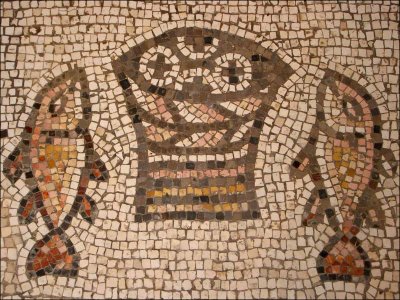
Another disciple who is only mentioned in the Synoptic gospels, Andrew, finds a boy with a small lunch. Andrew probably did not think the food could be shared, he was pointing out the impossibility of finding enough food for the crowd. The fish were probably small pickled fish (not a sardine, but something similar). No one would carry a pair of rainbow trout in their satchel on the outside chance they were needed to feed a crowd!

Jesus takes this small amount of food, offers thanks, and then distributes the food to the crowd. The crowd sees that is a miracle and wonder what kind of prophet Jesus is. They have in a mind a tradition drawn from Deut 18:15-18 that another prophet like Moses will come into the world. Moses fed the Israelites manna in the wilderness, in a similar way Jesus gives bread to a new Israel in a new wilderness.

Deuteronomy 18:15-18 (ESV) “The LORD your God will raise up for you a prophet like me from among you, from your brothers—it is to him you shall listen— 16 just as you desired of the LORD your God at Horeb on the day of the assembly, when you said, ‘Let me not hear again the voice of the LORD my God or see this great fire any more, lest I die.’ 17 And the LORD said to me, ‘They are right in what they have spoken. 18 I will raise up for them a prophet like you from among their brothers. And I will put my words in his mouth, and he shall speak to them all that I command him.

It is possible this miracle is an allusion to Elisha (2 Kings 4:42-44). In 2 Kings the prophet Elisha feeds 150 men with a small amount of food. There are similarities, but the more important allusion is to the wilderness period of Israel’s history.

The food provides enough for all the crowd to eat until they are satisfied and still have twelve baskets left over. Consider these are poor people who are given free food and allowed to eat as much as they want. I think they probably overate and maybe stuffed a few leftovers in their pockets to take home to the family.

The point of the leftovers? “This is the ample provision of the Lord who declared, ‘My people will be filled with the bounty’ (Jeremiah 31:14)” (Carson, John, 271). Just as Jesus provided plentiful excellent wine at the wedding in Cana (John 2:1-12) and healed a man who was crippled for thirty-eight years (5:5-6), now Jesus provides enough food everyone is satisfied and there are plenty of leftovers. Like the wine at the wedding in Cana, Jesus is revealing for those who have ears to hear that he is the host of an eschatological banquet, like the manna in the wilderness God is providing new bread for his people. But as Jesus will say later in John 6 this “bread of life” is his own body which will be given for them (6:48-51).

John 6:1-14 – Feeding the 5000

The Feeding of the Five Thousand appears in all four Gospels.The details in John are in some ways more detailed. For example, the role of Andrew and Philip are unique to John, in the synoptic gospels the disciples who ask Jesus about the crowds are anonymous. The use of the disciples to react to Jesus is typical of John, as is the mention of the words and deeds of other disciples outside of Peter, James and John.

Fish and Bread, Feeding the 5000

That this event occurs at the time of the Passover is extremely important for understanding the point of the miracle. Passover celebrates the rescue of Israel out of Egypt. God sent plagues on the Egyptians and took his people out into the wilderness where he provided for them both food and water. What is more, the rescue from Egypt at Passover marks the beginning of Israel as a nation.

John wants to present Jesus as a “prophet like Moses” in this section. It was Moses who provided food to the people of Israel in the wilderness after the first Passover and then led the people through the waters of the Red Sea. In Exodus 16 God provides for the people of Israel with manna and quail.  Jesus provides food then walks on the water. There is even a parallel in the reaction of the crowds – the crowds  “murmur” in 6:41 in such a way that implies that they have not really understood the miracle.

When Jesus provided food for a large crowd of Jews in a wilderness location, consciously re-enacting the original Passover. Like celebrating the fourth of July in America, celebrating Passover evoked a nationalistic spirit even in Galilee. Perhaps because many in Galilee thought of themselves as “occupied” by the Romans, Passover could easily develop anti-Roman sentiment.

This miracle could be taken as the beginnings of a revolution. When he seats people in groups he is organizing the people into “tribes” just as Moses did. The crowds in fact misunderstand the sign in just this way and try to force Jesus to be a king. As D. A. Carson said, “In the light of v. 15, where the people try to make Jesus king by force, it is easy to think that, at least in John, the specification of five thousand men is a way of drawing attention to a potential guerrilla force of eager recruits willing and able to serve the right leader” (Carson, John, 270).

The crowd thinks that Jesus is the Prophet, a messianic figure, a second Moses who leads Israel into the wilderness and provides manna for them. Isaiah 40-55 makes us use of the original wilderness period to describe the return of Israel from Exile.  There seems to have been a general feeling among the people, perhaps especially in Galilee, that the exile was still going on because Israel’s king had not come nor has the whole nation been gathered back to the land.

This nationalism would have been especially strong during the Passover. Israel was remembering his origins. Families were re-enacting the inaugural Passover meal in their homes and talking about what God has done for them in the Exodus and journey to the land. It is very easy to see what the people thought, Jesus is like Moses, gathering a force in the wilderness which could be used to secure the land, in this he is a new Moses. But Jesus is also a new Joshua- the people of Galilee were willing to take up arms to liberate the nation.

After Jesus explains that his kingdom is not going to be an armed rebellion, the crowds begin to fall away and even Jesus’ own disciples begin to grumble about this “hard teaching” (6:60-66) .  The verb used in verse 61 (γογγύζω) is used for the complaints of the Israelites in the wilderness period (they were “murmuring”). Just like Israel in the past, present Israel is complaining, questioning whether Jesus is the true messiah or not.

The Twelve, however, remain faithful (6:67-69).  Peter is the disciples who responds that there is no one else to follow since Jesus has the words of life.  The inner circle is committed to following Jesus since there is no life (water, bread) anywhere else.  If that is true, Peter says, “What other teacher are we going to follow?” If Jesus is the teacher who has the truth, it is because he is also God incarnate – once again, who else are they going to follow?  They know the truth, they cannot now turn to any other teacher.

Indeed, what other teacher are we going to follow?