A Righteous Remnant in 1 Enoch 83-84

1 Enoch 83-90 follows a long section of the astronomical speculations, although it is related to chapter 82 as a continuation of Enoch’s dialogue with Methuselah (83:1). These two chapters serve as an introduction to the Animal Apocalypse, a slightly veiled allegory of history up to the Maccabean period.

Enoch-manusrcriptEnoch received these visions before he was married and still living with his grandfather, Mahalalel (Gen 5:12-17). After Enoch receives a vision the coming flood (83:2b-2), he relates his dream to his grandfather Mahalalel. This is Enoch’s first vision, and like Samuel and Eli (1 Sam 3), Enoch requires guidance from his grandfather to understand the vision.

Within the world of the story, the vision refers to the coming flood. But the description goes beyond Genesis 7 to convey “a picture of cosmic collapse and annihilation” (Nickelsburg, 1 Enoch, 349). As is typical in the Enoch literature, the imagery of the flood is conflated with the ultimate judgment of God.

1 Enoch 83:3-4 I saw in a vision the sky being hurled down and snatched and falling upon the earth. When it fell upon the earth, I saw the earth being swallowed up into the great abyss, the mountains being suspended upon mountains, the hills sinking down upon the hills, and tall trees being uprooted and thrown and sinking into the deep abyss. (OTP 1:61)

Mahalalel explains that sin is so great the earth must “sink into the abyss” (primordial chaos), but there is a possibility God would allow a remnant to remain on the earth. He therefore counsels Enoch to pray for the earth (83:6-9), which he does (83:10-11, 84:1-6).  Enoch first praises God and acknowledges his greatness (83:2-4). These two verses resonate with many texts in the Hebrew Bible, although it is remarkably similar to Daniel 2:37-38 (describing Nebuchadnezzar) and Daniel 7:14 (describing the rule of the Son of Man), but also Isaiah 66:1-2 (heavens as God’s throne, the earth as his footstool).

1 Enoch 84:2 Blessed are you, O Great King, you are mighty in your greatness, O Lord of all the creation of heaven, King of kings and God of the whole world. Your authority and kingdom abide forever and ever; and your dominion throughout all the generations of generations; All the heavens are your throne forever, and the whole earth is your footstool forever and ever and ever.

These intertextual allusions to canonical books (as well as using the form of a biblical Psalm) create the image of a biblical prophet interceding on behalf of a people about to face the justice and wrath of God. Like Moses, David or Daniel, Enoch confesses the people of his generation ought to be destroyed for their wickedness (although he blames the angels, 84:5).

Enoch’s request on behalf of the present generation. Even if the angels must come under judgment, Enoch prays that God would allow a remnant of humans survive the devastation. He asks God to raise up the righteous and true flesh “as a seed-bearing plant” (84:6). Within the world of the story of 1 Enoch, this refers to the world after the flood and the family of Noah as a righteous family to repopulate the world. Noah is called a “preserved seed” (1 Enoch 10:3; 65:12; 67:3).

But the image of a plant which survives the coming judgment also resonates with the righteous remnant in Isaiah 6:13. For the writer of this apocalypse, the final judgment is still in the future. The prayer is that God will once again preserve the righteous remnant in that coming apocalyptic judgment.

It is very difficult to date with certainty any section of 1 Enoch, but if these two chapters were originally an introduction to the Animal Apocalypse (which follows in 1 Enoch 85-90), then the historical context of the righteous remnant in the present generation the Maccabean revolt and the righteous ones who remained faithful to the Law when tested by Hellenists.

But is this prophetic speech created to support the Hasmoneans (as the righteous ones struggling against the Greeks), or the Hasadim as they struggled against the later Hasmonean kings? Defining the “righteous remnant” seems to be a regular feature of apocalyptic literature (in the ancient world or today).

God as the Judge in Apocalyptic Literature

God as judge is a feature of apocalyptic drawn from the Hebrew Bible is the belief God will intervene in history to destroy the evil attacking the faithful. The nation of Israel always understood God as their defender.  There is a great deal of “warrior language” in the Old Testament, it is God that fights on behalf of the nation. In addition to this, Israel always understood God to be their king.

Last Judgment

The book of Daniel describes the judgment of the final nation to oppress Israel.

Daniel 7:9–10 (NRSV) As I watched, thrones were set in place, and an Ancient One took his throne, his clothing was white as snow, and the hair of his head like pure wool; his throne was fiery flames, and its wheels were burning fire. 10A stream of fire issued and flowed out from his presence. A thousand thousands served him, and ten thousand times ten thousand stood attending him. The court sat in judgment, and the books were opened.

After the books are opened the final beast is killed and burned with fire (7:11) and the “little horn” which oppressed God’s people will be destroyed. The dominion once granted to the kingdoms of the earth will be rescinded. The Ancient of Days will grant that authority to a son of man who will come on the clouds of heaven. This kingdom will never pass away or be destroyed (7:14, 7:26-27).

A similar judgment scene appears in 1 Enoch 50-52. James VanderKam calls this section a “Scenario for the End Time” because all of the powerful beings will be humiliated “in those days.” They will delivered into the hand of the Chosen One like grass to the fire or lead to the water. The image of grass being taken to a fire at the time of the harvest is used by Jesus in several parables (for example, the wheat and the tares, Matthew 13:24-30, 36-43). The reason they are delivered for judgment is that they have denied the name of the Lord of Spirits and his Messiah.

1 Enoch 50 describes the renewal of the righteous from their time of weariness.  This includes a judgment in which the sinners receive evil and the righteous receive good. The righteous are to be saved through the “name of the Lord of Spirits” who will lead people to repentance. This chapter stresses the justice of the judgment of the Lord of Spirits – “oppression cannot escape him.” Those who are under his judgment no longer receive mercy (verse 5).

Chapter 51 is in many ways the most important chapter in the Similitudes since it deals with the resurrection of the dead. The context is eschatological (“in those days,” parallel to the judgment in 50:1). Sheol will give up all the dead and the “Elect One” will sit on his throne and pick out of the risen dead the holy ones (50:1-2). The elect will sit on the throne of the Lord (51:3) and hear wisdom from the mouth of the Elect One. After this resurrection, the “mountains will skip like rams” and the whole earth will rejoice (51:5). This is an allusion to Psalm 114:4 and the messianic age. Verse four possibly connects the resurrection of the dead to the rising of the Elect One.

1 Enoch 51:4-5 In those days, mountains shall dance like rams; and the hills shall leap like kids satiated with milk. And the faces of all the angels in heaven shall glow with joy, because on that day the Elect One has arisen. And the earth shall rejoice; and the righteous ones shall dwell upon her and the elect ones shall walk upon her.

In both Daniel and 1 Enoch, an oppressed people look forward to God’s righteous and fair justice. They believe they are the ones who will be vindicated and those who have oppressed them will face a fiery judgment. In both cases the righteous will rewarded with a kingdom ruled by a representative of God (a son of man, an elect one) and that kingdom will never end. Both example look forward to God delivering his people from their oppressors once again.

Does this kind of apocalyptic judgment offer real hope to the oppressed? This seems like good news for the oppressed, but is there any hope for salvation or any chance of repentance for the oppressor? Is apocalyptic literature simply saying, “Endure to the end and you will be rewarded”?  Is there active resistance as in 1 Maccabees?


Psalms of Solomon and the Hasmoneans

Image result for psalms of solomon pseudepigraphaIf 1 Maccabees can be described as pro-Hasmonean propaganda, the Psalms of Solomon vilify the Hasmoneans as corrupt law-breakers who have brought the might of Rome down upon Israel. The eighteen psalms are preserved in both Greek and Syriac manuscripts from the tenth century A.D. but were likely written in Hebrew and date much earlier than the surviving manuscripts since the Psalms were used by the author of 2 Baruch. The psalms refer to an invasion of the land, so they may be dated as early as Antiochus IV Epiphanes, but Pompey (in 63 B.C.) and Titus (in A. D. 70) are also possibilities. R. B. Wright gives a range of dates from 70 to 45 B.C. for the dateable Psalms, but since some do not have events which can be dated, they may come from another period and were added to the collection when it reached its final form.
As Brad Embry summarizes, the Psalms of Solomon are “masterfully wrought defense of the Jewish faith in a time of crisis.” Given the range of dates suggested for this literature, this crisis of faith is the failure of the Hasmoneans to rule like proper sons of David. Rather than rule as righteous kings from the Hebrew Bible, they are more like Manasseh or even Antiochus himself!

For example, Psalm 4 condemns of those who sit in the council but are “far from the Lord” and provoking the Lord to anger. This person is eager to take the home of the poor person and to scatter the orphans.

Psalms of Solomon 4:1-2 Why are you sitting in the council of the devout, you profaner? And your heart is far from the Lord, provoking the God of Israel by lawbreaking; Excessive in words, excessive in appearance above everyone, he who is harsh in words in condemning sinners at judgment.

The word council is συνέδριον (synédrion), translated Sanhedrin in the New Testament. This ruling council has provoked the Lord (4:1 and 4:21). The verb παροργίζω is often used as an explanation for why a great calamity has fallen on Israel. For example, in LXX 2 Kings 23:26, Manasseh provoked the Lord to anger, resulting in the destruction of Jerusalem. In Daniel 11:36 (OG) with reference to the Antiochus’s action in the temple, provoking the Lord to anger. In t.Levi 3.10, the word refers to the sons of men insensitive to spiritual things and “keep sinning and provoking the anger of the Most High.”

Verses 14-22 is a harsh condemnation of these hypocrites. The writer pronounces curses on the hypocrites (using a series of aorist passive optative verbs), invoking the Lord to make the lives of these people miserable.  For example, verse 18, “May his old age be in lonely childlessness until his removal.”

PsSol 4:20-22 Let crows peck out the eyes of the hypocrites, for they disgracefully empty many people’s houses and greedily scatter (them). 21 They have not remembered God, nor have they feared God in all these things; but they have angered God, and provoked him. 22 May he banish them from the earth, for they defrauded innocent people by pretense.

In contrast to the fate of the hypocrite, the final three verses of the Psalm are a confession in faith in a beatitude form, “Blessed are those who fear the Lord in their innocence, the Lord will save them” (PsSol 4:23-25). The one who is innocent will be saved from these arrogant people.

The writers of the Psalms of Solomon do not see the descendants of the Hasmoneans as the fulfillment of the prophetic hope for a good, righteous shepherd king in the tradition of David. Their protest is against the current regime (whatever the date) is in the tradition of prophetic condemnations of Manasseh in the Hebrew Bible.

How does the contrast between the ideology of 1 Maccabees or 2 Maccabees differ from that of the Psalms of Solomon? Does reading the other Psalms in this collection provide additional evidence of this diversity in the Second Temple period?


Bibliography: Bradley Embry, “The Psalms of Solomon and the New Testament: Intertextuality and the Need for a Re-Evaluation.” Journal for the Study of the Pseudepigrapha 13 (2002): 99-136.

First Maccabees as Pro-Hasmonean Propaganda

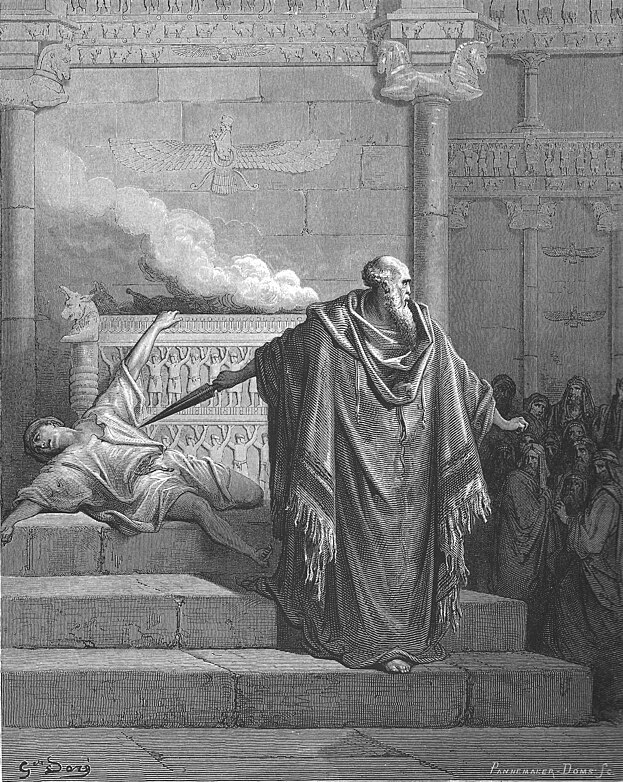
Image result for Matthias Maccabeus1 Maccabees is clearly in favor of the revolution against the Seleucid and the Hasmonean dynasty.  It is “a thoroughgoing pro-Hasmonean” (Fischer, 4:441). For the author of 1 Maccabees, the revolt was God’s will since the Hasmoneans liberated Judean from foreign rule.
For example, in 5:62 the early Hasmoneans are described as “those men into whose hands salvation of Israel was given.” Later Christian readers are accustom to hear salvation (σωτηρία) as “salvation from sin,” the noun regularly refers to liberation from enemies in the Septuagint. For example, in LXX 1 Sam 2:1, Hannah can “I rejoice in your salvation” because her “mouth derides my enemies.” LXX 1 Samuel 11:9, Saul tells the people of Jabesh-Gilead they will “have their salvation” by noon the next day. He is referring to a military campaign to rescue them from the Ammonites.

More significant, 1 Macc 6:62 uses a divine passive, ἐδόθη, salvation “was given.” Daniel 7 uses this passive form of the verb “to give” a number of times to indicate the sovereign God has granted something to another. For example, in 7:14 the son of man is given authority to rule. God grants to the son of man that authority. The writer of 1 Maccabees is therefore not attributing the rescue of Israel from their enemies to the military might of Judas, but rather to God.

Judas’s father Matthias provides the spark for the Maccabean revolt. Matthias was a priest in Jerusalem who left the city because of the ruin of Zion. The noun (σύντριμμα) refers to destruction of Jerusalem, as in Lamentations 4:10. The temple itself has lost its glory (ἄδοξος), recalling the loss of the Ark of the Covenant in 1 Sam 4:22(Ἀπῴκισται δόξα Ισραηλ).

Later, Matthias is described as “burning with the zeal of Phinehas” (1 Macc 2:26) when he first rallies people to rebel against the Seleucids. Phinehas was the priest who killed a man and prostitute who dared to flaunt their sin before the tabernacle in Numbers 25:11. This violent response to a flagrant sin is the immediate model for the Maccabean revolt: the sons of Matthias are willing to kill other Jews who have willfully broken the covenant.

Even his last words to his sons, Matthias urges his sons to emulate Phinehas, David, Caleb, Joshua, Elijah and other great heroes of the Hebrew Bible.

1 Maccabees 2:51 (NRSV) “Remember the deeds of the ancestors, which they did in their generations; and you will receive great honor and an everlasting name.

Most of the heroes of the Hebrew Bible Matthias urges his sons to emulate expressed their zeal for the Lord with violence, but some passively resisted the empire and were willing to die. He mentions Hananiah, Azariah, and Mishael who “believed and were saved from the flame” (2:59). Although they were saved, these three men were willing to die rather than bow to the image of the Empire (Dan 3:18). According to Matthias, Daniel was rescued from the mouth of the lions “because of his innocence” (1 Macc 2:60).

The Hasmoneans were therefore the next generation of great hero from the Hebrew Bible. The book consciously places them in the line of Phineas, Joshua, and David.

But Matthias’s speech says there are other ways to resist the Seleucids than armed rebellion. Some Jews did passively resist and were will to die. This last point may have some traction in discussions of how Christians used 1 Maccabees in the early church when they were being persecuted. No one “burned with zeal” and attacked the Roman pagans, but many went to their deaths like Hananiah, Azariah, and Mishael, willing to be executed rather than give up their faith in Jesus.

Factors Leading to the Maccabean Revolt (Part 2)

In 168 B.C. Antiochus IV Epiphanes made a second campaign into Egypt to annex it to his kingdom. This time, things were not going as well as he had planned. His army was met by a delegation from the Roman senate led by Popilius Laenas.  Popilius presents Antiochus with a letter from the Senate ordering him to leave Egypt or face the wrath of Rome. Antiochus asked for time to consider the letter, so Popilius drew a circle around him on the ground and told him not to leave the circle until he made his decision.  Humiliated, Antiochus was forced out of Egypt. Much of this history is found in Daniel 11:21-35.

Maccabean Revolt

Antiochus IV Epiphanes

On his way back from Palestine to Syria, he learns of the uprising in Jerusalem caused by the competing high priests. Jason had picked this time to attempt to regain the office of High Priest based on a rumor that Antiochus had been killed in battle (1 Macc 1:16-19). Antiochus waited until the Sabbath and sent his general Apollonius and some mercenaries into Jerusalem.  They slaughter men, women, and children indiscriminately and burn much of the city.

Antiochus IV Epiphanes fortified the citadel heavily, imposed a heavy tax on the city for the rebellion, and confiscated land.  He occupies the city with foreign troops and Hellenistic sympathizers. 1 Mac 1:35-36 calls these “people of pollution” who defile the sanctuary.  But this text also says these foreigners became a “great menace,” using the noun παγίς, often translated as “snare” or “trap.” The word is usually used for a trap laid by an enemy, as in LXX Psalm 56:7 (ET 57:6) or Jeremiah 5:26. The Greek invaders are certainly a danger. The real danger for the writer of 1 Maccabees is the temptation to surrender to the Gentiles and forsake the covenant.

The most shocking example is the action of Menelaus, the High Priest. As he would have in any other captured city, Antiochus combined the worship of Yahweh with Zeus. Within the temple itself, Antiochus sacrificed to Zeus, supported by the high priest and the Hellenistic Jews.

1 Maccabees 1:37-40 On every side of the sanctuary they shed innocent blood; they even defiled the sanctuary. 38 Because of them the residents of Jerusalem fled; she became a dwelling of strangers; she became strange to her offspring, and her children forsook her. 39 Her sanctuary became desolate like a desert; her feasts were turned into mourning, her sabbaths into a reproach, her honor into contempt. 40 Her dishonor now grew as great as her glory; her exaltation was turned into mourning.

There were two “paths of resistance” in the Maccabean revolt. One could take up arms, as Judas and his brothers did, or one could resist passively and be martyred for the faith.

1 Maccabees 1:62-65 But many in Israel stood firm and were resolved in their hearts not to eat unclean food. 63 They chose to die rather than to be defiled by food or to profane the holy covenant; and they did die. 64 Very great wrath came upon Israel.

For the writer of 1 Maccabees, violence was indeed the answer.