In 168 B.C. Antiochus IV Epiphanes made a second campaign into Egypt to annex it to his kingdom. This time, things were not going as well as he had planned. His army was met by a delegation from the Roman senate led by Popilius Laenas. Popilius presents Antiochus with a letter from the Senate ordering him to leave Egypt or face the wrath of Rome. Antiochus asked for time to consider the letter, so Popilius drew a circle around him on the ground and told him not to leave the circle until he made his decision. Humiliated, Antiochus was forced out of Egypt. Much of this history is found in Daniel 11:21-35.
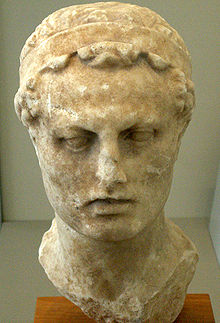
Antiochus IV Epiphanes
On his way back from Palestine to Syria, he learns of the uprising in Jerusalem caused by the competing high priests. Jason had picked this time to attempt to regain the office of High Priest based on a rumor that Antiochus had been killed in battle (1 Macc 1:16-19). Antiochus waited until the Sabbath and sent his general Apollonius and some mercenaries into Jerusalem. They slaughter men, women, and children indiscriminately and burn much of the city.
Antiochus IV Epiphanes fortified the citadel heavily, imposed a heavy tax on the city for the rebellion, and confiscated land. He occupies the city with foreign troops and Hellenistic sympathizers. 1 Mac 1:35-36 calls these “people of pollution” who defile the sanctuary. But this text also says these foreigners became a “great menace,” using the noun παγίς, often translated as “snare” or “trap.” The word is usually used for a trap laid by an enemy, as in LXX Psalm 56:7 (ET 57:6) or Jeremiah 5:26. The Greek invaders are certainly a danger. The real danger for the writer of 1 Maccabees is the temptation to surrender to the Gentiles and forsake the covenant.
The most shocking example is the action of Menelaus, the High Priest. As he would have in any other captured city, Antiochus combined the worship of Yahweh with Zeus. Within the temple itself, Antiochus sacrificed to Zeus, supported by the high priest and the Hellenistic Jews.
1 Maccabees 1:37-40 On every side of the sanctuary they shed innocent blood; they even defiled the sanctuary. 38 Because of them the residents of Jerusalem fled; she became a dwelling of strangers; she became strange to her offspring, and her children forsook her. 39 Her sanctuary became desolate like a desert; her feasts were turned into mourning, her sabbaths into a reproach, her honor into contempt. 40 Her dishonor now grew as great as her glory; her exaltation was turned into mourning.
There were two “paths of resistance” in the Maccabean revolt. One could take up arms, as Judas and his brothers did, or one could resist passively and be martyred for the faith.
1 Maccabees 1:62-65 But many in Israel stood firm and were resolved in their hearts not to eat unclean food. 63 They chose to die rather than to be defiled by food or to profane the holy covenant; and they did die. 64 Very great wrath came upon Israel.
For the writer of 1 Maccabees, violence was indeed the answer.
This is a very powerful and difficult situation we as Christians are called to a different standard when we choose to follow Christ. To live as Christ, can be accomplished in many cultures and societies. The question that is shown through the trials of the Maccabeans is where are the lines of the influence that lead the Jews to idolatry. That is a question that Christians need to ask themselves in modern society more and more. Even though it is not that common for people today to be worshiping Zeus, now more than ever people are carrying precious metal trinkets (cell phones) that allow them to see things from around the world. If we tried to explain to people during the Maccabean revolt what cell phones and other technology was they would probably quickly see it as an idol. So where is that line between being in this world and not being of it, and fighting a good fight as Paul calls us to? 1 Maccabees 1:62-65 tells of the martyrs that did not fight and died, when do we fight and when do we simply stand our ground?
It’s interesting to see the different powers that come into play throughout this intertestamental time period, and how certain powers are more forceful in their need to conquer and convert. The Jews had a very difficult time trying to remain true to their faith with the ever-growing pressure from Hellenism. Like what was stated in a previous post, it is clear that the writer of Maccabees is very biased towards the rebellion against the Seleucids, and advocated for the Hasmonean dynasty. In reality, most Jews did not “burn with zeal”, but rather passively accepted their fate by their willingness to die for their faith. “In 1 Maccabees there seems to be an assumption that our only hope of an”afterlife” is in gaining glory and a good name, so that our descendants will sing our praises” (Tomasino, 234). This assumption plays into the idea of glorified martyrdom, however, this just wasn’t the case.
“I probably spend more time on my phone, thinking about the phone then praying or reading the bible.” That is probably true for most Americans, older folks included. I now some grandmas that are always on their phones! (I assume they are reading this blog most of the time)
I think it is interesting that the position of high priest played such a big role in the Maccabean Revolt. So much of the Jews’ problem stems from the fights for the position of high priest. Hellenization was also an issue that played into the Maccabean Revolt, as was the desecration of the temple, but the struggle for the position of high priest was still behind even parts of these other reasons. Antiochus attacked Jerusalem to settle the fights caused by those fighting to be high priest. Antiochus probably thought he had a genius strategy to wait to attack until the Sabbath, but I think most people today would agree that it was rather cruel, quite unfair, and rude. Unfortunately, this left Jews with two basic options in the Maccabean revolt, as explained on page 41 in the notes. They could violate their customs and traditions by breaking the Sabbath and taking up arms to fight in order that they may keep their religion, or they could hold on to the values of their religion and rest on the Sabbath and be martyred. Many chose to keep their faith and died as a result. I think it is sad that in order to defend themselves and their faith, they had to break some of the rules of the faith they were fighting to defend. It is interesting to wonder what I would have done. Do you fight for what you believe in if it means breaking what you believe in to do so, or do you just resist and possibly die, without fighting at all?
After reading this, I got hit with the question of “would I be willing to do this?” I think that this is an incredibly difficult situation that a lot of Christians are put in all throughout history. A question that is asked is what the Jews are influences that lead them to idolatry and away from their faith. This can be taken as another question I need to continually ask myself is what “what influences am I allowing in my life that I am letting change me and get in the way of my faith?” John 14:6 talks about how we as believers need to be in the world not of the world. How can we in this world get rid of all idolatry, whether it be our phones, sports, work, etc. How can we get rid of it and have our sole focus be on Him alone? Back to my question would I be willing to take up arms and fight with Judas and his brothers, would I be willing to be martyred for my faith and not give up my faith at the face of death. I would like to say I would resist and stay strong in my faith. However, we can say one thing and in the face of the circumstances entirely change what we’ve told ourselves for so long.
A question I am going to work on personally that I mentioned is, what are my idols that I am holding onto and allowing to get in the way of my faith? I need to focus on this more and make sure that my mind is securely set on Christ as my only real NEED rather than feeling the need and importance of all these little truly insignificant things.
After the actions of Menelaus, the Jews were faced with a choice to make, they would either have to change and become more like the Hellenistic Jews, and adapt to Greek life, or they could rebel against the rule of Antiochus, for in their eyes he had defiled everything they held sacred. “For the writer of 1 Maccabees, violence was indeed the answer” (P.Long). Antiochus had taken hold of this city and abused the people within the city in nearly every metric. This is an example of a rebellion of a people that has had what they know and have come to expect taken from them. In the face of Hellenization being forced upon the Jews they made the decision that they believed to be right to rebel against the powers over them in a righteous battle. I find it interesting that this ear waged by the Maccabees was not only successful but is famous in Jewish culture and still celebrated during Hanukkah as a great Jewish victory over Hellenism. Its impressive that the Jews were able to muster an army that could defeat the Syrian forces in Jerusalem. “Judas developed the Jews into an effective guerrilla army and repeatedly defeated the Syrians in battle” (Strauss). It is incredible how far the Jews were willing to go to defend their way of life, and their city, and even more admirable in how effective they were at doing it. This group of people would rather die than see their religion and culture being besmirched by foreign influence, bringing with it an entirely new way of life that would take root.
This period of time tested the true faith of many Christians. There was a lot of chaos, and in the midst of it all, believers and their faith were being challenged by Antiochus. I think that is is pretty crazy how the man elected as high priest in part 1 (even without having any priestly background) is condoning and probably promoting the worship of Zeus alongside Yahweh. This can relate to present day issues, and issues throughout the past of Christianity, where people who are given platforms and labeled as Christians wrongly present the Gospel and the ways of Jesus. A lot of people today are so quit to point out the wrongdoings of pastors, religious leaders, or general believers even though we are all sinful. I heard a saying once that applies the correct way of thinking to this problem: If someone played a tribute to Mozart and played some of his songs, and he played and composed them all poorly, would you blame Mozart, or would you blame the man doing the tribute? People outside the faith often take on the idea that religious leaders represent Jesus without flaw, and that is simply not correct. Menalaus in the same way is not an accurate representation of how we should act as Christians. The imagery in the first piece of 1 maccabees is also quite horrifying and sad.
“This period of time tested the true faith of many Christians.”
This is 160 years before Christ was even born….so another 200ish years until there are Christians.
Power-hungry Antiochus started his second campaign with wanting to take control over Egypt and spread his Hellenistic lifestyle. When approaching Egypt, a Roman Senate told him that if he were to go forth with his plans, he would eventually face the wrath of Rome. When reading back to part one of the “Factors Leading to the Maccabean Revolt,” you gain a bigger picture of what is truly going on with everyone at the same time. Menelaus, Jason (Hellenist), and Onias (Jew) are all fighting for the position of high priest, all while Antiochus is getting threatened by a Roman. Furthermore, Antiochus then goes forward with the annihilation of Jews. He sent many of his men into Jerusalem and killed everyone. Even though it was two-thousand years ago, it is still heartbreaking to hear about such a travesty. During this period, the Jews had a choice between surrendering to the Hellenistic tradition or dying a martyr for their faith. One main part that stood out to me was the fact that Antiochus combined the worship of Yahweh with Zeus. That is blatant disrespect and incredibly disgraceful to the Jewish culture, and exactly why Onias III deserved to be the high priest. The other distinctive part was that blood was shed in the house of God. The bride of Christ was defiled and eventually abandoned by her people. Yet still, many people in Israel chose their faith and covenant than to stay alive and go against their beliefs. This is an incredibly powerful and significant moment for the Jews.
This was truly a very interesting time in history, as we see the mixing of several beliefs and religions. During this time Christians faith was truly put to the test, as they would have been forced to decide whether to allow these other religions to mix with what they believed, and go along with Antiochus, and the other Hellenistic Jews who were openly worshipping other God’s such as Zues as mentioned above. This would not have been an easy decision as anyone who would not have wanted to go along with Antiochus, was likely martyred for their faith, or persecuted heavily for what they chose to believe. This was truly a horrifying time in history as people were quite literally being sacrificed for going against what those in power believed, and you can certainly imagine why some people may have gone along with Antiochus, and the Hellenistic Jews, as they certainly would have feared for their life.
I find it incredibly powerful that throughout all the hardships and bloodshed that the people of Israel still remained adamant that they would not eat unclean food. How many of us in this situation would have remained that faithful to our beliefs. It is so easy to say that when faced with a tragedy that we will be capable of standing so strong. But how many are actually able to do it? Does everyone have a limit? I don’t think we know until we are faced with that situation. I can confidently say that I would remain strong but in the back of my mind there might be limits. Especially if it threatens the well being of my closest friends and family. Do you think that you could remain that faithful?
Another part that stood out to me was that Antiochus waited until the Sabbath to unleash this attack on the people of Israel. This combined with his worship of Yahweh and Zues shows his unfaithfulness to God. The Sabbath is supposed to be a day where believers would rest and worship God and all that he has done for them. Instead they were blindsided by this vicious attack that killed many of the people. It is heartbreaking to think of the fear these individuals endured.
Antiochus’s attack on Jerusalem is a very interesting order of events. When Jason heard the rumor that Antiochus was killed, he tried to take back his position by force but received push back from the people of Jerusalem (deSilva, 2 Maccabees, Section: Structure, Context, and Textual Transmission). It was this misunderstanding that caused Antiochus to attack the Jewish people on the Sabbath. Antiochus was likely also in a very bad mood after his humiliation in Egypt with Popilius. After being embarrassed in his attempted campaign to annex Egypt, Antiochus heard the beginnings of an uprising in Jerusalem (deSilva). Really, this was just the Jewish people defending against Jason’s attempt to regain the position of high priest. However, Antiochus decided to punish the people of Jerusalem and did so on the Sabbath so that they would not be prepared to fight back. Antiochus also attempts to create unity by eliminating local customs (deSilva 1 Maccabees, Section: Structure and Content). This began an extreme attempt to have Hellenism culture dominate. Judas and his army use this as their opportunity to revolt and kill for their culture and beliefs. However, many loyal Jews prefer death rather than following the king’s decree (deSilva). The Jewish people who followed Antiochus’s attempt at unity were called “Renegade Jews” and were attack by the Maccabees for their choice (deSilva). While some Jewish people would rather die for their faith, the Maccabees were willing to kill those who turned their back on the faith.
The escalation leading to the Maccabean Revolt is truly entertaining. When you think you’ve seen it all, someone does something even more extreme. It is like watching a political soap opera. However, like what we see in Tobit and Judith, it boils down to a turning point. Where the Jews are forced to make a decision as to what they will do next. Will they remain steadfast and be martyred for what they believe in against the enemy (Tobit and Daniel), or will they take matters into their own hands and fight back for their beliefs (Judith)? In the end, we know the results. The Maccabean Revolt is a clear example, like Judith, to how the Jewish people take up arms in their chosen path of resistance. Considering the chaos and extreme danger that the Jews saw themselves, it is understandable how they might come to their violent solution. Slaughter of men, women and children, burning of the city, heavy taxes, confiscated land, and foreigners that defiled the Temple and occupied their city (described as a trap). There is no singular guilty party in the making of the Maccabean Revolt. There is a complicated web of intricate choices that stir the hearts and swords of the Jews who sought to keep their covenant and take back their city.
What stood out to me from this blog post is how far people will go to hold onto their beliefs when someone in power tries to take them away. Antiochus IV did not want to only have political control over the Jewish people but he also wanted to change their religious practices and make them follow Greek cultures. Another thing that stood out to me was that some Jews were willing to die rather than give up their faith and break their covenant with God. This shows how important our beliefs are to everything we do in life but it also shows how difficult it can be to stand firm when there is pressure for you to conform.
This also reminds me of things we see today. People in positions of power can sometimes pressure others to give up their values or beliefs so they can fit in. It can be very easy to compromise when doing so makes life simpler and even more so when there is serious consequences for standing up for what you believe.
The events throughout the Maccabean Revolt just keep building and building. First, Antiochus was forced out of Egypt by Rome and then came back angry. Then when he got back to Jerusalem, he used violence against the people and took control of the city. A lot of people were killed, and the Temple was treated with disrespect. It was incredibly sad that the Jewish people were being pressured to give up their faith and traditions. Antiochus brought Greek beliefs into the Temple and even sacrificed to Zeus. Menelaus, who was supposed to be the High Priest, supported what was happening instead of standing up for his own people. What stood out to me most was that people responded in different ways. Some people, like Judas and his brothers, fought back, while others refused to break their religious laws even when it meant dying. I think this shows how important their faith was. Overall, this reading showed me that the Maccabean Revolt was not just about politics. It was about people trying to hold onto their faith and identity when they were being pressured to give it up.
The second part of the factors leading to the Maccabean Revolt reminds me of how dangerous it can be when a country or its leaders are made fun of and then take their anger out on innocent people. In 168 B.C., Antiochus IV Epiphanes attempted to conquer Egypt, but the Romans stopped him. Popilius Laenas, who was representing the Roman Senate, basically forced Antiochus to leave Egypt. I think this was a huge turning point because Antiochus had been publicly humiliated. On his way back to Syria, he learned that there had been an uprising in Jerusalem, which made the situation even worse.
Antiochus responded to the rebellion with a lot of violence. He sent hundreds of soldiers into Jerusalem, where they killed men, women, and children and burned down parts of the city. He then put foreign troops in Jerusalem, took land from the people, and taxed the city. This reminds me of how anger and pride can cause someone to make decisions that hurt people who aren’t even responsible for the original problem. Proverbs 16:18 says, “Pride goes before destruction, and a haughty spirit before a fall.” Antiochus’s pride and humiliation played a big role in the destruction that occurred.
What I find especially weird is what happened to the temple. Antiochus did not just take political control of Jerusalem he tried to change Jewish worship. He combined the worship of Yahweh with the worship of Zeus and sacrificed to Zeus in the temple. Even Menelaus, the High Priest, supported this. 1 Maccabees 1:39-40 shows the sanctuary eventually became desolate and how the people’s feasts and Sabbaths were turned into disgrace.
Another part that stood out to me was that not everyone responded to persecution the same way. Some people, like Judas Maccabeus and his brothers, fought back with weapons. Others did it by refusing to violate their faith, even if it meant dying. 1 Maccabees 1:62-63 says that many Jews chose to die rather than eat unclean food or break the holy covenant.
Overall, this shows me that the Maccabean Revolt was more than just politics. It was also about faith and identity. The Jewish people were being pressured to give up their religious practices and become like the other cultures around them. Some decided that staying faithful to God was worth fighting and even dying for.
I had no idea about the circle story with Popilius. That is so humiliating, no wonder Antiochus was angry when he came back through Jerusalem. It makes sense that he took it out on the city.
What stood out to me in this post was the part about the Sabbath attack. Sending Apollonius in on the Sabbath when people wouldn’t fight back is so brutal and then taxing them and putting foreign troops in the citadel. I also didn’t get the “snare” part before, but your explanation about it being a trap to make people give up the covenant makes a lot of sense.
The verse from 1 Macc 1:37-40 you shared was really sad, how the temple became desolate. And I liked your point at the end about the two paths of resistance. Some people fought like Judas and some just chose to die rather than eat unclean food. Both are pretty brave in different ways.