Characteristics of Greco-Roman Religions

Roman religious thought is characterized by the syncretic thinking of the Roman people. They had little imagination and largely assumed the Greek gods with new names. Zeus, for example, is Jupiter in Rome. The three key gods of Rome, Jupiter, Minerva and Juno, were honored as early as 500 B.C. with a temple in Rome.

  • Jupiter was a city / state-god, Iuppiter Capitolinus. Consuls were required to sacrifice upon entering office. When a young man first wore his toga virilis (toga of manhood) he sacrificed to Jupiter. The ludi Romani were devoted to him and the triumphal parade of a victorious general led to Iuppiter Capitolinus.
  • Minerva developed from a Sabine goddess, although she is roughly equivalent to Athena. She was a virgin goddess who became the patroness of crafts, warriors, poetry, medicine, wisdom, commerce, and the inventor of music.
  • Juno is Hera of Greek mythology, the wife and sister of Zeus. In early March she was honor with the festival of Matronalia, something of a mother’s day in which woman received gifts from husbands and daughters, and were to prepare the household meal.

Religion was administer by a collegia consisting of priests, although the priesthood was not a professional class. They were, however, the chief experts in matters of the gods. Religion in Rome was a matter of state, particularly in religious observance.

Zeus from Ephesus, A.D. 69-96

Zeus from Ephesus, A.D. 69-96

There are a number of important differences between Greco-Roman religions and modern religious practice. First, Religions in the Roman world were not usually exclusive. A person could devote himself to a particular god while recognizing other gods existed, or even worship various gods as needs arose.

Second, by the time of the Roman Empire, the identification of gods tended to reduce their numbers. Babylon and Egypt, for example, worship a wider variety of gods. The Greco-Roman trend was to reduce gods, blending multiple gods into a single deity. So, for example, all the “father gods” became Zeus. Although this seems like a trend toward monotheism, rarely would a Greek or Roman think in terms of a single god to the exclusion of all others.

Third, the Roman period tended to deify virtues, benefits, or abstract ideas, such as salvation (Salus) or liberty (Libertas), Luck (Tyche) and Fate (Moira). Even in Judaism, where monotheism was assumed, the angelic world was developed similar to the minor deity of the Greco-Roman world.

Fourth, the power of fate was very important in the early Empire. The idea of fate is critical to Stocism and was worshiped as a deity (Moira). Some religions developed, however, that claimed to have power over fate (Asclepius, Isis, Sarapis, for example). Since events were understood as somewhat “fixed” by fate, a belief in astrology became prominent. Astrology was rather technical, employing astronomy and mathematics.

Finally, morality was not closely tied to religion. Philosophy dealt with ethical matters, religion with the cultic ceremony. For example, there were few Greco-Roman writers who dealt with the religious problem of sin.

Once again, Christianity looks considerably different than most other religions in the Greco-Roman world. Although there were similarities to some mystery religions, the early Christians developed out of their Jewish foundations a distinctly different kind of religion in the Roman world.

Bibliography: Everett Ferguson, Backgrounds to the New Testament, 173-176.

Greco-Roman Religions and the New Testament

Greco-Roman Religions might be considered “the competition” of early Christianity, but this is not a fair description of how religions functioned in the first century.

A Guardian lares

First, in the first century, religion was rarely a choice. A person owed worship to a god because of a civic or family obligation or because the god is associated with a trade. A person living in the Roman world would not even think in terms of “converting” from one god to another, since gods had various functions; motivations were purely practical.  If one was going to sea, one appeased sea gods. In fact, the idea of choosing to worship a particular god was the attraction of the mystery cult. One might become a worshiper of Mithras by choice, although obligated to also worship other gods.

“The family cult was also the natural point of departure for the veneration of the dead and of graves…At the end of the year, during the Parentalia (13-21 February) the dead of the household were collectively honored as divi parentu…. Food, salt, and wine were carried to the graves, which were decorated with flowers and wreaths. It is noteworthy that the Romans never transformed the cult of the di parentes into a cult of divine ancestors of the clan.” (Gladigow, 811)

Despite this, religious practice in the Roman could be personal. For example, the custom of honoring a sacred image by touching one’s hand to one’s lips (adorandi gratia manum labris admovere) not only in a temple but even when passing by a temple (ANRW 2/16/1: 579-80). But even this devotion was not required, there was no “proper liturgical practice.” This practice developed as an expression of gratitude alongside the generally obligatory sacra privata and sacra publica.

Prayers were a part of Roman religious practice. Some may sit at the feet of an image in prayer, telling their troubles to the god or goddess:

Propertius 2.28.46 I bind myself with a sacred verse against this wish: I write: ‘By Jupiter, the Mighty, the girl is saved’: having taken such pains, she herself can sit at your feet, and, sitting there, tell you all her troubles. (Translated by A. S. Kline).

Family prayers were more likely made to household gods rather than powerful gods like Zeus. For example, families would offering prayers of thanks to Penates, the god of the storeroom, for providing daily meals. The spirits of family ancestors (lares) could be honored at meals as well.

  • Janus: God of doorways
  • Forculus: protector of doors
  • Limentinus: guardian of the threshold
  • Cardea: goddess of the hinges
  • Vesta: goddess of the hearth
  • Potina: goddess of children’s drinks
  • Sentia: goddess of children’s mental development
  • Orbona: the goddess who granted new children to parents who had become childless

Christianity entered a world already full of gods and goddesses and announces the one and only God who created all things has acted on behalf of all humans through Jesus his son. Although based on its Jewish roots, Christianity was a radical view and therefore generated suspicion and anger.


Bibliography: Burkhard Gladigow, “Roman Religion,” ABD 5:809.


Romans 13:1-7 – Paul and Empire (Part 1)

The transformed life ought to effect one’s relationship with government.  This is based on common idea in the Hebrew Bible that God ordains the rulers and the nations.  Since Paul is speaking about the Roman empire, it must mean that the Christian ought to obey even an evil government. Paul uses the same verb here in Romans 13 as he did in 8:7, with reference to submitting to the will of God.  Paul therefore means that the transformed believer must obey the government because it is God’s appointed authority.  Perhaps by extension, when you obey the government, you obey God.

PowerBut most people immediately ask: if that government abuses its power and rules unjustly, is it then appropriate for a Christian to rebel to change that government?  Usually Christians will say they will obey the government insofar as the government commands that are not contrary to God’s commands.  I can hear many former students asking about life under an oppressive government that does not allow personal freedom or abuses citizens.  What if the government restricts my personal freedom?  What if the government wants to take my guns away?  What if the government permits same-sex marriage, abortion, or the use of marijuana?  What if the government were to be controlled by Islam and Sharia law is imposed on us?  Should we rebel and against the government then?

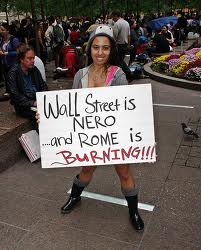
I think it is critically important to realize that in the first century, no member of Paul’s congregation would have ever asked this question.  No one would have plotted the fall of the Roman empire, nor would a Roman Guy Fawkes attempt to blow up the Senate.  Rome really did bring peace to the world and Rome did really provide services which raised the social and economic fortunes of everyone.  No one would have considered joining the Occupy Wall Street movement to protest the outrageous economic practices of the Roman Empire, nor (in the interest of being fair and balanced), would anyone dream of complaining about their taxes and joined the Tea Party.  Those categories simply do not exist in the first century, and if they did, Rome would have silenced them with extreme prejudice!  The young lady with the sign in this picture needs to realize that protesters did not burn Rome, Nero did!

Big-BrotherConsider what the Roman empire was like in the mid-first century.  They did oppress people, the enslaved millions, they promoted the worship of every god imaginable, and they imposed their religious laws on everyone.  Infanticide was practiced and homosexual relationships were permitted (although nothing like gay marriage really existed).  Paul does not add any sort of condition to the command to obey the established government, despite the fact that the Roman government was one of the most oppressive regimes in history!

I do not read anything in Romans 13 or in Paul’s relationship with Rome that sounds anything like a protest against the government.   Paul’s method for dealing with social ills was far more subtle than mass protests – and much more effective.  He told the church to fix the problems themselves by caring for the poor, the widow, the orphan.  There is nothing here in Romans 13 which would support the overthrow of Rome, either in the first century or the twenty-first.

Ephesians 3:1-13 – Paul’s Gospel

Paul describes himself in 3:1 as “Paul the Prisoner of Christ Jesus.”  Traditionally wrote Ephesians while he was under house arrest in Rome.  While house arrest was not exactly the same as being cast in the deepest dungeon in Rome, he was restricted from doing the kind of ministry he would have liked.  In addition, Paul’s appeal to Caesar may in fact go very badly and he could be executed.

The reader of Ephesians may have had some questions about Paul’s argument to this point.  If Jesus has in fact destroyed the authority of the principalities and powers, why is Paul in prison?  How could a “triumphant gospel” be reconciled with Paul’s current shame of house arrest?  If the power of Satan has indeed been broken, how could Paul, as God’s apostle to the Gentiles, find himself treated in this shameful way?

Paul’s answer is to simply point out that despite the fact that he is Rome’s prisoner, the gospel itself is not in prison.  He is in exactly the place where God wants him to be.  In fact, as Timothy Gombis points out in his Drama of Ephesians, God often uses the weak to accomplish his plan so as to highlight the fact that it is God’s victory, not ours (111-2).  Paul himself says in 1 Corinthians that God chooses the foolish things of the world to confound the wise.  If the gospel spreads throughout the Roman Empire, it will be by the power of God, not the power of Paul the Prisoner.

There are a number of words in this section which describe Paul’s Gospel in apocalyptic terms.  The fact that his gospel is a “mystery” which must be revealed may very well be allusions to apocalyptic literature like Daniel. There are several examples in that book of visions which need to be “unveiled” for the reader.  It is as if God is fulling a curtain back to in order to reveal what is going on behind the scenes.  In apocalyptic literature, the one who is reading the book cannot make sense of the vision until an interpreter makes the meaning of the vision clear.

Paul is describing himself as the one who is revealing the plan of God for the present age.  Specifically, God is creating a new person, a “body of Christ” which is made up of both Jew and Gentile without distinction.  There is no racial, class, or gender distinctions in this new body, nor does anyone have an advantage if they are Jewish, male, or free.  Even if a person is a Roman citizen with wealth and prestige, there is no advantage in the body of Christ.

Like the great apocalyptic texts of the Hebrew Bible, Ephesians 3:1-13 declares that God has a plan to redeem the world.  That plan was made in eternity past and God will most certainly bring that plan to completion.  Something as minor as the Roman Empire cannot possibly hope to hinder the Gospel!  I think that this is the sort of message which American Christians need to hear, since no modern “empire” can hope to hinder the gospel.

Romans 13:1-7 – Paul and Occupy Wall Street (Part 1)

The transformed life ought to effect one’s relationship with government.  This is based on common idea in the Hebrew Bible that God ordains the rulers and the nations.  Since Paul is speaking about the Roman empire, it must mean that the Christian ought to obey even an evil government. Paul uses the same verb here in Romans 13 as he did in 8:7, with reference to submitting to the will of God.  Paul therefore means that the transformed believer must obey the government because it is God’s appointed authority.  Perhaps by extension, when you obey the government, you obey God.

But most people immediately ask: if that government abuses its power and rules unjustly, is it then appropriate for a Christian to rebel to change that government?  Usually Christians will say they will obey the government insofar as the government commands that are not contrary to God’s commands.  I can hear many former students asking about life under an oppressive government that does not allow personal freedom or abuses citizens.  What if the government restricts my personal freedom?  What if the government wants to take my guns away?  What if the government permits same-sex marriage, abortion, or the use of marijuana?  What if the government were to be controlled by Islam and Sharia law is imposed on us?  Should we rebel and against the government then?

I think it is critically important to realize that in the first century, no member of Paul’s congregation would have ever asked this question.  No one would have plotted the fall of the Roman empire, nor would a Roman Guy Fawkes attempt to blow up the Senate.  Rome really did bring peace to the world and Rome did really provide services which raised the social and economic fortunes of everyone.  No one would have considered joining the Occupy Wall Street movement to protest the outrageous economic practices of the Roman Empire, nor (in the interest of being fair and balanced), would anyone dream of complaining about their taxes and joined the Tea Party.  Those categories simply do not exist in the first century, and if they did, Rome would have silenced them with extreme prejudice!  The young lady with the sign in this picture needs to realize that protestors did not burn Rome, Nero did!

Consider what the Roman empire was like in the mid-first century.  They did oppress people, the enslaved millions, they promoted the worship of every god imaginable, and they imposed their religious laws on everyone.  Infanticide was practiced and homosexual relationships were permitted (although nothing like gay marriage really existed).  Paul does not add any sort of condition to the command to obey the established government, despite the fact that the Roman government was one of the most oppressive regimes in history!

I do not read anything in Romans 13 or in Paul’s relationship with Rome that sounds anything like a protest against the government.   Paul’s method for dealing with social ills was far more subtle than mass protests – and much more effective.  He told the church to fix the problems themselves by caring for the poor, the widow, the orphan.  There is nothing here in Romans 13 which would support the overthrow of Rome, either in the first century or the twenty-first.