Book Review: Douglas Sean O’Donnell, The Beginning and End of Wisdom

O’Donnell, Douglas Sean. The Beginning and End of Wisdom: Preaching Christ from the First and Last Chapters of Proverbs, Ecclesiastes, and Job. Wheaton: Crossway, 2011. 235 pp. $17.99, pb. Link to Crossway

The plan of this book is to help the reader “build a fire” by helping them to know and enjoy Wisdom literature. More importantly, O’Donnell wants to show the reader “how to build the fire” by giving them some tools for reading Wisdom literature. What makes this book different than most short books of Wisdom Literature is that O’Donnell specifically wants to read this material through the lens of Jesus and the Cross. He wants the reader to “put on Gospel glasses and look at this text” in order to preach Christocentiric sermons on Job, Proverbs, and Ecclesiastes. In order to do this, he provides six sermons based on the beginning and end of the three Wisdom books. After these illustration sermons, he offers a chapter describing his Christological method for reading Wisdom.

What O’Donnell does not do in his sermons is exegesis of the text. By this I mean that there is little reflection on the meaning of words or the context of the ancient world. In his sermon on the opening section of Ecclesiastes, his title is “Why Work?” and the content of the sermon is on the importance of working hard for the at righteousness. He looks at work through “Gospel Glasses” and examines Jesus work doing the will of the father, then draws a line to his audience, urging them also to do the will of the father. I find this style of sermons as more or less thematic, based on some theme in the text, but in the end totally unconnected with the text read at the beginning of the sermon.

In his last chapter, O’Donnell shares several tips for preaching Christ in Wisdom literature. He recommends that the preacher not draw a straight line from the Old Testament to some ethical / moral teaching for his congregation. Rather, a Christocentric preacher will draw the line from the Old Testament, through Christ, and then to an ethical command for his congregation.

How is this to be done? O’Donnell recommends a judicious use of typology. For example, his sermon on Job 42 focuses on the sufferings of Job as a type of the sufferings of Jesus. “What Isaiah foretold, Job illustrated and Jesus embodied.” (125). I think that this style of typology is not particularly helpful if my goal is presenting what Bible actually says. There is nothing at all in Job 42 or in the later use of Job’s story that makes me think that this typological analysis is valid. In fact, I find it scarcely better than allegorizing the text. O’Donnell does not want to allegorize the Old Testament, and claims that this typological study is not allegory. I cannot see the difference. He does state that typology is “not an easy skill,” it takes time, hard work, and spiritual illumination (127).

I find this characterization intimidating since it implies that my resistence to typology is the result of non-illumination, even if it is the result of hard work and time spent in the text. The Holy Spirit may very well illuminate a pastor who takes the time to exegete a text and reflect on historical, cultural, and literary contexts in order to apply the text to his congregation. I think that a sermon on a section of Proverbs, for example, does not have to jump from the text of the Hebrew Bible to Jesus in order to be valuable for a Christian congregation. I certainly do not think that this is necessary for Job or Ecclesiastes. This is where I seriously differ with O’Donnell, I am after the original intention of the author. The application of a text ought to be drawn from that text. By using“gospel glasses” in parts of the Bible which are not expressly Christological, I think the meaning of the text suffers.

I found his appendix on reading Hebrew poetry well written and helpful, although he is standing on the foundation of Robert Alter. He provides a nice introduction to the forms of Hebrew poetry and gives some good advice on dealing with biblical imagery. For example, he urges his readers to not overanalyze imagery, allowing the fluid language of the text to be evocative and moving. I think that this section could be enhanced by taking into consideration the use (and abuse) of metaphors in poetry, but there is still much here that will help a preacher to better approach the poetry of the Hebrew Bible.

This was not the book I expected it to be when I began reading it. Rather than a short introduction to Wisdom Literature, it is book about how to preach Wisdom Literature with a decidedly Christ-centered approach. I think that O’Donnell achieves that goal, I just wonder if that goal is the right one for the pastor who preaches from Wisdom Literature.

Corinth as “Sin City”

Since I am spending time in Corinth this week (in class, not it real life, sadly enough), I thought I would dispense right away with the classic Pastor’s preaching point that Corinth was a “San Francisco of the ancient world.”  I think Chuck Swindoll said that, so most pastors have picked it up and try to illustrate how bad Paul’s church was by comparing it to Haight-Ashbury circa 1969.  This is one of those points that gets picked up in a commentary and repeated with little additional research, sadly it is not exactly accurate.

Usually the evidence for this sexual freedom is that the city was built around two ports and attracted sailors.  In addition, there is usually some reference to the temple of Aphrodite with more tan 1000 prostitutes. Maybe Corinth’s reputation is deserved, but it has little to do with the city that Paul visited. All of these sorts of things were true of Greek Corinth, almost 400 years before the time of Paul!  As Jerome Murphy-O’Connor says:

Such success inevitably provoked the envy of those less fortunate in their location and less industrious in their habits, and so in the 5th–4th centuries b.c., Athenian writers made Corinth the symbol of commercialized love. Aristophanes coined the verb korinthiazesthai, “to fornicate” (Fr. 354).  Philetaerus and Poliochus wrote plays entitled Korinthiastes, “The Whoremonger” (Athenaeus 313c, 559a). Plato used korinthia kore, “a Corinthian girl,” to mean a prostitute (Rest. 404d). These neologisms, however, left no permanent mark on the language, because in reality Corinth was neither better nor worse than its contemporaries. (Murphy-O’Connor, ABD 1:1135).

In fact, the whole Roman empire at the time Paul visited the Corinth had sexual morals significantly different than those of Jews and the early Christians. Corinth was no less moral that Ephesus or Thessalonica. This is not to say  the city of Corinth was virtuous, but no one was singing “I Wish They Could All Be Corinthian Girls.”  Perhaps it is better to think of the Greco-Roman world as having a radically different sexual ethic as Christianity. The type of sexual morality Paul’s gospel demands simply cut across the grain of the culture of the Greco-Roman world, as it should in the modern world.

More on Quality Exegesis

I had my Greek students read D. A. Carson’s Exegetical Fallacies. This is usually a popular assignment since the book is an easy read and interesting. There is something amusing about reading about other people’s mistakes, for some reason.

One of my students made several excellent observations based on his reading of the book. Jon Austin claimed in his review that “…there is a moral responsibility of pastors, professors, and myself to present the exegesis of the gospel with integrity.” I think this is an interesting way to put the problem. It is a moral responsibility to do good exegesis for sermons and Bible studies. I do not think the opposite of “good exegesis” is necessarily “bad exegesis,” but “lazy exegesis.” Most pastors have a very busy schedule and more likely than not do not get to spend quality time “doing exegesis” of the Bible for their sermons. I understand this and experience this regularly myself.

At best, most pastors have to struggle along with the commentaries rather than doing genuine exegesis. Hopefully they are able to use more than one commentary, but likely as not a single favorite source is all that informs the reading of a text. Hopefully the pastor is able to purchase a few new resources when they begin a new series, but I am afraid that some are content with the old standards they had in college or seminary.

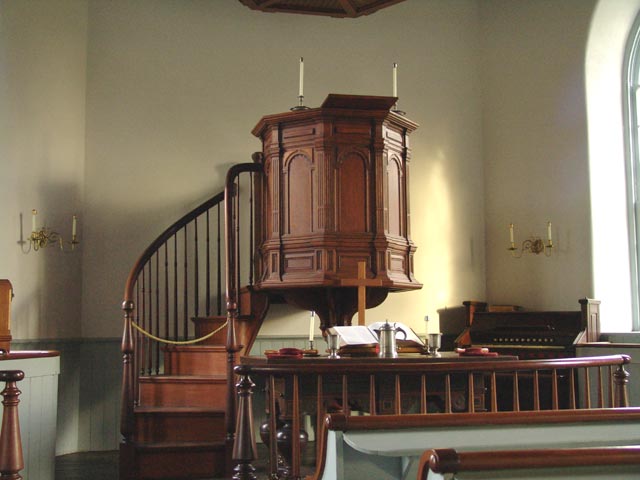
This Pulpit is Plagiarized.

What I fear is that many pastors limp along with the worst form of preparation: surfing the internet for ideas which they can cut and paste into their sermons. If the pastor’s moral responsibility is good exegesis, then the pastor’s moral failure is using sources without critical evaluation or worse yet, plagiarizing sermon elements from blog posts or considering Wikipedia “sufficient preparation.” This is just as much of a moral failing as plagiarizing a paper in college or lying on a resume. My guess is that there are too many pastors who do not agree and continue reading things they got in an email that week as part of their sermons.

Another factor is reliance on topical sermons rather than exegetical ones. I have commented on this before, but I am strongly in favor of expositional preaching, usually through books. Part of the reason for this is that it allows the preacher / teacher to address topics as the arise out of the text, rather than using the Bible as a proof text to support and already-assumed premise. Again, Jon was insightful in his paper: “When we are teaching our congregations topically, we tend to manipulate meanings of words and sentences to our advantage.” I am sure most pastors do not think they are “manipulating” the Bible, but it usually turns out that way when proof-texts are offered. When someone actually reads the proof-text in context and finds that it does not say what the preacher claimed, credibility is lost.

I think that more pastors need to take seriously their high-calling to present the Word of God powerfully by immersing themselves in the Scripture they intended to preach. Since we are dealing with the most precious thing imaginable, God’s Word, legitimate, quality preparation is absolutely essential.

Good Scholarship vs. Good Preaching

The senior pastor at my church is preaching through Philippians this month, and doing a fine job.  He assumes the traditional location and circumstance for the writing Philippians, that is, the Roman imprisonment, sometime between 60 and 62.  Paul is under house arrest while awaiting trial after his appeal to Caesar.  The pastor made several excellent preaching points, great applications which were intended to spur us on to godly living, just as good preaching should do.

However….I am sitting there thinking that it is at least possible that Paul wrote Philippians from Ephesus quite a few years earlier.  In fact, I have become more warm to that idea in this recent round of teaching Pauline Lit in the college classroom.  If Paul is in prison in Ephesus and not Rome, is the fine preaching and application value of the sermon no longer valid?  At the very least they based on some wrong assumptions, and therefore may be improper applications to draw fro this particular text.

This hit me more in my own Sunday School class, since I went to Philippians 4 in order to talk about joy in extreme circumstances.  This is the obvious text to use since Paul is obviously in prison and can still talk about his joy in that rather difficult circumstance.  Which circumstance?  I had to say that he was in prison in Rome since that is what the congregation just heard, and that is the traditional answer that is in all their study Bibles, and I would have to take a half hour to explain the possibility that he was in Ephesus rather than Rome, and by that time people would not care about any “preaching point” I was trying to make.  I simply assumed, for the sake of the congregation, the traditional, and quite possibly wrong background to the letter.

I suppose this was not too great of an academic sin on my part, but it did bother me that I was willing to set aside good scholarship in order to make an equally good point which was for the spiritual benefit of my class.  It was not a lie, but I suppose it was a sin of omission.

This set me to thinking about all of the people every Sunday who preach and teach the word of God and simply set aside good scholarship in favor of making a great point. Usually this involves some abuse of the Greek language and most likely an inadequate understanding of the aorist tense.  Everyone has heard that sermon.  These preachers might very well have good intentions (bringing people to Christ, building people up in their faith), or very bad intentions (increasing their own influence, increasing giving to their ministry).  Either way, it is a sin which must be avoided at all cost.

But if I knowingly and intentionally ignore what I know is true in order to make the sermon “work,” I have sinned because I have not been intellectually honest.  I should never separate preaching from teaching, both must reflect a truthful understanding of the world of God.