As Paul and Barnabas moved into new territory they evangelized the Gentiles directly. After the initial contact in a town at the synagogue, the work of evangelism focused on the Gentiles of the community. The new church was expanding into areas that the Jewish church would not have naturally seen as their “mission field.” As Gentiles accepted Christ and began to fellowship with ethnic Jews, some problems arose primarily concerning the Gentiles not keeping of the Law.
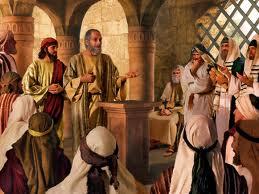 We know from Acts 10 that Peter was instructed by the Lord to preach the gospel to the Gentile Cornelius, a Roman Centurion and God-Fearer. Peter was hesitant to do so, and after he returns to Jerusalem the Jewish Christians there question Peter closely about why he had entered into the house of a Gentile. Peter appears to have understood that salvation was moving into the Gentile world. But Paul was doing more than preaching to God-Fearers in the synagogues who were keeping most of the Law in the first place. He was preaching the gospel to Gentiles and telling them that they did not have to keep the Law in order to be saved. This means that they did not have to worry about Jewish food laws or circumcision, two of the most fundamental boundary markers for the Jew in the first century.
The core of the problem is that up until Paul, Christianity was a messianic movement within Judaism. The people that were accepting Christ in Jerusalem (and even Antioch) were not rejecting the Law, they remained fully “Jewish” in every sense. They maintained ritual purity as they always had, they ate only clean foods, and they continued the practice of circumcision for converts to the faith. This conflict between Jewish Christians and Gentile (Pauline) Christians was the first major problem in the church. The issue appears in several of Paul’s letters (Galatains primarily, but it is also found in 1 Corinthians and Colossians as well. Romans 9-11 deals with the problem of the Jews in the current age.)
Darrell Bock makes an excellent observation concerning this “council,” it ought to be called a “consultation” rather than a council since this is not anything like the later “church councils” that decided doctrine for the church. This is quite true, although Bock does not take this far enough. Paul does not take his doctrine that Gentiles are not required to keep the Law to Jerusalem in order to have it approved by the apostolic community. He does not argue his case and accept the will of the apostolic community. Rather, he reports what it is that God has been doing and the “Judiazers” accept Paul’s position on the issue.