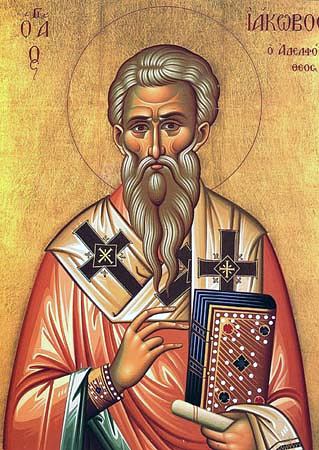
The Significance of James

For many years I have had an interest in Jewish Christianity in Jerusalem in general, and James in particular. In general, I am think that James, the brother of Jesus, was the key leader of the Christian Community in Jerusalem throughout the period covered by the book of Acts. I am always pleased when I read things that more or less state that James was the leader in Jerusalem, such as James Dunn in Beginning in Jerusalem, especially chapter 36, although he says things like this throughout the book.

I think a fair reading of the book of Acts will show that Twelve fade from the scene quickly.  James the Apostle is killed in Acts 12 and not replaced.  Peter sends a message to James the “goes elsewhere.”  Peter drops out of site at that point in the narrative, except for a brief report at the Jerusalem council.  Luke introduces James as a significant player in in Acts 12 and the major force behind the Jerusalem conference in Acts 15.  John, the only other apostle mentioned in Acts also disappears from the book after Acts 8 (and he was silent anytime he was in the story anyway!)

What is remarkable to me is that James appears as a leader at the level of Peter and Paul as early as 1 Corinthians.  In 1 Cor 15:7 Paul passes along the tradition that he received concerning the resurrection.  Only three names of individuals are included, Peter, James and Paul.  These are the three men to whom the Lord appeared, and at least in Peter and Paul’s case, they are commissioned to a particular ministry.

James appears as a leader in Jerusalem quite early, a point that is often missed.  Gal 1:19 describes Paul’s visit to Jerusalem after his conversion.  He met with no one except Peter and James, the Lord’s brother.  It is possible that James the apostle and James the Lord’s brother are confused in the later traditions, but there seems to be strong evidence that the family of Jesus did not believe he was the Messiah before the resurrection.  Gal 1:19 therefore can be understood as saying that within three to four years after the resurrection James not only became a believer in Jesus as Messiah, but he had already risen to some sort of leadership position in Jerusalem.

The book of James is therefore a window into an early form of Christianity, one that was comfortable with Judaism and perhaps did not see Christianity as separate from Judaism in quite the same way Paul does later in Ephesians 2 or Romans 9-11.

How would this observation change the way we read James?

James and the Diaspora

James 1:1 indicates that he is writing to “the twelve tribes in the Dispersion.” Assuming that this line is to be read literally, we need to understand what a Jewish writer would have meant when he said “twelve tribes” and Diaspora. Simply put, a Jew “living in the Diaspora” was a Jew living outside of “the land.” But things are a bit more complicated than that.

Elephantine, Egypt

Elephantine, Egypt

The Judaism of the first century developed the way it did because of the exile. The exile could begin as early as 722 B.C. when Samaria fell to Assyria, but the fall of Jerusalem in 586 B.C. is the usually beginning point for most scholars. The fall of Jerusalem was the event that shaped Jewish religion as we know it in the Second Temple Period because it stripped the Jews of all things which constituted ethnicity. They no longer had land, their language began to shift from Hebrew to Aramaic, and there was a significant threat from intermarriage. The Jews, as a people, were at risk of losing their ethnicity.

How did the Jews survive the exile? All other peoples of the ancient world integrated and disappeared from history. How many people claim to be Moabites these days? The primary factor is Jewish Religious tradition centered on the Torah. These traditions kept them from assimilating into a host culture. The story of Daniel is only one example of Jews working within a culture yet remaining distinct from it. Centers of Jewish cultures developed in Alexandria and Elephantine in Egypt and in Babylon. These places continued to develop well into the current era. It is likely that Babylon and Alexandria were superior centers of Judaism to Jerusalem for much of the Second Temple period.

Those who chose to live outside of the land rather than return to Jerusalem always face problems in living in accordance with their traditional customs. The main three which are typically identified: monotheism, Sabbath, circumcision, and dietary laws. It is not a surprise to find these as the main points of controversy in the New Testament. While Paul does not shift on monotheism, he does not require gentiles to conform to the other three boundary markers and it is at least possible he may have been open to Jews not practicing food laws or worshiping on a day other than Sabbath.

The important thing to remember when discuss the Diaspora is that it was not as much geographical as cultural. Paul might encounter strongly traditional Jews in Ephesus or Rome, and relatively “liberal” Jews in Jerusalem. In fact, I suggest that the Jews who ran the Temple in the first century were far less traditional than the Jews who worshiped in the Greek-speaking synagogues in and around Jerusalem. The fact that the first violent persecution of the followers of Jesus came out of the Greek-speaking synagogue (Acts 7) is an indication that at least those Diaspora Jews were “conservative” with respect to the Temple.

So back to James. I think that he is certainly writing to Jews who are Christians, but they are people who may very well represent the more conservative form of Judaism before accepting Jesus as Lord. If this is true, it may explain James’ insistence on good works, for example, as a sign of true faith.

How might this understanding of Diaspora help us to read the Letter of James? How can this Letter be understood as addressing the needs of Diaspora Jews?

Who Wrote the Book of James?

The question of who wrote the book of James is controversial. The traditional view is that James, the brother of Jesus, wrote the book. Nothing in the Book of James does not resonate with what we know about James from the Book of Acts and Paul’s letter to the Galatians.

Who Wrote the Book of James?

Some scholars doubt whether the Book of Acts is useful for constructing the first thirty years of the church. Still, in the case of James’s role in the early church, Galatians and Acts confirm the picture of James as the leader of the Jewish Christians in Jerusalem as early as A.D. 50 and as late as A.D. 57. But the name James (Ἰάκωβος, Jacob) is very common in the first century, and the author does not explicitly call himself the brother of Jesus in the letter. He is a “servant of God and the Lord Jesus Christ” in verse one rather than “James the Just, Brother of Our Lord Jesus Christ.”

Several traditions describe James as the first “bishop” of Jerusalem, although the use of that title in Eusebius (Hist. Eccl. 4.5.1-4) is anachronistic. An additional complication is that there are a bewildering number of apocryphal stories about James the Just and his leadership of the Jerusalem church. Some of these may contain historical memories of James, but they are buried in layers of polemic legend. Unfortunately, they are not much help in either identifying the author of James or developing a profile for the “historical James.”

The letter of James is sometimes seen as a response to the growing dominance of Pauline theology in the early church. Robert Wall recently suggested James is a second-century pseudepigrapha added to the canon to balance Paul’s theology. (Nienhuis and Wall, Reading the Epistles of James, Peter, John & Jude as Scripture, Eerdmans, 2013; read my review of the book here). He points out the collection of James, Peter, John, and Jude contains letters from the “Pillars of the Church” and is framed with two letters from the brothers of Jesus. He, therefore, suggests James is a kind of introduction to a “pillars” collection developed in the second century to balance the Paul collection.

Challenges to the Traditional View

This traditional view that Jesus’ brother wrote the Book of James has been challenged for a number of reasons in modern scholarship. Most recently, Dale Allison’s magisterial commentary on James in the ICC series weighs the evidence and concludes James is likely not the author. He points out there is there is no clear knowledge of James before the time of Origen (13). In order to evaluate this claim, Allison surveys many of the alleged allusions to James in early Christian literature, especially in Shepherd of Hermas. He concludes that “informed opinion is dramatically divided over the meaning of these parallels” (22). For some, it is obvious James used Shepherd of Hermas (therefore, not historical James and a later date for the book). For others, James was the inspiration for Hermas (implying an earlier date and maybe the historical James).

Allison also points out that the letter of James seems to misunderstand the theology of Paul (20), something which would be remarkable given the contact between Paul and James according to both Acts and Galatians. This is a good point, but it seems to me to argue against a later date since a writer living in A.D. 150 is less likely to misunderstand Paul than one living a hundred years earlier. The later writer would have all of Paul’s letters available to him and knowledge of the controversial nature of Paul’s theology in the first decades of the church. A misunderstanding is more understandable if James was written before Paul wrote Galatians or Romans. On the other hand, one could argue that a later writer deliberately misrepresented Paul to argue against him, creating a straw man argument.

On the other hand, Karen Jobes points to the use of Q (rather than the canonical gospels) as evidence of an early date (Letters to the Church, 159). Q refers to the sources used by both Matthew and Luke. If James can be shown to use Q, then perhaps this is evidence for an earlier date, before the canonical Gospels were written and circulated.

I believe the letter is the best representative of Jewish Christianity in the New Testament. While I fully understand there were Jewish Christians in Jerusalem well into the third and fourth centuries, the Christian community was almost entirely Jewish until Paul’s missionary activity in the late 40s. The letter of James “fits” the historical context of Acts 1-12 better than the second century.

How would reading James as coming from the leader of the Jerusalem church writing before Acts 15 affect our understanding of the letter?


Bibliography: Dale C. Allison Jr., A Critical and Exegetical Commentary on The Epistle of James (ICC; London: Bloomsbury, 2013).

Is the Letter of James Pseudonymous?

James 1_5The Letter of James is often described as pseudonymous, meaning that the letter is attributed to James but not actually written by him.  In fact, this is an issue for several of the books of the New Testament: The Pastoral Epistles, Ephesians, Colossians, 2 Thessalonians, 1 and 2 Peter, and Jude have all been described as pseudonymous.  It is important therefore to think a bit about the practice of pseudonymity in the ancient world, especially as it relates to the authority of the text.

James Dunn wrote the article on Pseudepigraphy in the Dictionary of Later New Testament (IVP, 1997, 977-984).  Beginning with the alleged Pauline pseudonymous letters, Dunn creates a methodology for identifying a letter as post-Pauline.  Simply put, compare the letter to the others which are undeniably from Paul.  In his view, Ephesians and Colossians may or may not be pseudonymous, the pastorals likely represent a “post Pauline tradition.”  But as Dunn admits, this method is hard to use on James, Jude, and the letters of Peter.  There is no other undisputed work of James, so it is difficult to judge.  In fact, he says that the distinction between genuine and pseudonymous with respect to James and 1 Peter is a meaningless argument since in the end we cannot really tell.

On the other hand, a fair argument could be made that James the Just was the author of the letter of James. Conservative scholars (Karen Jobes, Letters to the Church, Terry Wilder, Faithful to the End) consider James’s allusions to the teach of Jesus as well as similarities with the character of James in the book of Acts a evidence the traditional authorship is at least possible (if not likely). These observations track with Dunn’s method (compare the letter to a known source), but at least the comparison to Acts is potentially week since we read the speech of James as reported by Luke, who was not yet a companion of Paul. I do think that Faithful to the End is correct in connecting the James of Acts 15 to the James of the Letter. The character of James in Acts is so consistent with the writer of the Letter of James I have no trouble equating the two.

But the issue of pseudonymity remains.  If a letter can be proven to be pseudonymous, does that reduce the authority of that letter in the New Testament canon?  Perhaps not.

A writer may choose to attach another name to their work for a variety of reasons, some of which are entirely innocent. For example, it is entirely possible that a writer knew the teaching of James very well and created a letter which accurately reflected the teaching of James, and perhaps this writer even used snippets of James’ teaching. In this case, the Letter of James was not actually penned by James, but is an accurate record of his teaching.  There are still some ramifications for inerrancy since the first lines of the book claim to be a letter from James to churches in the Diaspora, but this sort of soft-pseudonymity is not a serious problem.  In fact, it is likely that prophets of the Hebrew Bible were assembled in just this way by anonymous editors who accurately recorded the words of their prophet.

On the other hand, a writer may have attached the name of James to the letter in order to give credence to his own ideas, whether they came form James or not.  Usually any theory of this sort places the writing of the book well beyond the time of James life, perhaps as late as the second century.  This strong-pseudonymity is a much bigger problem for the authority of the text, since the books of the New Testament are assumed to have Apostolic authority. If the letter comes from a much later date and a non-Apostolic author, does it have the same level of authority?

For someone like J. I. Packer, “Pseudonymity and canonicity are mutually exclusive” (Packer, “Fundamentalism” and the Word of God, 184).  Conservative scholars appeal to Eusebius, who reported that the church fathers rejected anything that was not known to have come from an apostle or someone from within the apostolic (Eccl. Hist. 6.12.3).  I think most conservatives would agree with this assessment and dismiss any argument against the traditional answer that James, the brother of Jesus wrote the letter.

If James was a collection of sayings of the historical James rather than a letter written by him, would that change the authority of the Letter of James for you?

Jewish Christian Literature and Pauline Theology

Another common element in descriptions of Jewish Christianity is “anti-Paulinism.” To what extent does a given document disagree with Paul and Pauline theology? There is a wide range of opinion on what Paul’s theology really was, especially in the wake of the New Perspective on Paul. For some writers, James clearly disagrees with Paul, but for others, there is no real disagreement between the two on the relationship of faith and works.

Is there evidence of “differences” in theology between the Jewish-Christian writers and Paul in the New Testament? Acts 21 suggests that at least some in the Jerusalem church were suspicious of Paul’s theology and his understanding of the Law. Whether Acts 21:21 implies that James believed Paul to have “turned away from the customs of Moses” is an open question, but at the very least, some in the Jerusalem community were not supporters of Paul! Paul’s conflict with Peter and Barnabas in Galatians 2 may be another example of resistance to Paul’s view of the Law. I personally think that John Mark’s “defection” in Acts 13:13 is a reaction to Paul’s condemnation of Elymas and his contact with the Roman proconsul on Cyprus. It might even be possible to find some evidence of division in Ephesus in the background of 1 Timothy that is “anti-Paul.”

Paul and James

Because most readers of the New Testament do not hear these echoes of division, Hagner’s second point is hardest to test in the biblical material. Perhaps we want to think that the earliest days of the church were theological pure and wholly unified, and this skews our reading. But there was some tension between the Jerusalem community and Paul, even if it is only hinted at in the New Testament.

For example, James 2:14-26 is at least potentially “anti-Pauline,” although most commentators on James work hard to show Paul and James are not contradictory. To what extent is James “anti-Paul”? If James was written very early, it is possible that James had never read Paul’s theology (a copy of Galatians or Romans, for example) since Paul had not written anything yet! If so, James may be reacting to Pauline Theology as reported to him, not as it was actually taught. On the other hand, there is no reason to think that more extreme applications of Paul’s theology did not appear early on. There may very well have been Jews who rejected the Law in favor of Paul’s doctrine of Grace and, therefore, are attacked by James. (I am not against the idea that James is actually arguing against Paul, but that is for another posting.)

It is sometimes hard for people living after the Reformation to understand that anyone rejected Paul’s theology or that there were groups in the early church that considered Paul a heretic. For many people today, Paul’s theology is Christian theology. Imagine writing a book on Salvation without referring to Paul’s letters! Yet there were at least some sub-Christian groups that did reject Paul’s letters as authoritative sources for developing doctrine.  It is still an open question whether the seeds of this anti-Pauline theology existed in the Apostolic period.

Is there anything in the Jewish-Christian literature that might help with this question? James 2:14-26 and 2 Peter 3:15-16 are two places where Paul is in the background – are there others? By way of application, to what extent is the modern church pro- or anti- Pauline in their way of doing theology?