Gary M. Burge, Galatians and Ephesians Through Old Testament Eyes

Burge, Gary M. Galatians and Ephesians through Old Testament Eyes. Grand Rapids, Mich.: Kregel, 2025. Pb. 327 pp. $28.99.   Link to Kregel

Gary Burge, a Wheaton College emeritus professor of New Testament and well-known scholar, contributes the first volume in the Through Old Testament Eyes series on Paul’s epistles. In his short introduction to the commentary, Burge illustrates the difficulty of interpreting something from another culture. Beit Alpha has a synagogue mosaic with a series of recognizable Jewish symbols, but it also has zodiac symbols and an image of Helios, the Roman sun god, at the center. Burge suggests it takes humility to look at a Jewish mosaic with zodiac symbols and admit that we do not know what the combination means. A similar humility is required for interpreting Galatians and Ephesians (or any other biblical book). We are reading ancient letters in another language, from another culture, and we only hear Paul’s side of the argument. This TOTE commentary series attempts to bridge the gap by offering insights from the Old Testament to help a modern reader interpret Paul’s letters. By ignoring this context, Burge suggests, we risk interpreting these letters in a way that Paul would not recognize.

Galatians and Ephesians Through Old Testament Eyes

Like previous TOTE commentaries, Burge does not write a detailed intertextual study, nor is the commentary on “how the New Testament uses the Old” in Galatians and Ephesians. Burge does not discuss intertextual methodology (how to detect allusions to the Old Testament) or address hermeneutical issues of how Paul interpreted the Old Testament. Burge recognizes that Paul used the Septuagint but does not draw parallels to rabbinic exegesis (Galatians 4:21-31, for example). On one occasion, he draws attention to Second Temple literature (Jubilees in the endnote 5 on Galatians 4), but the focus of the commentary is on how the Old Testament sheds light on Galatians and Ephesians.

His twelve-page introduction to Galatians begins with a discussion of the location of Galatia and the timing of the letter with respect to the Jerusalem Conference (Acts 15). Burge accepts a southern Galatia position. Although this is compatible with either a date before Acts 15 or after, Burge uses the early date in his interpretation of the letter. Galatians is therefore the earliest of Paul’s letters, written just after the conclusion of the first mission trip (Acts 13-14). The introduction briefly describes the spiritual climate of the Galatian churches in a Hellenistic culture where Roman gods mixed with local religious practice. The crisis in Galatia is that “certain men from James” came to Paul’s churches, telling the Gentiles that they must be circumcised to be fully saved. Paul hears of this, postpones his return to the churches, and returns to Jerusalem to settle the issue (Acts 15). The Letter to the Galatians confronts the Jewish teachers. Burge suggests that Paul “believes that an epic shift has occurred in history” (36), by which Gentile Christians are now part of God’s family, the children of Abraham, without keeping the Law (starting with circumcision).

In the introduction to Ephesians, Burge suggests, “Paul is a different person when he writes Ephesians.” Since commentary series rarely pair Galatians and Ephesians, the contrast between “early Paul” and “later Paul” is even more profound. Like most commentaries on Ephesians, Burge discusses the letter’s destination (to the Ephesians or not?) and authorship (written by Paul, or not?) He surveys the critical consensus is that Paul did not write the letter and suggests that an amanuensis or the circumstances later in Paul’s life may account for these objections. Paul might be the author, or the letter could be written “in Paul’s voice.” He concludes Ephesians is “curiously unlike the other Pauline letters.” After offering a brief overview of the context of western Anatolia (culture, religion, imperial cult, mystery religions), Burge says the message of Ephesians is a “grand vision for the church, its place in the world, its qualities, and its mission to create a society unlike any known in the Roman world” (164). In Ephesians, the Christian life is like a battle with dark spiritual forces (like the mystery cults).

Through Old Testament Eyes commentaries have three types of sidebars. First, “What Does the Structure Mean?” These sidebars comment on structural elements of the text, such as the rhetorical strategy of pathos in Galatians 4:11-20. Second, every chapter contains several “Through Old Testament Eyes” sidebars. Burge uses these spaces to focus on how Paul uses certain Old Testament passages (Habakkuk 2:4 and Leviticus 18:5 in Galatians 3:11-12; Isaiah 57:19 on Ephesians 2:13), but also for tracing important Old Testament themes in Paul’s thought. For example: Yeast (Gal 5:9), New Creation (Gal 6:15), The Temple (Eph 2:19-22), or Sealing (Eph 4:30). Third, each chapter contains at least one sidebar entitled “Going Deeper.” These sections draw application from the text and are pastoral. For example, while discussing Galatians 5:14, “Love your Neighbor,” Burge draws application for believers who find loving some neighbors difficult. Others interact with contemporary scholarship. Commenting on Galatians 2:19-21, Burge discusses the contribution of John Barclay’s Paul and the Gift.

Compared to other volumes of the TOTE series, there are far more “Through Old Testament Eyes” sidebars. There are 25 for Galatians and 31 for Ephesians (nearly five per chapter). The Matthew commentary in this series had 29 sidebars in this category, one per chapter of Matthew. In addition, there are fewer “What Does the Structure Mean?” sidebars, only seven in the entire commentary and only one for Ephesians. By comparison, there were 26 in the Matthew volume.

This is an improvement since the commentary’s theme is reading the text through Old Testament Eyes. I found Karen Jobes’ commentary on John curiously lacking in comments on how the Old Testament illuminates John’s Gospel (there were no “Through Old Testament Eyes” sidebars in chapters 4, 5, 8, and 11). Burge’s commentary has far more commentary on how the Old Testament illuminates Galatians and Ephesians. I hope this is the case for future commentaries in this series.

The commentary proper is based on the English text (NIV) with occasional comparison to other modern translations. When Burge refers to a Greek word or phrase, it appears in transliteration. Readers without Greek will be able to use the commentary without difficulty. In the body of the commentary, he rarely refers to secondary sources. Endnotes refer to other commentaries. Burge also uses endnotes for Greek grammatical issues and occasional references to historic interpreters. Although I prefer footnotes, the body of the commentary is distraction-free and a pleasure to read.

Conclusion: Burge’s Galatians and Ephesians Through Old Testament Eyes is an excellent commentary on these two books and will be helpful for pastors and teachers preparing sermons or lessons. Although the TOTE commentaries do not deal with every detail of the text, the focus on how the Old Testament illuminates the text is a welcome contribution to the study of the New Testament.


Other volumes in the Through Old Testament Eyes series:


NB: Thanks to Kregel Academic for kindly providing me with a review copy of this book. This did not influence my thoughts regarding the work.

 

Michael H. Burer, Galatians (EEC)

Burer, Michael H. Galatians. Evangelical Exegetical Commentary. Bellingham, Wash.: Lexham Press, 2024. xxii+575 pp.; Hb.; $69.99. Link to Lexham Press

Michael H. Burer serves as dean of faculty development and professor of New Testament studies at Dallas Theological Seminary. He previously published A New Reader’s Lexicon of the Greek New Testament (with Jeffrey E. Miller; Kregel Academic, 2012) and Divine Sabbath Work (Eisenbrauns, 2012). He was an editor and assistant project director for the NET Bible and edited John Glynn’s Best Bible Books (Kregel 2018, reviewed here). This new addition to the Evangelical Exegetical commentary joins recent Galatians commentaries by David deSilva (Eerdmans, 2018, reviewed here) and Craig Keener (Baker Academic, 2019).

EEC Galatians Commentary

The commentary begins with a twenty-one-page introduction. This seems brief, especially considering this includes an outline of the book and major commentaries. For comparison, Keener’s introduction is forty-five pages, and deSilva’s is one hundred-eight. The rest of the book is about the same length as these recent major commentaries. There is little doubt that Paul is the original author, and this news is never seriously challenged. Unlike authorship, there is more controversy concerning the recipients, date, and relationship to the Book of Acts. After surveying the options, he concludes that Acts 11:27-30 is the meeting described in Galatians 2:1-10. (See this post for my views on Galatians and Acts.)This meeting sets in motion the tensions that culminated in the Jerusalem conference. In the book of Galatians, these tensions are not yet settled. Burer prefers the South Galatians theory, so Galatians is written on the eve of the Jerusalem Council, approximately A.D. 49. The recipients are the churches Paul established on his first missionary journey, the city and Antioch, Iconium, Lystra, and Debre. “the bubbling tension surrounding full gentile inclusion in the people of God on no bases other than faith forces Paul to write these churches to clarify what he preached to them before and it’s outworking in their relationships” (9).

Burer argues the opponents are Jewish Christians who visited Paul’s churches to correct his claim that Gentiles were saved by faith. Instead, they insisted Gentiles must join the people of God, starting with circumcision as a sign of obedience to the Mosaic Law. Who were these opponents? Paul does not identify them by name, nor does he systematically detail their preaching. After serving all the references in Galatians, Burer concludes that Paul thinks the opponents are “hypocritical charlatans” with self-serving motives (13). They want to avoid persecution because of the cross. Older commentaries call the opponents “Judaizers,” but for Burer, this is too simplistic, as if they want to convert Gentiles to Judaism. The opponents are within the social circles of Jewish Christianity. For Burer, they may not be Christians, based on Paul’s strong condemnation (calling them false brothers, etc.). He does point out that the false brothers in Jerusalem may not be the same as the opponents in Galatians, but they share the same theology. They used their association with James to sneak into meetings in Jerusalem. He stops short of connecting the opponents with James, the Lord’s Brother, or the Jerusalem church. After all, Jerusalem acknowledged Paul’s gospel and did not require Titus to be circumcised (Gal 2:1-10, p. 103).

He briefly comments on the relationship between Galatians and Romans. Since Paul wrote Galatians first to address a specific situation, it is better to interpret the later work (Romans) in the light of the former (Galatians). He recognizes there are clear connections and several nuanced differences. In the commentary, he attempts to bracket out his understanding of Romans as much as possible to focus on the text of Galatians. For example, commenting on Galatians 2:15–21, he recognizes that there are clear parallels with Romans, but he does not investigate those parallels to interpret Galatians (170).

The introduction concludes with an exegetical and theological overview. “What has impressed me throughout the writing of this commentary is the intensely pastoral nature of Paul’s interaction with the Galatian congregations (16). The book is personal and practical for the original readers. There are real-world effects on the lives of the people in Galatia if they accept the teachings of the opponents. Certainly, this includes the unity of the church but also physical changes in their bodies (circumcision). “Galatians is in no way a dispassionate discourse on disconnected theological issues” (17). The book is an exegetical, theological defense of Paul’s gospel.

Each unit of the commentary begins with textual notes. He treats major textual variants, perhaps in more detail than usual in most commentaries. This is followed by the author’s English translation and commentary on the Greek text. Greek appears without transliteration. He moves through the text, commenting on words and phrases. He uses extensive footnotes to interact with secondary literature, although major commentaries are cited in-text. Footnotes often point to lexical and syntactical resources. Following his detailed commentary is a brief section of theological comments. Here, Burer often comments on the implications of his exegesis and how contemporary New Testament scholars work with the text. This is followed by a section entitled Application and Devotional Implications. Although this is not a homiletical or devotional commentary, he does try to draw appropriate applications to contemporary church life. Each section is concluded by additional comments, often commenting on an academic article on a finer point in the text. The section concludes with a selected bibliography for that prey. However, not all the key literature in the section is included in this bibliography. For example, in Galatians 2:11-14, he includes Cohn-Sherbok’s article responding to James Dunn but not Dunn’s article (which is cited in the chapter).

As expected in a Galatians commentary, Burer engages with the New Perspective on Paul where appropriate in the commentary. This is especially true for Galatians 2:15–21, something of ground zero for the New Perspective. In fact, this section has several lengthy excurses. The first is on Paul’s use of Psalm 143:2. Second, Burer examines Paul’s use of δικ- word group in Galatians, emphasizing how the New Perspective on Paul has changed contemporary scholarship thinking about this important word. Here, he comments on both James Dunn and N. T. Wright. In a potential understatement, Burer suggests that “the extent and depth of rights argument defies simple summary” (208). Paul used the δικ- word group because he was interested in an individual’s legal status before God (the old perspective), and he was also interested in much more: a community delineated by faith in the Messiah (the new perspective) (208). Although this sounds like he is trying to have his theological cake and eat it too, Burer more regularly sides with the traditional view of Paul against the New Perspective. But this is far from a polemic. His comments often seek to find the best of both views.

The third excurses in this section deals with Paul’s use of the πίστ- word group in Galatians. Fourth, he treats Paul’s use of the phrase “works of the Law.” The New Perspective argues that Paul does not have in mind the entire Mosaic Law, but only the “boundary markers” (circumcision, food, laws, sabbath). Burer concludes that Paul uses the phrase for the whole Torah (the traditional view). Fifth, Burer deals with the difficult exegetical problem in Galatians 2:16, διὰ πίστεως Ἰησοῦ Χριστοῦ (usually reduced to πίστις Χριστοῦ, pistis Christou). Briefly, did Paul intend the genitive case (Christou) to refer to the faithful act of Jesus Christ on the cross (subjective genitive) or to Jesus as the object of one’s faith (objective genitive)? (See this post commenting on the phrase in Romans 3:21-26.) This is an extremely troublesome topic, which is generated many articles and at least one lengthy monograph, The Faith of Jesus Christ: Exegetical, Biblical, and Theological Studies (Hendrickson, 2010; edited by Michael F. Bird and Preston M. Sprinkle). Burer lists briefly eighteen points in favor of the objective genitive and fifteen points in favor of the subjective genitive. He concludes that the phrase refers to “Faith directed at Christ,” the traditional view (220). In his view, Paul refers to humanity’s responsive faith directed toward Christ alone as the basis for a declaration of justification.

Conclusion. Michael Burer has made an excellent contribution to the study of Galatians. This commentary stands alongside other recent major commentaries from Keener and deSilva.

Bonus: Read an interview with Burer and Garrett on the Lexham Press blog.

Review of other commentaries in this series:


NB: Thanks to Lexham Press for kindly providing me with a review copy of this book, both in print and Logos format. This did not influence my thoughts regarding the work.


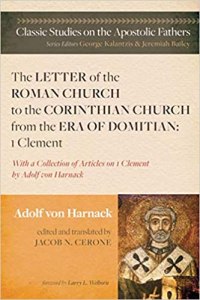
Adolf Von Harnack, The Letter of the Roman Church to the Corinthian Church

Von Harnack, Adolf. The Letter of the Roman Church to the Corinthian Church from the Era of Domitian: 1 Clement with a Collection of Articles on 1 Clement by Adolf von Harnack. Edited and translated by Jacob N. Cerone. Foreword by Larry L. Welborn. Classic Studies on the Apostolic Fathers. Eugene, Ore.: Pickwick, 2021. xxvii+249 pp. Pb; $34.00.   Link to Pickwick  

Edited by George Kalantzis and Jeremiah Bailey, the Classic Studies on the Apostolic Fathers will reprint important studies on the Apostolic Fathers and provide translations of important studies which have not yet appeared in English. In this first volume, Jacob Cerone contributes the first translation of Adolf von Harnack’s brief commentary on 1 Clement, and four articles Harnack wrote on 1 Clement. Cerone previously edited volume two and three of Strack and Billerbeck and translated volume three. Along with Matthew Fisher, he edited Daily Scriptures: 365 Readings in Hebrew, Greek, and Latin (Eerdmans, 2021).

Harnack 1 ClementHarnack published Einführung in die alte kirchengeschichte: Das schreiben der Römischen Kirche an die Korinthische aus der zeit Domitians (I. Clemensbrief); übersetzt und den studierenden erklärt (An Introduction to Ancient Christianity: The writing of the Roman Church to the Corinthian from the time of Domitian (I. Clement); translated and explained to the students) in 1929. Published shortly before he died in 1930, the book has never been translated into English. As the title implies, the book was a farewell gift to students in his Church History seminar. Cerone translates German into smooth English as faithfully as possible. He breaks up “unbearably long, complex sentences” and fixes many of Harnack’s incomplete sentences. He “gives attention to English aesthetics” and cleans up typographical errors in the original. More importantly, Cerone conforms Harnack’s citations to modern academic writing. In the original, Harnack cited sources as author and year, and Cerone added a footnote with full bibliographical information where available. In addition, Harnack sometimes quoted specific verses but only cited the chapter. Harnack had “an irritating habit of quoting sources without citing a source.” When possible, Cerone adds a footnote to the source. Cerone adds Translator’s Notes throughout the book to clarify Harnack’s point or explain his translation choices. The original book restarted footnotes on each page. These new translation numbers footnotes continuously in each chapter. This means the new translation has different footnote numbers than the original. This will not be a problem for most readers unless one is comparing the original German text to the translation. As Cerone says in his preface, if anyone objects to his translation, the German text is available online for anyone who wants to read the original.

Contemporary readers may wonder what value a hundred-year-old monograph on 1 Clement offers to the study of early Christianity. Recent translations of 1 Clement rely on more manuscripts and rely on an additional century of scholarship. Aside from the historical curiosity, what does Harnack contribute to a contemporary discussion of 1 Clement?

As Larry Welborn says in his forward to this book, Harnack saw 1 Clement as an expression of a pure, simple ethic (the kind of Christianity he thought was desperately needed in the early twentieth century. For Harnack, 1 Clement is the most important early church document after the New Testament. Welborn offers four examples. First, for some readers, 1 Clement’s use of the Old Testament as a foundation for Christianity may indicate he sees the church as a replacement of Judaism. Still, Clement may have the attitude of a respectful God-fearer. Second, 1 Clement’s Christology is based on a bread stream of early tradition that does not use Paul. Welborn states this observation had little impact on subsequent scholarship. Third, 1 Clement is permeated with Hellenistic Roman idealism. Harnack draws attention to allusions to Epictetus, Dio Chrysostom, Seneca, etc. Fourth, 1 Clement’s attitude toward the state is entirely positive. Earthly Rome is parallel to the heavenly kingdom of God. There is no right to resistance for those who ought to be subservient. Perhaps this is a defensive posture for those suffering under Nero or Domitian, but it is striking that Clement (writing from Rome) is so positive toward the Empire.

Harnack included two short lists as a kind of appendix to his original book: first, “Problems that have not yet been conclusively investigated” and second, “A look at the development of church history which the letter grants and that should be studied.” These are brief suggestions for his students to explore in a church history seminar. Many of these issues have not been sufficiently explored since this book was published. Harnack asks, for example, what position the letter takes on culture. This is an ongoing discussion in contemporary scholarship. Further investigation of Clement’s positive attitude toward Rome would contribute to the current discussions of Christianity and the Empire. A second example is Harnack’s discussion of church structure in Clement (chapter 5). The letter offers a window on the trajectory from the New Testament to the later institution of the Church, especially concerning the office of bishop.

Conclusion. For anyone studying early Christianity, Cerone’s new translation of Harnack’s final work on 1 Clement is a welcome addition. Reading Harnack’s study of this important post-apostolic writer will be profitable for tracing the development of doctrine and practice in the early church.

Bonus: Tavis Bohlinger interviewed Cerone for the Logos Academic blog in 2021 about this book.

NB: Thanks to Jacob Cerone for kindly providing me with a review copy of this book. This did not influence my thoughts regarding the work.


Matthew S. Harmon, Galatians (EBTC)

Harmon, Matthew S. Galatians. Evangelical Biblical Theology Commentary. Bellingham, Wash.: Lexham Press, 2021. xvi+531 pp.; Hb.; $49.99. Link to Lexham Press  Link to Logos

This new volume in the Evangelical Biblical Theology Commentary series combines detailed exegetical Galatians commentary with theological observations on theology drawn from one of Paul’s earliest letters. Matthew Harmon (Ph.D., Wheaton College) serves as professor of New Testament studies at Grace College and Theological Seminary in Winona Lake, Indiana. He previously contributed Rebels and Exiles: A Biblical Theology of Sin and Restoration in the Essential Studies in Biblical Theology series (IVP Academic, 2020).

Harmon, Galatians

In the twenty-four-page introduction, Harmon defends a southern Galatian view. Galatians 2:1-10 is a private meeting with the pillars during the famine visit (Acts 11:27-30). Paul wrote Galatians after returning to Antioch (Acts 14:26-28) and before the Jerusalem Council (Acts 15:1-21). A date of 48-49 is most likely.

As is typical in a Galatians commentaries, Harmon engages in mirror reading to flesh out the circumstances of the letter. After Paul returned to Antioch, opponents arrived in the newly established churches in Galatia. They argued that since Abraham was circumcised before the Mosaic Law, so too should the Gentile believers. The Mosaic Law provides the Gentiles with guidelines for living the Christian life. The opponents also question Paul’s status as an apostle. Since they are acting on the authority of the Jerusalem church, they claim a higher status than Paul. Paul reviews his relationship with Jerusalem, beginning and concluding with an assertion that his authority ultimately rests with God. Anyone who preaches a different gospel than Paul has already preached is “under a curse.” Any leader can be wrong, as was Cephas in Antioch.

Paul’s theological response begins with justification. Abraham is his chief witness: he was made right with God before circumcision or the law. Since Christ has come, all are united to Christ by faith regardless of ethnicity, socioeconomic status, or gender. Paul gets to this hermeneutically by reading scripture differently than the opponents. Paul reads scripture through the lens of the death and resurrection of Jesus Christ.

For Harmon, this is a “redemptive-historical” lens that evaluates earlier scripture in the light of later scripture. In Galatians, Paul reads Abraham through the lens of Isaiah 49-54. By redemptive historical, Harmon says that Paul sees both continuity and discontinuity between the pre-cross and the post-cross periods. The opponents see significant continuity and very little, if any, discontinuity (20). Regarding ethics, by choosing the Mosaic Law as an ethical guideline, one rejects Christ. Freedom from the law in Christ means an opportunity to serve one another in love and to live a transformed life free from the power of sin and death.

The body of the commentary (25-371) moves through Harmon’s exegetical outline of Galatians. Each unit begins with the CSB translation, followed by two paragraphs on context and structure. Harmon then exposits the text phrase by phrase. Although the commentary is based on English, he extensively uses Greek (without transliteration), using footnotes for lexical, grammatical, and syntactical issues. He also treats textual issues in the footnotes and refers to secondary literature. Each unit ends with a paragraph bridging the exposition to larger canonical and theological issues. The result is an uncluttered commentary useful for scholars, students, and laypeople.

On several occasions, Harmon deals with controversial topics in the study of Galatians, sometimes in two places in the book. For the troublesome phrase, “works of the law” (ἐξ ἔργων νόμου). He summarizes James Dunn’s views that the phrase refers only to certain boundary markers (primarily circumcision and food laws in Galatians) in a lengthy footnote (110). He then returns to the Works of the Law in the biblical theology section of the book (434-38) as part of a larger discussion of the Mosaic Law in Galatians. In that section, he discusses the background of circumcision, table fellowship and food laws, Sabbath, and Jewish festivals. He concludes, “There is good reason to conclude that the mosaic law demanded perfect obedience.” Paul, therefore, insists that anyone who submits to circumcision must keep the entire law, not only so-called boundary markers. For Harmon, this agrees in principle with James 2:10.

Similarly, he introduces the issue of “faith of Christ Jesus” in 2:16. In the commentary’s body, he briefly describes the issue: Is the phrase an objective genitive or subjective genitive? Should the phrase be translated as “faith in Jesus” or “faith of Jesus?” Does Paul refer to a person having faith in Jesus to be justified, or does he refer to the faithful act of Jesus on the cross? This has been a highly controversial topic in recent years and part of the so-called new perspective on Paul. He returns to the issue in the biblical-theological section (465-70). After summarizing the various sides of the issue, he concludes in favor of the objective genitive: Paul refers to the believer’s faith in Jesus Christ.

Like the Two Horizons commentary series, Harmon makes a series of biblical theology comments following his exposition (373-478). This is a robust biblical-theological section. It is, in some ways, a “theology of Paul through the lens of Galatians.” He begins with salvation history, or apocalypticism, in the apostle Paul. This has been a hot topic in Galatians studies since the commentaries of J. Lewis Martyn and Martinus de Boer. By salvation history, Harmon means a “gradual unfolding of God’s plan culminating in Christ.” The apocalyptic view focuses on God breaking into history through Christ, providing a sharp antithesis: before Christ and after Christ. These are not two opposing views; Harmon wants to integrate them into a more holistic reading of Galatians, not unlike N. T. Wright or Michael Bird, An Anomalous Jew (Eerdmans, 2017). he lists several of the apocalyptic antitheses or contrasts before and after Christ. For example, the present evil age stands in contrast to the new creation or the messianic age. Paul’s view is a modified version of the common Second Temple Jewish view that history is divided into the present evil age and a future messianic age (403). The modification is “already/not yet. Justification paves the way for the new creation, as evidenced by the activity of the Holy Spirit in this age.

Harmon includes several pages on the Abrahamic covenant, summarizing his monograph on the covenant in Second Temple Judaism, She Must Go Free (de Gruyter, 2010). Although the importance of the Abrahamic covenant was recognized in Paul’s day, there was a wide range of opinion on how to interpret it. In Galatians, there is a clear disagreement between Paul and his opponents on the relationship between the Abrahamic covenant and the work of Christ (386). The promise to bless all the nations is fulfilled in Christ. Those who trust in Christ are justified before God.

A second major topic in the theology for a Galatians commentary concerns the exile and return from exile. Paul quotes Deuteronomy 27:26 in Galatians 3:10, and in Deuteronomy, the ultimate curse is exile. Although Israel returned from exile, they did not experience salvation. For Harmon, Paul is reading Isaiah 40-55, especially the fourth servant song (Isaiah 52:12-53:12), through the lens of Jesus’ suffering under the curse of the law. For Harmon, “Isaiah consistently connects the promise of return from exile with the transformation of creation” (393), the gift of the spirit (394), and the blessing of the nations (395). Christ accomplishes the new exodus by becoming a curse for us. “Paul uses the sin-exile-restoration theme as a supplement to the larger framework of the Abrahamic covenant fulfilled in Christ” (401). Some of this material appears in Harmon’s Rebels and Exiles: A Biblical Theology of Sin and Restoration (IVP Academic 2021).

Paul’s view of the purpose of the Mosaic Law is one of the most challenging biblical theology issues in Galatians. For Paul, sometimes the law has a positive function, but in other cases, it is a negative function. The law is limited to a time and has a clear beginning and end. Other times, Paul repudiates the law, rejecting a specific aspect such as circumcision and food laws (Galatians 2:3-6; 2:11-14). Other times, Paul replaces the law with a new guideline, such as the law of love. In other examples, Paul re-appropriates the law, using it like wisdom literature or prophecy, so that the story of Abraham is read as a prophecy fulfilled in the work of Christ.

Justification and righteousness are central to the dispute between Paul and his opponents and are crucial for understanding Galatians. But, as Harman observes, this is no easy task. He, therefore, focuses on the Jewish background for justification, specifically the book of Isaiah (once again following his own monograph, She Must Go Free). He argues Isaiah 40-55 uses righteousness language in parallel with salvation language with strong eschatological overtones. In Isaiah, God is fulfilling his promises to set things right in the world, saving people from sin and bringing judgment on his enemies. This righteousness is forensic, dealing with a person’s status before a holy and just God in his court of law. But this status ought to lead to ethical righteousness. Paul closely tracks this view from Isaiah in Galatians. Christ is the means of justification through faith in Jesus, but there is an “already/not yet” aspect to justification. Both are present in Galatians, but Paul often has the future in mind (450). But Paul does not disconnect justification from present realities. The future or final justification shapes the believer’s life in the present age.

The biblical theology section of the book has shorter sections on God (Father, Son, and Holy Spirit), the servant of the Lord, seed/offspring, and the use of the Old Testament in Galatians.

Conclusion. Even if this book only contained Harmon’s detailed commentary of Galatians, it would be valuable. But his lengthy discussion of Paul’s theology drawn from Galatians makes this an especially welcome contribution to the study of Galatians.


Reviews of other Commentaries in this Series:

NB: Thanks to Lexham Press for kindly providing me with a review copy of this book. This did not influence my thoughts regarding the work.


N. T. Wright, Galatians (Commentaries for Christian Formation)

Wright, N. T. Galatians. Commentaries for Christian Formation. Grand Rapids, Mich.: Eerdmans, 2021. xix+419 pp. Hb; $39.99.   Link to Eerdmans  

This new Galatians commentary is Eerdmans’s first in the Commentaries for Christian Formation series, edited by Stephen E. Fowl, Jennie Grillo, and Robert W. Wall. The goal of the commentary is to serve the church by “showing how sound exegesis can underwrite preaching and teaching, which in turn forms believers in the faith” (ix). This is not a homiletical, pastoral commentary. The commentary does serious exegesis and thoughtful reflection on the text. Considering the general editors, this series may look like a theological commentary like the Two Horizon series (Eerdmans, with contributions by Fowl and Wall). Unlike the Two Horizons volumes, Wright integrates his theological observations into the commentary itself rather than in a second section. Wright is not doing “theological interpretation of scripture” as practiced in that series. For example, he observes Galatians could teach “there is one holy, catholic, and Apostolic Church,” and Paul would agree with this statement. Yet Wright thinks we should never substitute a “creedal checklist” for the specificity of Paul’s own argument in his own situation (5).

N. T. Wright, Galatians Commentary

Galatians is a dense argument and theologically challenging. As Wright explains in the introduction to the volume, his goal is to “get inside those tight-packed paragraphs and see what makes them work as they do, or at least as Paul hopes they will” (xiv). How does all this relate to Christian formation? Wright assumes “Christian formation means the shaping of communities, and individuals within them so that they reflect more fully and faithfully the fact that the Spirit of Messiah Jesus is dwelling in their midst (corporately) and within them bodily (individually)” (3). Christian formation is more than the spiritual or theological equivalent of a team-building day at work or a football coaching session. It is discovering, sometimes through painful practice, what it means to be the Messiah’s people, a single anointed community. This requires more than a rational analysis of the text, the “what did it mean at the time,” although it requires that hard work be done properly. What it meant must move toward what it means now through the prayerful and pastorally sensitive work of pastors and teachers.

In the introduction to the commentary, Wright states Galatians is not about “how to be saved from sin in order to go to heaven.” In fact, Paul hardly mentions sin in the letter, and salvation is not mentioned at all. The book of Romans is about sin and salvation, but these are not the main topics of Galatians. Galatians is about who should be counted as a part of the single family of God (9). That Galatians is about sin and salvation results from the Reformation’s response to the medieval Catholic view of purgatory and indulgences. All this is classic N. T. Wright, drawing from previous work on Paul’s theology, in his more popular level, Surprised by Hope. As he says, “If you change your eschatology, everything changes.” If Galatians is not about “life after death” but that the new heavens and new earth are “here and now,” then the book is no longer about medieval purgatory and salvation from sin. Galatians is about “how you can tell, in the present time, who were the people of God; who will be vindicated as the true Israelites in the new age to come” (14).

But it is not as though he does not believe that God saved people from their sins. This is absolutely clear from the book of Galatians. God demonstrated his love by sending his son for our sins. “This love—freely given, greatly returned, lavishly shared—is at the heart of Christian formation” (21).

Wright devotes the second half of the introduction to the situation in Galatia. He states his view that the book was written to southern Galatia, to churches visited by Paul on his first missionary journey in Acts 13-14. Paul wrote Galatians after the first missionary journey but before the Jerusalem council in Acts 15 (21). This differs from some other recent commentaries (Keener, for example, argues for southern Galatia but dates the book after the Jerusalem council). Wright offers no arguments in favor of this view but refers interested readers to several historical and archeological studies and his Paul: A Biography for the details. (See also my comments on Galatians and Act 15.)

Instead of engaging in protracted arguments about the destination of the letter, Wright wants to think more deeply about “the social and political situation,” what he calls “the real-life situation” of the Galatian readers. He sees Roman imperial ideology and the demand to worship Caesar as Lord as a serious challenge for gentile believers in Jesus as Messiah. Jews were exempt from these demands, so gentile Galatian believers could claim to be part of the Jewish exemption from the imperial cult. They are not part of a new religion but part of an ancient (and exempt) religion. This view worked in Corinth (Acts 18) but did not work in southern Galatia. A new group of non-Jews claiming the Jewish exemption would threaten that exemption for the local Jews. Local Jews would, therefore, want to separate from the gentile Christians. Even some zealous Jews from Jerusalem, the men from James, could see Paul’s mission to the Gentiles as “colluding with Pagan wickedness” (28).

The solution was to compel gentile believers to convert fully to Judaism, starting with circumcision. This showed that the new movement was indeed genuinely Jewish and showed the “puzzled or suspicious local pagan authorities that the claim to the exemption from normal imperial religious practices was genuine, however unexpected and unwelcome it might have been” (29).

Paul’s answer is not to offer Christianity as a superior alternative to Judaism. That reading reflects eighteenth-century History of Religions thinking (and I would add, those categories really didn’t even exist as alternatives when Paul wrote Galatians). Instead, Paul offered a messianic eschatology, resulting in personal and communal transformation (32). Wright develops this in three main points found in Galatians:

  • First, the God of Abraham, Isaac, and Jacob have done what he has always promised: he has launched his new creation (32). The present evil age is ending, and the age to come has already begun with the death and resurrection of the Messiah. Therefore, to get circumcised denies the new creation has really begun (33).
  • Second, God’s Messiah, Jesus, has fulfilled the divine purpose for Israel in his death and resurrection and has accomplished the new exodus. This is the ultimate rescue from the ultimate enemy, sin and death. It would shock Jewish readers to learn that Israel is fulfilled through a crucified Messiah. But even more shocking, the Torah has done its job and is now set aside. The Torah accomplished its purpose, and its time is complete. To force non-Jewish believers in Jesus as Messiah to keep the Torah for its own sake or to look like good Jews to the Roman magistrates or to the anxious, zealous Jews from Jerusalem must be firmly resisted (36).
  • Third, God has given his spirit to be the transformative energy for his new people. The spirit is an advanced gift from the future inheritance (38). As a result, all of God’s people belong at the same table. The church’s Jewish neighbors would not understand this, and maybe even other Jewish believers in Jesus as messiah would not understand. Even the “men from James” from Jerusalem didn’t understand the importance of the unity of all believers, whether Jew or Gentile, male or female, slave or free.

The main body of the commentary begins with a new translation drawn from his The New Testament for Everyone. Unlike some exegetical commentaries, Wright does not comment on lexical or syntactical issues, along with his translation. In fact, his translation is periphrastic, occasionally sounding more like The Message than the NRSV. This is not a problem since the goal of the translation is to express Paul’s ideas in language “for everyone.”

After a brief introduction to the main theme of the unit, the commentary precedes paragraph by paragraph, divided into verses and clauses. Although there are occasional references to Greek, these are always in transliteration and will not distract readers who do not know Greek from understanding the commentary. He occasionally interacts with modern secondary literature in footnotes. But as he says in the introduction, he does not engage in “zealous footnoting that is now common in commentaries.” He recommends recent commentaries by Moo, deSilva, and Keener for that sort of thing. His primary goal is to explain what Paul meant and then what it might mean for today. This book is not a compendium of what other commentaries have already said.

Even though this is a “Christian formation” commentary, it is thoroughly historical, sociological commentary. Wright does the exegetical work required (“what did Paul say”) and places Paul in the proper historical context, both in terms of Jewish backgrounds and the Greco-Roman world of the Galatian churches. More than most commentaries, reading the introduction is critically important. Wright consistently ties his exegesis back to the three main points from the introduction describing the situation of the Galatian churches.

Because this is N. T. Wright, the prose is well-written and will be enjoyed by both laypeople and academics. He highlights the main points with judicious use of italics and bold print. The lack of argument in the book will frustrate some academic readers, but footnotes to Wright’s many other books on the Apostle Paul are sufficient. However, it is unnecessary that one read the 1500-page Paul and the Faithfulness of God to understand this commentary. Although it helps to have a working knowledge of the last 40 years of Pauline studies, one can appreciate the argument of this commentary without working through Wright’s Paul and his Recent Interpreters.

In the end, this Galatians commentary achieves the goal of clearly explaining the text of Galatians as it would have been understood in the original historical and cultural context (as described by Wright). The commentary does make a significant contribution toward Christian formation by challenging readers to hear and apply the text in a modern context.


NB: Thanks to Eerdmans for kindly providing me with a review copy of this book. This did not influence my thoughts regarding the work.