It is the time of year to be thankful, and I am thankful that I have an extra copy of Michael Bird’s new book, The Gospel of the Lord: How the Early Church Wrote the Story of Jesus(Eerdmans, 2014) to give away to some lucky reader of this blog. This is a new copy; mine is well read, marked and dog-eared by now. I will send a clean copy to a reader of this blog. There are no geographical limits here, although I am hoping someone from Antarctica does not win.
I plan on posted my review of the book in a few days, but for now let me say this is a nice introduction to several related topics at the foundation of Gospels studies, touching on related by diverse topics like Oral Tradition, Source Criticism, and the Genre of the Gospels. Each chapter has an excursus which digs a little deeper into some aspect of the chapter, so it is like getting two books in one. I highly recommend the book as an introduction to Synoptic Gospels study.
To have a chance at winning these books, leave a comment telling me what Famous Gospels Scholar you are most thankful for this Holiday season. Or at the very least, leave your name. I will announce the winner picked at random on December 1.
Burke, Tony. Secret Scriptures Revealed: A New Introduction to the Christian Apocrypha. Grand Rapids, Mich.: Eerdmans, 2014. 170 pages; Pb. $18.00 Link to Eerdmans
Tony Burke’s Secret Scriptures Revealed is one of the few books to introduce the Christian Apocrypha to the general reader without engaging in sensational claims or overly emphasizing Gnosticism as a suppressed competitor to early Christianity. Burke has been blogging on the Christian Apocrypha at Apocryphicity since 2006. His site has a wealth of information on this literature, but this short introduction provides the background the average needs to read this diverse literature properly.
The Christian Apocrypha is not really a collection in the same sense that the Old Testament Apocrypha is. There is no set “canon” for the Christian Apocrypha. Even the titles of these books are not official since anything concerning Jesus is a “gospel,” and the most prominent apostle gets his name attached. Books like the Gospel of Thomas or the Gospel of Philip are not gospels in the same sense that Matthew is a gospel, nor is there a claim to have been written by Thomas or Philip. Burke includes some documents that seem to come from more orthodox Christian writers as well as documents from Gnostic writers that are clearly heterodox. Since most non-scholars have only heard about this literature through highly sensationalized media reports on The Da Vinci Code or the Gospel of Judas, many have the impression that the church actively suppressed this literature. In some cases, that was true, but all of these books were preserved and copied by Christians for centuries.
Some of the books were known only by name until several significant discoveries in the twentieth century. A full copy of the Gospel of Thomas, for example, was discovered in Egypt in 1945. Perhaps it is better to describe some of these books as “not very popular” rather than “suppressed” or “secret.” Many of the texts Burke discusses were found in Oxyrhynchus, Egypt. Some have only recently been published.
A “Christian Apocrypha” would include texts that are not only post-apostolic (although Burke suggestions some of the books may originate in the late first century), but also outside of what is usually described as the “church fathers.” The Apostolic Fathers is a fairly set collection, although that collection seems more dependent on the Loeb Library volumes. The oft-reprinted ante-Nicene, Nicene, and post-Nicene collections edited by Philip Schaff represent more or less orthodox theology and traditions. The books Burke is describing will not be found in the Ancient Christian Commentary on Scripture.
After two chapters explaining issues of canon and the origin of the books, usually included in the Christian Apocrypha collections, Burke examines apocryphal gospels. Chapter three concerns the various lives of Jesus. This chapter covers infancy gospels—books that claim to tell the story of Jesus’ birth and childhood. Under “Ministry Gospels,” he covers the agrapha, approximately two hundred sayings of Jesus that do not appear in the canonical Gospels. There are also, a number of fragmentary gospels discovered at Oxyrhynchus. Burke briefly discusses the controversial Secret Gospel of Mark, leaving the question of authenticity open.
Chapter four examines passion and resurrection gospels. Here, Burke briefly discusses the Gospel of Judas and the Pilate Cycle and a series of smaller fragments describing Jesus’ descent into Hell. The latter was highly influential in the development of the church’s teaching on the “harrowing of hell.” Chapter five surveys the many apocryphal books that develop legends about the early church. The Acts of John, Acts of Peter and Acts of Paul are the most important books Burke surveys, but he also includes a number of other stories about Mary, Joseph, John the Baptist, and Mary Magdalene. Stories about Mary were obviously important in developing devotion to Mary in the medieval period.
In a final full chapter, Burke attempts to dispel misconceptions about this apocryphal material. Some are directed at popular scholars like Bart Ehrman or Elaine Pagels, who make too much of this material. This material was not violently suppressed by the (male) establishment. These books were not forgeries written to undermine the true gospels. In fact, not all Christian Apocrypha can be described as Gnostic or heretical. Burke clearly states that the Christian Apocrypha (as he describes it) is not as dangerous as the apologists claim, nor is it a forbidden source for the real, original teaching of the church that Dan Brown makes it out to be.
This book intends to overview the most important post-apostolic texts briefly. Since it is an introduction, Burke does not include a chapter on Christian apocalypses. He places his four pages on Christian apocalypses in his chapter on resurrection stories. Perhaps texts such as the Christian Sibylline Oracles, the additions to 4 Ezra, and the Ascension of Isaiah were omitted because they are Christian editions of earlier Jewish books. Burke includes the apocalypse of Peter, but there are also apocalypses of Paul and Thomas. This criticism falls under the category of “this is not the book I would have written.”
Burke does not include lengthy readings from the books he discusses. This is a decision to make the book more readable to a broad audience. He occasionally quotes a few lines to illustrate a point, but for the most part, he simply summarizes the original text. On the one hand, this streamlines the book and makes it easier for the popular audience to read. However, several times, I would have liked more primary material embedded in the book itself. The reader can look the texts up in various collections if they are interested.
One feature that non-professionals will appreciate about the book is that Burke does not use footnotes. At the end of each section of a chapter is a box of “further reading” on topics covered in the section. There is a four-page “for further study” appendix, and a five-page bibliography provides the interested reader with full details for these more technical works. While I prefer full footnotes, these quasi-endnotes make the book much easier to read.
Update: Since this small book was published, Burke has edited three hefty volumes of more New Testament Apocrypha. Links go to my reviews of those volumes.
Conclusion: I would highly recommend this book to people wanting to know more about non-canonical Christian Apocrypha texts. Burke’s introduction is accessible to laymen and accurate in presenting the facts. I am very pleased that the book does not use sensationalism (aside from the title) to attract attention.
NB: Thanks to Eerdmans for kindly providing me with a review copy of this book. This did not influence my thoughts regarding the work.
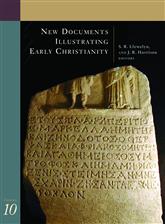
S. R. Llewelyn and J. R. Harrison, with E. J. Bridge, ed. New Documents Illustrating Early Christianity Volume 10. Grand Rapids, Mich.: Eerdmans, 2013, 269 pp., paperback, $40.00. Link
This is the second part of my review of New Documents Volume 10.Here is the first part, which includes an overview of the book up to the first two sections.
J. R. Harrison has four articles under the heading “Cult and Oracle,” including a papyri describing how Artemis overcame an evil sorcerer. The inscription is from a white marble slab from Ephesus, dated to A.D. 165. The article interacts with Clint Arnold’s Magic in Ephesus, which tends to describe Artemis as a demonic goddess, and R. Strelan’s Paul, Artemis, and the Jews of Ephesus, which argues Artemis is associated with salvation from evil spirits. On the whole, this long article favors Strelan (summarizing his arguments concisely). The inscription says that the temple of Artemis was a place of much gladness and that the goddess rescued the city from an evil magician who brought down a plague on the city.
There are two sections on Public life in the Greco-Roman world. Entry 11 describes a marble inscription in Latin and Greek honoring Augustus for sponsoring the paving of a street in Ephesus 22/21 B.C. While the inscription itself was discovered in 1958, an article appeared in 1991 which used this inscription to illustrate benefaction in the Roman world. Twice in this brief inscription the gift which Augustus made to the city of Ephesus is described as χάρις, a “gift.” The source of the gift is the Empire and the “sacred revenue” of the Temple. As Harrison points out, Augustus became “an iconic example of beneficence” and a model for other benefactors to follow. Later, Tiberius would be called “the benefactor of the world.” Since the Emperor and Empire was a source for huge sums of money, provincial elites in Ephesus found ways to exploit their patronage and line their own pockets. Harrison cites an edict dated A.D. 44 which indicates that selling the office of priest of Artemis was a lucrative trade. Harrison suggests that this benefaction (and corruption of the system) illustrates Paul’s use of grace-language in Ephesians as well as his frequent used of wealth metaphors in the book. “Paul’s language of ‘wealth’ in Ephesians could also be profitably looked at against the background of the wealth of the Artemis cult” (61).
Four articles comprise the section entitled “Household.” D. C. Barker describes an Egyptian divorce agreement dated A. D. 177, on papyri. Among the fascinating details is the fact that the wife Aphrodisia is 21 years younger than her husband, Ptolemaios. From census records Barker points out that 83% of men were older than their wives, from one to thirty years older. One of the more fascinating articles in this section is entitled “Every Dog Has Its Day.” The text is from a limestone sarcophagus from Termessos (Psidia). This is a eulogy for pet dog, Stephanos, written by the owner Aurelia Rodope. She “wept for the dog and buried him as a man.” Harrison discusses the popularity of pet dogs in the Roman world, stating that some “Mediterranean peoples were besotted by the small white long-coated Melitaen” (127). There are many examples from Gerco-Roman literature as well as inscriptional evidence that dogs were often fed from the table. This devotion to dogs as pets seems to stand in contrast to Jesus’ attitude toward the Syro-Phoenician in Mark 7:26. It is customary to emphasize more negative the Jewish attitude toward Gentiles; they are “dogs.” But Harrison points out that the image of a dog could be taken as positive, indicating that after the children are fed (the Jews) it is appropriate for the dogs (the Gentiles) to receive food.
Five articles are collected under the heading “Judaica,” including a pay slip for a Roman soldier at Masada and comments on two well-known items, the Temple Warning and the Babatha Archive. The Babatha archive is a collection of documents found at Nahal Hever (near En-Gedi). The documents are her important legal papers” and date to about A.D. 125. The documents were stored before the Bar Kokhba revolt, perhaps hinting that she participated in the revolt. The burden of this article is to compare the documents to Roman Law, especially with respect to marriage, divorce, polygamy, and guardianship. Babatha was a “second wife” to her husband Judah, leading G. Rowling to suggest that polygamy was not only practiced by the upper echelons of society, but may have been practiced in traditional rural areas as well (151).
Finally, three articles comprise the section on Christianity. Two of these are fourth century papyri letters from Oxyrynchus and illustrate early Christianity. Item 28 is a “Difficult Request (?) to ‘Beloved Father’ Diogenes.” It is clearly Christian because the words for Lord and God are abbreviated as Nomina sacra. The letter was written by Barys to Diogenes. Barys describes himself as a “brother” and Diogenes as “father.” Such language for social or religious relationships is common in the Greco-Roman and Jewish world, as it is in the New Testament. In addition, Barys refers to Diogenes as “lord” (κύριε), perhaps indicating that Diogenes has a higher status than Barys. Bridge points out the use of κύριε for a religious leader in Matt 9:28, 17:15, etc.) The letter would perhaps shed light on Paul’s letter to Philemon, especially since Barys uses the word λιτουργία (spelled λειτουργία in the NT). While the word can refer to public service, Paul used it in Phil 2:17, 25, 30 for service within the church, and in 2 Cor 9:12 for Christian giving. In the end, Bridge concludes that this letter is “two Christians in communication, one of whom has authority over the other, on the ‘secular matter’ of public service.”
Conclusion. Virtually every section of New Documents Volume 10 is worthy of attention. The entries make for fascinating reading and they all contribute to our understanding of the world of the New Testament and early Christianity. I highly recommend this volume to students and scholars. Every serious library should own all ten volumes of this important series. I look forward to additional volumes in the series, although my preference is that the next volume arrives sooner than ten years from now.
Thanks to Eerdmans for kindly providing me with a review copy of this book. This did not influence my thoughts regarding the work.
S. R. Llewelyn and J. R. Harrison, with E. J. Bridge, ed. New Documents Illustrating Early Christianity Volume 10. Grand Rapids, Mich.: Eerdmans, 2013, 269 pp., paperback, $40.00. Link
After a more than ten year wait, a new volume of the New Documents series has finally been released. New Documents Volume 9 came out in 2002, covering Greek inscriptions of interest to Early Christianity published in 1986-87; this new volume covers 1988 through 1992. To give you some perspective on how important this series is, I did a search in A Greek-English Lexicon of the New Testament (BDAG), the current edition of the standard lexicon for New Testament Studies in English. There were 354 hits in 323 articles in the lexicon. BDAG only included material through volume 8 of the New Documents series. The New Documents series provides a database on which future lexical studies will rely.
Because this is such an important book, my review is quite long. I have therefore decided to break it into two parts, the second appears here.
For those unaware of the New Documents series, it began under the editorship of G. H. R. Horsley in 1981. E. A. Judge was a contributor to that first volume and now serves as the director of the project. He wrote the preface to the first volume explaining the rationale for the series. Since the publication of Deissmann’s Light from the Ancient Near East (1908) and Moulton and Milligan’s Vocabulary of the Greek New Testament illustrated by the Papyri (1930), there has been a flood of new published papyri documents and inscriptions, many which are important to historians of early Christianity as well as interpreters of the New Testament. The New Document series proposed to survey newly published material and collate that material into a single printed volume as a “fresh digest of the ancient evidence.”
That first volume covered documents published in 1976. After more than thirty years, the series now has ten volumes which cover published material through 1992. The tenth volume covers more years than the last and contains about 50 pages more in the main section than volume nine. In addition, Volume ten contains six cumulative indices for volumes 6-10, including subjects, words (sub-divided into Greek, Latin, Hebrew and Aramaic), ancient authors, inscriptions, papyri, and biblical works (sub-divided into Hebrew Bible, Apocrypha, Pseudepigrapha, Qumran, Rabbinic literature, and the New Testament). My suggestion to E. A. Judge and the New Documents project is to merge the index for the first five volumes with this index and move the whole thing online. That would allow scholars to search the whole series from a single index, and the index could be edited and expanded. In addition, moving the indices online would save nearly 100 pages in this volume which could be used for additional articles!
Each volume is sub-divided into sections, although the sections are unique to each installment. For example, volume nine had two long sections for inscriptions and papyri; volume ten divides the material topically. Each entry begins with an entry number and a title for the article. The entry begins with a physical description of the item including location, media (papyri, inscription, etc.) and suggested date. A transcription of the text is printed with the translation in a parallel column. The author of the article then provides a running commentary on the item, intentionally drawing out implications for the study of the New Testament or Early Christianity (the stated goals of the series).
In the first section of Volume 10, E. A. Judge contributes two articles on Philosophy. The second describes an inscription on a marble block from Philadelphia (Lydia) from the early first century. The inscription celebrates a person who has become wise, but more interesting is the arrangement of the site where the inscription was found. There is a narrow, straight path between illustrations to the left of ἀσωτία, distractions to wisdom (Luke 15:13,the prodigal son, Eph 5:18, Titus 1:6, 1 Peter 4:4), and illustrations to the right of ἀρετή, excellence of character (Phil 4:8). This illustrates the “two ways” found in a number of philosophical and biblical texts. Judge suggests that the arrangement of the site illustrates Jesus’ metaphor of ethical life as the “narrow way” (Matt 7:13-14).
There are three articles on magic, including an interesting note on “overcoming the strong man” by J. R. Harrison. This article describes an inscription on a cameo dated A. D. 25-50 calling on Iao and Adonai (Greek transliteration of names for the God of the Hebrew Bible) to protect the wearer, one Vibia Paulina. All of the names on this early first century amulet are found in later magical texts, indicating that these sorts of “power words” were used to ward off evil. This illustrates the use of “Jesus whom Paul preaches” in Acts 19, but also the words of the demon in Mark 1:24. In that text the demon indicates that he has knowledge of Jesus’ real name, the “Holy One of God.” The amulet uses the phrase “holy name” as one of the powerful names invoked to protect the wearer. Harrison points out a close parallel: “I know you Hermes, who you are and where you come from and what your city is, Hermopolis” (PGM VIII 13).
Conclusion (Part 1). Even though I plan to continue this overview of the book tomorrow, let me conclude this first section by saying that virtually every section of New Documents Volume 10 is worthy of attention. The entries make for fascinating reading and they all contribute to our understanding of the world of the New Testament and early Christianity. I highly recommend this volume to students and scholars. Every serious library should own all ten volumes of this important series.
Robert W. Wall, with Richard B. Steele. 1 & 2 Timothy, Titus. The Two Horizons New Testament Commentary Series. Grand Rapids, Mich.: Eerdmans, 2012. 416 pages, pb. $24.00. Link to Eerdmans.
Robert Wall is well known for a series of articles on the canonical reading the New Testament documents. In this Two Horizons commentary from Eerdmans, Wall applies this canonical approach to the Pastoral Epistles. The result is a very readable commentary which interacts with the text of the Pastorals on a theological level. This achieves the goal of the Two Horizon series to “bridge the gap” between biblical and systematic theology.
As Wall points out in the introduction to the commentary, the Paul of the Pastorals is not the “historical Paul,” but rather the “canonical Paul.” Even though the evidence against the traditional view that Paul was not the author of the pastorals fails to convince Wall, he considers authorship more or less irrelevant for reading the Pastoral Epistles. The letters were included in the canon based on the practical use of the letters and the intuitive judgments of early Christians. It is not necessary, for example, to worry about the problem of comparing the early letters of Paul, Acts and Paul’s biographical statements in 1 Tim 1:12-13. The description of God’s grace in Paul’s life is the “canonical Paul.” Questions of authenticity are not helpful since these letters are included in the Canon and ought to be read in the light of the rest of the Canon.
The occasion of the letters is Paul’s departure. Whether this is from Ephesus or not is again not particularly important from a canonical perspective, the letters should be read with Ephesus in mind, but every generation of the church lives in a “post apostolic” world, virtually the same occasion as the original letters. The Pastorals therefore define a set of normative practices and beliefs that help every generation after Paul to understand how successors to the Apostle ought to take place.
Wall places an emphasis on the metaphor of the “household of God” as he reads the Pastoral Epistles. The letters are written as official communications from a superior administrator (Paul) to an associate (Timothy, Titus) for use in a specific location. Some elements are for public reading, others are persona instruction to Timothy and Titus. This household metaphor does not promote a proto-catholic hierarchy (implying a second century date). The household metaphor would have resonated with Jews since the synagogue was structured in a similar way, but it works with Gentiles as well who experienced the same sort of structure in a Roman collegia. In the Pastorals, Paul is more interested in forming moral character than created rigid job descriptions and a hierarchy for the church.
The body of the commentary is an exegetical discussion of the Greek text (with transliteration in parenthesis). Wall does an excellent job efficiently explaining the text in a Greco-Roman context. He is well aware of rhetorical forms and points out examples of Paul conforming to those standards as well as deviations from expected rhetorical forms. In keeping with Wall’s canonical interest, he occasionally compares 1 Timothy to the book of Acts (“canonical Paul” vs. “Acts Paul”). For example, commenting on 1 Tim 1:12-13, Wall suggests that the conversion stories on Acts serve as an “intertext.” 1 Timothy is illuminated by Acts, but Acts is also illuminated by 1 Timothy. To me this is an interesting use of intertextual relationships between New Testament texts since it is not al all clear that the writer of 1 Timothy (whether that is the historical Paul or a later disciple) knew the conversion stories in Acts, or that the writer of Acts knew the description of Paul’s conversion in 1 Timothy. This is an example of a reader hearing echoes of other texts which were not expressly intended by the original authors.
After the exegesis of each book, Wall provides a “rule of faith” reading based on five categories drawn from Tertullian’s “Theological Grammar.” The five categories are: Creator God, Christ Jesus as Lord, Community of the Spirit, Christian Existence and Discipleship, and Consummation in a New Creation. With his exegesis in mind, Wall reads back through each Pastoral Epistle with these five areas in mind, creating a kind of mini-theology for each book. He gathers all the data from the letter on each element and provides a running theological commentary for the book. For 1 Timothy, this is nearly 50 pages!
An additional feature of this commentary are three “case studies” written by Richard B. Steele, Wall’s colleague at Seattle Pacific University. These short sections are applications of each Pastoral letter to a particular historical situation. Steele discusses 1 Timothy’s view of leadership in “John Wesley and Early Methodist Societies,” 2 Timothy in “John William Fletcher: John Wesley’s Designated Successor” and Titus in “Phoebe Palmer and the Wesleyan Holiness Movement.” Given then theological commitments of Wall and Steele, the content of these articles are obviously interested in Wesleyan applications. Since I am not a Wesleyan, I found these brief historical discussions interesting, although I had very little personal connection to the topics chosen.
Conclusion. Wall’s commentary on the Pastoral Epistles delivers on the Two Horizon series goal to “bridge the gap between biblical and systematic theology.” While the commentary is not as rich in detail as the recent commentaries by Towner, Marshall or Johnson, it is a very helpful contribution to the study of the Pastorals which will be profitable for both layman and pastor.
Thanks to Eerdmans for kindly providing me with a review copy of this book. This did not influence my thoughts regarding the work.
 It is the time of year to be thankful, and I am thankful that I have an extra copy of Michael Bird’s new book, The Gospel of the Lord: How the Early Church Wrote the Story of Jesus (Eerdmans, 2014) to give away to some lucky reader of this blog. This is a new copy; mine is well read, marked and dog-eared by now. I will send a clean copy to a reader of this blog. There are no geographical limits here, although I am hoping someone from Antarctica does not win.

You must be logged in to post a comment.