Before examining the challenge of the new Perspective on Paul, it is important to have some understanding of what the traditional on Paul view is. At the foundation of Sanders’ critique of the standard view of Paul is that Luther read Paul through the lens of his own struggle with sin and his battle with the Pelagian / semi-Pelagian Roman Catholic church which claimed one could earn merit before God by preforming good deeds.
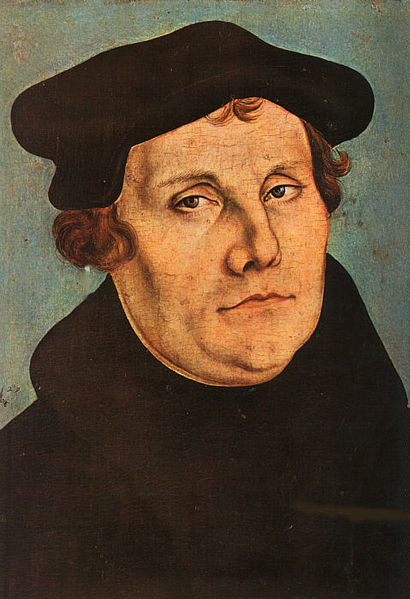 I will start with the observation that I find much of what is written on the traditional view is more or less Systematic Theology with respect to method. This is not necessarily negative, Luther and Calvin did not “do biblical theology” quite the same way it is done today. They were simply unable to examine the historical and cultural background to Pauline literature. They did in fact return to the text of Scripture, but they did so in order to serve a developing theological reformation. In addition, they were waging a theological (and political) battle. They could not examine texts apart from the theological questions raised by Luther.
In his book on the New Perspective on Paul, Stephen Westerholm provides a seven-point summary of what he calls the “Lutheran” Paul. He arrives at these points after examining the Pauline Theology of Augustine, Luther, Calvin and Wesley. I am summarizing his points here and offer some commentary.
- Human nature was created good, but has become corrupted by sin and is unable to please the Creator. This entails the idea that all who are in Adam are also in his sin. Romans 5 clearly indicates that Adam’s sin is somehow imputed to his descendants so that all humans have a sinful nature which separates them from a holy God.
- Humans must therefore be “justified by divine grace” through faith, apart from works. This is the cornerstone of the Reformation: since humans do not merit salvation, they can only be saved by a sovereign act of a gracious God.
- This justification by faith leaves humans with nothing to boast before God. A text like Eph 2:8-9 shows that Paul’s view was that no person could stand before God as their judge and claim to have done anything to merit salvation, either before or after they were justified.
- Even though humans are justified by God’s grace, they are still expected to do good works. There is a unfortunate misunderstanding that some theologians in the reformed tradition think that after justification, a believer may sin all they want. It is clear from Paul’s letters that he expects believers to behave in a certain way, but does he ever threaten them with the loss of salvation?
- The Law was given to awaken the awareness of sin in humans. The role of the Jewish law is the burden of Galatians. Paul argues there that the believer is not required to keep the Law since it only functioned as a guide until God acted decisively in Jesus.
- Sin is still a reality in the life of the believer. Westerholm comments that there is a different in the way Wesley or Luther deal with the problem of sin, nevertheless they recognize that humans still sin even after they are justified before God.
- Divine grace may or may not be irresistible. Again, this varies between Luther / Calvin and Wesley. The very act of having faith may constitute a “work” which can be seen as a human contribution to salvation.
 For the most part, I read this list and want to shout “Amen!” after the first five points, and I have some strong opinions on the last two where there is divergence in the various streams of the Reformation. These theological points, when properly defined, are a solid theological response to the growing influence of Pelagianism in the church in the sixteenth century (or the early twenty-first century for that matter). With respect to the first five points, I believe I could support each statement with enough proof-texts in Paul to show that this general outline is “Pauline.”
The challenge of the New Perspective is to start with the text in the proper historical climate. Is it possible that this tight outline of systematic theology is not what Paul intended at all?
Bibliography:
Stephen Westerholm, Perspectives Old and New on Paul: The “Lutheran” Paul and his Critics (Grand Rapids, Mich.: Eerdmans, 2004), 88-97.