Hebrews 6:1-3 – Leaving Elementary Teachings Behind

Open BibleThe context of the notoriously difficult “falling away” passing in Hebrews 6:4 is critically important.  In Hebrews 6:1-3 the author of Hebrews implies his readers are immature and have failed to grow at an expected pace. They need to “build again” on the foundation and re-learn the basics of the faith. In all of the Jewish Christian literature, there is a struggle to integration Judaism and Christianity. How much of the “old covenant” ought to be brought over to the new faith?  Hebrews 6:1-3 lists six foundational items (three pairs), all of which fit into the Jewish Christian world of the original authors, but need to be considered in the light of the New Covenant.

Repentance from Sin. Both Peter (Acts 2:38) and Paul (Acts 17:30-31, 26:20) preach repentance from sin in the book of Acts. Although turning to God is turning away from sin, the phrase “acts which lead to death” is unique to Hebrews 6:1. It is similar to James 2:17, “dead faith.” The original readers of Hebrews were not pagans converted from a sinful life, but faithful Jews who may have been (from an Old Covenant perspective), not all that sinful. The emphasis is on unproductive works vs. faith. So what exactly needs to be confessed and repented of when one comes to Christ? Perhaps the readers are overly concerned with outlining the exact nature of that repentance rather than repenting and then maturing!

Faith in God. Perhaps this is simply the natural partner of “works which lead to death,” the active sense of repentance. Since the audience is Jewish, it is unlikely that they worshiped idols.  The acts that lead to death and faith in God have to do with their participation in salvation, two sides of the same coin.

Instruction on Baptisms. The word “teaching” here may be an introduction to the final four items since they are all under the heading of “teaching.” This is a fairly difficult exegetical problem; the noun didach'” was used at the end of the first century of a body of instruction on these sorts of things (Didache, for example). That the noun for baptism is plural is a strong indication the readers were still practicing Jewish ceremonial washings in mikvoth.  If this is so, then either this is evidence Jews in Rome practiced ritual purity at a much higher level than we might have thought, or that the book of Hebrews was sent to Jerusalem, where there is clear evidence of mikvoth and ritual washing. In either event, plural “baptisms” likely does not refer to Christian baptism as we understand it, an “initiation ritual.”

Laying on of Hands. Like baptisms, it is tempting to read this in terms of later Christian practice, but “laying on of hands” was practiced in Judaism before it was taken over by Christians (Gen 48:14, Num 27:15-23, Deut 34:9). Since this is paired with baptisms, it is possible that laying on of hands was associated with the beginning of Christian life in the Jewish churches (Cf. Acts 8:16-17, 19:5-7).

Resurrection of the Dead. The final pair in this list are not practices but doctrines which were subject to strong (and perhaps emotional) debates among first century Jews.  One only needs to recall the division between Sadducees and Pharisees to know that the resurrection was a controversial issue (both for Jesus, Mt 22:23-33) and Paul, Acts 23:6).

Eternal Judgment.  A related theological problem in first century Judaism was the final judgment.  If there is a resurrection in the future, what will happen to those who are raised from the dead and condemned?  Is there “eternal torment”?  There are a number of texts from the Second Temple period which describe eternal torment of the unrighteous dead.  2 Enoch and 3 Enoch, for example, seem to indicate that at least some Jews of the first century did think that the dead would face eternal (and sometimes ironic) punishment.

The author does not say these “foundational items” are unimportant, but that these ought to be settled by now to that the readers are ready to move on to more mature doctrines. The “deeper” things in this case is next section of Hebrews, the teaching on Melchizedek and the Tabernacle.  The readers are fretting over foundational issues (who is in/out, details of theology which are not critical), and they are therefore unprepared for the difficulty of the argument which he is about to make.

But more important for the writer of Hebrews, the readers are unprepared for the possibility of persecution. If they have not progressed beyond the first things of the faith, will they be willing and able to endure physical persecution in the near future? Are the mature enough to continue in their faith in Jesus?

It is fairly easy to draw some analogies to Christian maturity in the western church. Although there are some large and wealthy churches, it is possible most members of those congregations have not moved much beyond the basics (an initiation ritual and when to stand for worship, basic teachings or what political party to support). Just as for the audience of Hebrews, when persecution comes, these will not be enough to ensure loyalty to Jesus Christ.
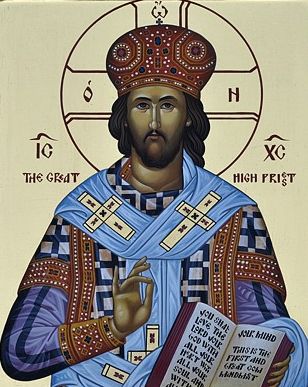


Hebrews 5:1-10 – The Great High Priesthood

In my last post on Hebrews I looked at Hebrews 4 as a part of the author’s argument that Jesus is superior to Moses and the priesthood of the Hebrew Bible.  This is the theme which will continue through chapter 10.  In fact the book of Hebrews is interested in Jesus as a priest more than any other book in the New Testament.  Jesus is called a priest and high priest only in this letter.  Since the argument of the next few chapters is based on the idea that Jesus is a priest in the order of Melchizedek, it is critically important to understand what these offices meant in the first century.

Two words of caution here.  First, the high priesthood of Jesus is based on the ideal forms found in the Bible, not in the high priesthood as it actually functioned in the first century.  By way of analogy, we could study the office of president of the United States as it is described in the constitution, or by the way various presidents have functioned as president over the more than two centuries.  James Buchanan, for example, usually is ranked at the bottom of the list of presidents by historians, mostly for his handling of the issues which erupted into the Civil War.

We would not, therefore, want to describe the office of president using Buchanan as our example!  In the same way, the high priests who held office in the first century were politically motivated and not particularly good examples of the way a priest ought to behave in his office. What is remarkable is that the book of Hebrews does not condemn the current High Priest as corrupt, nor does he say anything negative about the worship of the Temple other than it has been completed in Jesus.

Secondly, the word “priest” has connotations in English which are not present in the function of a Jewish priest.  We are not describing a Catholic or Orthodox priest, but rather the Jewish priest.  This modern sense of the word is not particularly helpful in understanding the priesthood in the Hebrew Bible.  The priest in the Jewish Temple was the mediator between God and man. As such, the office of priest foreshadowed the ministry of Jesus who was provides access to the throne of God for those who have entered into new life through him.

The original intention of a priest in the Hebrew Bible was to be an intermediary between God and Man.  The High Priest chosen to enter the Holy of Holies on the Day of Atonement.  He represented the nation and did his duty on that Day on behalf of the nation.  If the High Priest performed his function right, then the sin of the nation was covered.  Since he was a fallible human, there was always the possibility that the atonement was imperfect.

Not so with Jesus as the ultimate High Priest.  He is the perfect intermediary between God and man because (Hebrews argues) he was true human – untainted by sin.  Therefore he preformed his duties in the real sanctuary properly, providing real atonement to the whole world, once and for all!

Hebrews 5:5-10 – Why Does Hebrews Call Jesus a Priest?

Like human priests, Christ was divinely appointed to his office (5:5-6). The writer will deal with his points in reverse order, dealing first with the appointment of Jesus to the office of High Priest. The writer cites two Psalms which he already used in the first chapter.  The first quote is from Psalm 2:7, and emphasizes the fact that God called Jesus to the role of High Priest as he called him his Son. The second quote is from Psalm 110, and calls Jesus a priest forever in the order of Melchizedek, the mysterious “priest of the most high God” in Genesis 14.

Melchizedek was a priest of the true God in Palestine at the time of Abraham, nothing is known of him from scripture other than Abraham’s tithe after the victory that liberated Sodom and his nephew Lot. More will be said about Melchizedek in chapter 7, for now it is sufficient to say that Melchizedek is a true priest of God, before the Law, and for that reason Christ can be said to be a true priest even though he is not directly in the priestly line.

Because Christ fully human, the writer of Hebrews says he was able to fully sympathize with our struggles (5:7-10).  The humanity of Christ was mentioned in an earlier passage, making him a sympathetic high priest but now that humanity is shown to be the same humanity as ours because he submitted to the father.

Jesus PassionIn fact, Jesus “offered up prayers and petitions with loud cries and tears to the one who could save him from death, and he was heard because of his reverent submission.”  “Offered” is the same word as the function of the high priest in verse one, the offering of sacrifices.  Here it is “prayers and petitions. This verse is may related to the prayers in the garden, when Jesus prayed to the Lord concerning the death he was about to endure.

Since the wording is similar to Psalm 22:24, some think that this refers to the words spoken on the Cross.  This fits better with the “loud cries” and tears, since the prayers in the Garden were not reported in this way.

Several theological issues converge here, concerning Jesus’ reason for even asking God to take the cup from his hand, and whether or not he really meant to have his death postponed. Many have pointed out that Jesus was probably praying for strength to endure the tortures awaiting him before the Cross. Whatever the case, it is also important to understand that Jesus was submitting himself to the will of God, just as every other human being must do, he fervently prayed that God’s will be done, not his own will; he made his will conform to that of the Father.

It is this submission to the will of God the writer of Hebrews wants to call to our attention. Jesus was “like us” to the point that he cried out to God. But rather than complaining about his suffering or begging for mercy, he humbly submitted to his Father’s will in all things.

Unfortunately the image of Jesus as a faithful high priest is presented in popular preaching and teaching only as a personal encouragement, something like “Jesus suffered this way too so stop complaining.” The theologically rich image of Jesus as a high priest should not be so quickly turned into pep-talk for dealing with normal daily stress. Does the writer of Hebrews think the image of Jesus as a High Priest should be used like this?

Hebrews 3:1-6 – Moses, the Servant

After proving that Jesus is superior to the angels in Hebrews 1-2, the writer moves to his second argument, that Jesus is superior to Moses.  Why move from angels to Moses? For most modern readers, angels are superior to humans, so if Jesus is superior to angels, he would obviously be superior to Moses. But it is important to read this argument in the context of first century Jewish Christianity.  For Jews living in the Second Temple period, Moses was the most significant person in salvation history. In Sirach (about 200 B.C.), Moses is described as equal to the “holy ones” or even God himself (as the Hebrew text of Sirach can be translated):

Sirach 45:1-2 …and was beloved by God and people, Moses, whose memory is blessed. He made him equal in glory to the holy ones, and made him great, to the terror of his enemies.

In addition, messianic hopes in the first century sometimes focused on the coming of a prophet like Moses. Hope for a “return of Moses” as messiah was so strong that at least one messianic pretender stopped the Jordan in a re-enactment of the crossing of the Red Sea. Matthew’s gospel is designed to highlight Jesus as a new Moses who goes up on the mountain and gives the people the Law (the Sermon on the Mount).

Charlton-Heston-as-MosesThe writer of Hebrews might be trying to counter an objection to the first two chapters of Hebrews: Jesus might be superior to the angels, but the ultimate servant of God was Moses, who gave the Law. In the context of the first century, then, our author will argue that Jesus is a superior to even Moses as a servant of God.  Ultimately, this will lead to the conclusion that the covenant which Jesus made (the New Covenant) is superior to that of the Old Covenant made by Moses.  In verse two Moses is compared to Jesus, then he is subordinated to Jesus (verse 3) and by verse 5 he is contrasted to Jesus, negatively.

The author of Hebrews makes a “lesser to greater” type of argument. If Moses was faithful in God’s household in the previous age, how is Jesus be superior to him in the present age? First, Jesus is superior because he is the builder of the house.  Here the writer is making the point that Jesus is God, and because God is the designer of the administration that Moses presided over, he is therefore superior to him.

Second, Moses is a servant of the house, but Jesus is the son of the Builder, and therefore heir to the administration himself.  He is of a different class that Moses, beyond servant.  This takes into consideration the first argument of the book, that the angels were servants, but Jesus is the son.  Moses is a servant, but the word here is unique in the New Testament to Moses.  It is not a slave, but an “attendant,” one who “renders devoted service” (BDAG). The LXX uses the word for Moses in Num 12:7 (as well as Exod 4:10 and 14:31). Moses was a servant of the first class, but he is still a servant of Jesus.

How does the author of Hebrews develop this Moses/Jesus typology? Does he intentionally denigrate Moses or the Law when he argues Jesus is superior?


Hebrews and the Shame of Suffering

One of the problems with reading Hebrews is identifying the date and recipient of the letter. I am convinced the recipients were in Rome, living just before the Neroian persecutions.  I think the standard arguments for this position are solid, although I realize there are other possibilities.   Karen Jobes (Letters to the Church) argues the book does not capitalize on the destruction of the Temple as a “proof” that the Old Covenant has been replaced by the New, implying a pre-A.D. 70 date. In addition, the church has “not yet suffered to the point of shedding blood” (12:4).  If the recipients are in Rome, then the letter must refer to a time prior to Nero’s persecution of Christians (A.D.64), but after Caligula expelled Jews (A.D. 49).

Given this context, the recipients struggle with the promises of Christian faith.  If Jesus is the true sacrifice and the fulfillment of the promises of the Hebrew Bible, why have they suffered so much?   As J. W. Thompson says in his Hebrews commentary, the book is written to “reorient a community that has been disoriented by the chasm between Christian confession of triumph and the reality of suffering it has experienced.”

Coptic Christians protest against the killings of people during clashes in Cairo between Christian protesters and military police, and what the demonstrators say is persecution of Christians, in Los Angeles, California October 16, 2011. Egyptians detained in connection with clashes between Christian protesters and military police that left 25 people dead should be tried in civilian not military courts, presidential candidate Mohamed ElBaradei said on Sunday. The former U.N. diplomat's comments reflect public frustration at the army's handling of clashes on Oct. 9, when protesters said they were attacked by unidentified "thugs" and then said military police used excessive force against them. The authorities have detained 28 people on suspicion of attacking soldiers during the protest. Trials will be held before a military court. Rights groups have criticised the use of such courts by Egypt's ruling army council. The demonstrators are rallying for Barack Obama's administration to intervene. REUTERS/David McNew (UNITED STATES - Tags: POLITICS CIVIL UNREST RELIGION)

This is not apologetics in the modern sense, it does not argue against Judaism, nor does it state that Judaism was bad or wrong in any way.  Rather, the writer constructs a positive argument for Jesus’ superiority to various elements of Judaism; he is superior because he is the fulfillment of these things. (He is the substance to which the shadow pointed).

If I am right about the context of the book and the recipients have suffered for their faith already (and are about to suffer even more so under Nero), then the readers may very well have struggled with the shame of suffering in a culture which did not see suffering as a virtue. Within a Jewish context, suffering is sometimes seen as a result of sin, or at the very least, a lack of blessing from God.  We only need to look at the discussion in the book of Job to see that there was a lively discussion of why humans suffer.  If Christians are right and Jesus has triumphed, then why are his followers not blessed?  Why are they suffering?

Within a Greco-Roman context, Christians were not seen as successful because they suffered.  Roman thinking was very much based on honor and shame, of one suffered shame and humiliation in public, one cannot be described as successful!

The book therefore addresses a very real problem.  If Jesus is already seated at the right hand of the Father, why is it that Christians suffer shame and persecution?  Christians are not “of this world,” they are part of the real, unshakeable reality which is not of this world at all.

The theological dissonance which the book of Hebrews addresses is certainly applicable to Christians living in the persecuted world. They may ask, like the recipients of Hebrews, “what good is being faithful”? There are many examples of faithful Christians who suffer frequent shame and humiliation. I am not sure it has come to this in American, where we considered a Red Cup oppressive. But it is true Christianity is becoming a minority voice in American and evangelical Christianity may soon have little or no impact on culture.

How does Hebrews help the Christian who suffers in an anti-Christian world?