Book Review: Adrio König, Christ Above All: The Book of Hebrews

König, Adrio. Christ Above All: The Book of Hebrews (Transformative Word). Bellingham, Wash.: Lexham, 2019. 100 pp.; Pb; $12.99.  Link to Lexham

This short book is the third in a new series of Bible study books from Lexham. The Transformative Word series is edited by Craig Bartholonew and David Beldman and intends “identify a key theme in each book of the Bible, and each volume provides careful Biblical exegesis centered on that gripping theme.” Lexham has published Carolyn Custis James, Finding God in the Margins: The Book of Ruth and Dru Johnson, The Universal Story: Genesis 1–11.

König begins with a short overview of the book of Hebrews and an outline of the main themes of the book (the magnificence of and humanity of Christ, chapters 2-4). This first chapter also briefly introduces a few problems for the reader of Hebrews, namely the use of the Old Testament (chapter 5), the six warning passages (chapter 6) and the unforgiveable sin (chapter 7).

He begins his three chapters on Christ with a close look at the first three verse of Hebrews, followed by a chapter on the humanity and sinlessness of Christ. The longest chapter in the book is devoted to the magnificence of Christ (ch. 4). Here König tracks how Hebrews describes Jesus as “greater than” a wide range of things from the Old Testament. He concludes this section by suggesting the recipients of this message were Jewish Christians in danger of returning to the synagogue as a result of persecution.

König then examines both the positive and negative uses of the Old Testament in Hebrews (ch. 5). Even a cursory reading of Hebrews will demonstrate the writer’s knowledge of the Old Testament. In many places his argument hinges on a particular detail, such as his allusion to Melchizedek. To illustrate the negative, he points to the several statements in the book in which “it is impossible” for a sacrifice to take away sin, etc.

One of the more difficult aspects of Hebrews are the warning passages. König deals with these in two separate chapters, the first asking if grace can be lost. After a short survey of the six warning passages, he offers evidence for both yes and no. He includes short lists of biblical support for both sides of this troubling issue and concludes “we have to accept this open situation” (80). He then focuses specifically on the warnings in 6:4-6, 10:26-27 and 12:14-17 as “The Unforgivable Sin.” He draws the analogy to Matthew 12 (where the language is “blasphemy against the Holy Spirit) and suggests “we have more or less the same depiction of this sin” in Hebrews (88). I am not convinced the sin in Matthew 12 is what the writer of Hebrews has in mind. König does not take into account real possibility the readers of Hebrews are warned against recanting their faith in the face of persecution. In addition, there is more exegesis to be done in Hebrews 6 to decide whether this is “unforgiveable sin” is a real possibility. This is impossible given the limits on this brief book.

Within each chapter are short sidebars explaining some detail in the text (Marcion, the Historical Trustworthiness of the Gospel) or a list of Scripture on a theological point (Christ Called God; Jesus is Greater Than, etc.) Each chapter ends with a collection of parallel biblical texts for further study and a set of reflection questions. These questions are designed to facilitate a small group Bible study. In addition, König introduces a discussion without necessarily answering all the questions. This should lead to a lively discussion.


NB: Thanks to Lexham Press for kindly providing me with a review copy of this book. This did not influence my thoughts regarding the work.

Hebrews 12:18-29 – Marching to Zion

The writer of Hebrews concludes his book by using a common metaphor for Israel’s relationship with God – they are in the wilderness and coming to Mt. Sinai.  It is clear that the writer has Sinai in mind in verses 18-21, but he draws a strong contrast between the “mountain which could be touched” (Sinai) and Zion, a mountain which cannot be touched.  In order to describe this contrast between the two covenants, he contrasts the two mountains where the covenants were enacted.  He combines texts from Exodus and Deuteronomy which describe the theophany at Mt. Sinai as fearsome and then compares them to our heavenly destination, Mount Zion.

The writer begins saying that salvation in the present age is not at all like the Old Covenant.  Sinai was a  physical place, which can be touched, but it is a place burning with fire.  There may be a bit more referred to here than just the mountain itself.  The word for “touched” is to “make an effort, despite difficulties, to come to know something, when the chances of success in such an enterprise are not particularly great – ‘to feel around for, to grope for, to try to find.’” (Louw/Nida) It is used of a “groping about like a blind man” (LS)

When you read the passage from Exodus it is clear that there was a tangible “feeling” of the presence of God, but the people were not comforted by it at all, they were terrified.  The image is of a person robbed of sight, feeling around for something that cannot really grasp.

The story of the terror of Mt. Sinai is, for the writer, a summary of the Old Covenant, it could not bring a relationship with God, it could only bring fear and judgement.   The New Covenant, however, does not bring its participants to Mt Sinai, but rather to Mt. Zion.

In contrast to this terror, the New Covenant is associated with Mount Zion, the heavenly Jerusalem, the city of God.  While the physical Zion was the original name of the fortress captured by David in Jerusalem in 2 Samuel, Zion replaces Sinai as the focal point of Israel’s relationship with God in the prophets.  Isaiah 25, for example, describes Israel and all the nations gathering at Zion to eat the feast which the Lord has prepared there, rather than at Sinai.  Because the Lord “dwelt” in Zion, the place became a metaphor for heaven itself, the real dwelling place of God.  Here in Hebrews the City of God is called Zion, the Heavenly Jerusalem.

Instead of terror, our entry to Mount Zion is described as a joyful celebration.  There are thousands of angels in a joyful festival.  This “festival” (πανήγυρις).  The word is used only here in the New Testament and only four times in the LXX (Ez 46:11; Hos 2:13; 9:5; Am 5:21, all religious feasts). So too in classical Greek the word refers to a festal assembly in honor of some god.

But this is not only a “party,” the writer says that we are coming to God, the Judge of all men.  The entrance into heaven is to come into the presence of God.  God is described here as a Judge.  The word judge always has a negative connotation in our minds, though some take this word as meaning “vindicator” or “avenger.”  The entrance into God’s holy city is the ultimate vindication for our lives of suffering here on earth.

Salvation in the New Covenant therefore results in the glory of Heaven.  Instead of marching in the wilderness, we are Marching to Zion.

Hebrews 12:1-3 – Running the Race

In Hebrews 11 the writer explained what he meant by faith, and then gave numerous examples of faith.  Based on these examples, Hebrews 12:1 exhorts the reader to “run the race marked out for us.”  This is possible because we are surrounded by a “great cloud of witnesses.” They are spectators at a sports event, watching present believers “run the race.” But more than that, they are also people who have already run the race and know what must be done in order to win the race.

Lay AsideSince we have this great crowd of witnesses, the writer urges his readers to run the race with perseverance. There are two ways in which the runner might not finish the race – by being hindered or entangled.  “Everything that hinders…” refers to weight or bulk. A runner in training would want to lose every extra pound that might hinder then from winning the race. Greek athletes competed naked, just as modern runners will wear very little clothing and shoes designed to be as lightweight as possible.

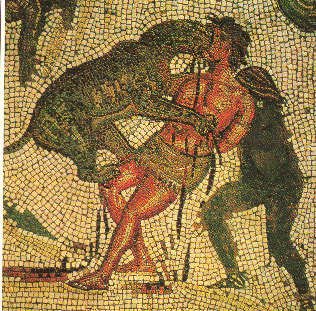
But the Christian is not simply training to compete, but is running the race already. If this is the case, there is an urgency to the writer’s encouragement to dispense with the things we do not need to run the race properly.

He calls the things which slow us down “the sin that so easily entangles.” Easily entangles is a single word and is only used here in the New Testament. The word has the sense of something which is tight or constricting. If the weight of life hindered us, sin can so entangle us that running the race is no longer possible. Think of a runner that instead of a 100 pound bag of potatoes has his shoes laces tied together.  They cannot walk, let alone run the race!

In order to run the race, the writer also tells his readers to “throw off” hindrances and sin. The word here is used most often for taking off one’s clothes, an apt metaphor here since runners will try to wear as little clothing as possible. The writer is saying if you are going to run the race, run it in the proper equipment.  Imagine that marathon runner dressed in the clothes used for Arctic exploration, a huge parka, heavy gloves, snow shoes, goggles, etc. He will not compete well because he is entangled with things that he does not need, he needs to throw all that stuff off and compete in running shorts. Anything that slows you down should be tossed.

The writer says that the race is “marked out for us.” This is not a sprint, this is a race that has a course marked out, a long race like a marathon. Sprinters, though very athletic, do not usually run in marathons.  There are too many differences between sprinting and marathons that people don’t usually excel at both. (Before I get hate mail from people who run in decathlons, I get it, work with my metaphor. Yes you are special.)

Finally, the writer tells us to run with perseverance. This fits the metaphor of a marathon better than a sprint.  A sprint is a short distance, and the runner gives it all he has, in 5 seconds it’s over. Not much perseverance. The marathon runner runs much slower, he is much more methodical about how he runs, pacing himself so he can finish the race.  As the race progresses, it takes determination to keep going.  Even the best runners have to be mentally fit to run the race all the way, they have to be running with the goal of finishing, and finishing requires perseverance.

If the Christian life is like competing in a marathon, what are other ways Hebrews 12 (or the whole book of Hebrews) exhorts the reader to “compete”?

Hebrews 10:39 – We Are Not of Those Who Shrink Back

Since they have suffered, the writer encourages his readers not to throw away what they have done thus far.   Compared to their suffering, their reward is great!  To continue the athletic metaphor, only the one who competes to the end of the race wins the prize.  There is no “participation” award for those who quit the race early.

There are  many examples of great endurance under extreme persecution. This is the point of chapter 11 – all of the individuals listed are examples of people who suffered for their faith in God.  Even though they did not fully understand at that point in history what God was doing in his overall plan, they understood that they possessed something that was greater than life.  In fact, most of the people listed in chapter 11 of Hebrews suffered greatly for their convictions and in some cases lost their lives.  They were looking forward to something greater and were willing to give their lives up for what they believed.

The readers have “great confidence.” This is the same word he used in the previous section to describe our access to the Throne of God.  If that is the level of confidence we have there is every reason to believe that we will overcome whatever suffering we may presently face.

Therefore, the readers ought not “shrink back and are destroyed.”  The noun  ὑποστολή only appears here in the New Testament and has the idea of being timid, shy, hesitant.  This is the opposite of the confidence which we have before God.  According to the argument of Hebrews, the salvation we have in Jesus is so great that we can “boldly enter the throne room of grace.” Imagine the boldness it would take to enter into the Holy of Holies in order to worship God!

If we have confidence before the throne of almighty God, why are we timid in a public trial? Why are we so timid even when we are not in a public trial?

Hebrews 10:32-39 – Recall the Former Days

In Hebrews 10:32-39 the writer invites his readers to “recall the former days,” likely a reference to the time just after the accepted Christ.  The writer wants the readers to recall what they have already suffered so that they might continue to endure in the present.

They endured struggle with suffering.  Whenever people in the Roman world accepted Christ, they necessarily rejected the culture of the Roman World – their gods associated practices.  For this they suffered some level of persecution.  The book of Acts demonstrates that the Greco-Roman world did in fact “fight back” against the Pauline mission in Philippi, Thessalonica, and Ephesus.

They were publicly exposed to reproach and affliction.  While some commentators have connected this with the persecution of Nero, this does not seem to be the case.  It may refer to the Claudius’ decree expelling Jews from Rome; or it is a general comment that describes the experience of many Christians in the first century.

  • The noun used for reproach (ὀνειδισμός) is used only a few time sin the New Testament, most importantly for the suffering of Jesus in Rom 15:3 (citing Ps 68:10), and similarly in Heb 11:26 (Moses’ reproach in Egypt).
  • The word-group has the connotation of “loss of standing connected to disparaging speech” (BDAG), perhaps a reference to rumors and lies spread about Christians which led to their loss of property in the community.
  • The verb translated “be shamed” (θεατρίζω) is only used here in the New Testament and includes a public shaming, the related noun has to do with a theater or public spectacle.  The suffering described is not “behind closed doors,” but rather in front of the whole community. Christians were easy targets since they refused to worship the gods of Rome; they could be accused of atheism at the very least.

They had compassion on those in prison.  Those who have been arrested and placed in prison must be cared for by friends and family.  The Roman world did not usually imprison people for punishment, so they were in prison until they face trial.   Compassion on the prisoner is part of the duty of a disciple of Jesus (Mt 25, for example, Philippians).

They joyfully accepted plundering of their possessions.  The readers “welcomed” the loss of their property, with the connotation of friendliness.  Imagine if someone was losing their home to a creditor and their property was being repossessed, and they helped carry their stuff to the trucks and served the workers coffee!  We cannot know how the readers were joyful or if they acted in this way to the ones who were attacking them, but the idea here is that they did not fight the loss of property because they know where their treasure truly is.

These people who lost property could do so because they knew they had a “better possession” which is real, abiding. This word will also re-appear in 11:26 describing Moses loss of position in Egypt.  In fact, this verse anticipates Moses as an example of one who suffered great loss for the cause of Christ. All of this suffering is not simply in the past (when they were first enlightened). They are suffering now, and perhaps the writer is concerned that their ongoing suffering will cause some of the readers to become discouraged to the point of “shrinking back.”

For most Christians in the western world, suffering is an abstract idea or something Christians in other countries do. American Christians occasionally experience minor inconveniences or imagined insults (like those Starbucks holiday cups). How would the American church be different if it suffered like the readers of Hebrews, or the Christians in Nigeria?