Ephesians 3:1-13 – Paul’s Gospel

Paul describes himself in 3:1 as “Paul the Prisoner of Christ Jesus.”  Traditionally wrote Ephesians while he was under house arrest in Rome.  While house arrest was not exactly the same as being cast in the deepest dungeon in Rome, he was restricted from doing the kind of ministry he would have liked.  In addition, Paul’s appeal to Caesar may in fact go very badly and he could be executed.
The reader of Ephesians may have had some questions about Paul’s argument to this point.  If Jesus has in fact destroyed the authority of the principalities and powers, why is Paul in prison?  How could a “triumphant gospel” be reconciled with Paul’s current shame of house arrest?  If the power of Satan has indeed been broken, how could Paul, as God’s apostle to the Gentiles, find himself treated in this shameful way?

Paul’s answer is to simply point out that despite the fact that he is Rome’s prisoner, the gospel itself is not in prison.  He is in exactly the place where God wants him to be.  In fact, as Timothy Gombis points out in his Drama of Ephesians, God often uses the weak to accomplish his plan so as to highlight the fact that it is God’s victory, not ours (111-2).  Paul himself says in 1 Corinthians that God chooses the foolish things of the world to confound the wise.  If the gospel spreads throughout the Roman Empire, it will be by the power of God, not the power of Paul the Prisoner.

There are a number of words in this section which describe Paul’s Gospel in apocalyptic terms.  The fact that his gospel is a “mystery” which must be revealed may very well be allusions to apocalyptic literature like Daniel. There are several examples in that book of visions which need to be “unveiled” for the reader.  It is as if God is fulling a curtain back to in order to reveal what is going on behind the scenes.  In apocalyptic literature, the one who is reading the book cannot make sense of the vision until an interpreter makes the meaning of the vision clear.

Paul is describing himself as the one who is revealing the plan of God for the present age.  Specifically, God is creating a new person, a “body of Christ” which is made up of both Jew and Gentile without distinction.  There is no racial, class, or gender distinctions in this new body, nor does anyone have an advantage if they are Jewish, male, or free.  Even if a person is a Roman citizen with wealth and prestige, there is no advantage in the body of Christ.

Like the great apocalyptic texts of the Hebrew Bible, Ephesians 3:1-13 declares that God has a plan to redeem the world.  That plan was made in eternity past and God will most certainly bring that plan to completion.  Something as minor as the Roman Empire cannot possibly hope to hinder the Gospel!  I think that this is the sort of message which American Christians need to hear, since no modern “empire” can hope to hinder the gospel.

Ephesians 1:20-23 – God’s Great Victory

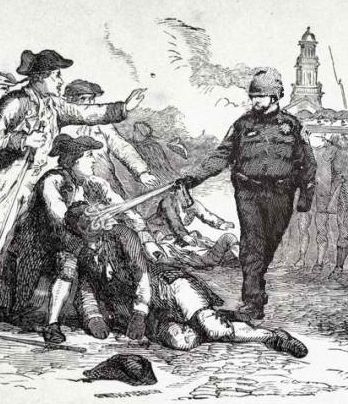
After spending some time reading in the so-called anti-Imperial texts in Paul, I would suggest that Paul does in fact envision the eventual destruction of the Roman empire.  But Paul does not encourage the sorts of anti-government protests and social actions people in the West would recognize.  The reason Paul is anti-Empire is because in reality Rome has already fallen and God’s kingdom has come in the person of Jesus.

I do not think that Paul is coded his letters with subtle anti-imperial language.  He is in fact drawing upon the well-known (and not particularly subtle) language drawn from the Hebrew Bible, especially as it was translated in the Septuagint. Jesus is Lord, but not because Paul is encoding an anti-imperial message by using words with subversive meanings The Greek word κύριος was already used in the LXX to refer to the Lord, God of Israel.  By calling Jesus “our Lord” in Ephesians 1:2 Paul is declaring that Jesus is the Lord of the Hebrew Bible.

As such, he evokes the image of Jesus as the God of the Bible, but especially in apocalyptic literature.  Why is it that the Roman government can be safely ignored?  It has already been defeated!  God decreed long ago that the coming Son of Man would destroy the power of the kingdoms of men and establish the rule of the Ancient of Days.  I am thinking here of Daniel 7:14, but I would include the image of the statue from Daniel 2 as well.  The greatest of the kingdoms of men will be destroyed and turned to dust when God rises to defend his people.  The grand conclusion to the narrative of the Hebrew Bible is that God will restore his people to Zion by dealing justly with the kingdoms of this world.  Paul says that this apocalyptic event in many ways happened when Jesus died, was buried, rose from the dead, and ascended to the right hand of the throne of God.

Timothy Gombis has taken this observation as the main thesis of his book The Drama of Ephesians. This little book argues that Paul is using imagery of spiritual warfare drawn form the Hebrew Bible to describe what Jesus has done on the cross.  Using Ephesians 1:20-23, for example, Gombis points out that Paul says that Jesus was vindicated by being raised to the right hand of the father in heaven.

This is a place of authority which is far above every ruler, authority,  power and dominion.  These are spiritual forces at work in the world, the actors in the apocalyptic drama, as Gombis describes Ephesians.  Jesus has an authority which is so high above every spiritual thing in creation that it does not even make sense that human rulers should be considered as competitors to Jesus’ rule and authority!

Rome, in Paul’s view of spiritual reality, does not really count for all that much.  If the “rulers of this age” are the spiritual forces behind Rome, and if those spiritual forces have already been defeated, then the Empire itself is doomed to defeat.  This situation reminds me somewhat of the end of the Soviet Union.  The “union” dissolved so quickly that I imagine there were many people living in areas formerly controlled by the USSR that had no idea they were under a “new government.”  I always wondered if Gorbachev went to work one morning and found his offices “under new management.”

This is what happened when Jesus the Messiah, the Lord of the Universe, died and rose again.  The power of the spiritual forces of this dark age was broken – but it happened in such a way that the world did not really notice.  But for Paul, the victory has already been won and Rome has no real power anymore.

Ephesians and Anti-Imperialism

A few weeks ago I blogged a bit on Romans 13, then heard a paper at ETS from Michael Bird on Anti-Imperialism in Romans.  Turning my attention to Ephesians this week I was surprised to see the topic coming up once again.  I read an article by Denny Burk in JETS a few years ago which was a decent summary of anti-Imperial readings of Paul, although I think that he has lumped N. T. Wright along with Richard Horsely and Hal Taussig. To me, Wright is not doing the same sort of work as Horsely, even though there are some similarities.  Both make the same sorts of observations concerning Paul’s alleged use of imperial language, but Horsely and Taussig take the issue much further than Wright by applying Paul’s anti-Imperialism to the imperialism of the United States.

First I will lay out the basics of anti-Imperial readings of Paul and then I will make a few observations about why this is an important issue for reading Ephesians.

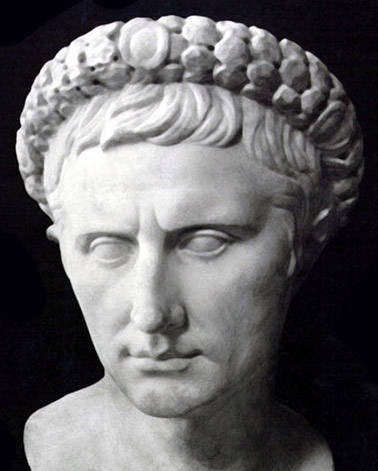
The increased interest in the impact of the Imperial cult in Asia Minor in the first century has driven anti-imperial readings of Paul.  In the first century, Caesar was described as Lord (κύριος) and god in art and coinage.  Since he was the one who brought peace (εἰρήνη) into the world, the emperor should be thought of as the savior (σωτήρ)  of the world.  News of the Emperor was announced as “good news” (εὐαγγέλιον).  This imperial propaganda was pervasive and could not be avoided, although most people in the first century would have simply accepted the equation of “Caesar as God” and moved on with life.

Paul preached the good news that Jesus was the Lord and savior of the world, the one who brings peace.  For those of us with Christian ears, these words are all quite familiar .  But to anyone who heard them in the first century Roman world they were just as familiar, but applied to Caesar, not Jesus!  By calling Jesus Lord, it is argued, Paul is setting up an implicit anti-Roman narrative.  Once words like gospel, Lord, savior, and peace are taken as anti-imperial, then other less common Pauline concepts are seen through this lens, such as the language used for the return of Christ in 1 Thess 4:13-18.

For the most part, the implications of these anti-Imperial readings of Paul for reading Ephesians is to confirm the non-Pauline nature of the book.  It is thought that Ephesians lacks the anti-Imperialism of Romans or other certain Pauline letters, This is evidence of a later, more pro-imperial writer.  This is a major factor for Crossan and Reed in their In Search of Paul.  Ephesians is not considered to be Pauline because of the reversal of the egalitarianism evident in Romans and Galatians.

But as Wright says early on in his Paul: A Fresh Perspective, “The argument recently advanced (in North America particularly) that Ephesians and Colossians are secondary because they move away from confrontation with the Empire to collaboration with it is frankly absurd.”  The reason for this “absurdity” is that Ephesians is just as anti-Imperial (according to Wright) as Romans 13 or any other certain Pauline text.  In fact, if there is actually an anti-empire subtext in the choice of terms Paul uses to describe Jesus and his mission, the Ephesians ought to be considered right at the heart of Pauline anti-Imperialism.   I suspect the section on submission of wives drives Ephesians out of the Pauline corpus for most of the anti-Imperialist scholars.

What elements of Ephesians might be considered “anti-imperialist”?   What benefit is there in reading Ephesians 1-2 in this way?

Bibliography:  

Burk, Denny.  “Is Paul’s Gospel Counterimperial? Evaluating The Prospects Of The Fresh Perspective” For Evangelical Theology,” JETS 51 (2008; 2009): 309-338

Why Not Ephesians?

Ephesians is one of the books in the Pauline collection which is frequently assumed to be pseudonymous.  Despite the fact that Paul refers to himself four times in the letter (1:1, 3:1, 4:1, and 6:19-22), the majority of scholarship in the last 150 years denies the authenticity of the letter. Rather than written by the “historical Paul,” the letter was created in the late first century, perhaps as a companion to the book of Acts.

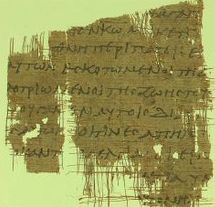
P49 Verso

While there are many variations on this argument, many introductions to Paul reject the letter as authentic on the basis of vocabulary, style, and theology.  For many, the letter does not sound enough like Romans, Galatians, or 1-2 Corinthians to be accepted as authentic.  Usually the letter of Ephesians is thought to be a post-Pauline compendium of Paul’s theology.  It was written by a disciple of Paul (“Paul’s best disciple,” Brown, 620).  Sometimes the reconstruction of the circumstances are quite complex. For example, Goodspeed suggested that Onesimus returned to Philemon, was released from his slavery and eventually became the bishop of Ephesus. After Acts was published, there was a great deal of interest in Paul, so Onesimus gathered all the various letters Paul sent to the churches of Ephesus as an introduction to Paul’s theology.  As Brown says, this is interesting but “totally a guess.”

There are some differences between Ephesians and the other Pauline letters.  For example, the common Pauline term brethren is missing (except 6:23), and the letter never calls the Jewish people “Jews” in the epistle, even though the Jews are an important part of his argument.  More surprising is the fact that the verb “to justify” is not used, even though while it is common in Galatians and Romans and might have been useful in the argument of 2:11-22.

Does it matter if Paul did not write the letter himself?  If the letter contains the actual “voice of Paul” then the letter can be considered Pauline.  By way of analogy, in the study of the Gospels there is a great deal of discussion over the words of Jesus.  When I read the words of Jesus in my ESV Bible, can I know that these are the real words of the historical Jesus?  The answer which satisfies me is that the words of Jesus in the Synoptic Gospels are true “voice of Jesus,” even though they are not the actual words Jesus’ words were originally spoken in Aramaic, translated to Greek and then to English for me to read!

In the same way, even if Ephesians was not written by Paul, the true “voice of Paul” can be found in the letter.  As it happens I think Paul did write Ephesians, albeit much later in his life during his Roman house arrest.  The letter was intended to go to all the house churches in Ephesus and there is no burning problem which Paul has to address (as in Galatians or Corinthians).  This explains why the letter is generic in terms of theology and practice.

Considering Ephesians to be an authentic Pauline letter may change the way we envision Paul’s  theology.  While Romans and Galatians are concerning with justification and the struggle to define the Church as something different than Judaism, Ephesians is a witness to the universal church which includes Jews and Gentiles in “one body.”  Unity of the church seems to be Paul’s main theme in the letter.  Rather than drawing lines, Paul is arguing for unity among those who are “in Christ.”

How might taking Ephesians seriously change the way we think about various elements of Pauline Theology?