Von Harnack, Adolf. The Letter of the Roman Church to the Corinthian Church from the Era of Domitian: 1 Clement with a Collection of Articles on 1 Clement by Adolf von Harnack. Edited and translated by Jacob N. Cerone. Foreword by Larry L. Welborn. Classic Studies on the Apostolic Fathers. Eugene, Ore.: Pickwick, 2021. xxvii+249 pp. Pb; $34.00. Link to Pickwick
Edited by George Kalantzis and Jeremiah Bailey, the Classic Studies on the Apostolic Fathers will reprint important studies on the Apostolic Fathers and provide translations of important studies which have not yet appeared in English. In this first volume, Jacob Cerone contributes the first translation of Adolf von Harnack’s brief commentary on 1 Clement, and four articles Harnack wrote on 1 Clement. Cerone previously edited volume two and three of Strack and Billerbeck and translated volume three. Along with Matthew Fisher, he edited Daily Scriptures: 365 Readings in Hebrew, Greek, and Latin (Eerdmans, 2021).
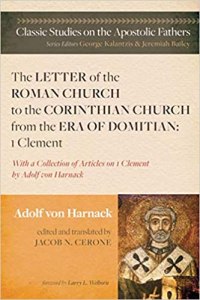 Harnack published Einführung in die alte kirchengeschichte: Das schreiben der Römischen Kirche an die Korinthische aus der zeit Domitians (I. Clemensbrief); übersetzt und den studierenden erklärt (An Introduction to Ancient Christianity: The writing of the Roman Church to the Corinthian from the time of Domitian (I. Clement); translated and explained to the students) in 1929. Published shortly before he died in 1930, the book has never been translated into English. As the title implies, the book was a farewell gift to students in his Church History seminar. Cerone translates German into smooth English as faithfully as possible. He breaks up “unbearably long, complex sentences” and fixes many of Harnack’s incomplete sentences. He “gives attention to English aesthetics” and cleans up typographical errors in the original. More importantly, Cerone conforms Harnack’s citations to modern academic writing. In the original, Harnack cited sources as author and year, and Cerone added a footnote with full bibliographical information where available. In addition, Harnack sometimes quoted specific verses but only cited the chapter. Harnack had “an irritating habit of quoting sources without citing a source.” When possible, Cerone adds a footnote to the source. Cerone adds Translator’s Notes throughout the book to clarify Harnack’s point or explain his translation choices. The original book restarted footnotes on each page. These new translation numbers footnotes continuously in each chapter. This means the new translation has different footnote numbers than the original. This will not be a problem for most readers unless one is comparing the original German text to the translation. As Cerone says in his preface, if anyone objects to his translation, the German text is available online for anyone who wants to read the original.
Contemporary readers may wonder what value a hundred-year-old monograph on 1 Clement offers to the study of early Christianity. Recent translations of 1 Clement rely on more manuscripts and rely on an additional century of scholarship. Aside from the historical curiosity, what does Harnack contribute to a contemporary discussion of 1 Clement?
As Larry Welborn says in his forward to this book, Harnack saw 1 Clement as an expression of a pure, simple ethic (the kind of Christianity he thought was desperately needed in the early twentieth century. For Harnack, 1 Clement is the most important early church document after the New Testament. Welborn offers four examples. First, for some readers, 1 Clement’s use of the Old Testament as a foundation for Christianity may indicate he sees the church as a replacement of Judaism. Still, Clement may have the attitude of a respectful God-fearer. Second, 1 Clement’s Christology is based on a bread stream of early tradition that does not use Paul. Welborn states this observation had little impact on subsequent scholarship. Third, 1 Clement is permeated with Hellenistic Roman idealism. Harnack draws attention to allusions to Epictetus, Dio Chrysostom, Seneca, etc. Fourth, 1 Clement’s attitude toward the state is entirely positive. Earthly Rome is parallel to the heavenly kingdom of God. There is no right to resistance for those who ought to be subservient. Perhaps this is a defensive posture for those suffering under Nero or Domitian, but it is striking that Clement (writing from Rome) is so positive toward the Empire.
Harnack included two short lists as a kind of appendix to his original book: first, “Problems that have not yet been conclusively investigated” and second, “A look at the development of church history which the letter grants and that should be studied.” These are brief suggestions for his students to explore in a church history seminar. Many of these issues have not been sufficiently explored since this book was published. Harnack asks, for example, what position the letter takes on culture. This is an ongoing discussion in contemporary scholarship. Further investigation of Clement’s positive attitude toward Rome would contribute to the current discussions of Christianity and the Empire. A second example is Harnack’s discussion of church structure in Clement (chapter 5). The letter offers a window on the trajectory from the New Testament to the later institution of the Church, especially concerning the office of bishop.
Conclusion. For anyone studying early Christianity, Cerone’s new translation of Harnack’s final work on 1 Clement is a welcome addition. Reading Harnack’s study of this important post-apostolic writer will be profitable for tracing the development of doctrine and practice in the early church.
Bonus: Tavis Bohlinger interviewed Cerone for the Logos Academic blog in 2021 about this book.
NB: Thanks to Jacob Cerone for kindly providing me with a review copy of this book. This did not influence my thoughts regarding the work.
I really liked his book on Marcion.