While the synagogue was a place for prayer and study of scripture, the Temple was a place for sacrifice. Just as the sacrifice of animals was always a part of religion in the ancient world, it played an important part in the practice of religion in Jerusalem. However, in the Second Temple Period, Judaism differed from other pagan religious ceremonies in some very important ways. For example, unlike Greco-Roman religions, there is only one place in the world where an acceptable sacrifice can be made: the Temple at Jerusalem. A Roman could offer a sacrifice anywhere, at any time, even when there was no temple or priest to officiate.

Robinson’s Arch
The physical appearance of the Temple was impressive. The Temple grounds were larger than nearly every other ancient religious center, with the exception of Karnak in Egypt. The sanctuary could not be enlarged since the architects were working from biblical descriptions of the Solomonic Temple (no matter how beautiful the building was it had to be built after the pattern of Solomon’s temple, especially the dimensions.)
The Temple was designed with “areas of increasing sanctity,” with various courts limiting access based on the relative purity of the worshiper. The Court of the Gentiles, for example, was as far as a Gentile could go without risking his life; the Court of the Woman was as far as a woman could proceed, etc. Even the male priesthood had limits. None could enter the Holy of Holies except the high priest and then only once a year on the Day of Atonement. The Holy of Holies was the most sacred place in the whole complex and was, therefore, the center of the Temple structures. This place is holy because is “there” in the Holy of Holies.
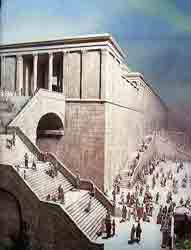
From reading the more extreme views of the Essenes or from Jesus’ sharp critique in the New Testament, our impression is that the Temple was viewed negatively in the first century. Despite politically ambitious High Priests and possible corruption in the first century, most Jews supported the Temple through offerings willingly given.
The Temple was, therefore, central to the life of the “common Jew.” As N. T. Wright puts it, “At the heart of Jewish national life, for better or worse, stood the Temple” (Jesus and the Victory of God, 224).
It is remarkable, therefore, that in the Synoptic Gospels, Jesus does not visit the Temple Mount until his final week. Undoubtedly, he visited Jerusalem frequently (Luke 2 as a child, three times in John’s Gospel), but for the most part, Matthew, Mark, and Luke save the visit to the Temple for the dramatic end of Jesus’ life and ministry. Even when he finally enters the Temple courts, he protests against the “moneychangers.” Jesus seems to see the activity of the Temple in much the same way a prophet of the Hebrew Bible might have; it is too little, and it is too late. He knows that what he is about to do on the Cross will change everything.
Given the Temple’s importance, I find it remarkable that in each of the Synoptic Gospels, Jesus brings God and the revelation that the “Kingdom was Near” to the common people rather than to the Temple hierarchy. He does not request a meeting with the High Priest, assemble the Sanhedrin, and announce that he is the Messiah. He goes to people in Galilee (of all places!) and demonstrates through his words and deeds that he is the fulfillment of the Hebrew Bible.
Reblogged this on Zwinglius Redivivus and commented:
A nice reminder of the essential facts.
It’s important to remember that the moneychangers and the people selling cattle, doves, and so forth were providing a legitimate and absolutely necessary service in the functioning of the Temple. What were Diaspora Jews supposed to do, bring animals with them all the way from Rome or wherever in order to be able to offer a sacrifice? What were the city dwellers of Jerusalem supposed to do, for that matter? It’s not like you can raise your own cattle in a crowded city.
As for the moneychangers, this too was necessary. Roman currency had pictures of Caesar that identified him as divine: arguably idolatry, that should not be brought into the holy Temple. Plus, again, Diaspora Jews from all over the known world came to the Temple with whatever money they had in their pockets, and would have needed this service.
My understanding is that at the time of Jesus, the Temple had become something of a haven for the Zealots who were plotting rebellion against Rome. (Makes sense, right? Where better to plot against the Gentiles than in places the Gentiles can’t go?) To the extent that Jesus rejected the path of violent resistance, it makes sense that he would not have contacted the Temple leadership that were giving shelter to this faction.
I recommend N. T. Wright’s chapters in The Meaning of Jesus: Two Visions for a very helpful presentation of Jesus in his Jewish context. (We used this in my Gospels and Jesus class, in the section on the historical Jesus.)
I am not so sure that the Temple of AD 30 would be considered a “haven for Zealots,” there is a real problem identifying the Zealots of AD 66 (who do occupy the Temple) with the “zealots” of AD 30. When Jesus is in the Temple courts teaching there were likely some who would become (official) Zealots later, but I am not sure they were dominant.
That Jesus had a disciple with the nickname “the Zealot” is interesting, but some jump to quickly to the Zealots of AD 66.
I like what Wright says, though, but demonstrating that “zeal” usually erupts in violent protection of the Law or the Jewish boundary Markers (Phineas, Maccabees, Paul).
Wow, I feel really lonely over here.
“In the Second Temple Period, Judaism differed from other pagan religious ceremonies in some very important ways. . . unlike Greco-Roman religions, there is only one place in the world where an acceptable sacrifice can be made: the Temple at Jerusalem” (Long, 2017). This is a key distinction to make from the pagan worldview that deemed anywhere an appropriate place to make a sacrifice. As written by Strauss (2020), “The book of Deuteronomy identifies this central sanctuary as the only place where sacrifices may be made (12:5–14)—the one temple for the one God.” Before the Temple existed was the portable tabernacle, which Israel carried around with them in the wilderness after the exodus from Egypt (Ex 25–30). The Temple, in contrast, was constructed with various areas of sanctity in mind that a person could enter based on their ritual purity. A Gentile could only go as far as the Court of the Gentiles without risking their life, a woman could only go to the Court of the Woman, etc. Death was warned for any who transgressed these boundaries. The design of the temple was meant to reflect the holiness and supremacy of God, with the exclusive concentric courtyards physically delineating exclusivity. Nearly all except the high priest on the Day of Atonement were restricted from entering the Holy of Holies, the most sacred place of the building because the presence of God was physically there.
Despite the Temple possibly being viewed negatively due to corrupt High Priests and political officials, it is evident that most Jews supported the Temple through willing offerings. Therefore, the Temple was the crux of Jewish life. Thus, “It is remarkable that in the Synoptic Gospels, Jesus does not visit the Temple Mount until his final week” (Long, 2017). This is likely communicated in light of the Gospel and the work on the cross, with Jesus criticizing the Temple as a “den of thieves” that has its spiritual thrust removed (Matthew 21:13). A person no longer has to concern themselves with entering the Holy of Holies, because the real “Holy of Holies” is personally residing among them. Regarding patronage in the ancient world, many considered Herod the Great himself to be a patron. According to Strauss (2020), “The leading priests of Jerusalem found a patron, though a sometimes dangerous and erratic one, in Herod himself, as he built their Jerusalem temple and provided resources for their synagogue communities.” Ancient rabbinic proverbs even identified the Temple with Herod’s achievements, “He who has not seen the temple of Herod has never seen a beautiful building” (Strauss, 2020).
I found it interesting that the Romans would sacrifice anywhere regardless if they were in a temple or if there was a priest or other religious leader there. But for Jews they needed to be at the temple to perform sacrifices. I also find it incredibly interesting that most major religions have some sort of sacrifice and that the Jews are different from others because of the temples they performed them at and how sacrifices were used to pay for one’s sins and be right with God. The temples themselves were different because there is only one God at this temple and the only God you could have a personal relationship with. In other temples in other religions they would worship many gods. The temple is a very sacred thing in Jewish faith. One story from the bible that sticks with me is when Jesus arrives at the temple and sees people selling things in his fathers house and how he responded with righteous anger. Even though Jesus viewed the temple as sacred his death put temple worship to an end because after his resurrection Christians started forming churches and stopped going to temples because Jesus is our sacrifice and we don’t need go go to temples to sacrifice anymore