These three verses describe a conflict in heaven: the dragon, identified as Satan in 12:9, attacks Michael and his angels. The battle goes against Satan and he is thrown down to the earth along with his angels.
As with Revelation 12:4, the problem of “when” comes up again. Does this refer to the fall of Satan? Does John have some event in his own lifetime in mind? Or is this a future event in the last says before the return of Christ? Similar to the problem with verse 4, this war in heaven is sometimes is thought to refer to the fall of Satan, but there is no other reference to Satan making war against Michael in the distant past.
Between the cross and the second coming Satan is active in the world (1 Peter 5:8, for example). But Revelation has already described an increase in demonic activity in the fifth and sixth trumpets.
Who is Michael? Michael is mentioned by name in Daniel (10:13, 21; 12:1) and twice in the New Testament (Jude 9 and Revelation 12:7). The name means ‘who is like God?’ and is synonymous with Micaiah and Micah in the Old Testament. In Daniel Michael is “one of the chief princes” (10:13) who assists the great angel who delivers Daniel’s final vision to overcome the prince of Greece and the prince of Persia. In Daniel 10:21 he is called “your prince” and in 12:1 he is “the great prince.”
Second Temple Literature develops the idea of Michael as a mighty angel who protects Israel. He is mentioned often in 1 Enoch. Although he is one of the chief angels, he is not called an archangel in the book. 2 Enoch 22 calls him “the archangel Michael” although the title “archistratig” (“top general? Cf. Gk. Apoc. Ezra 4.24) is used more often, highlighted Michael’s military role. By 3 Enoch, he is “Michael, the Great Prince, is in charge of the seventh heaven, the highest.” IN 3 Enoch Michael begins to blend with Metatron, a semi-divine angelic being. “At some point, however, the connection between Meṭaṭron and Michael was obscured, and a new, independent archangel with many of Michael’s powers came into being (P. Alexander, OTP 1:244).
In the Book of the Watchers, Michael interceded on behalf of humanity when they were oppressed by the giants (1 Enoch 10:11). In 1 Enoch 20:5 he is one of the “holy angels who watch.”
1 Enoch 20:1-8 And these are names of the holy angels who watch: 2 Suruʾel, one of the holy angels—for (he is) of eternity and of trembling. 3 Raphael, one of the holy angels, for (he is) of the spirits of man. 4 Raguel, one of the holy angels who take vengeance for the world and for the luminaries. 5 Michael, one of the holy angels, for (he is) obedient in his benevolence over the people and the nations. 6 Saraqaʾel, one of the holy angels who are (set) over the spirits of mankind who sin in the spirit. 7 Gabriel, one of the holy angels who oversee the garden of Eden, and the serpents, and the cherubim.
In 1 Enoch 40:9 Michael is one of the four “faces” who never slumber but always watch God and praise him. He is called “the merciful and forbearing Michael.” Along with Raphael, Gabriel, and Phanuel, Michael seize the armies of Azazʾel, on the great day of judgment and casts them “into the furnace (of fire) that is burning” (1 Enoch 54:5). In 1 Enoch 60 Michael explains Enoch’s disturbing vision (similar to the mighty angel in Daniel 10, cf., 1 Enoch 71:3).
In the War Scroll (1QM), Michael leads an army into battle:
1Q33 Col. xvii:7-8 (God) sends everlasting aid to the lot of his [co]venant by the power of the majestic angel for the sway of Michael in everlasting light,7 to illuminate with joy the covenant of Israel, peace and blessing to God’s lot, to exalt the sway of Michael above all the gods, and the dominion of 8 Israel over all flesh.
If Melchizedek is Michael in 11QMelch (Vermes, Dead Sea Scrolls, 300), then this angelic figure will “carry out the vengeance of Go[d’s] judgments, [and on that day he will fr]e[e them from the hand of] Belial and from the hand of all the sp[irits of his lot]” (11Q13 Col. ii:13). The text is fragmentary, but there is certainly a war between the angelic Melchizedek and the demonic Belial prior to the day of peace predicted by Isaiah 52:7 (line 15) and a coming anointed prince anticipated in Daniel 9:25 (line 18). In fact, line 25 says “Melchizedek, who will fr]e[e them from the ha]nd of Belial.”
The war in heaven results in the dragon being thrown down to the earth (Rev 12:7-9) and immediately John hears a loud voice in heaven announcing, “Now the salvation and the power and the kingdom of our God and the authority of his Christ have come” (12:10). Like the seventh trumpet, Revelation 12:10 announces the arrival of God’s kingdom.
After the woman clothed in the sun gives birth to the male child, she escapes into the wilderness where she is protected for a period of 1260 days. The interpretation of the escape into the wilderness depends on the identity of the woman.
The child is obviously the messiah. Several messianic texts converge here. First, the child is the “seed of the woman” from Genesis 3:15. Second, Isaiah 66:7 has similar language, “Before she was in labor, she gave birth; before her pain came upon her she delivered a son.” Third, that the child is destined to rule the nations with a rod of iron alludes to Psalm 2:9. John already quoted this messianic Psalm in 2:27 and will again in 19:15 with reference to the coming of the messiah ruling over the nations.
Following the Septuagint of Psalm 2:9, all three occurrences in Revelation use the verb shepherd, ποιμαίνω, rather than rule. A rod (ῥάβδος) refers to a staff or scepter, but here it is likely a shepherd’s staff. Micah 7:14, for example, refers to the Lord shepherding his people with his staff. This passage looks forward to the eschatological age when the Lord would rule over his people as a shepherd cares for is flock. Ezekiel 37:24 looks forward to a tome of peace and prosperity when a future David will shepherd God’s people.
Greg Beale draws attention to a “conceptual parallel” in 1QH 3.7-12. The author of 1QHodayot describes his distress as “like a woman giving birth the first time when her labor-pains come on her.” She “gives birth to a male,” a child who is free from the breakers of death. Then the author alludes to Isaiah 9:5-6, describing the child as “a wonderful counsellor with his strength.” This is in contrast to “she who is pregnant with a serpent.” It is possible this contrast alludes to Genesis 3:15, the seed of the woman and the seed of the serpent. Beale suggests the text referred to the origin of the Community or (less likely) the birth of the Teacher of Righteousness. By line 22 the psalm seems to refer to entrance into the Community, “the host of the holy ones, and can enter in communion with the congregation of the sons of heaven.” (Text from Martı́nez and Tigchelaar, The Dead Sea Scrolls Study Edition (translations) (Leiden: Brill, 1997–1998).
The child is caught up to “God and his throne.” The sequence of sentences does not make it clear this catching up into heaven represents rescue from the dragon. If the child represents Jesus, it is very strange his death on the cross and resurrection is omitted from the imagery. In Revelation 5 John described Jesus as a lamb that had been slain. But here the vision jumps from the birth to the ascension.
After the child has been snatched away from the dragon, the woman flees into the wilderness. If the woman is Israel, then there is an allusion here to Israel’s experience in the wilderness. In the Old Testament, the wilderness is sometimes a positive experience and at other times the result of judgment. Mauser points out that it is in the wilderness that God reveals his name and his law, beginning the religions life of Israel (Christ in the Wilderness, 29). He finds the three major elements of Israel’s theology initiated in the wilderness: covenant and law, election, and rebellion. The Covenant is established at Sinai, confirming Israel’s election. Immediately, however, there is rebellion against God in the golden calf incident. But the focus here is on the wilderness as protection, just as Elijah was protected and nourished in the wilderness for three years, so too will God’s people be protected and nourished for a similar period of time.
Adele Yarbro Collins argues Revelation 12 was originally composed in a Jewish context rather than Christian. She points writer emphasizes the birth of the male child rather than the death (as expected in a Christian apocalypse). God rescues the child from the dragon after he is born (Combat Myth in the Book of Revelation, 105-6). Reading Revelation 12 in a Jewish context would take the woman as Israel (mother Zion of Isaiah 54) and avoids the problematic interpretation of the woman as the church (since the church did not “give birth” to Jesus).
If this is a Jewish apocalyptic fragment, where did it come from? Massyngberde-Ford suggested disciples of John the Baptist reworked and interpreted his apocalypse (Rev 4-11). She argues the flight into the wilderness occurred in the forties A.D. when the “mad Emperor” Gaius demanded his statue be placed in the Temple. This would have been interpreted as the “abomination that causes desolation” and prompted faithful Jewish-Christians to flee Jerusalem.
Although Massyngberde-Ford’s suggestion is intriguing, it has not convinced many. But could Revelation 12:5-6 be a highly creative re-working of Jesus’s warning in Mark 13:14-20? In his apocalyptic discourse, Jesus warned his followers to flee Jerusalem when they see an abomination which causes desolation. There are differences. Jesus tells “those who are in Judea” to flee to the mountains immediately. Revelation 12 indicates only the woman fled into the wilderness. If the woman represents Israel, then (perhaps) the flight to the wilderness is similar to the Judeans fleeing the Romans beginning in AD 66.
In Revelation 12:3-4 a “great red dragon” sweeps a third of the stars of heaven down to earth with his tail. Since Revelation 12:9 identifies the red dragon as Satan and the male child is Jesus, is there a real, historical event John has in mind when he says the dragon swept a third of the stars from heaven?
For some writers, Revelation 12:3-4 is a reference to the fall of Satan. At some point before the fall of humans in the Garden of Eden, Satan himself rebelled against God and deceived one third of the angels to join him in this rebellion. In order to support this origin of Satan, Isaiah 14:12-15 and Ezekiel 28:11-19 are read as allusions to the fall of Satan. Michael Heiser argues there are clear parallels between Genesis 3 and these two passages (Demons, 68-70. Heiser does not think Revelation 12:3-4 refers to the primordial fall of Satan, p. 245).
For some (usually conservative) commentators, Revelation 12 looks back at this satanic rebellion. For example, Robert Thomas said this “must refer to angels who fell with Satan in past history” (Revelation 8-22, 124). Lenski observed the clear allusion to Daniel 8:10 and drew an analogy to Antiochus IV Epiphanes, who threw down some of the stars from heaven and trampled them on the ground, and Satan, who threw down a third of God’s stars” (Lenski, Revelation, 366; cf., Patterson Revelation NAC, 263). Most who see Revelation 12:3-4 as a reference to the fall of Satan cite Jude 6 as a parallel text, “the angels who did not stay within their own position of authority, but left their proper dwelling.”
If the sweeping away of a third of the stars is the fall of Satan and the stars are the angels deceived by Satan, then perhaps there is a parallel to the Book of the Watchers, 1 Enoch 6-11. In this detailed expansion of the biblical story of the flood, two hundred angels take an oath to descend to Mt Hermon, find women to marry and have children with them. Michael and the other archangels hear the cries of the humans and respond in a prayer to God himself. The archangels point out to God the activities of Azazel and they blame him for teaching humans the “eternal secrets.” However, there is nothing in 1 Enoch which describes the leader of the rebellion as a dragon and there is nothing to indicate the wicked angels are “one third” of the angels.
There are problems with the interpretation of Revelation 12:3-4 as referring to the fall of Satan. The woman was pregnant and about to give birth to the male child (presumably Jesus, v. 2, 5) prior to the second sign, the great rea dragon who seeps away a third of the stars from heaven and flings them to the earth (v. 3-4). War does not break out in heaven until after the child is born and is snatched up to heaven (presumably the ascension). The chronology is confused, although that may not be convincing since Revelation 12 is a highly symbolic description of history.
More troubling for those who want this text to refer to a pre-Edenic fall of Satan is the lack of evidence for the kind of rebellion against God assumed in most descriptions of the fall of Satan. Even if Isaiah 14 and Ezekiel 28 are admitted as evidence for an angelic rebellion against God, there is nothing in either passage to support one-third of the angels falling along with the rebel, nor do either of those passages make a clear connection to Satan as the leader of an demonic horde. In fact, the idea that demons are the angels who fell with Satan is built on a number of assumptions built up over centuries of myth-building rather than solid textual / biblical evidence.
If the sweeping of one third of the stars from heaven to earth does not refer to the original fall of Satan, then it may allude to the activity of the little horn in Daniel 8:10. This little horn grew great, “even to the host of heaven” and “even as great as the Prince of the host” (v. 11). When it became great, it threw down some of the stars to the ground and trampled on them.
In the context of Daniel 8, the starry host refers to Antiochus’s attacks on the Jewish people,beginning with the assassination of Onias III in 170, the sacking of the temple in 169, and the general persecution of Jews in the period which follows (see also 1 Maccabees 1:41-64; 2 Maccabees 6:1-5). “Antiochus’ hurling them down to earth and trampling them is symbolic of what he did to the Jewish people” (J. Paul Tanner, Daniel, EEC, 491). Tanner also points out Alexander brutally trampled the Persians in 8:7, using the same word as verse 10. Alexander certainly did not trample angels, so in the context of Daniel 8 this host refers to those slaughtered by Antiochus.
There are other Second temple texts which use stars to represent righteous people. 1 Enoch 43.4 identifies stars in heaven as “the holy ones who dwell upon the earth and believe in the name of the Lord of the Spirits forever and ever.” 2 Maccabees 9:10 describes Antiochus as thinking “thought that he could touch the stars of heaven,” which could be hyperbole but likely refers to the righteous in the context of 2 Maccabees.
If John alludes to Daniel 8 here, then sweeping of the stars from heaven to earth is another reference to the war of the beast against God’s people (11:7; 13:7). This war against God’s people is a main theme of the second half of Revelation, culminating in the ultimate battle at Armageddon (16:16, 19:11-21). As Beale concludes, “Though Dan. 8:10 first had application to Antiochus, John now applies it in an escalated way to the devilish power behind Antiochus” (Revelation, 636). Just as Satan was the power behind the Seleucids in the past and the power behind Rome in the present, he will be the power behind the ultimate enemy of God in the future.
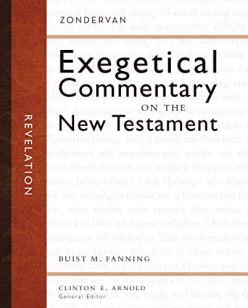
Fanning, Buist M. Revelation. Zondervan Exegetical Commentary on the New Testament; Grand Rapids, Mich.: Zondervan, 2020. 623 pp. Hb. $59.99 Link to Zondervan
In the preface to this new contribution to the Zondervan Exegetical Commentary on the New Testament series, Buist Fanning mentions three pairs of influences on his thinking about the book of Revelation: G. B. Caird and S. Lewis Johnson; Richard Bauckham and Craig Blaising; R. H. Charles and John Nelson Darby. In the strange universe of Revelation commentaries, these are indeed strange bedfellows. As Fanning comments, “Revelation functions as a kind of literary Rorschach test” (p. 23).
In fact, Fanning observes the interpretation of Revelation often tells you as much about the interpreter as the message of the book. Therefore, he identifies himself as an evangelical committed to the truthfulness and authority of Scripture, using a “chastened” historical-critical method and reading Revelation in the light of other first-century Jewish apocalypses. Following Richard Bauckham, he recognizes Revelation as the climax of the canon. Fanning’s commentary blends a typological method with a futurist reading of Revelation. He certainly considers the context of first-century Asia Minor and apocalyptic literature of the Second Temple period, yet he does not get lost in the parallelomania which sometimes plagues commentaries on Revelation.
In the introduction to the book of Revelation, Fanning argues John the Apostle is the best candidate for authorship, writing in A.D. 95-98 to churches in Asia Minor.
As is common in commentaries on Revelation, a major section of the introduction is devoted to method. Fanning makes six axiomatic statements with respect to imagery and symbols in Revelation. First, literal does not equal “real, actual,” nor does symbolic equal “imaginary.” It is not as though literal is true and a symbol is untrue. Second, literal and symbolic language can refer to various entities with different characters and scope. Third, a literal description can include emotive or connotative elements as well as denotative. Fanning offers as an example, “the Big Apple.” This symbolic language refers denotatively to New York City but also evokes certain connotations and emotions. Fourth, a symbol can refer to a real entity without corresponding point-by-point comparisons that relate to reality. Fifth, Fanning follows Norman Perrin by contrasting steno-symbols (one-to-one specific historical figures) and tensive symbols. A tensive symbol cannot be totally exhausted nor adequately expressed by one reference. It “teases the mind into ever new evocation of meaning” (p. 35). For example, the Lamb in Revelation 5:6 refers to Jesus, but there is little literal correspondence. The reader knows the lamb is Jesus. The trumpets in Revelation 8 build on imagery drawn from the Exodus. “They are intensified and universalized to be sure, but not changed to a different ontological realm” (p. 37).
Regarding the classic hermeneutical approaches to the book of Revelation, he begins by defining each preterist, futurist, historicist, and idealist. Except for historicism, he concludes each approach offers value for reading Revelation. Like Grant Osborne’s BENTC on Revelation, Fanning grounds his commentary in the world of the first century and finds application appropriate for the contemporary Christian reader, but he is also clear the book refers to future events.
In fact, Fanning has a consistently futurist perspective. With respect to the seven seals, Fanning suggests they are “the initial expression of God’s judgment on sin in anticipation of completing worldwide redemption.” These vivid symbols “referred to “real, this-worldly suffering that the earth and its inhabitants will experience as a judgment from God during the future climactic events of this age” (p. 235). The 144,000 are ethnic Jews: “John affirms the widespread ancient Jewish expectation of the regathering in the end-times of all the tribes of ethnic Israel from the exile among the nations” (p. 263). The locust from the abyss are demons functioning in some ways like an invading army (p. 299), but this “nightmarish scenario will be devastatingly real” (p. 306). The mark of the beast most likely refers to Nero, but it is part of John’s typological pattern which foreshadows “the escalated fulfillment in the future antichrist” (p. 380). As for the meaning of Babylon in Revelation 17, he rejects the classic dispensationalist view of the city as literal Babylon, as well as the common preterist view the city is Jerusalem. He argues Babylon refers to Rome as part of John’s use of typology. First-century Rome foreshadows the ultimate future worldwide enemy of God (p. 440-41).
The introduction concludes by discussing what Fanning means by typology and how the book of Revelation alludes to the Old Testament (possibly Jewish apocalyptic, Greco-Roman literature, and ancient Near Eastern mythology). The clearest examples of Old Testament types or patterns in Revelation are the reuse of the Egyptian plagues from Exodus in the Trumpets (Rev 8-9) and the broader Exodus typology found throughout the book. For Fanning, this typology is more than a matter of how the New Testament uses the Old. It is “grounded in observations about God’s consistency in working out his purposes a crossed human history” (p. 47). Typology should not be limited to Christology or Soteriology, although those are common examples. In Revelation, the judgment of the ungodly and opposition to God often conform to patterns found in the Old Testament. Fanning is clear: typology does not “require a metaphysical shift from physical, geographic, or historical entities to some sort of spiritual or eternal realities in the New Testament antitype” (p. 48). His view of typology does not require an antitype to be limited to a single climatic fulfillment. This allows Antiochus IV Epiphanes to be a type of a future Roman emperor and a still-future antichrist (p. 48). Fanning argues this use of typological patterns accounts for John’s references to realities in the first century (preterism) and a final climactic period in the future (futurism). He cites favorably Marvin Pate’s progressive dispensationalist approach in Four Views on the Book of Revelation (Zondervan, 1998) and the “already/not yet” rubric.
In the commentary’s body, each unit begins with the literary context of the section, followed by a concise summary of the pericope. Fanning’s translation appears in a graphical layout showing the relationship of clauses and the use of interpretive labels. A brief comment on the structure and an exegetical outline follow. The bulk of each unit explains the text. Each verse begins with a translation and the Greek text. Greek words appear without transliteration in the body of the commentary. The introduction to the series suggests readers with two years of Greek and some intermediate grammar will follow the discussion well. As the editors lay out the text, even readers without Greek will find the text accessible. Almost all detailed discussion of syntax and interaction with secondary literature appears in the footnotes. Each commentary chapter concludes with a section entitled “Theology in Application.” These are brief biblical-theological observations rather than pastoral guidance for preaching various sections of Revelation. Nevertheless, these observations often reveal Fanning’s pastoral heart as he seeks to apply the text of Revelation to a Christian reader.
Following the commentary proper is a chapter entitled “Theology of Revelation.” Fanning argues the book of Revelation is centered on “the true and living God engaged with his good creation.” He observes that Revelation is a “God-saturated book” (p. 568) and offers a series of points summarizing how Revelation describes God. Revelation is also a book about the reality of evil that has corrupted humans as well as creation. The book, therefore, describes an ongoing enslavement to deception and corruption by Satan and his minions (p. 571). Yet God works to establish his reign over his defiant and rebellious creation. God and the Lamb finally rule over creation, fulfilling God’s purpose of redemption. Revelation also describes a new community of the redeemed, although the word church does not appear in the book after chapter 3. Those who follow Christ suffered greatly in the severe final tribulation to come. The church is called to endure in faith and obedience in these intense trials (p. 573) while looking forward to the final salvation of diverse corporate worship of God.
Conclusion. It seems strange to describe a 600+ commentary as brief, but this is only in comparison to the mammoth commentaries from Aune and Beale. Fanning’s contribution is worth consulting, especially as a representative of a future-orientated commentary on Revelation. His approach to symbolic language and typology grounds the exegesis in the overall story of Scripture. It is superior to Robert Thomas’s overtly dispensational commentary (Moody, 1992) or Paige Patterson’s attempt at a consciously pre-millennial commentary in the NAC series. Like other Zondervan Exegetical New Testament Commentaries, Fanning’s work is exegetically solid and reflects evangelical theological commitments.
NB: Thanks to Zondervan for kindly providing me with a review copy of this book. This did not influence my thoughts regarding the work.
After John sees the doors to the heavenly temple opened, a great sign appeared in heaven. The vision in Revelation 12 describes a war in heaven followed by a war on earth. The dragon attacks a woman and her child, forcing her to flee into the wilderness for a period of time where she will be protected by God.
Revelation 12 has been described as being “consciously or nor, considered as the center and key to the entire book” (Prigent, Apocalypse 12, 1, cited by Beale 621). The description of the woman is highly symbolic as if John describing with words. This is certainly the case in Revelation 17 although it is less clear in chapter 12.
The first great sign is a pregnant woman “clothed with the sun, with the moon under her feet and a crown of twelve stars on her head.” The second sign is a “great red dragon, with seven heads and ten horns, and on his heads seven diadems” who makes war in heaven and is cast down to the earth. The description of the great red dragon with multiple heads and crowns is familiar to readers of Daniel. (I plan on discussing the war in heaven in a separate section.)
The woman is clothed in the sun, feet on the moon and has a crown of twelve stars. The number twelve calls to mind the regular use of twelve in the Old Testament for the sons of Jacob and the twelve tribes comprising the nation of Israel. In Genesis 37 the sun and moon represent Jacob and Rachel in Joseph’s dream. Song of Songs 6:10 describes the bride’s beauty as like the moon and sun. Greg Beale surveys a range of rabbinic literature which interprets Song of Songs 6:10 faithful Israel (Beale, Revelation, 625 citing Midrash Rab Exod. 15.6; Num 2.4, Num 9:14).
Who is the woman and her child? As with most things in Revelation, there have been a wide range of views from the Egyptian goddess Isis (the “queen of the cosmos,” (Yarbro Collins, Combat Myth, 71–76) to the American Revolutionary War and Civil War (Alan Johnson, “The Bible and War in America: An Historical Survey,” JETS 28 (1985): 169-181).
The two most common views take the woman as a symbol for either Israel or the church. That the woman represents the church has been a common view in the history of the church. of the woman is that she represents the church, since her offspring are attacked by the power of the beast. Medieval commentators often interpreted the woman as Mary and the child as Christ.
For many writers these are not mutually exclusive. Mounce, for example, observes there is one continuous people of God through redemptive history, so it should not be a surprise the imagery refers to both Israel and the church (Mounce, Revelation, 236). However, since this is a Jewish Christian apocalypse, an emphasis on the Jewish-ness of this image is important.
The woman represents the Jewish people as the persecuted people of God and her child is the Messiah. The metaphor of Israel or Zion as husband to the Lord is common (Hosea 1-3; Isa 54:1-55; Jer 3:20; Ezek 16:8-14). In Isaiah 49 Zion believes she has been abandoned by her husband; her children scattered throughout the word (in the exile). The Lord restores her children (the end of the exile) and tells her to “expand her tents” because so many children will return to her (54:2-8) and her marriage is restored (Isa 62:1-5). Isaiah 62:1-5 may be important for understanding the imagery of Revelation 12. When Zion is restored, she will be given a new name and she will be like a crown of splendor and a royal diadem in the hand of the Lord (Isa 62:3).
The woman gives birth to a son. John describes this child with allusions to several messianic texts from the Old testament. In Isaiah 66:7 Zion goes into labor and gives birth to a son. The time before the messianic ages is often described as birth pangs. For example, Jesus said the non-signs leading up to the final conflagration were birth (Matthew 24:8; cf., Paul. 1 Thessalonians 5:3). The child will “rule all the nations with an iron scepter.” This is clear allusion to Psalm 2:9, a text regularly interpreted as messianic in the Second Temple period.
The child was “snatched up to God and to his throne.” This seems like a clear allusion to the ascension. But there are problems with that interpretation. The child is born, threatened by the dragon, and then immediately snatched to heaven. It seems strange a Christian apocalypse would not make some reference to the cross and resurrection. In addition, this “snatching” rescues from the power of the dragon. After the resurrection, Jesus did not need to be rescued, he had already overcome the powers of evil. It is possible, however, the birth and ascension refer to the totality of Jesus’s mission.
The word translated “caught up” (ESV) or “snatched” (NIV is the aorist passive of ἁρπάζω. The word refers to rescue from danger with the connotation of a sudden, violent pulling away, “in such a way that no resistance is offered” (BDAG). Although Paul the word in 1 Thessalonians 4 17, the catching away of the child in Revelation 12 does not refer to the rapture of the church.
 As with Revelation 12:4, the problem of “when” comes up again. Does this refer to the fall of Satan? Does John have some event in his own lifetime in mind? Or is this a future event in the last says before the return of Christ? Similar to the problem with verse 4, this war in heaven is sometimes is thought to refer to the fall of Satan, but there is no other reference to Satan making war against Michael in the distant past.