Psalm 43 – Vindicate Me!

[Audio for this study is available at Sermons.net, as is a PDF copy of the notes. You may right-click and “save as….” ]

Psalm 43 begins with the writer asking God to “vindicate” him. Verse one uses a legal metaphor common in the prophets to picture the writer and his enemy before God as his judge. About 40% of the occurrences of the word שפט have God as the judge, nine times the verb is used as a noun to describe God as the “judge.” Sometimes God is called on to judge between two people who are at odds. The phrase “defend my case” is also the language of a lawsuit. The verb ריב and the related noun are both used in the context of someone taking someone to court to sue them. The psalmist is picturing himself going to the city gates of his town and standing before the elder of the town, a king’s magistrate. In order to get real justice, perhaps he has to go to the king himself and plead his case.

The psalmist is calling on God to “do justice” in this case. In a human court, the goal is to hear the evidence on both sides of that case and let the judge decide who is “right” and who is “wrong.” If God is the judge, the Psalmist can be assured of justice because God is ultimately just in his nature.

GavelLike most modern translations, the ESV has “vindicate” here. In English, “vindicate” has the connotation of clearing someone from suspicion, or to prove that they are in the right. In this court context, the writer is asking God to judge the case and declare that he is in the right, and the enemy is “in the wrong.”

Just as in a human court, the psalmist offers evidence against his enemy. First, his enemy is “an ungodly nation.” The noun is simply nation (גּוֹי), although in the context most translations render the word as referring to non-Jewish, pagans or heathens. In the next Psalm, for example, the word is used for the nations the Lord drove out of the land (44:2).

Second, they are not faithful . One of the cornerstone virtues in the Hebrew Bible is faithfulness(חָסִיד). The word does not mean “full of faith,” as if it is a synonym for “a believer.” The idea of faithfulness in the Hebrew Bible is an action, one “does faithfulness.” The word is frequently used to describe those who abuse the poor and needy, to be “unfaithful” to the covenant (Mic 7:2).

Third, they are unjust. The noun מִרְמָה has the connotation of being a fraud, a trickster. The writer’s adversary tries use some sort of subterfuge to get his way. The word describes Jacob stealing his brother’s blessing (Gen 27:35) and the actions of Simeon and Levi when they made a false covenant with the king of Schechem (Gen 34:13). Micah 6:11 uses the word to describe dishonest weights, which look like the real thing but intend to steal from the unaware. The word is among the many things listed in Psalm 24 which qualifies someone for going up to the Holy Hill of God to worship (someone who does not swear deceitfully).

Last, they are oppressing the writer (v. 2). The noun לַחַץ does not appear frequently in the Hebrew Bible, but it does appear in each of Psalms 42-44 (and only in this series of Psalms in the Psalter). Exod 3:9 and Deut 26:7 use the noun to describe the oppression Israel faced when they were in Egypt. The verbal form of the root is used in a number of other passages which describe foreign oppression Judg 2:18, 4:3, 6:9, 10:12; Isa 19:20(, oppression which is sometimes a punishment for covenant unfaithfulness )Amos 6:14,

This description of an enemy is applicable during the life of David, either when he was running from Saul or later from Absalom. But it is also generic enough that this Psalm would be a great comfort for someone living outside the land during the Exile – when has Israel not been oppressed by a faithless enemy?

This psalm is a promise that God does in fact judge fairly, he will vindicate his people and render justice.

Psalm 42 – As the Deer

The writer describes his oppression as being desperate with thirst, longing for water. The opening line is a vivid metaphor for thirst, the writer’s soul thirsts after God “as a deer pants for water.” The verb is rare, only used here and in Joel 1:20, where it refers to animals panting for water after a fire has destroyed all water. But do not think of a dog panting, that is how the animal cools itself.

Deer Drinking

The verb has the sense of craving. When someone “craves” a food, they psychologically have to have whatever it is. The animal is dying for water in the midst of a drought. In this case, the animal is nearly dead and it is desperate for water. The verb in the second verse is usually associated with literal thirst, such as Israel in the wilderness (Exod 17:3). The craving for water here is to meet a basic need or the animal / psalmist will die.

But rather than being refreshed by God, the writer drinks his tears day and night (v. 3) The song does not describe why the writer is crying out, only that his tears on constant. The irony is that he has water to drink, but it is undrinkable tears.

Because of his desperation, his adversaries taught him, asking where his God is now? This is a common theme in the Psalms, the enemy of the songwriter mocks the writer because he has faith in God in spite of his suffering. There is a hint of the common view that God will reward the righteous and punish the sinner. This is not always the case, frequently in the Psalms the reverse is true, the wicked prosper  If the song writer is suffering, it is possible that his enemies are using that as proof that God is punishing him.

En GediAs with other Psalms of Korah, the writer remembers leading worship in the house of God. The writer is the leader of a procession, going into the Temple. At the very least he is a worship leader (as the sons of Korah were), although there could be a hint of David’s life since he did lead a festive crowd into Jerusalem when the ark was first brought to Jerusalem. If the song writer intends himself to stand for all of Israel, perhaps he is looking back to that kind of joy under David, in contrast to the “present” time of the exile. The “festival” could refer to Tabernacles, which is a feast associated with great joy, recalling Israel’s time in the wilderness, or even Passover, recalling the time of God’s salvation of Israel from their slavery in Egypt.

When the Psalmist Remembers the Lord, He Is Overwhelmed by Water (42:6-7). Is this water a positive or negative metaphor? It is possible that verses 6-7 refer to additional suffering. Being caught in raging water is often used as a metaphor for extreme suffering, and these lines are often taken as a reference to the underworld, as if the writer finds himself swept away by primordial chaos into the caverns of Sheol.

On the other hand, the writer began by describing his great need for water, and in these verses he recalls the supplies of water in the Land of Israel. At the moment of his greatest need, God overwhelms him with water!

The writer remembers his God by mentioning three specific locations:

The Land of Jordan. This is a reference to the Jordan River, the main river for most of the land, especially from the Sea of Galilee to the Dead Sea. While the river is quite dry today because most of the tributaries are dammed, in the ancient world the river flowed freely. Recall that Joshua was not able to cross the river at flood stage.

Mount Hermon. This mountain in the far north of the Land of Israel is nearly 10000 feet (in Lebanon and Syria today). But the reference here is likely not to the mountain itself, but to the foothills. The Hebrew word used here חֶרְמוֹנִים, the plural of Hermon, referring to the whole range of mountains )like “The Rockies”(. There are three sources for the Jordan which flow south into Galilee, eventually feeding the Jordan River. At Dan and Banias in Israel today there is a constant flow of water fed by snows on Mount Hermon. The area is extremely fertile and jungle-like.

Mount Mizar is an unknown location, although it is often identified with. The Hebrew word מִצְעָר means small, or “a few,” so it might refer to foothill near Hermon and the sources of the Jordan.

Ten DanBut the writer does not simply take a drink to satisfy his thirst, he is overwhelmed by water! When the Lord responds, it is as if he is standing in a roaring waterfall. The word is rare, only used here an in 2 Sam 5:8 (where the meaning is disputed). The Hebrew צִנּוֹר refers to gushing, flooding water, a fast flowing stream, etc. The “deep” is a word which usually refers to the deep sea, the abyss (תְּהוֹם). “Deep calling to Deep” gives the impression of a constant thunderous flow of water. The parallel line is a similar image, waves and breakers sweep over the writer. The first word is used literally for waves in Jon 2:4, and as a metaphor for disaster in Ps 88:8, 2 Sam 22:5, and for God’s strength in Ps 93:4, the second word is far more common and is frequently used to describe restless power.

God’s grace is often overwhelming; at the moment the writer felt he was about to die of thirst, he is overwhelmed with more water than he can imagine!

Psalm 23 – An Eschatological Reading (Part 2)

In a previous post I argued that Psalm 23 should be read as a corporate song expressing the hope Israel has in their God as a Good Shepherd.  The song is laced with messianic hope for a future true Shepherd who will lead them out of the “valley of the shadow of death” to the House of the Lord, where they will live forever.  As I stated previously, the two metaphors (God as shepherd and God as host) are common metaphors expressing messianic hope in the Hebrew Bible and they are often paired (Ezekiel 34 and Isa 40-55, for example).

The presence of the Shepherd is a comfort to the flock.  Unlike Psalm 22, the worshiper feels the presence of God in a very real way and he is comforted by this.   While it is true that “to comfort does not mean to sympathize but to encourage,” (HALOT, 689, citing Elliger), the word has a very tender and compassionate undertone. It is often associated with comforting someone after the death of a loved one.  The word is used in Gen 37:35 to describe the effort of the family to comfort Jacob after Joseph appears to have been killed (cf. Jer 16:17).

The word appears in several Messianic contexts.  In Isa 61:2 the activities of the “anointed one” includes comforting those who mourn. This is the text Jesus read in Nazareth at the beginning of this ministry, directly applying it to himself as the Messiah, the good Shepherd who will comfort the one who mourns.  In Isa 66:13, when Jerusalem is restored, she will be comforted by the Lord as a mother comforts her child.

There are a number of texts which describe God as tenderly comforting Israel (Isa 1:21; Ps 71:21 86:17 119:82; God comforts his people Isa 49:13, 52:9, 66:13, God comforts Zion, Isa 51:3; Zech 1:17; Isa 51:12 Jer 31:13, Lam 2:13; Ps 119:76, with hesed).  Perhaps most significant for the argument I am making here is Jer 31:13 which describes the future time when God makes a New Covenant with his people.  “Then shall the young women rejoice in the dance, and the young men and the old shall be merry. I will turn their mourning into joy; I will comfort them, and give them gladness for sorrow.”  The future age will be characterized by a reversal of Israel’s mourning (Lam 2:13).  Instead she will rejoice as the Lord tenderly comforts her.

Verse five has three metaphors which are usually found in the context of the Messiah elsewhere in the Hebrew Bible. A Banquet Table

Preparing a Table – Messianic Banquet.  This is a banquet eaten in the presence of the enemy.  This may be a result of a treaty (the enemy is invited to eat with the King who conquered them), or more likely the table is spread on the field of battle and the enemy is destroyed. To “spread a table” implies a sumptuous meal. While the word table can refer to any meal, it is used for a king’s banquet (Judg 1:7 1Sam 20:29, 34, 2Sam 9:7,10, 11, 13; 19:29 1Kings  2:7, 5:7 10:5 / 2 Chron 9:4; Dan 11:27; Neh 5:17), this does not have to be a table, but rugs spread out on the ground for a king to eat a banquet, as Isa 21:5.   The term is used of an eschatological banquet in Isa 65:11, the Lord sets a table for Fortune, and in Ps 78:19 it refers to God setting a table in the wilderness, in Prov 9:2 Lady Wisdom has prepared a table.)

Anointing with Oil – Messiah.  This is not the word typically used for anointed which becomes the title Messiah. The verb דשן in the piel has the connotation of refreshment or enrichment.  But since the object is the psalmist’s head, and oil is used to “refresh his head,” anointing with oil seems to be the meaning.  It is used in another messianic text, Psalm 45:7. The cognate noun is used to describe foods at the eschatological banquet, they are “fatty” (Isa 55:2, Jer 31:4, cf. Ps 36:9, 63:6, 65:12 for rich, abundant foods).  This word is also a connection between the end of Psalm 22 and Psalm 23. Psalm 22:30 may use a rare form of this verb meaning “grow fat.”

Overflowing Cup – The banquet described is abundant, the worshiper’s cup (goblet) of wine is never empty, it overflows.  The word is rare in the Hebrew Bible, but in cognate languages the verb has the idea of satisfaction of appetite and even drunkenness, but also irrigation, springs, a good water supply.

The psalm began with an affirmation of faith in the gracious provision of the Lord even in the midst of suffering, but it ends with a future hope that the Lord’s people will dwell in his presence forever.

Despite the fact that we tend to personalize Psalm 23, read in the context of the Hebrew Bible, it is likely that God as Shepherd implies Israel as sheep.  As the nation passes through the valley of the shadow of death, they need not be afraid since the Lord defends them and will comfort them when they suffer.

Psalm 23 – An Eschatological Reading

Psalm 23 is probably one of the most well-know texts in the entire Bible, one that provides comfort to those who have lost loved ones. It is often personalized – the Lord is my Shepherd, I will not want.  But that is not the original intent of the Psalm.  I want to argue in this short introduction to Psalm 23 that the nation of Israel as a whole is in view and that Psalm 23 is eschatological.  What follows is an application of my dissertation topic to Psalm 23.

The Psalm is associated with David, the original shepherd-king (verse 1).  As is well known, the phrase “of David” does not necessarily mean that David wrote the psalm, but in the case of Psalm 23 there is a certain attraction to the image of David watching his sheep, thinking about his relationship with God, and creating this song comparing that relationship to a Shepherd watching over his flock.

There may be more to this Psalm than a shepherd-king’s piety.  The song may very well have been created by David after he has become king.  Throughout his life he has certainly experienced the providential care of God, and he has certainly “walked through the valley of the shadow of death” many times in his rise to the throne.  The final two verses describe victory of enemies and an anointing with oil, perhaps alluding to the fact that David has been anointed officially as king, he has established peace in the Land, and his kingdom is prosperous (his cup overflows).  He looks forward to dwelling in the Lord’s house forever, perhaps an anticipation of building the Temple.

More likely, the psalm was written in order to express a hope in the future restoration of Israel, possibly during the exile.  The Psalm combines  two classic images of the future in the Hebrew Bible, a Good Shepherd and an eschatological banquet.  Just as David was a pious shepherd-king, the coming messiah will be the ultimate Good Shepherd who will host a victory banquet which inaugurates a new age of peace and prosperity for all Israel in the Land of the Promise.

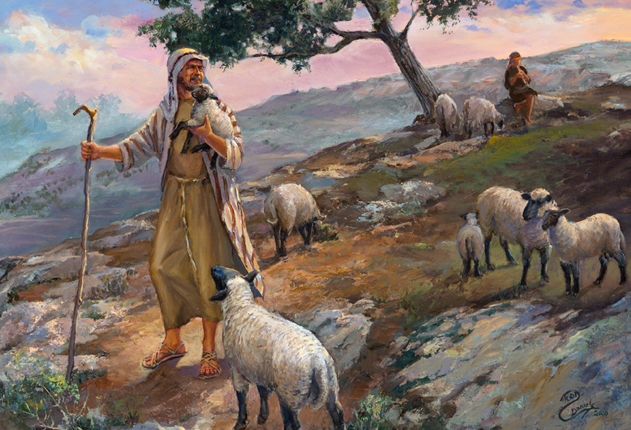
In the Hebrew Bible the image of God as Shepherd is common (Isa 40, Jer 23, Ezek 34, Ps 80) as well as in the Ancient Near East (King Hammurabi, ANET, 164b; Shamash, ANET, 388). The nation of Israel is God’s flock, the king is to be a “good shepherd” and care for the flock on behalf of the owner.  The psalm could have in mind the experience of Israel in the wilderness, where God led them, provided for them, and brought them to the land of Promise. (A.A. Anderson, Psalms, 1:196–97; Craigie, Psalms 1–50 , 206-7, Willem A. VanGemeren disagrees, EBC, 7:215.)  Ezekiel 34 points out that the shepherds of Israel (the kings) have been terrible and the sheep (the people) are not taken care of properly. The prophet therefore looks forward to a time when God will send a true and good shepherd who will care for the people properly.

The metaphor of the Lord as a host of a great banquet is also found elsewhere in the Hebrew Bible.  Isaiah 25:6-8 is the key passage for an eschatological banquet, but there are others.  Isaiah 40-55 describes the Lord leading Israel out of exile and providing for them a banquet in the wilderness as the people come out of Babylon and return once again to the land of the promise. This banquet celebrates God’s victory over his enemies and the restoration of the kingdom to Israel.  In fact,Ezekiel 34 combines the shepherd image with provision of food in a way similar to Psalm 23.

The combination of these two images (shepherd, host) is clearly messianic.  The Psalm looks forward to the time when the Lord will provide a Good Shepherd to rule over the people, but also to a king who will preside over a great victory banquet.  Jesus himself uses both the image of the Good Shepherd and the image of a banquet-host often in the gospels.  The Parable of the Good Shepherd in Luke 15, “my sheep hear my voice,” and other statements make it clear that Jesus presents himself to Israel as the expected Messiah.  Jesus’ table fellowship is often seen as an anticipation of the messianic banquet.  While there is no one text in the gospels which allude to Psalm 23, the traditions found in the psalm resonate with the teaching of the historical Jesus.

Psalm 23 therefore represents a blending of two messianic images, a shepherd and a banquet-host.  The canonical context is important – Psalm 22 concluded with an anticipation of an eschatological banquet at which the afflicted will eat and be satisfied, the prosperous will also eat and worship, but they will “bow down to the dust.”

Does this mean that reading the Psalm as God’s personal protection of individuals is wrong?  This may be a case where personal application is valid, even if it ignores the original meaning of the Psalm.

Psalm 4 – “They Love Vain Words”

[The audio for this week’s evening service is available at Sermon.net, as is a PDF file of the notes for the service. You should be able to download the audio directly with this link, if you prefer (right-click, save link as….)]

Like many psalms, the writer describes his oppressor, although it is impossible to relate this to an event in David’s life with any certainty.  It is possible Psalm 4 was intended to be read along side of Psalm 3, which does make reference to Absalom’s rebellion, but this is not necessary.  In fact, there is enough ambiguity in the text to apply it to any number of scenarios in the Hebrew Bible.

They seek to turn the Psalmist’s glory into shame.  The noun honor (ESV, Heb. כָּבוֹד) can refer to personal glory, distinction, or even reputation. In the context of David’s life, this could refer to the time when he was king.  At that time he was honored and had a growing reputation, but many were jealous of his success and sought to attack him.  On the other hand, the noun could be taken as a title for God, he is “My Glory.” The opponents may be attacking the Psalmist’s God.  If the opponent is outside of Israel, then the opponent may be claiming that he is not worthy of worship. If the opponent is from within Israel, then perhaps the attack is aimed at the worship of God in the Temple at Jerusalem.  There are a number of times in the Hebrew Bible when exclusive worship fo the Lord at the Temple was attacked (from the northern kingdom under Ahab and Jezebel, or later under the Judean kings Ahaz and Manasseh).

If “my Glory” refers to God himself, then the point of this line is that the opponent is saying that the God of Israel is not worthy of worship, he is in fact a shameful God.  This could be the words of a foreign nation, or even from the Northern kingdom, saying that worship in the Temple is not acceptable, it is in fact a shameful thing.

They love vain words. The adjective “vain” (רִיק) refers to something that is empty or void.  This can be an action which cannot hope to succeed (the nations plot in vain against the Lord’s anointed, Ps 2:1), and frequently it refers to work which is “in vain” (Isa 49:4; Jer 51:58; Hab 2:13).  The noun “words” does not appear in the Hebrew Bible, hence the NIV’s “they love delusions.”  This is particularly evocative translation for me, since it seems to me that there are many people who are committed to an illusion of life rather than to life as it really is. But this illusion is in vain, it cannot come to any benefit at all since it is empty to begin with.

They seek after lies.  Just as the oppressors seek an illusion rather than reality, they seek lies rather than truth.  The noun here (כָּזָב) is not the usual word for a lie, this is a deception, something which tries to look like the truth but is in fact false. It is very easy to create a self-deception, it is also very easy to believe the lies you tell yourself – the opponents in this Psalm create a reality which suits them!

Just as in Psalm 4, There is a sad tendency in contemporary culture to dismiss someone who even believes in God as some sort of sub-intellectual who holds on to a fairy-tale belief in the face of real-world scientific fact.  To believe in God is to be “shameful,” to be an evangelical Christian is to be the same as people who believe a flat Earth.

This attack is (unfortunately) creates a spiritual inferiority complex.  People say something like, “I believe in God, but not like those people.” Or people reject the name Christian, preferring to be called a “spiritual person” instead.   The real problem is that there are too many Christians who are shameful (Fred Phelps, and many others).  They are the ones who manage to get into the media, or make YouTube videos, or get caught in some incredible hypocrisy.

There are too many of “those people” who turn “our Glory” into a shameful thing.