Jesus’ Prayer of Thanksgiving (John 11:42-44)

Jesus prays a “prayer of thanksgiving” before commanding Lazarus to come out of the tomb. This prayer has been discussed with respect to the possibility of historicity – is it the type of prayer that Jesus might have prayed in this context?  Some scholars dispense with the historicity of the prayer as an addition by the writer of the Gospel.  For example, R. H. Fuller, (Interpreting the Miracles) wrote that:

To the modern reader this prayer is irritating, if not offensive. The whole thing looks like a put-up show, anything but genuine prayer. Jesus knows he need not pray, but apparently stages a prayer to impress the bystanders.

Rather than an “irritating prayer”, this is actually a Prayer of Thanksgiving as prayed by Jews commonly in the context of first century Palestine. Following J. M. Robinson, Bingham Hunter has demonstrated that there are formal parallels to a Jewish thanksgiving prayer. As a Jewish Hodayoth, the prayer is intended to be heard by the audience for which it is prayed. The cited article lists many examples (including in the Pauline and Qumran literature) indicating that this sort of prayer was not only common enough in the first century, but expected in a religious context such as the one Jesus finds himself in John 11.

Because of its form the prayer seems to be genetically related to and a part of a tradition of piety exemplified by the Jewish personal thanksgiving psalm. Thanksgivings of this sort are characteristically prayers that both God and spectators are meant to hear.

With respect to the scholars that find offense in the prayer, Hunter points that the offense is entirely modern. Read in the context of the first-century, the prayer is exactly the sort of thanksgiving prayer we might have expected.

Bibliography:  R. H. Fuller, Interpreting the Miracles (Philadelphia: Westminster, 1963); W. Bingham Hunter, “Contextual And Genre Implications For The  Historicity Of John 11:41b-42” JETS 28:1 (March 1985) 53-70.

John 18 – The Arrest of Jesus

Judas leads a group of soldiers and guards to the garden to arrest Jesus (18:2-9). Judas’s role as betrayer is to lead the temple guard to the place where Jesus is camping. It is likely that there are a number of campsites on the Mount of Olives, the Passover crowds probably made finding the exact spot where Jesus was nearly impossible. In addition, it is possible that another person could substitute themselves for Jesus, Judas provides a positive identification of his master.

The solders include Temple guards (who make the actual arrest) and Roman soldiers. Two observations are important about these two groups of soldiers. First, it is historically plausible that the Romans would assign a few soldiers to accompany the Temple guards to arrest Jesus. Passover was a celebration of the Exodus, the time when Israel’s God redeemed his people from their slavery. That imagery was a vivid reminder that the Romans were now the power which “enslaved” God’s people.

Jesus was claiming to be the anointed one of God, he selected twelve disciples who form a new Israel, he rode a donkey into Jerusalem just as Solomon did when he was crowed king, the son of David. The Romans therefore were present to “keep the peace,” or at the very least they were there to keep Jesus from initiating a nationalistic riot.

Second, the two groups represent both Jews and Gentiles. Both come to arrest Jesus and both will have a hand in his execution.

When Jesus speaks, the crowd “drew back and fell to the ground” (18:4-7). Jesus asks the crowd who they are seeking, recalling the first words of Jesus in the book, spoken to two disciples who began to follow him: “What do you want?” When a group representing the whole world arrives, Jesus demands to know their intentions.

Jesus’ response is “I am,” and the guards and soldiers “fell to the ground.” The phrase is rare, the adverb χαμαί appears in Job 1:20, Job fell to the ground in worship; Dan 2:46 (Old Greek), Nebuchadnezzar fell to the ground to honor Daniel (cf. Ant. 20.89). It is hard to know what the solders expected when they went out to the garden, but it was not hearing the voice of God, so powerful that they are driven back in worship!

Jesus specifically asks for the disciples to be left alone, John tells us this fulfills Jesus’ own prayer that not one of his followers should be lost. Peter, however, attacks the servant of the High Priest, cutting off his ear with a short dagger (μάχαιρα). The servant is named in John’s Gospel, although he is unknown to us. (BDAG points out that the name appears in inscriptions, although almost exclusively for Gentiles, Nabatean Arabs (implying that the servant represents the Herodians).

Peter’s actions are sometimes dismissed as laughable, but the represent the actions of the most zealous of Jesus’ followers. Jesus wanted to protect them by giving himself up to the arresting guards, but Peter seizes the moment and “starts the revolution.” Even if this is a colossal failure, it is better than the response of the rest of the disciples!

John 11:42-44 – Jesus’ Prayer of Thanksgiving

Jesus prays a “prayer of thanksgiving” before commanding Lazarus to come out of the tomb. This prayer has been discussed with respect to the possibility of historicity. Is it the type of prayer that Jesus might have prayed in this context? Some scholars dispense with the historicity of the prayer as an addition by the writer of the Gospel. For example, R. H. Fuller, (Interpreting the Miracles) wrote that:

To the modern reader this prayer is irritating, if not offensive. The whole thing looks like a put-up show, anything but genuine prayer. Jesus knows he need not pray, but apparently stages a prayer to impress the bystanders.

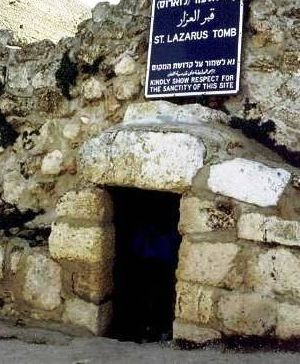
The Tomb of LazarusRather than an “irritating prayer”, this is actually a Prayer of Thanksgiving as prayed by Jews commonly in the context of first century Palestine. Following J. M. Robinson, Bingham Hunter argued there are formal parallels to a Jewish thanksgiving prayer. As a Jewish Hodayoth, the prayer is intended to be heard by the audience for which it is prayed. The cited article lists many examples (including in the Pauline and Qumran literature) indicating that this sort of prayer was not only common enough in the first century, but expected in a religious context such as the one Jesus finds himself in John 11.

Because of its form the prayer seems to be genetically related to and a part of a tradition of piety exemplified by the Jewish personal thanksgiving psalm. Thanksgivings of this sort are characteristically prayers that both God and spectators are meant to hear.

Interpreters may legitimately feel that the way Jesus is said to have prayed in John 11 offends their religious sensitivities. Yet such sensitivities do not seem to have characterized either Christians or Jews in the first century, and a correct approach to exegesis requires that determinations of whether Jesus’ thanksgiving is a real prayer be based on first-century Jewish, not modern, criteria. In the historical context that the evangelist gives it, the prayer seems authentically real and quite uniquely appropriate. (Hunter, “Contextual and Genre Implications,” 70)

With respect to the scholars that find offense in the prayer, Hunter points that the offense is entirely modern. Read in the context of the first-century, the prayer is exactly the sort of thanksgiving prayer we might have expected.


Bibliography:  R. H. Fuller, Interpreting the Miracles (Philadelphia: Westminster, 1963); W. Bingham Hunter, “Contextual And Genre Implications For The Historicity Of John 11:41b-42” JETS 28 (1985): 53-70.