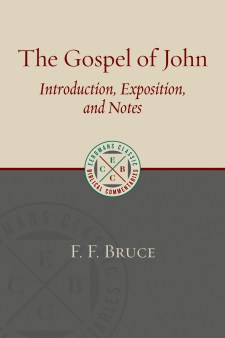
Bruce, F. F. The Gospel of John: Introduction, Exposition, Notes. Grand Rapids, Mich.: Eerdmans, 2018. 425 pp. Pb; $32. Link to Eerdmans
This commentary on John by F. F. Bruce is not new, but it is the first of nine commentaries in the new Eerdmans Classic Biblical Commentaries series. Some of these Classic commentaries were NICNT volumes replaced by new commentaries (Verhoef was replaced by Mignon Jacobs, Murray on Romans was replaced by Douglas Moo, for example). Eerdmans recognizes the ongoing value of these older commentaries and modern printing technology makes it is possible for publishers to keep older works in print. As the series preface observes, these commentaries have been used by pastors, teachers, seminary students, and are cited literary thousands of times by later works.
Eerdmans plans to republish these the following commentaries by the end of the year:
The Books of Haggai and Malachi, Pieter A. Verhoef
Romans (Shorter Commentary), C. E. B. Cranfield
The Epistle to the Hebrews, F. F. Bruce
The Epistle to the Romans, John Murray
A Commentary on the Revelation of John, George Eldon Ladd
The Gospel of John, Herman Ridderbos
The Epistle to the Romans, Leon Morris
John, Merrill C. Tenney
The first in the series is a 1983 commentary on the Gospel of John by F. F. Bruce. The text of the book is identical to the earlier edition so this is a true reprint rather than a second edition. Bruce had been studying the Gospel of John for more than thirty years when he wrote this book and now the book is another thirty years in the past. Although this means the bibliography is obviously out of date, few modern students of John’s Gospel interact with much of this secondary literature on John.
The body of the commentary offers short paragraphs on one or two verses at a time. Bruce provides his own translation of each verse and then comments on the text. Where Greek appears it is always transliterated. The minimal endnotes cite other major commentaries. In his preface, Bruce acknowledges his debt to C. H. Dodd and Barnabas Lindars appears often in the notes as well. One element of the commentary which may seem dated is the use of rabbinic sources in the endnotes. On a number of occasions Bruce cites the Talmud, the Exodus Rabbah, etc (p. 187, for example). In more modern commentaries these might be omitted since it is impossible to state that any given saying in these late sources has relevance for a first century Jewish context.
What is striking about the body of the commentary is how brief Bruce’s notes are. But this is the way commentaries were written at the time. It is refreshing to read a simple, well-written commentary which does not get bogged down in parallel literature, hunting for intertextual allusions or reception history. Also missing are homiletical pointers or attempts to “bridge the gap” between an ancient writer and a modern reader. This is what helps Bruce’s commentary to retain its value over the years. Bruce offers what is necessary to illuminate the text and allows the reader (pastor, teacher) develop appropriate application in their own context. It is refreshing to sit and read a commentary without the distraction of hundreds of notes to other literature. Although Bruce is not as minimal as J. B. Lightfoot’s John commentary, it will seem light to anyone who has read Craig Keener first. There is a place for the exhaustive commentary or for a commentary which traces reception history, or a commentary which closely studies Greek syntax and rhetorical features. It is, however, refreshing to read a clear and concise commentator like F. F. Bruce.
It is fair to question the relevance of a thirty year old commentary which has been replaced, but each volume of this new Eerdmans Classic Biblical Commentaries series is worthy of staying in print. Each generation of Bible student ought to have the chance to read the work of these scholars.
NB: Thanks to Eerdmans for kindly providing me with a review copy of this book. This did not influence my thoughts regarding the work.
Buckley, Michael J. What Do You Seek? The Questions of Jesus as Challenge and Promise. Grand Rapids, Mich.: Eerdmans, 2016. 158 pages; pb. $18.00 Link to Eerdmans
This short monograph collects fourteen short meditations on questions asked by Jesus in the Gospel of John. Many of these questions are recognized as programmatic in the Gospel of John. For example, Buckley draws his title for the book from the first question Jesus asks in the book. In In John 1:35-38, the first words Jesus speaks in the book asks two disciples following him, “What do you seek?” The Gospel of John returns to this theme frequently as people seek something from Jesus (healing, living water, bread from heaven, etc.) In his final question in the Gospel Jesus asks Peter, “Peter do you love me?” (John 21:15-16). Jesus’s question demands a response just as the whole Gospel of John demands a response from its readers.
Buckley’s short reflections on the text focus on the challenge issued by Jesus’s questions. For example, his comments on Jesus’s question to Peter in 21:15-16 concern forgiveness. He devotes two chapters to questions asked in the passion narrative, “what shall I say, save me from this hour?” and “shall I not drink this cup?”) On occasion the meditation ranges far from the original intention, such as in John 2:3-4, when the wedding runs out of wine Jesus asks his mother, “What has this to do with us?” Buckley uses this question to address concern for the suffering and responding to those in need. Perhaps, but Jesus used the opportunity to reveal something about himself by providing wine at a wedding. When Jesus asks his disciples “how can we buy bread” (John 6:5), he reveals something about himself as “bread from heaven,” but Buckley develops an application from the text about the unpredictability of the power of God and our weakness in service. Since this book is devotional reading, these applications are inspiring and challenging even if they seem tertiary to the text.
The book is rich in allusions to classic literature (many citations of T. S. Eliot, Dostoyevsky), philosophy and especially classical of western spirituality (St. John of the Cross, Cardinal Newman) and a few nods to modern scholarship (Bultmann, Barth, and Raymond Brown). Buckley reflects his Roman Catholic background (pp 34-24, for example) but this is not at all distracting.
Readers will be challenged by Jesus’s questions and Buckley’s thoughts on these questions.
NB: Thanks to Eerdmans for kindly providing me with a review copy of this book. This did not influence my thoughts regarding the work.
Johnson, John E. Under an Open Heaven: A New Way of Life Revealed in John’s Gospel. Grand Rapids, Mich. Kregel, 2017. 256 pp. Pb; $15.99. Link to Kregel
John Johnson has served as a pastor and a professor of Pastoral Theology at Western Seminary in Portland. This blend of experience serves him well as he presents thirteen conversations from the Gospel of John. Each chapter is a meditation on an encounter with Jesus in the fourth Gospel. Johnson uses this conversation to present the theology of John’s gospel in a personally challenging way. Some of the conversations are with seekers (Nicodemus and the woman at the well), people seeking healing (the blind men), and others with people antagonistic toward Jesus (his brothers and the Jews in John 8:30-59, even Pilate in John 18:28-19:11).
Johnson presents enough historical and cultural detail (although not exegesis) to set the story in its proper context. For example, he explains the Jesus’s unusual response to his mother in John 2:4 or the clear parallels between Nicodemus and the woman at the well, or the contrasts between the two blind men in John 5 and 9. But since his goal is not to write a fully researched commentary on John, many details are overlooked. For example, there is far more to say about the Feeding of the 5000 than “pointing to a better meal” (116), or the quantity and quality of the wine Jesus provides in John 2 than “Jesus can be so generous” (50). Still, Johnson’s goal is a devotional reading of the text, it is not fair to expect him to fully tease out all of the theological implications of John’s Gospel.
The thirteen chapters of the book read like sermons, with introductory illustrations drawn from pop culture or personal experience, and chapter sections with alliterative headings. He even cites Bob Dylan, which is always a plus. Since the book is written on a conversational level, it would work well in a small group environment or as personal devotional reading. Johnson has included a few questions at the end of each chapter to prompt discussion. Johnson also maintains a blog which touches on some of the topics in this book.
NB: Thanks to Kregel for kindly providing me with a review copy of this book. This did not influence my thoughts regarding the work.
Cronin, Sonya Shetty. Raymond Brown, ‘The Jews’ and the Gospel of John: From Apologia to Apology. LNTS 504; London: T&T Clark, 2015. 232pp. Hb; $112.00; Pb. $39.95 (2013); PDF eBook $27.95. Link to Bloomsbury
Sonya Cronin’s monograph tracks a development in the thinking of one of the greatest Johannine scholars of the twentieth century, Raymond Brown. Her interest is focused on the development of Brown’s thought on John’s characterization of the Jews as responsible for the crucifixion of Jesus. Cronin’s thesis is that Raymond Brown changed his views over his career. Perhaps it is more accurate that Brown’s views on the issue were enlightened over his long career. Brown himself was never anti-Semitic, but his sensitivity to the way John’s Gospel had been misused to justify anti-Semitic belief and actions developed considerably over time. In his earliest writings he offers an apologetic to deflect a charge of anti-Semitism directed at the fourth Gospel to an apology for how the church has used the Gospel of John to blame the Jews for the death of Jesus and the resulting persecution of Jews.
The Gospel of John has often been described as anti-Jewish or anti-Semitic based on the way the author of the Gospel uses the word Ἰουδαῖος, the Jews. For example, John 8:44 states the “Jews are of your father the devil” and John 19 lays the blame for the crucifixion on the Jews rather than Pilate and the Romans. Cronin does not devote any space to showing how an anti-Jewish reading of John developed in the early Church nor how blaming the Jews for the crucifixion became an invitation to abuse the Jews at various times in Church history. There are other books which trace the history and it is a well-known problem in Johannine Studies.
Cronin divides Brown’s work on John into four stages: from 1960-1970, including a short book on John and the Epistles and the Anchor Bible commentary on the Gospel of John; from 1971-1988, including the Community of the Beloved and The Gospel and the Epistles; from 1988-1998, including The Death of the Messiah and a short Retreat with John the Evangelist; and Brown’s posthumous works, including An Introduction to the Gospel of John (with Maloney). In each chapter she examines references to the Jews in works in each stage and describes Brown’s shift in thinking. Initially this was as simple as using quite marks for “the Jews” in order to indicate the Gospel writer does not have all Jews in mind when he declares the Jews “sons of the devil.”
In each chapter she provides some biographical information which may have influence Brown’s development on this issue. For example, when he moved to Union Theological Seminary in 1970, he came into contact with Louis Martyn. That relationship had an impact on Brown’s development of a Johannine Community hypothesis. During his time at Union Brown also had regular fellowship with Rabbi Dr. Burton Visotzky from Jewish Theological Seminary. According to Cronin, after this time Brown “did not publish anything on the Jews without allowing a Jewish scholar to screen it first” (76). An additional factor in each period of Brown’s work on John is developments in the Catholic Church and his participation in statements from the Church on the Jews. The 1965 document Nostra Aetate (In Our Time, Declaration on the Relation of the Church with Non-Christian Religions of the Second Vatican Council).
Of particular interest is Cronin’s account in Brown’s Death of the Messiah. Since this particular monograph was devoted to the death of Jesus, Brown includes a section on the responsibility and/or guilt for Jesus’ death. Both Rome and the Hews are to blame, but since Rome no longer exists, anti-Roman sentiment is meaningless. Brown did not “vindicate nor vilify” the passion narratives for blaming the Jews for the crucifixion (99). It is not the place of the exegete to judge historical attitudes and accurate historical research requires the recognition of hostility in the Gospels. But he also is quick to point out that Christians are also guilty of acting in the same manner as those who killed Jesus (104). Modern anti-Judaism is, therefore, morally wrong and historically misplaced (107).
For John Dominic Crossan, this was a failure to deal with the anti-Judaism of the Fourth Gospel. Crossan’s Who Killed Jesus? was written as a kind of response to Brown and argued Brown did not go far enough in condemning the what he considered anti-Semitism in the passion narratives. Crossan thought a fair historical assessment of the passion narratives necessarily led to anti-Judaism, which can is closely linked to the kind of anti-Semitism which led to the Holocaust (113). Brown is content to acknowledge anti-Judaism in the passion narratives as a historical reality and observe that “not everything in Scripture is to be emulated” (146). Crossan considers the passion narratives to be “defensive fiction” which perpetuate hatred and blames Brown for giving aid and comfort to that fiction.
Cronin concludes her argument with a short survey of commentaries and articles which interact with anti-Judaism in John. Her interest is to compare this data to Brown’s developing sensitivity to the issue. For some scholars, the “Jews” are the Jewish authorities who attack Jesus (not all Jews), for others the “Jews” are a stereotype who function as the theological representatives of unbelief in John’s Gospel. Many scholars have been influence by Brown to argue the Jews serve as a kind of “intra-Jewish debate” with a Jewish Christian community. Brown developed this view in his Johannine Community view, and along with Louis Martyn, suggested some Jews were ejected from the Synagogue because of their faith in Jesus.
In the end, Cronin shows how Raymond Brown was able to move from only the most cursory interest in anti-Judaism in the Gospel of John to a defense of John’s gospel against the charge of anti-Judaism, and ultimately to an apology for the way John’s gospel has been used against the Jewish people in both scholarship and society. Brown did this, Cronin argues, first as a Catholic and secondly as a biblical scholar. Brown was, she suggests, a leader in the Church against anti-Judaism and a “significant voice in leadership” forming official Catholic documents and statements on the Jewish people.
Lamb, David A. Text, Context, and the Johannine Community. LNTS 477; London: T&T Clark, 2014. 232pp. Hb; $110.00; Pb. $39.95 (2013), PDF eBook $27.95. Link to Bloomsbury
In this revision of his 2012 doctoral thesis at the University of Manchester, David Lamb evaluates Raymond Brown’s Johannine Community using recent insights from sociolinguistics, primarily genre and register. Few scholars have had an impact on a field within biblical studies like Raymond Brown, and although many of the details of his Johannine Community model have been challenged and abandoned, it is impossible to study the Gospel of John without taking into consideration his ideas.
The first two chapters of Lamb’s book are a necessary overview of the “rise and fall” of the Johannine Community in scholarship. He begins his literature with Martyn, Culpepper and Cullman as precursors to Brown as well several scholars who developed the theory after Brown’s initial work. Wayne Meeks developed thesis that the Community was sectarian in nature, so that the Gospel is a “book for insiders” rather than a universal Gospel for all Christians. This is the direction of the work of Bruce Malina and Jerome Neyrey. Lamb gives significant attention to Edward Klink’s Sheep of the Fold (Cambridge 2007), calling it “the most sustained attack on the Johannine Community to date” (21). In this dissertation written under the supervision of Richard Bauckham, Klink argues there was no local audience for the Gospel of John. In fact, it is largely impossible to move from text to social location with any degree of certainty.
Most recent introductions to John’s Gospel will trace a similar history and then state the Johannine Community theory is less popular than it once was. Lamb surveys a series of scholars who have contributed to this erosion. This includes evangelicals like Morris, Carson, and Köstenberger who are more interested in traditional authorship of the Gospel of John as well as Richard Bauckham’s suggestion John is a gospel “for all Christians” rather than a narrow sectarian document.
The second chapter of this monograph presents Brown’s Johannine Community. It is not necessary to summarize the well-known development of Brown’s work here, but it is significant that Brown himself understood his reconstruction of a Johannine Community was only a “probability” (29), but one based on what he considered a scientific, critical foundation. Lamb is right to describe Brown as a faithful Catholic scholar who did his work in the spirit of modernism. Brown used the historical-critical method, including source and redaction criticism and was deeply suspicious of newer hermeneutical methods (43). Lamb suggests his use of these methods was tempered by his allegiance to the Catholic Church (54). His method did, however, employ a “two level” reading of the Gospel of John, so that the blind man in John 9 is “acting out the history of the Johannine Community” (42).
In order to critique Brown’s Johannine Community theory, Lamb employs a sociolinguistic method to better understand the relationship between text and context. The third chapter of this monograph therefore introduces the reader to sociolinguistics and defines key terms (genre, register, style and dialect). Genre refers to relatively stable forms of discourse. By “register” Lamb means the way language varies according to its social situation. For example, a scientific text has a different register than a religious text. By style Lamb refers to an author’s idiolect, the particular choice of words or grammatical features. By dialect Lamb choices of vocabulary according to the culture of the writer. It is the variety of language which may say something about the “context of culture” behind a text. After surveying several examples Lamb concludes that register analysis may help to define the “context of situation” of the Gospel of John as the well as the relationship between the implied readers of the text and the actual readers. That relationship will be “realized in terms of its tenor” (101).
Although Raymond Brown was reluctant to describe the community as secretary in, this is not been the case for other New Testament scholars. In his fourth chapter Lamb explores the idea of antilanguage, by which he means the way that he community defines or redefines terminology along sectarian lines. Wayne Meeks thought the Johannine community was sectarian, other scholars described as a “countercultural group.” If this is the case, then we ought to expect relexicalization of common vocabulary in order to create insiders and outsiders. For example, prisoners create new words or redefine old words in order to create an insider language that sets them apart from prison staff. Another example might be teenagers who regularly redefine words or use them in ways radically different than their parents’ generation. If this kind of antilanguage appears in the Gospel of John, then it is evidence the community was sectarian. But after examining some examples in the Gospel, Lamb finds this thesis to be unacceptable Although there are a number of words in John’s Gospel which contrast to spheres of existence (spirit above in contrast to flesh below), none of these are redefine nor are there examples of new vocabulary unique to the community. Lamb offers several suggestions to explain this. First, there is simply not enough data to a sociolinguistic method to achieve results in the Gospel of John. Second, even if there was antilanguage in the Gospel, it does not necessarily imply the readers were members of an “antisociety.” Even a dominant group uses “coded language” (141).
For Lamb, previous attempts to use sociolinguistics to the Gospel of John have been rigorous enough because these attempts are dominated by the assumption of a Johannine Community which is sectarian (145). He therefore devotes his fifth chapter to the register of John’s Gospel. Lamb surveys the narrative asides in the Gospel since these are from the author, paying close attention to the possibility of new words created by the writer, speech functions and modulations of clauses, use of personal pronouns and vocative adjuncts. By assessing the use of these features, Lamb draws conclusions with respect to power, contact and affective involvement. Who holds the “power” in the relationship, the author or the reader? What is the level of contact between the two? The higher the affective involvement, the more likely the “context of situation” is a close-knit community.
In each of these three categories, neither the Gospel nor the Epistles imply a close-knit community. The author hold all the power and there is no evidence of contact in the narrative asides in the Gospel. There is some contact in 2 and 3 John, but this contact is slight in comparison to the rest of the Johannine literature. It is possible Ἀγαπητοί in 1 John implies some affective involvement, but Lamb considers this language was used for rhetorical value rather than implying a community. Lamb does not consider Τεκνία μου in 1 John, presumably this would also be considered a rhetorical device.
Does Lamb’s register analysis signal the death of the Johannine Community? As Lamb states in his concluding chapter, he has attempted to chart a course between historical criticism and literary methods, Brown himself was only interested in the former and was suspicious of the latter. He concludes Bauckham and Klink are correct, the audience of John’s Gospel is “broad and hard to define” and certainly not an introverted, sectarian community (203). For scholars who want to continue to use the Johannine Community hypothesis, they need to bear in mind the language of the Gospel is sociolect rather than idiolect and is targeted at a loose network of communities which may have formed around the Gospel.
Conclusion. David Lamb has employed what is for many a new method for understanding the “context of situation” behind the Gospel of John. Such literary methods are often arcane and create terminology which unnecessarily obfuscates. To his credit, Lamb develops his register analysis in a way which brings clarity to the ongoing discussion of the Johannine Community.
 The body of the commentary offers short paragraphs on one or two verses at a time. Bruce provides his own translation of each verse and then comments on the text. Where Greek appears it is always transliterated. The minimal endnotes cite other major commentaries. In his preface, Bruce acknowledges his debt to C. H. Dodd and Barnabas Lindars appears often in the notes as well. One element of the commentary which may seem dated is the use of rabbinic sources in the endnotes. On a number of occasions Bruce cites the Talmud, the Exodus Rabbah, etc (p. 187, for example). In more modern commentaries these might be omitted since it is impossible to state that any given saying in these late sources has relevance for a first century Jewish context.


You must be logged in to post a comment.