Why Not Ephesians?

Ephesians is one of the books in the Pauline collection which is frequently assumed to be pseudonymous.  Despite the fact that Paul refers to himself four times in the letter (1:1, 3:1, 4:1, and 6:19-22), the majority of scholarship in the last 150 years denies the authenticity of the letter. Rather than written by the “historical Paul,” the letter was created in the late first century, perhaps as a companion to the book of Acts.
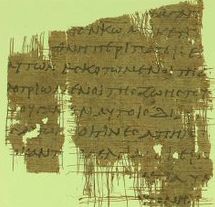
P49 Verso

While there are many variations on this argument, many introductions to Paul reject the letter as authentic on the basis of vocabulary, style, and theology.  For many, the letter does not sound enough like Romans, Galatians, or 1-2 Corinthians to be accepted as authentic.  Usually the letter of Ephesians is thought to be a post-Pauline compendium of Paul’s theology.  It was written by a disciple of Paul (“Paul’s best disciple,” Brown, 620).  Sometimes the reconstruction of the circumstances are quite complex. For example, Goodspeed suggested that Onesimus returned to Philemon, was released from his slavery and eventually became the bishop of Ephesus. After Acts was published, there was a great deal of interest in Paul, so Onesimus gathered all the various letters Paul sent to the churches of Ephesus as an introduction to Paul’s theology.  As Brown says, this is interesting but “totally a guess.”

There are some differences between Ephesians and the other Pauline letters.  For example, the common Pauline term brethren is missing (except 6:23), and the letter never calls the Jewish people “Jews” in the epistle, even though the Jews are an important part of his argument.  More surprising is the fact that the verb “to justify” is not used, even though while it is common in Galatians and Romans and might have been useful in the argument of 2:11-22.

Does it matter if Paul did not write the letter himself?  If the letter contains the actual “voice of Paul” then the letter can be considered Pauline.  By way of analogy, in the study of the Gospels there is a great deal of discussion over the words of Jesus.  When I read the words of Jesus in my ESV Bible, can I know that these are the real words of the historical Jesus?  The answer which satisfies me is that the words of Jesus in the Synoptic Gospels are true “voice of Jesus,” even though they are not the actual words Jesus’ words were originally spoken in Aramaic, translated to Greek and then to English for me to read!

In the same way, even if Ephesians was not written by Paul, the true “voice of Paul” can be found in the letter.  As it happens I think Paul did write Ephesians, albeit much later in his life during his Roman house arrest.  The letter was intended to go to all the house churches in Ephesus and there is no burning problem which Paul has to address (as in Galatians or Corinthians).  This explains why the letter is generic in terms of theology and practice.

Considering Ephesians to be an authentic Pauline letter may change the way we envision Paul’s  theology.  While Romans and Galatians are concerning with justification and the struggle to define the Church as something different than Judaism, Ephesians is a witness to the universal church which includes Jews and Gentiles in “one body.”  Unity of the church seems to be Paul’s main theme in the letter.  Rather than drawing lines, Paul is arguing for unity among those who are “in Christ.”

How might taking Ephesians seriously change the way we think about various elements of Pauline Theology?

Acts 19:13-20 – Sons of Sceva and the Magicians of Ephesus

Most people in the ancient world believed in the power of protective magic.  According to Clint Arnold, Jewish magic was famous in the ancient world (Acts, 193).  In his monograph Magic in Ephesus he details magical practices in the Ephesus as well as Jewish use of magic and talismans to ward off evil.  It is no surprise to find people in Ephesus who are not only using magical items, but that Jews functioned as exorcists and magicians may come as a shock.  Many Jews found a lucrative trade selling incantations and amulets in Ephesus.

Jewish exorcists are well known in the ancient world, especially in Ephesus (see for example, Josephus Antiq. 8.42-49) and Jews were especially famous for magic. Jewish names were especially thought to have magical powers, as is illustrated by Paris Papyri 574, “I abjure you by Jesus the God of the Hebrews,” and “hail God of Abraham, Hail God of Isaac, hail God of Jacob, Jesus Chrestus, Holy Spirit, Son of the Father.”

Some of these Jewish exorcists have begun to use the names of both Jesus and Paul as “power words” to cast out demons. This is the only place in the New Testament where the Greek ἐξορκιστής (exorcist) is used.  Sceva is identified as a chief priest (not the high priest), although it is his sons who are attempting to cast out this demon.  When commanded, the demon reverses the usual process and “exorcizes” the exorcists! This humorous scene shows that the God of Paul is not to be manipulated like the other gods of the ancient world.

The news of beating of the sons of Sceva spreads quickly.  The text says that the name of the Lord Jesus was held in high honor (μεγαλύνω).  This does not necessarily mean people became believers. The word appears in Acts 5:13 to refer to the reputation the apostles gained in Jerusalem (“held in high regard by the people”), but certainly in that context  people were not converted to Christianity.

Luke reports that many who were already believers openly confessed their sin of magic and publicly burned their scrolls. Luke uses the perfect tense to describe these magicians – they have already believed in Jesus and were saved, but they had not given up their magical practices quite yet.  Perhaps burning their scrolls is an act of “self preservation,” as Witherington puts it.  Other magicians and exorcists had to be amazed at what had happened to the sons of Sceva, even if they were not willing to have a saving faith in the Lord Jesus (Acts, 582).

The people public confess their evil deeds.  This likely means they made public spells and magical words which were kept in secret.  Public confession would render them ineffective (Bruce, Acts of the Apostles, 412).  In addition to the public confession of guilt, many others bring magic texts to voluntarily burn. Public book burnings are common in the Greco-Roman world, subversive or dangerous texts were destroyed.  The best example is Augustus himself, who collected Greek Sibylline oracles and had them destroyed since they could be used to foment rebellion against the empire.

This points out that the new converts in Ephesus were not yet “de-paganized.”  Like the Corinthians, the converts in Ephesus struggled to integrate Christ and their culture.  What strikes me as odd is that the disciples of John the Baptist were not Christians because they had not yet received the Holy Spirit, but these magicians were in fact Christians (having received the Spirit), despite the fact they continued in a pagan practice after becoming “in Christ.”  I seriously doubt that Paul and the other missionaries approved of the practice, but there must have been some toleration at first since it took some time before the magicians renounced their trade.

What are the implications for modern evangelism, either in America or in other missions work?

Further reading in Magical Papyri: H. D. Betz, “Introduction to the Magical Papyri,” in The Greek Magical Papyri in Translation (Chicago: University of Chicago Press, 1986).