Testament of Moses

The first few fragmentary verses set the context for the testament.  Moses called Joshua and commanded him to go forth in the strength of the Lord. Moses tells Joshua he was prepared by the Lord to be the mediator of the covenant and now he is about to die.  Moses must pass along to Joshua some knowledge and books which he is to preserve. Moses tells Joshua will lead the people into the land, but some of the tribes will violate the covenant and commit idolatry.

Chapter 3-4 “predicts” the fall Jerusalem in 586 B.C., the exile and the return from exile. Moses predicts they will be captives in the east for seventy-seven years (rather than expected seventy years). A prophet-like character will pray to the Lord on behalf of the nation, as does Daniel in Dan. 9:4-19. God will remember his covenant and return two of the tribes to the land, the other ten will spread out through the nations.

Image result for Testament Of MosesChapter 5-6 is prophetic speech concerning the Maccabean period.  People will worship idols and “play the harlot,” a reference to Hellenism.  Priests who are not truly priests will be active (the non-Zadokite high priests of the Hasmoneans). The prophecy into the reign of Herod the great (thirty four years in power, a wanton and rash man, killing both young and old).

Chapter 7-8 is fragmentary but appears to describe “the time of the end” when people please only themselves and commit criminal deeds. Moses describes a great persecution, including torture and Jews forced to undergo reversal of the circumcision (8.3).

Chapter 9 – This is by far the most difficult text in the book.  A man from the tribe of Levi named Taxo will appear with seven sons. Cf. 1 Maccabees 6, the story of the martyrdom of Eleazar, 2 Maccabees 7:20f, seven sons martyred, parallel to 4 Maccabees 15. Tobias, in his final testament, has seven sons (Tobit 14:3).We cannot be sure what it is this Taxo does because the text is corrupt, but it appears he leads in a resistance against evil which leads to martyrdom.

The poetic section is the high point in the book (ch. 10), drawing together numerous Old Testament apocalyptic themes and texts. It describes a kingdom during which time the devil will be at an end.  The heavenly one will arise from his kingly throne and will cause the earth to tremble and make the valleys low.

The book concludes with Joshua writing out the words of Moses as a testament. He then falls at Moses feet, weeping and mourning. He desires to know where the tomb of Moses will be, but the question is never answered.  He continues to ask how he will lead the people in Moses’ absence. Moses encourages Joshua by telling him God has created everything and has foreseen all things, all things are “under the ring of his hand.”

Unfortunately, the text breaks off at this point.

What is the “Testament of Moses”?

This book is called The Assumption of Moses in Charles, although the Testament and the Assumption may be two separate books. The only extant copy of the Testament of Moses is a Latin palimpsest dating to the sixth century A.D.  This manuscript is missing a section and in other places it is illegible (OTP 1:919-920). Most Christian interest is due to the allusion in Jude to this book.

Image result for Testamentof MosesThe book may have been written in Greek since there are a few words which are simply transliteration of Greek words.  Priest notes, however, that the consensus opinion is that the book was originally written in Hebrew (OTP 1:920). Dates range from the time of the Maccabean revolt to the second century A.D.   There seem to be clear references to the Herodians in chapter 6, although this may be the result of a revision of a Maccabean text.  Some have tried to connect the book to the Qumran community, although there is no exact representative of the sort of Judaism found in the book even at Qumran (OTP 1:921). Knibb argues that the history of Israel ends in 6:8-9 with an allusion to Varus, just after the death of Herod.  He therefore dates the book “fairly precisely to just after 4 B.C.E.”
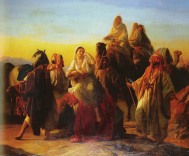
The Testament of Moses comes from another pietist group of anti-Hasmoneans but is more focused on Herod, “an insolent king” who mistreats the people for thirty-four years (6:2-5). The reign of Herod is a terrible time, but one which was foreseen by God from the beginning of creation to the smallest detail (12:4).  This view of “fate” corresponds to Josephus’ description of the view ascribed to the Essenes and Pharisees.  There is less to work with in the Testament of Moses so we cannot know if the writer also held some sort of view of free will.  Like the Psalms of Solomon, there is an expectation of a final consummation, although the details are confused.

According to this book, a Levite named Taxo will arise and lead his sons to a cave where they will die rather than break the commands of God. A similar attitude is demonstrated by 1 Mac 2:29-38, the martyrs who refused to fight on the Sabbath. While this event took place nearly 200 years before Testament of Moses was written, the Maccabean martyrs were revered as patriots even in the first century. According to John Collins, R. H. Charles identified him as Taxo as Daniel “for no good reason,” Tromp thought he was Ezra, and S. Mowinckel took the name to mean “orderer”, as in “one who is over them” ((The Apocalyptic Imagination, 130 notes 54 and 55).

There may be material missing which explains why Taxo does this, but the point is very much in line with the various stories we have encountered of pietist groups willing to die for the cause (Pharisees and Sicarii for example.)  In the later chapters of the book, God is described as appearing to punish the Gentiles and to exalt Israel “in heaven above the stars.” (N. T. Wright thinks this passage is dependent on Daniel 12:1-3, Resurrection of the Son of God, 157, so also Collins, The Apocalyptic Imagination, 131). This is not an end of the world, but rather a defeat of Israel’s enemies parallel to their exaltation.  There are now details of this exaltation, however (a re-gathering of the nation, a messiah, a new temple, etc.)


Bibliography. M. Knibb, “The Exile in the Intertestamental Period,” Heythrop Journal 17 (1976): 253-72, reprinted in M. Knibb, Essays in the Book of Enoch and Other Early Jewish Texts and Traditions (SVTP 22; Leiden: Brill, 2009), 191-212; 200 n. 33.

Testament of Jacob

This testament is a Christian work with a Trinitarian introduction (the exact same words as the Testament of Isaac). The writer refers the reader to the Old Testament to learn the rest of the history (7.2). The work is known primarily from an Arabic text, but is preserved in Coptic and Ethiopic as well (OTP 1:913). In 7.12, the writer comments that the patriarchs are “the ones whom the Arabs have designated as the holy fathers.” The ethical section seems to allude to Jesus’s teaching when the writer encourages the reader to “Clothe the poor person who is naked on the earth, so that God may clothe you with the apparel of glory in the kingdom of heaven, and you will be the sons of our holy fathers, Abraham, Isaac, and Jacob in heaven forever.” Finally, the book ends with a reference to the Virgin Mary as the “mistress of intercessions, the source of purity, generosity, and blessings, the mother of salvation.”

As with the other two patriarchal testaments, the Lord sends Michael to bring the soul of Jacob to heaven. He is told to order this household, and he says “let the will of the Lord be done.” He goes to his son Joseph and blesses him. Jacob is visited by an angel, but he thinks it is his son Jacob (also similar to the Testament of Isaac. The angel blesses Jacob and reviews his history – this angel has protected Jacob all throughout his life. After the angel ascends back into heaven Jacob is surrounded by his family and they weep over him. He prophesies that the Lord will make the people great in the land of Egypt.

Chapter 4 recounts Genesis 48, Jacob’s blessing on the two sons of Joseph. This is remarkably accurate with very little expansion on the canonical story. Chapter 5 is similar to Genesis 49, the biblical “testament” of Jacob. After a short moral exhortation, Jacob is taken into heaven. The Arabic text is missing this ascension, the Boharic describes the Lord himself coming with Michael and Gabriel to take Jacob’s soul to heaven.

Chapter 6 expands the canonical story to explain how Joseph kept his promise to return Jacob to Egypt. After Joseph completes his mourning for his father he worships God before the Pharaoh. In fact, all the elders of Egypt mourned Jacob attended the body when it was delivered to the tomb in Canaan.

The author of the book steps forward and recommends the reader consult what Moses wrote in the Old Testament for further information about Jacob. The author gives a moral exhortation to be diligent in prayer and fasting in order to drive away demons, to avoid sin (a sin list is given). In 7.21 we are encouraged to honor the saints because they intercede for us. As with the Testament of Isaac, the twenty-eighth day of Misri is to be honored.

Testament of Isaac

Originally written in Greek, this testament is only know in translation. The book is dependent on the Testament of Abraham and therefore must be dated after the first century. While Stinespring dates the book to the second century A.D., he also notes the popularity of the book among Coptic Christians and speculates the book may have had an origin in the Coptic Christian church, requiring a much later date. In the end he settles for an original form in Greek, written by an Egyptian Jew which has been Christianized at a much later date (OTP 1:903-904). If the book can be dated to the second century, then it would contain a very early Trinitarian statements such as the opening verse (Father, Son and Holy Spirit in apposition with “One God”).

Image result for Isaac Bible BanquetAfter a two-verse introduction we read that Isaac has called his family together in testament-like fashion. He tells his family the one who has a pure heart and faith in God will be an inheritor of the kingdom of God. God is compassionate and has received thieves and tax-collectors to himself (the thief on the cross and Matthew, Zacchaeus, presumably.) This is an example of the obvious “christianizing” of the text.

Just as in the Testament of Abraham, chapter 2 begins with Michael the archangel dispatched from heaven to visit Isaac before he dies. Isaac thinks the angel is his father Abraham, but eventually he figures out this is an angel. Isaac is concerned for his son Jacob since this appears to be after Jacob has offended him. The angel responds that Jacob will be protected by the Supreme God as well as the Son and the Holy Spirit (a rather Trinitarian thing for a Jew to say!) He does not want Jacob to hear the news he is about to die.

Jacob comes to his father and is ignorant of his impending death (ch. 3). Jacob wants to go with his father, but Isaac explains he is about to die and cannot change the decree. In verses 17-19 there is an odd bit of prophecy of twelve giants, then Jesus the Messiah will come from a virgin named Mary. God will be incarnate in him until the completion of a hundred years. This is a very odd text indeed since we cannot really know what we are to make of the “giants.” If these are “kings,” then we would have a typical run of Roman emperors, but there were clearly not twelve prior to the incarnation. Nor is there a convenient run of twelve kings among the Herodians, Hasmoneans, or earlier kings. That God will be incarnate is obviously Christian, but the period of a hundred years cannot be a reference to the life of Jesus unless the author was ignorant of the facts of Jesus’ life.

When people begin to gather when they hear a man of God has visited, Jacob asks Isaac to begin a discourse to comfort him (ch. 4). The rest of this lengthy chapter is a moral exhortation which in some ways is Jewish (“do not present an offering when you are not ritually clean”) yet in other ways distinctly Christian (“guard your body, it is the temple of the Holy Spirit,” similar to 1 Cor. 6). This blending may be the result of an incomplete “Christianizing” of a Jewish document.

While crowds are impressed with Isaac’s speech, an angel comes and takes him up into heaven. Isaac has a short “heavenly journey” including a river of fire and the “overseer of punishment” of Hell. This journey section continues as Isaac ascends into heaven to see Abraham. Isaac is brought before the throne of God and he worships along with Abraham. The Lord commands Isaac to not profane the body since it is in the image of God. The Lord takes Isaac’s soul from his body, which is snow white, and he places it on his holy chariot and they ascend into the heavens.

According to chapter 8, the day this happened was the twenty-eighth day of Misri, a day the writer still commemorates. The one that keeps this day will be blessed and will be present at the millennial banquet. This is clearly a Christian gloss, since the writer describes the kingdom as the kingdom of “our God and our King and our Savior, Jesus the Messiah.”

Testament of Isaac 8.6 Whatever person has manifested mercy in the name of my beloved Isaac, behold I will give him to you in the kingdom of heaven and he shall be present with them at the first moment of the millennial banquet to celebrate with them in the everlasting light in the kingdom of our Master and our God and our King and our Savior, Jesus the Messiah.

Abraham’s Heavenly Journey – Testament of Abraham 10- 14

Many apocalyptic texts include a heaven journey. For example, in the Book of the Watchers Enoch passes through the heavens and sees various locations. He sees the “high places” and storehouses of the earth where the rains and snows are kept. In Chapter 18 he sees the storehouse of the wind, the cornerstone of the earth, and the pillars of heaven. He also sees a “dark pit” with heavenly fire, described as a “desolate and terrible place.” Second Enoch also has a heavenly journey in which he sees the orderliness of the universe.

Image result for Abraham Bible visionIn chapter 10 Abraham’s “heavenly tour” begins. He sees various things happening all over the world, including many sinners (robbers, immorality, etc.) He asks the Lord to open the earth and swallow them up, which it does. This sort of thing reoccurs several times. We are told Abraham has never sinned, therefore he has no mercy on sinners. Michael then takes Abraham to a place where he can see two ways, a narrow way and a broad and spacious way (ch. 11). There are two gates here, one leading to the broad way, which is destruction and the other to the narrow way, which leads to life. This motif of “two ways” is common in the testament literature.

Abraham sees two terrible angels appear and drive people with fiery lashes who have entered through the broad gate. Within the broad gate Abraham sees a terrifying throne and the books open for judgment (cf. Rev 20). Abraham asks who the judge and angels are. The one seated on the throne is the “Son of Adam” – Abel, the first formed. This is an interesting use of a phrase which might be taken as “son of man” which does not refer to a messianic figure in quite the same way as 2 Baruch. At the time of the Parousia every person will be judged by the twelve tribes of Israel and will receive a judgment which cannot be changed. This eschatological outline is familiar from other apocalyptic in the pseudepigrapha, but also from the New Testament.  On either side is an angel who records either good or bad deeds.

An archangel, Purouel, holds a balance in his hand to test the works of those being judged. This angel, we are told, is in charge of the fire by which he tests the works of men. C. W. Fishburne has argued that Paul was aware of T.Abraham in his description of judgment in 1 Corinthians. The verbal parallels noted by Fishburne are fairly general and may be a reflection of a similar topic rather than Paul’s knowledge (and use) of T. Abraham.

Abraham asks about the soul in the hand of the angel in the middle of the scene (ch. 14). It is lacking one righteous deed more than its sin in order to be saved. Abraham prays for the soul, and it is saved as a result. Perhaps this added to the popularity of the Testament of Abraham in the medieval period since it implies the prayers of the righteous are effective for the dead.