Hebrews 11:1-3 – Faith is Being Sure…

One of the more common characterizations of Christians is that they live by “faith” not facts.  Sometimes this is said in the context of a “faith versus science” debate.  Scientists (we are told) hold to facts proven to be true, Christians believe in things that cannot be proven by facts.  If a Christian is telling the story, then the scientist (probably an atheist Democrat) is too close-minded and too prejudiced to accept things he cannot explain rationally.  If a scientist is telling the story, then the Christian is a soft-headed uneducated person (probably a Republican from Texas) who believes in childish things.

I am reminded of a rather funny passage in Douglas Adams’ classic Hitchhikers Guide to the Galaxy.  All science fiction stories have to come up with some explanation for why everyone in the future distant reaches of space all speak English.  Star Trek has a universal translator, for example.  In his story, Adams describes the Babel Fish, a tiny fish which, when inserted in one’s ear, translates all languages into what every language the host person thinks.  This fish is so complex it could not have possibly evolved naturally, so it is a clear proof of the existence of God.  Adams goes on to say:

Now it is such a bizarrely improbable coincidence that anything so mindbogglingly useful could have evolved purely by chance that some thinkers have chosen to see it as a final and clinching proof of the non-existence of God.

The argument goes something like this: “I refuse to prove that I exist,” says God, “for proof denies faith, and without faith I am nothing.” “But,” says Man, “the Babel fish is a dead giveaway isn’t it? It could not have evolved by chance. It proves that you exist, and so therefore, by your own arguments, you don’t. QED.”

“Oh dear,” says God, “I hadn’t thought of that,” and promptly disappears in a puff of logic. “Oh, that was easy,” says Man, and for an encore goes on to prove that black is white and gets himself killed on the next zebra crossing.

As funny as this is, it points out a misunderstanding about faith.  Faith is not believing in things you know to be untrue, or impossible, or strange.  Having faith in the Easter Bunny does not make him real.

The writer of Hebrews defines faith is being sure of what we believe in.  When a Christian talks about having faith, they are certain what they believe is built on a proper foundation and is objectively true.

“Sure” here is an important word, used only two other times in Hebrews (1:3 and 3:14).  The NIV renders this word in three different ways, although the difference between Hebrews 1:3 and Hebrews 11:1 should not be as great at the NIV translates (substance vs. sure). Literally, the word means that which stands under, or foundation. The word began as a medical or scientific term, although nothing of that meaning remains in the New Testament usage.  The word then was used in philosophy to describe the reality of something, as opposed to the philosophical “being.”

BAGD identifies ὑπόστασις as “substantial nature, essence, actual being, reality…”  The meaning here in Heb 11:1 is most often given as “realization” or “reality.”  Or as Louw and Nida comment, faith is “that which provides the basis for trust and reliance – trust, confidence, assurance.”   The NIV’s “sure” tries to combine these meanings, the substance of hope is the thing that gives one confidence that the hope for goal will occur, something that gives assurance of an abstract concept, something that is not necessarily provable, without substance.

The “substance/proof” is for things that are hoped for, not seen.  Hope is “to look forward with confidence to that which is good and beneficial.”  In the New Testament, it is Jesus Christ that provides the basis for that hope, first in his work on the cross, and secondly in his promise to return.   In the other five occurrences of the word in Hebrews, hope is rooted in salvation, each verse is talking about the content of our salvation, and in each case that hope is certain.

Hope in modern use tends to be more “wishful thinking.”  I hope this is over soon, I hope I get that for Christmas, I hope my kids grow up right, etc. Biblical hope is an expression of something that will happen at some point in the future and it is so certain that I can live my life on the foundation of my hope.

Hebrews 6:4-12 – Other Views on the Warning Passages

Collin Hansen has an excellent interview with Peter O’Brien which specifically discusses the warning passages in Hebrews.  Essentially, O’Brien makes the point that there are two kinds of faith in Hebrews, a genuine faith, analogous to the Parable of the Sower.  Some people respond to the gospel, but not fully and therefore recant their faith when a time of persecution comes.  Indeed this is usually the case when the gospel is preached, whether in the ministry of Jesus, people may respond positively but not come to real Faith in Jesus.  That inadequate response is found in John’s Gospel as well.  Nicodemus was positive towards Jesus, even friendly towards his teaching, but in John 3 I think he falls short of “saving faith.”

Scot McKnight has a response to this interview.  He does not like this two-kind-of-faith approach, stating that it “strains the very language of the letter to the Hebrews.”In essence, McKnight says that it really does not make any sense to warn someone about apostasy (falling away from faith) if they have no faith to begin with! If someone has “spurious faith” then they really ought not be encouraged to continue in that faith.  McKnight does not understand what “spurious faith” means in this context, although late in the article he offers what might be a good definition real faith “perseveres and to salvation” and spurious  faith “doesn’t persevere and that leads to judgment.”

I wonder if O’Brien’s parallel to the Parable of the Sower is not a useful way to understand these warning passages.  Within a group of followers of Jesus, there is a range of responses to the Faith.  They all have heard the real gospel and have some sort of a response to it.  They have all responded positively, but only one type of response is “salvation which perseveres.”  In the Parable, it is the person who bears fruit. To appreciate the faith, or to admire Jesus and his teaching, or to enjoy the gifts of the Spirit is simply not enough.  To be “right with God” one clings tenaciously to the Faith as it has been handed down to them, they bear fruit, and they endure whatever persecution comes their way.  In fact, suffering for the faith seems to be a hallmark of “genuine faith” (Hebrews 12:3-11).

If this analogy is useful, then the exhortations in Hebrews are trying to draw those with weak or inadequate faith into a deeper, more full understanding of this “great salvation.”  The time is coming, says the writing of Hebrews, when you cannot play at being a Christian – you may have to pay with your life!

Thanks to Brian Small at Polumeros kai Polutropos for these links as well as including Reading Acts on his January Hebrews Carnival!

The Author of Hebrews – Why Remain Anonymous?

Of all the letters in the NT, only Hebrews and 1 John lack the typical opening expected in a Letter.  Why does the author remain anonymous?

It is possible the letter was not anonymous in the first place, but the address was lost early in the history of the letter. Perhaps the original document was intended to be delivered with a cover letter from the author which was customized for various synagogues or churches in Rome.  Since the cover letter was unique to the church, it was not copied in the same way the letter might.  But there is no evidence for this, either by manuscript or tradition. It is better to see the letter as intentionally anonymous.

It is also possible the letter was anonymous to protect the writer from any attacks from either Jews hostile to the gospel or Romans wishing to persecute the leaders of the church.  Some scholars have pointed out that the Gospel of John does not identify every disciple (there are unknown disciples throughout the book).  At least one explanation for this was to protect these still-living disciples from persecution.  But this would seem odd for the author to hide his identity given that the letter encourages the readers to face persecution with boldness!

It is more likely that the letter was likely intended to be read in a number of different contexts as a literary piece, not a letter written for a particular occasion.   Hebrews is a sermon addressed to anyone struggling with the relationship of Judaism and Christianity, although it is especially applicable in Rome in the early 60’s.  An introduction with greetings from the author may not have been appropriate, if this is the case.

The Purpose of Hebrews

One of the problems with reading Hebrews is identifying the date and recipient of the letter. I am fairly well convinced that the recipients were in Rome, living just before the Neroian persecutions.  I think the standard arguments for this position are solid.  Jobes (Letters to the Church) makes the point that the book does not use the destruction of the Temple as a “proof” that the Old Covenant has been replaced by the New.  In addition, the church has “not yet suffered to the point of shedding blood” (12:4).  If the recipients are in Rome, then the letter must refer to a time prior to Nero’s persecution of Christians (A.D.64), but after Caligula Claudius expelled Jews (A.D. 49).

Given this context, the recipients struggle with the promises of Christian faith.  If Jesus is the true sacrifice and the fulfillment of the promises of the Hebrew Bible, why have they suffered so much?   As J. W. Thompson says in his Hebrews commentary, the book is written to “reorient a community that has been disoriented by the chasm between Christian confession of triumph and the reality of suffering it has experienced.”

This is not apologetics in the modern sense.  The author does not argue against Judaism nor does he state that Judaism was bad or wrong in any way.  Rather, the writer constructs a positive argument for Jesus’ superiority to various elements of Judaism; he is superior because he is the fulfillment of these things. (He is the substance to which the shadow pointed).

If I am right about the context of the book and the recipients have suffered for their faith already (and are about to suffer even more so under Nero), then the readers may very well have struggled with the shame of suffering in a culture which did not see suffering as a virtue. Within a Jewish context, suffering is sometimes seen as a result of sin, or at the very least, a lack of blessing from God.  We only need to look at the discussion in the book of Job to see that there was a lively discussion of why humans suffer.  If Christians are right and Jesus has triumphed, then why are his followers not blessed?  Why are they suffering?

Within a Greco-Roman context, Christians were not seen as successful because they suffered.  Roman thinking was very much based on honor and shame, of one suffered shame and humiliation in public, one cannot be described as successful!

The book therefore addresses a very real problem.  If Jesus is already seated at the right hand of the Father, why is it that Christians suffer shame and persecution?  Christians are not “of this world,” they are part of the real, unshakeable reality which is not of this world at all.

The theological dissonance which the book of Hebrews addresses is certainly applicable to the church today, especially in America.   Evangelical American Christian can be described as “triumphant,” especially in the last half of the 20th century.  Evangelical churches expanded greatly and had a greater impact on culture than at any time in history.

We very well may be past that now.  Studies indicate that the church is still growing, but at a pace which is slower than the general population.  We are beginning to lose ground and we have in many ways lost our voice in the public square.   Perhaps this is due to Christians who have humiliated themselves and brought shame to the cause of Christ, or because some very bad people chose to use evangelical Christianity as a way to advance political careers or other agendas.

Pseudepigraphy and Jewish Christian Literature

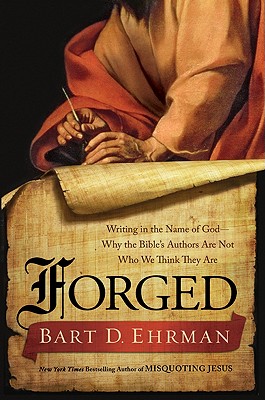
Karen Jobes deals with the issue of pseudepigraphal authorship in her recent Letters to the Churches (Zondervan, 2011).  As she defines it, a document is pseudepigraphical if the author intentionally uses another name rather than his own (page 6).  This is different than a pen name (she cites Samuel Clemens, more commonly known as Mark Twain), and it is also different than using an amanuensis, or scribe, to compose a letter.  If a person was not “officially commissioned” to write a document then it should be considered pseudepigraphic.

Here is the problem for evangelicals with a commitment to inerrancy.  If Second Peter says Peter wrote it, then that means Peter wrote it (or commissioned a scribe to write what he intended).  Many scholars consider 2 Peter to be written well after Peter’s death by a well-meaning disciple of Peter, but without Peter’s direct authorization.  That 2 Peter is a “pious forgery” is almost axiomatic in NT studies.

I agree that the way in which most American evangelicals define inerrancy requires the “historical Peter” to be the author of 2 Peter.  Not only is the name attached to the first verse, but there are several clear hints that Peter is the author in the book.  On the other hand, if I were forging 2 Peter, I would include these very things.   So yes, Justin is correct.  A pseudepigraphical author of  any New Testament book would be contrary to inerrancy.

But what if the definition of inerrancy was expanded to include pseudepigraphy as a literary genre in the first century?  Here’s what I am thinking: those of us who hold to inerrancy would never say that there was a real, historical “prodigal son” behind Jesus’ parable in Luke 15.  In the genre of Parable, the characters are by definition a fiction.  That Jesus told the parable of the Prodigal Son is true, but that there was a prodigal son is not true.  That part is a story.  I would say the same for Jotham’s fable in Judges 9.  Inerrancy must be broadly defined to include genres such as a parable or illustration.

Can you argue that the genre of Testament literature allows for the use of a pseudonym? No one really thought the Testament of Levi was written by Levi, it was fairly clear that it was not.  One might argue the same about 2 Peter – it is really a “Testament of Peter,” using the literary conventions of the first century.

I am not sure that I agree with this line of argument, but it would allow for an evangelical to teach that Peter is a pseudonym still hold to inerrancy.

On the other hand, it is difficult to accept that letters which claim to be from eye-witnesses of Jesus and “teaching the truth” as opposed to falsehood would themselves be foundation on a lie, even if that was a culturally acceptable literary genre.